www.Muhammad.com
In the Name Allah, The Most Gracious, The Most Compassionate
Prayer and 'Al-Islam
in 100+ Languages
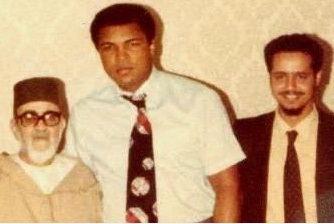 Ghumari, Ali, Darwish, Hyde Park, Chicago Year 1982
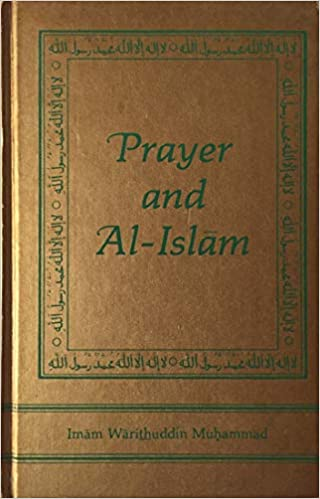
Prayer and 'Al-Islam
The Muhammad Ali Islamic Foundation, Chicago, IL, Year 1982
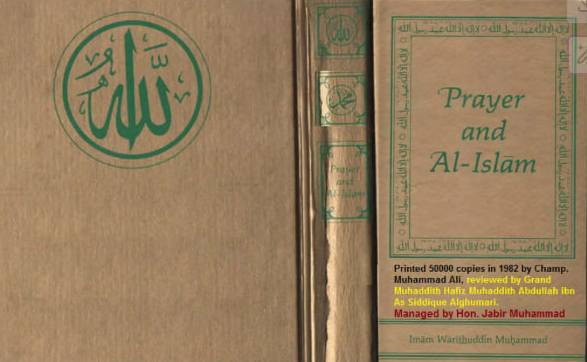
In 1982 it was Printed 50000 copies hard cover with golden cover
Preface
for this 2021 word release
Ghumari, Ali, Darwish, Hyde Park, Chicago Year 1982
Prayer and 'Al-Islam
The Muhammad Ali Islamic Foundation, Chicago, IL, Year 1982
In 1982 it was Printed 50000 copies hard cover with golden cover
Preface
for this 2021 word release
 WORD
http://www.Muhammad.com/prayerandislam.docx
Praise be to Allah, I served on this book 39 years ago with a team in 1982 in Muhammad Ali villa, in Chicago, most of the team passed away with honor namely Muhammad Ali, Jabet Muhammad, Hafiz Muhaddith Abdullah ibn As-Siddiq Al Ghumari, and Anne Khadijah
50,000 copies were printed in 1982 to correct the creed of Mr. Elijah Muhammad,and to teach the comunity to practice the 5 daily prayers etc.
In Cairo in Jun. 04, 2016 I released for-free a photocopy in pdf format which was viewed by 836،100 persons
PDF:
https://www.slideshare.net/allahcom/muhammad-ali-printed-this-book-prayer-and-islam-in-1982
WORD
http://www.Muhammad.com/prayerandislam.docx
Praise be to Allah, I served on this book 39 years ago with a team in 1982 in Muhammad Ali villa, in Chicago, most of the team passed away with honor namely Muhammad Ali, Jabet Muhammad, Hafiz Muhaddith Abdullah ibn As-Siddiq Al Ghumari, and Anne Khadijah
50,000 copies were printed in 1982 to correct the creed of Mr. Elijah Muhammad,and to teach the comunity to practice the 5 daily prayers etc.
In Cairo in Jun. 04, 2016 I released for-free a photocopy in pdf format which was viewed by 836،100 persons
PDF:
https://www.slideshare.net/allahcom/muhammad-ali-printed-this-book-prayer-and-islam-in-1982
Muhammad
Ali printed this book Prayer and Islam in 1982
Viewed/liked/downloaded
by 806,007 views
Allah.com
Follow
http://www.Muhammad.com/prayerandislam.pdf
http://muhammad.com/AllEnglish335booksOfMuhammad.rar
Please go and download for free
www.Allah.com www.Muhammad.com
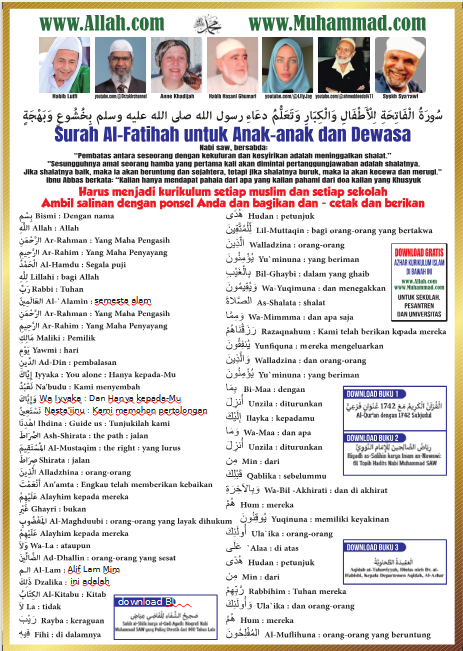
سُورَةُ الْفَاتِحَةَ
Surah Al-Fatihah for Children and Adults
The Prophet (peace be upon him) said:
"The barrier between someone and disbelieve (shirk status) is abandoning prayer."
"Indeed, on the day of judgment, the first deed a worshipper will be asked to account for is his prayer. If his prayer is good, then he will be fortunate and prosperous, but if his prayer is bad, then he will be disappointed and lose."
Ibn Abbas said: "You only get reward for what you understand from your devout prayers.
It should be the curriculum of every Muslim and every school. Take a copy with your phone and share it and - print it and give it away.
The First Chapter which is read 17 times a days as obligation with two topics
A. Allah prasies himself by Himself
B. The supplication of the believers
1. Allah prasies himself by Himself
بسم Bismi : By name
الله Allah (Proper noun of the Uncountable Singular Unique One)
الرحمن Ar-Rahman: The Most Gracious
الرجيم Ar-Rahim, the Most Merciful
الحمد Al-Hamdu : All praise is due Allah is the Most Gracious:
لله for Allah
رب Rabbi : Lord of
العالمين Al-Alamin: universe
الرحمن Ar-Rahman: The Most Gracious
الرجيم Ar-Rahim, the Most Merciful
مالك Maliki: Owner
يوم Yawmi : day
الذين Ad-Din: recompense
B. The supplication of the believers
إِيَّاكَ Iyyaka: You alone: Only to You
نَعْبُدُ Nabudu : We worship
وإياك Wayyaka And Only to You
نستعين Nastalinu: We ask for help
اهدنا Indina : Guide us: Show us
السراط Ash-Shirata: the path: road
المُسْتَقِيم Al-Mustaqim : the right: the straight one
صراط Shirata : Road of
الذين Alladzhina : people
أنعمت An'amta: You have favored
عَلَيْهِمْ Alayhim to them
غير Ghayri: not
المغضوب upon them the anger
عليهم Alayhim to them
ولا Wa-La: or
الضالين Ad-Dhallin : people who have gone astray
الم Al-Lam : Alif Lam Mim
ذلك that is
الكتاب Al-Kitabu: The Book
لا no
ريب Rayba : doubt
فيه Fihi: in it
هذى Hudan : a guidance
لِلْمُتَّقِينَ Lil-Muttaqin : for those who are pious
الَّذِينَ Walladzina : people
يُؤْمِنُونَ Ya'minuna who believe
بالغيب Bal-Ghaybi : in the unseen
وَيُقِيمُونَ Wa-Yagimana: and upholding
الصلاة As-Shalata: prayer
وَمِمَّا Wa-Mimmma: and of anything
رَزَقْنَاهُمْ Razaqnahum : We have given them
يُنفِقُونَ Yunfiquna : they spend
وَالَّذِينَ Walladzina : and the people
يُؤْمِنُونَ Yu'minuna who believe
بما Bi-Maa with
أنزل Unzila : revealed
إليك layka : to you
وما Wa Maa : and what
أنزل Unzila : revealed
من Min: from
قبلك Qablika : before you
بالآخرة Wall Akhirat and in the afterlife
هم Hum : they
يُوقِنُونَ Yoginuna : having faith
أوليك Ula ika : people
على Alaa : above
هذى Hudan : guidance
من Min: from
ربهم Rabbihim: Their Lord
وأوليك Ula ika : and those
هم Hum : they
المُفْلِحُونَ Al-Mutlihuna: the fortunate ones
Indonesian one page copy
 Supplications of the Prophet Muhammad
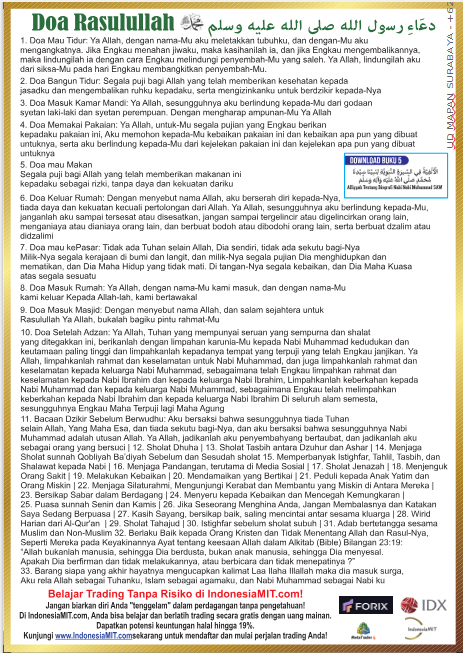
1. Supplication for going to sleep: O Allah, in Your name I lay down my body, and with You I lift it up. If You hold my soul, then have mercy on it, and if You return it, then protect it in the way You protect Your pious devotees. O Allah, protect me from Your punishment on the day You raise up Your devotee.
2. Wake Up Supplication: Praise be to Allah who has given health to my body and returned my soul to me, and allowed me to dhikr of Him
3. Supplication to Enter the Bathroom: O Allah, indeed I seek refuge in You from the temptations of male devils and female devils. With hope for Your forgiveness, O Allah
4. Supplication for Wearing Clothes: O Allah, to You all the praise that You have given me this clothing, I ask You for the good of this clothing and whatever good is made for it, and I seek refuge with You from the ugliness of this clothing and whatever ugliness is made for it
5. Prayer for eating
All praise be to Allah who has given me this food as sustenance, without any power or strength from me.
6. Supplication Leaving the House: By mentioning the name of Allah, I surrender to Him, there is no power and strength except help from Allah. O Allah, indeed I seek refuge in You. Let me not be led astray or misled, lest I slip or be derailed by others, persecute or be wronged by others, and act stupidly or be fooled by others, and do wrong or be wronged.
7. Supplication for going to the market: There is no god but Allah, He alone, has no partner. To Him belongs the kingdom of the earth and the heavens, and to Him belongs all praise. He gives life and causes to die, and He is the Living One who does not die. In His hand is all good, and He has power over all things.
8. Supplication to Enter the House: O Allah, in Your name we enter, and in Your name we go out In Allah, we put our trust
9. Supplication to Enter the Mosque: With the name of Allah, and peace be upon the Messenger of Allah, O Allah, open for me the door of Your mercy
10. Supplication after the call to prayer: O Allah, the Lord of this perfect call and established prayer, grant the abundance of Your grace to the Prophet Muhammad the highest position and priority and grant him the praiseworthy place that You have promised. O Allah, bestow mercy and safety on the Prophet Muhammad, and also bestow mercy and safety on the family of the Prophet Muhammad, as You have bestowed mercy and safety on the Prophet Ibrahim and on the family of the Prophet Ibrahim. Bestow blessings on the Prophet Muhammad and on the family of the Prophet Muhammad, as You have bestowed blessings on the Prophet Ibrahim and on the family of the Prophet Ibrahim. In the entire universe, verily, You are the Most Praiseworthy, the Most Glorious
11. Dhikr recitation before ablution: I bear witness that there is no God
except Allah, the Almighty, and He has no partner, and I testify that the Prophet Muhammad is indeed the messenger of Allah. O Allah, make me a repentant worshiper, and make me a pure person | 12. Dhuha Prayer | 13. Tasbih Prayer between Dhuhr and Asr | 14. Maintain Sunnah Qobliyah Ba'diyah Prayers Before and After Prayer 15. Increase Istighfar, Tahlil, Tasbih, and Shalawat to the Prophet | 16. Maintain Views, especially on Social Media | 17. Funeral Prayer | 18. Visiting Sick People | 19. Doing Good | 20. Reconciling Conflicters | 21. Caring for Orphans and the Poor | 22. Maintaining Friendships, Visiting Relatives and Helping the Poor Among Them | 23. Be patient in trading | 24. Calling to Goodness and Preventing Evil | 25. Sunnah fasting Mondays and Thursdays 26. If someone insults you, don't reply and say I'm fasting | 27. Affection, being kind, loving each other between family members | 28. Daily Wirid from the Koran | 29. Tahajjud Prayer | 30. Istighfar before morning prayer | 31. Manners towards fellow Muslims and non-Muslims 32. Be kind to Christians and not oppose Allah and His Messenger, as they believe in Verses about the oneness of Allah in the Bible (Bible) Numbers 23:19: "Allah is not a human being, so He lies, nor a son of man, so He regrets. Does He say and not do it, or speak and not keep it?" 33. Whoever at the end of his life says the sentence Laa Ilaha Illallah will enter heaven, I accept Allah as my God, Islam as my religion, and the Prophet Muhammad as my Prophet
Supplications of the Prophet Muhammad
1. Supplication for going to sleep: O Allah, in Your name I lay down my body, and with You I lift it up. If You hold my soul, then have mercy on it, and if You return it, then protect it in the way You protect Your pious devotees. O Allah, protect me from Your punishment on the day You raise up Your devotee.
2. Wake Up Supplication: Praise be to Allah who has given health to my body and returned my soul to me, and allowed me to dhikr of Him
3. Supplication to Enter the Bathroom: O Allah, indeed I seek refuge in You from the temptations of male devils and female devils. With hope for Your forgiveness, O Allah
4. Supplication for Wearing Clothes: O Allah, to You all the praise that You have given me this clothing, I ask You for the good of this clothing and whatever good is made for it, and I seek refuge with You from the ugliness of this clothing and whatever ugliness is made for it
5. Prayer for eating
All praise be to Allah who has given me this food as sustenance, without any power or strength from me.
6. Supplication Leaving the House: By mentioning the name of Allah, I surrender to Him, there is no power and strength except help from Allah. O Allah, indeed I seek refuge in You. Let me not be led astray or misled, lest I slip or be derailed by others, persecute or be wronged by others, and act stupidly or be fooled by others, and do wrong or be wronged.
7. Supplication for going to the market: There is no god but Allah, He alone, has no partner. To Him belongs the kingdom of the earth and the heavens, and to Him belongs all praise. He gives life and causes to die, and He is the Living One who does not die. In His hand is all good, and He has power over all things.
8. Supplication to Enter the House: O Allah, in Your name we enter, and in Your name we go out In Allah, we put our trust
9. Supplication to Enter the Mosque: With the name of Allah, and peace be upon the Messenger of Allah, O Allah, open for me the door of Your mercy
10. Supplication after the call to prayer: O Allah, the Lord of this perfect call and established prayer, grant the abundance of Your grace to the Prophet Muhammad the highest position and priority and grant him the praiseworthy place that You have promised. O Allah, bestow mercy and safety on the Prophet Muhammad, and also bestow mercy and safety on the family of the Prophet Muhammad, as You have bestowed mercy and safety on the Prophet Ibrahim and on the family of the Prophet Ibrahim. Bestow blessings on the Prophet Muhammad and on the family of the Prophet Muhammad, as You have bestowed blessings on the Prophet Ibrahim and on the family of the Prophet Ibrahim. In the entire universe, verily, You are the Most Praiseworthy, the Most Glorious
11. Dhikr recitation before ablution: I bear witness that there is no God
except Allah, the Almighty, and He has no partner, and I testify that the Prophet Muhammad is indeed the messenger of Allah. O Allah, make me a repentant worshiper, and make me a pure person | 12. Dhuha Prayer | 13. Tasbih Prayer between Dhuhr and Asr | 14. Maintain Sunnah Qobliyah Ba'diyah Prayers Before and After Prayer 15. Increase Istighfar, Tahlil, Tasbih, and Shalawat to the Prophet | 16. Maintain Views, especially on Social Media | 17. Funeral Prayer | 18. Visiting Sick People | 19. Doing Good | 20. Reconciling Conflicters | 21. Caring for Orphans and the Poor | 22. Maintaining Friendships, Visiting Relatives and Helping the Poor Among Them | 23. Be patient in trading | 24. Calling to Goodness and Preventing Evil | 25. Sunnah fasting Mondays and Thursdays 26. If someone insults you, don't reply and say I'm fasting | 27. Affection, being kind, loving each other between family members | 28. Daily Wirid from the Koran | 29. Tahajjud Prayer | 30. Istighfar before morning prayer | 31. Manners towards fellow Muslims and non-Muslims 32. Be kind to Christians and not oppose Allah and His Messenger, as they believe in Verses about the oneness of Allah in the Bible (Bible) Numbers 23:19: "Allah is not a human being, so He lies, nor a son of man, so He regrets. Does He say and not do it, or speak and not keep it?" 33. Whoever at the end of his life says the sentence Laa Ilaha Illallah will enter heaven, I accept Allah as my God, Islam as my religion, and the Prophet Muhammad as my Prophet
 In the Name Allah, The Most Gracious, The Most Compassionate
Prayer and 'Al-Islam
The Muhammad Islamic Foundation is a non-profit
tax exempt organization…
Acknowledgments
Textual Note
A Note From Muhaddith Abdullah ibn As-Siddiq
A Note From Imam Warithuddin Muhammad xv
Muhaddith Abdullah ibn As-Siddiq xvi
Muslim Community Leadership xvii
Publisher's Note Xxv
A Comment on Al-Fatiha, A. Yusuf Ali xxvi
The Opening (Al-Fatiha) xxvii
INTRODUCTION TO AL-ISLAM
Prophet Muhammad ^,, the Perfect Example 6
Al-Islam, the Perfect Religion 15
Faith in Al-Islam 21
A Muslim in Al-Islam 23
The Believer 24
Fundamental Principles of Faith 29
Fundamental Principles of Practice 37
The Faithful Muslim 42
PROPHET MUHAMMAD'S LAST LECTURE 52
PRAYER
THE TIMES OF PRAYER
Diagram of Times of Prayer 60
Morning Prayer (Salatul-Fajr/Subh) 62
Noon Prayer (Salatuz-Zuhr) 62
Afternoon Prayer (Salatul-'Asr) 63
vii
Sunset Prayer (Salatul-Maghrib) 64
Night Prayer (Salatul-Isha) 64
Daily Prayer Time Chart 66
ABLUTION 67
Performing Ablution 72
Acts Which Nullify Ablution 78
Acts Which Do Not Nullify Ablution 79
How to Perform Tayammum 79
When to Perform Tayammum 80
Supplications During Ablution 80
ADHAN 83
Iqamah 88
PERFORMANCE OF PRAYER
How to Perform the Muslim Prayer Service 99
Illustrations of Positions 100
CONGREGATIONAL PRAYER 134
Friday (Jumu'ah) Prayer 141
Regulations Relating to Jumu'ah Prayer 144
Reasons for not Attending Jumu'ah Prayer 144
Undesirable Acts During Prayer 145
THE'ID FESTIVALS 147
The 'Id Congregation 156
Regulations Related to 'Id 158
ATTRIBUTES OF ALLAH 161
SUPPLICATIONS OF PROPHET MUHAMMAD se 177
ESSENTIALS FOR PRAYER 187
Key Words Which Describe Muslim Actions 187
Essential Requirements for Prayer 187
When Prayer Becomes Obligatory 188
Obligatory Acts of Worship 188
viii
Combining Prayers 189
Observing Delayed or Missed Prayers 189
Shortening Prayer 190
Modification of Prayer Positions 191
Correcting Mistakes in Prayer 191
t The Adhan and Iqamah 192
Determining Direction of the Ka'bah 192
Acts Which Invalidate Prayer 193
Acts to Avoid in Prayer 193
Women's Prayer Positions 194
Recommended Acts for Jumu'ah Prayer Service 194
Intentions Before Prayers 195
Tarawih Prayer 195
Witr and Shaf' Prayer 196
Tahajjud Prayer 197
Duha Prayer 197
When Obligatory Prayers are Forbidden 198
Obligatory Bath (Ghusl) for Prayer 199
Performing Obligatory Bath 200
General Impurities 200
Procedure for Removing Impurities 201
Proper Toilet Use 202
Sutrah 203
The Masjid 204
Clasping of the Hands in Prayer 207
Announcing the Call to Prayer 207
Prayer During the Friday Khutbah 207
Prayer Before 'Id 208
Prostration 208
The Friday Khutbah 208
APPENDIX I, FUNERAL REGULATIONS 211
Washing (Ghusl) the Body 214
The Shroud 216
Washing, Shrouding and Burial Illustrations 222
APPENDIX II, GLOSSARY 235
ix
In the Name Allah,
The Most Gracious, The Most Compassionate
APPENDIX III, REFERENCE MATERIAL AND
EXPLANATORY NOTES 251
BIBLIOGRAPHY 289
INDEX . 291
Perfection is only for Allah, the Creator, the one and only God.
We pray that He will forgive us our shortcomings. Any errors
within the text which warrant change, and which are brought to our attention will be cor-
rected in future editions. Please forward all comments to: Muhammad Islamic Foundation,
c/o Mr. Jabir Muhammad, 4944 South Woodlawn Avenue, Chicago, Illinois 60615.
Acknowledgements
Praise be to Allah, Guardian Evolver, Cherisher and Sustainer
of the worlds. We seek help from Him. We believe in Him, we ask
forgiveness from Him. We bear witness that nothing deserves wor-
ship except Allah, the One Lord and Creator, and We bear witness
that Muhammad is His Servant and His Messenger. Peace and
blessings upon his companions, upon all the righteous, and upon
the Muslims, the believing people here and throughout the world.
For Allah there is no associate, no helper in the rule of the heavens
and the earth. He is ruler alone, He has no partner, no associates in
His Rule, no one sharing the rule of the kingdom with Him. Allah
Most High says in the Holy Qur'an that any who come to Him
come to Him as a servant, and that He has no need of any servants
Himself. Therefore, angels, men and jinn all serve in the cause of
Al-Islam as a duty or requirement of their nature, and Allah needs
nothing from any of them. It is for their own good, their own ben-
efit that they serve.
We thank Allah for Blessing us through the following people,
whose efforts through the Muhammad Islamic Foundation assisted
in the preparation of this book: Mr. Abdul Hamid Bin-Asad, assis-
tant to the chief editor, Mr. Jabir Muhammad. Mr. Ahmad Dar-
wish (special assistant to Muhaddith ibn As-Siddiq in English and
Arabic), Mr. Mark Durham, B.A., Mr. Richard Durham, B.A.,
and Mr. John M. Nussbaum who helped in organizing much of the
material. Mrs. Bahiyyah Muhammad, who worked diligently typ-
ing, Mr. John Gler.n Omar, M.A., and Mr. Eugene Majied, former
editor of Bilalian News, who provided the illustrations used
throughout this book. My brother, Dr. Akbar Muhammad,
(Ph.D.), Professor of African-American History, State University
of New York. Mr. Elijah Muhammad, B.A., who is Jabir Muham-
X
In the Name Allah,
The Most Gracious, The Most Compassionate
mad's son, for typing material from the various transcripts used in
the text, and Jabir Muhammad's wife, Mrs. Aminah Muhammad,
and their daughter, Ms. Safiyya Muhammad, B.S., my nephew
Imam Sultan Muhammad, B.S., and son, Imam Sultan Muham-
mad, B.S., and his wife Diane Muhammad, who drew information
on file from computers. Sheikh Ahmed Rafi Shittu, M.A., Sheikh
Muhammad Nur, M.A., Dr. Ibrahim Eldosoughi Muhammad,
(Ph.D.), Dr. Hassan Abdullah, (Ph.D.), Dr. Ahmad Hussein Sakr,
(Ph.D.), Mr. Syid El-Dabbas, Dr. Muhammad Abdullah, and Dr.
Salman Nadvi, (Ph.D.), head of Arabic and Islamic Studies,
University of Westville, Durban, South Africa, who served as
reviewers and consultants to the section on Funeral Regulations.
Mr. Claire Mahoney, master typesetter, who assisted in making
sure that the copy was consistent. Ms. Patricia Klegman, for set-
ting the type from copy. Ms. Florence Dejoie, M.A., Instructor of
English, Kennedy King College. Mrs. Azizah Muhammad, Mrs.
Hafeezah Bahar, and Mrs. Donna Cooke Joseph, who helped type
and review the manuscript. Dr. Charles Williams, Jr. (M.D.) com-
puter engineer, for maintaining the word processor. Attorney
Charles E. Lomax, of Sidley & Austin Law Firm, who devoted
much of his time and influence in seeing that this book en-
countered few obstacles in its production.
Only a fraction of the material these people worked on was used
in this book; the rest is on file with the Muhammad Islamic Foun-
dation for use in future publications. We pray that Allah blesses
each and everyone who worked toward the final realization of this
publication.
Textual Note
There is the Name Allah Ju, and three phrases in this book
which appear in Arabic. The first phrase which appears on the
cover is, *1)1 , translated, "No god but Allah, Mu-
hammad is His Messenger." The second phrase appears at the head
of each section, preceding the title. It is A, translated, "Allah is
the Greatest." The third is transliterated, "Sallalahu alayhi wa
sallam," ("May Allah praise and venerate him [Prophet Muham-
mad], and grant him perfect peace," or "May the peace and bles-
sings of Allah be upon him") is a prayer which we should say,
audibly or silently, each time we read, mention, or hear Prophet
Muhammad's 5^ name. By asking that Allah's Eternal Blessings be
upon Prophet Muhammad sg, we express our devotion, rever-
ence, and respect for him. Whenever Prophet Muhammad's sg
name appears in this text, it is followed by "|g," to remind the
reader of the prayer.
xii
xiii
In the Name Allah,
The Most Gracious, The Most Compassionate
In the Name Allah,
The Most Gracious, The Most Compassionate
A Note From
Muhaddith Abdullah ibn As-Siddiq
Imam Warithuddin Muhammad
Praise be to Allah, He is Sufficient. Peace be upon His Servants,
those who are selected.
I have reviewed this book, Prayer and Al-lslam, which is based
on six years of lectures by Imam Warithuddin Muhammad. In-
cluded in the text are Qur'anic verses and Hadiths (Prophetic say-
ings). I have found this to be a book which incorporates the won-
derful meaning of prayer, the reasonable wisdom of Islamic legis-
lation, a good approach and sound expression. It is extensive in
listing the rules (of the Holy Qur'an and Hadith), and in showing
their reasoning and wisdom.
This book is unique in its scope. No book like it has previously
existed in America. We ask Allah that Muslims will strive to em-
brace it and benefit from its wisdom and rationale. We pray that
Allah give Imam Muhammad success and guide him on the path of
righteousness.
May Allah reward Ustadh Jabir Muhammad for assisting his
brother, the Imam, and for publishing the book, with the best of
rewards which he bestows upon those who are generous. May
Allah multiply people like him among the Muslims. May Allah
protect him from all harm and evil, and may Allah grant him hap-
piness and goodness.
15 Shawwal 1401 a.h.
16 August 1981 c.e.
Al Muhaddith
Abdullah Bin As-Siddiq, Ph.D.
In the Name Allah, The Most Gracious, The Most Compas-
sionate. We pray and we thank Him for His generous Messenger.
The members of the American Muslim Mission deeply value the
precious comments of the esteemed and Grand Muhaddith, Dr.
Abdullah Bin As-Siddiq, regarding the presentation of this book.
We are grateful to Allah, and are deeply gratified that Jabir
Muhammad, a credited and popular businessman, has his heart in
religion to such an extent that it has involved him daily, over a
long period, in giving diligent and untiring attention to the job of
rendering excerpts from volumes of material into book form for
the best possible work which I have reviewed and approved.
Your brother in the Path of Allah,
Imam Warithuddin Muhammad
xiv
xv
In the Name Allah,
The Most Gracious, The Most Compassionate
Muhaddith Abdullah Ibn As-Siddiq
Muhaddith Abdullah ibn As-Siddiq, the primate, Muhaddith of
Africa is a direct descendant of Prophet Muhammad 5®, and one
of the top seven scholars in the world on the science of Hadith
(sayings and practices of Prophet Muhammad jg). He was former-
ly Professor of Hadith of Al Azhar University in Cairo, Egypt, and
he has written over one hundred books on Al-Islam, including an
encyclopedia of hadith falsely attributed to Prophet Muhammad
££ . He is the originator of the science of innovation of the Explana-
tion of the Holy Qur'an. His former students include a number of
Grand Muhaddiths and Islamic officials throughout the world.
Muhaddith Siddiq was born in Tangier, Morocco, in 1914 (A.H.
1328). As a child he learned the Holy Qur'an by heart and studied
the Quranic science of calligraphy. He studied the complete
sciences of Malik Jurisprudence and Explanation of the Holy
Qur'an at Kairouyine Masjid in Fez, Morocco. In December, 1931,
he began studies at Al Azhar Masjid in Cairo, Egypt, where he
passed the final examination within a year, and subsequently
began teaching at the University of Al Azhar. He received his
Ph.D. in 1942. He currently resides in Tangier, Morocco, where he
lives and teaches in the Masjid and Center founded by his father.
We thank Allah for blessing us with Muhaddith Siddiq, who has
contributed greatly to this book. We pray that Allah grants him
good health, extends his presence among us and blesses him with
the reward of Paradise.
xvi
In the Name Allah,
The Most Gracious, The Most Compassionate
In the Name Allah,
The Most Gracious, The Most Compassionate
A Comment on Al-Fatiha
The Opening
First comes that beautiful Surah from the Holy Qur'an, The
Opening Chapter of seven verses, rightly called the essence of the
Book. It teaches us the perfect prayer. If we pray aright, it means
that we have some knowledge of Allah, His Attributes, His Rela-
tions to us and His Creation, which includes ourselves. If we pray
aright, we get a glimpse of the source from which we come, and
that final goal which is our spiritual destiny under Allah's True
Judgment. This is why we offer ourselves to Allah and seek His
Light.
Prayer is the heart of religion and faith, but how shall we pray?
What words shall convey the yearnings of our miserable, ignorant
hearts to the Knower of all? Is it worthy of Him, or of our spiritual
nature to ask for vanities, or even for such physical needs as our
daily bread? The Inspired One, Prophet Muhammad sg taught us
a prayer that sums up our faith, our hope, and our aspirations in
things that matter. We think in devotion of Allah's Name and His
Nature. We praise Him for His Creation and His Cherishing Care,
and we call to mind His Guidance, and we know the straight from
the crooked path by the light of- His Grace that illuminates the
righteous.
A. Yusuf Ali
Al-Fatiha
1. In the Name Allah, The Most Gracious,
The Most Compassionate.
2. Praise be to Allah,
The Lord of all the worlds;
3. The Most Gracious, The Most Compassionate.
4. Master of the Day of Judgment.
5. You do we worship,
and Your Aid we seek.
6. Guide us on the straight way,
7. the way of those on whom
You have bestowed Your Grace.
Those whose [portion] is not wrath,
and who go not astray.
XXVI
xxvii
In the Name Allah,
The Most Gracious, The Most Compassionate1
INTRODUCTION TO
AL-ISLAM
Man needs an authority superior to him to rule and discipline
his life. He will never completely fulfill his human potential until
he recognizes The Creator as that authority and finds his true rela-
tionship with Him. Only when man has The Creator as his author-
ity in his total life can he reach his highest potential for growth and
discipline.
In order for man to satisfy his narrow frame of understanding he
is constantly trying to use his tainted, limited logic and knowledge
to make science justify his moral weaknesses. That is where too
many of us go wrong. Through the ages, man's misguided appetite
directed his logic and led him to put his faith in things other than
The Creator. Sometimes man has been led to idolize and worship
himself. When we trace the evolution of worship throughout the
world, we can clearly see the path that man's struggling intellect
has taken in its search for the correct concept of God.
We have here a very touching lesson: man came to know the
truth about God only through Divine Revelation, which was
brought by human messengers (God's Prophets) who told us the
Rules and Laws of God. God created a class of human messengers
to be His Intermediaries in carrying His Message to the people.
These messengers possessed the best of human characteristics, and
they approached perfection as much as is humanly possible. They
1
INTRODUCTION TO AL-ISIAM
submitted themselves entirely to the Will of God. They are, with-
out doubt, models for humanity. We must confess belief in God
and His Prophets. We must pray to God and worship Him, The
One Who has no partners or associates in His Rule.
God has created man to grow naturally. Those who accept the
proper worship of God are united by a bond stronger than any of
man's philosophies or institutions. Democracy is a powerful phil-
osophy, but look how it has failed to unite the world. There are a
great many institutions and fraternal orders within the free world
which claim to promote humanity, but those which ignore The
Creator do not foster unity. Karl Marx's Manifesto, the philos-
ophy of the Communist Party (a great and powerful set of ideas),
has failed to unite even the Communist people. Unity in the form
of worship removes all corruption. Pure unity in worshipping The
Creator is the only force effective enough to bring all people
together.
The sincerity of our worship determines the form of our thoughts
and the nature of our deeds. When your worship is sincere,
another sincere person recognizes it. The recognition is sometimes
instant. That is why some people can meet with those of different
religions and immediately strike up a strong friendship and love.
Their religious labels may be different, but the sincerity of their
worship is the same. No philosophy or force has united human
beings in an understanding of their common origins as strongly as
conformity in knowledge of the Oneness of God and of His Crea-
tion, who has no associate in His worship and His Rule.
Unity is important because man wants and needs peace. Peace
suggests unity.2 Man needs the worship of God to discipline his life
because everything else is futile in the long run. Nothing in man's
history has united him like the worship of God. It is the very
nature of man to worship God (Allah). The remembrance of the
Oneness of Allah in the form of worship is the most productive
idea on earth. It has always been and will never change.
Allah is The Creator of the heavens, the earth and everything
above and below. He has power over all things. There is only The
Creator and His Creation, and Allah is the Greater. Allah says in
the Holy Qur'an, "Certainly, everyone who is in the heavens and
the earth is coming before [Me}, The Merciful as a slave.''3
Everything belongs to Allah. His Throne is not divided with
others. The management of creation is His alone. There is no way
for any prophet, righteous person, angel, spirit or anything else to
come to Allah except as a slave. The angels serve Him, the pro-
phets serve Him and we serve Him. Highly Glorified is He above
that which is worshipped by those who attribute divinity to per-
sons and things other than Allah.
Allah is truly Marvelous. He gives honor and dignity to His
Faithful Servants. He has the power to advance the cause of His
Righteous Servants long after they have been overcome. When
those who plotted against Abraham, Moses, Jesus and Muham-
mad see what is coming, they will say, "Good God Almighty,
we thought we had defeated them, but here Abraham, Moses,
Jesus and Muhammad are pronouncing judgment on us." Of
those who plotted against Allah's Prophets, the Holy Qur'an says,
"And for certain, they had plotted their plot, and their plot is
[known] before Allah."4 The Holy Qur'an also says, "And indeed
for sure, they will bear their burdens together with other burdens
along with their own, and indeed for sure they will be questioned
on the Day of Resurrection concerning that which they fab-
ricated."5
The prophets will come in Allah's Truth, and it is Allah Who ad-
vances His Truth through messengers, angels, the elements, the
forces of nature, and even through the forces that He has created
in us. Allah will do His Will and nothing can frustrate it. Allah
says in the Holy Qur'an, "Say; He is Allah, the One and Only;
Allah the Eternal, Absolute; He begets not, nor is He begotten;
and there is none like unto Him."6 No vision can grasp Him, but
His Grasp is over all vision. He is above the limits of our com-
prehension, and He is acquainted with all things.7
The Holy Qur’an tells us, "There is no god but He, The Creator
of all things, therefore worship Him only.''8 He (Allah) will con-
clude all affairs and settle all differences in the end. Praise be to
Allah, Guardian Evolver, Cherisher and Sustainer of all the
worlds. If it were not for Him sustaining the worlds, they would
not be sustained. Everything depends on Allah for its continued
existence. We ourselves are the creations of Allah, and our well-
being depends upon His Grace. He is Allah, The Almighty, The
2
3
INTRODUCTION TO AL-1SLAM
All-Knowing, The Eternal, Whose existence is always the same.
He was never born, nor can He die. It is He Who creates all things
and nourishes them until completion. He introduces and describes
Himself through prophets who deliver His Message for the guid-
ance of humanity.
The Prophets of Allah are like builders given separate jobs in
one building plan. Each builder does his part until the structure is
complete. Each prophet made his contribution and Prophet Mu-
hammad the Last Prophet, finalized and enhanced what had
been established before him. The work that Abraham, Moses,
Jesus and others were doing was leading up to a completion. We
see the completion of their works in the message that was given to
Prophet Muhammad Allah gave him the same message He
gave to the earlier prophets, as well as additional guidance to
make that message complete for all time and for all people. This
trend represents the natural progression toward universality. The
Holy Qur'an tells us that the believers do not discriminate against
any of Allah's Prophets because all prophets are scriptural broth-
ers under Him.’
When we say we bear witness that Prophet Muhammad x£, is the
Messenger of Allah and the Seal of the Prophets, we are bearing
witness to the legitimacy of all the true prophets, while acknowl-
edging Prophet Muhammad jfe as the one who established their
legitimacy with the message that he brought.
In the Holy Qur'an Prophet Muhammad 3^5 is told to tell the
People of the Book, "Say, We believe in the Revelation which has
come down to us and in that which came down to you; our God
and your God is One; and it is to Him we bow [in Al-Islam]."10
Allah revealed the Holy Qur'an to Prophet Muhammad and
made it clear that the way we follow is not a new way, but an old
way: the way of Allah's Upright Servants, the Prophets.”
Though Prophet Muhammad was an Arab, the message he
received was not for Arabs only. He received a message for the
world. Speaking to Prophet Muhammad through the Angel
Gabriel, Allah says, "We have revealed unto you the Remem-
brance [the Qur'an], that you may explain to the people that
which has been revealed for them, and that haply they may
reflect.''12 The Holy Scripture (Qur'an) was revealed to him 1400
years ago. During the fortieth year of his life, in the month of
Ramadan, he received the first in a series of Divine Revelations
which continued for a period of twenty-three years, thirteen in
Makkah and ten in Madinah, until the whole of The Book was
completed.13
After 1400 years, we have established proof that not a word of
the Holy Qur'an's original Arabic text has been changed.14 It re-
mains as it was when revealed to Prophet Muhammad $?.. No
religion except Al-Islam can boast of having a pure text in its com-
plete form. Allah says in the Holy Qur'an, "We have, without
doubt, sent down the Message, and We will assuredly guard it
[from corruption]."15
In the Holy Qur'an Allah tells Prophet Muhammad jg, "That
which We have revealed to you of The Book is the Truth, confirm-
ing what is revealed before it.''16 Unlike the Bible and other
religious books, the Holy Qur'an tells us that it claims no innova-
tion. It says that the fundamental principles it calls upon us to
observe are those same teachings which Abraham, Moses, Jesus,
and every other true Prophet or Messenger of Allah taught. Allah
says, "Verily this is no less than a Message to all the worlds; with
profit to whoever among you wills to go straight."17
The Holy Qur'an allows me to believe in it and still be devoted
to science as a scientist, to philosophy as a philosopher and to the
Constitution of the United States of America as a citizen. The Holy
Qur'an does not destroy healthy, sound relationships in society, it
does not uproot and throw out of me that which has contributed
to my strength, health and development. It has united my essence
with its environmental needs, social community life, government,
business, industry, the air, earth, wind, fire, water and sunlight. It
is from the universe that my nature and matter came. This Book
tells me that Allah has used the wonders of His Creation to speak
to my brain, to bring messages into my nervous system and to give
birth to a mind within my body. I have a Book from Allah which
reveals how my mind was created, and how it connects me with
the rest of His Creation so that I will not be in conflict with the
things He has provided to serve my being and development.
The Holy Qur'an invites me to join with my ancestors and their
descendants who are dispersed all over the earth. Since the dawn
4
5
INTRODUCTION TO AL-ISLAM
of creation they have spread into Asia, the Islands of the Pacific,
North and South America, Europe, Africa and every other corner
of the earth. The Holy Qur'an is the first Book that tells me that we
are not only the children of one father and one mother, but that
we must also accept every human being as our brother or sister,
regardless of his or her color or national origin. It tells me that all
of us are the children of the same ancestor when it says, "O people!
We created you from a single [pair] of a male and a female, and
made you into nations and tribes that you may know each other
[not that you may despise each other!."18
PROPHET MUHAMMAD «
When we study the history of Prophet Muhammad S§, we can
better understand why he is the perfect example for all to follow.
He was born in Makkah, Arabia, April 20, 570 A.D., fifty-three
years before the Hijrah (flight to Madinah), His father was 'Ab-
dullah, who was the son of 'Abdul Muttalib of the tribe of
Quraysh. His mother was Aminah, daughter of Wahb Ibn 'Abd
Manaf Ibn Zuhrah, Chief of the tribe of Zuhrah. His father died
seven months before he was born, and his mother when he was six
years old. He was then placed under the care and protection of
'Abdul Muttalib, his grandfather, after whose death his uncle,
Abu Talib, was his sponsor.19
Prophet Muhammad 5® lived during a time when there was no
law or science in Arabia, and the Gentile world was so dominated
by superstitions and ignorance that historians refer to the period as
the "Dark Ages." Although the Dark Ages occurred throughout
Europe and the Middle East, it has been reported that knowledge
of civilization was more lacking in Arabia than in all other parts of
the known world. It was in Arabia during this period that Allah
revealed the Holy Qur'an, with its great light of truth and its
universal message, to Prophet Muhammad si. The Holy Qur’an
says, "And lo! It is a Revelation from the Lord of the worlds,
which the True Spirit has brought down upon your heart that you
may be [one] of the warners, in plain Arabic speech."20 The
Message of Light had to overcome all of the ignorance which had
come into Arabian society, ignorance which held the people down
by enslaving their minds, their morality and their spirituality.
Prophet Muhammad obeyed the upright, natural instinct for
goodness within him. This instinct is the basis for obedience to
Allah, and it is found in every human being. The Holy Qur'an did
not come to Prophet Muhammad is because he had wealth, be-
cause he was the son of a great man or woman, or because he had
worldly knowledge. He had a good heart, impeccable human char-
acter, and Allah chose him as the best example for humanity. In
the forty years prior to becoming the Messenger of Allah, Prophet
Muhammad did not isolate himself from the challenges of so-
ciety, he met and overcame them. He did not run from the slum
areas and their problems of alcohol, prostitution, gambling and
filth. He was strong enough to live among the ignorant without
falling victim to the corruption in the society, and to provide a liv-
ing example of the way of life which Allah intended for human be-
ings. He was sincere, truthful, honest, rational and upright, and he
was deeply troubled by the confusion, corruption and misguided
sentiments of his people. In his efforts to find ways to help them,
Allah began to give him understanding. In time he went to the
Cave of Hira (the Mount of Light) in the vicinity of Makkah. It
was there that Allah sent him Revelation and the Light of Truth by
way of the Angel Gabriel.21
Prophet Muhammad Si was born a free native of Makkah, but
because he refused to bow to tribal gods, and because he guided-
the people to Allah and to one humanity, he was harassed and
persecuted by the ruling clan, the Quraysh. When they began to
plan his assassination, Allah guided him to flee to Madinah, where
the inhabitants had invited his leadership and the religion of Al-
lslam.
When Prophet Muhammad sg began his mission he did not have
many followers. However, after a few years, he was able to march
back into Makkah with ten thousand strong-hearted Muslims.
They were from many different nations and tribes, and they in-
cluded Suhayb, the Roman; Salman, the Persian; Bilal, an Abys-
sinian, born in Makkah; and Usamah ibn Harithah, from the tribe
of Kalb. Prophet Muhammad's sS return brought an end to Mak-
kah's tribal wars. He demonstrated the Mercy of Allah by declar-
6
7
INTRODUCTION TO AL-ISLAM
ing that there would be no further bloodshed. Instead of revenge,
he gave amnesty; instead of exile, he allowed former enemies who
would accept Al-Islam to participate in his adminstration. To
families who had suffered and still wanted revenge, he taught in
essence, "You must bury your differences and learn to live in peace
with each other."
Prophet Muhammad sg was a flesh-and-blood human being.22
He was not an angel or an unnatural spirit. He had a father and a
mother. He had children. He had problems. He commanded an
army and fought as a warrior. He was a conqueror, a judge, a
ruler and law-giver. He operated businesses. He mended his own
clothing, repaired his shoes and milked his goats. He was humble
and affectionate toward his family, and he lived among his friends
as a sincere companion and a devoted brother. He paid equal
regard to the poor and to the rich, and he graciously accepted the
invitations of those who asked him into their homes. He visited the
sick and paid respects to the deceased.
All of Prophet Muhammad's actions and movements were
characterized by the utmost simplicity and humility. When he
walked, people would walk in front of him and behind him. When
seated among his followers, who loved him more dearly than their
own lives, he would not occupy a special seat in order to make
himself conspicuous. Prophet Muhammad had much wealth at
his disposal. However, he never lost his compassion for the com-
mon man. During his lifetime the poorest and wealthiest of men
found company with him. He lived humbly and exercised perfect
discipline. People could not say, "You are rich Muhammad, and
we are poor." He used his wealth to raise the living standards for
Muslims and for non-Muslims who respected the laws of Al-Islam.
Prophet Muhammad placed such a high value on education that
he freed unbelievers captured in battle on the condition that they
each taught ten Muslims to read and write. He made the way to
knowledge easy for the common people, and he made the way to
economic sustenance accessible to the poor.
One morning some of Prophet Muhammad's SS companions
noticed that when he awoke, the imprint of the burlap Imaterial]
mattress frame he had slept on was showing on his flesh. They felt
sorry for him and asked him to allow them to get something more
comfortable for him to lie on. Prophet Muhammad -jg told them
that he was, in respect to this world, but a traveler. This world
was not his end in aspirations. This was not his final place. This
was not where all his hopes lay. There was something beyond this
that he was striving for. But he stopped under a tree of temporary
Imaterial] comfort and enjoyed its shade [appetite-soothing provi-
sions].23
Material comfort gives us protection from poverty and material
inconveniences, just as the shade tree gives us comfort from the
heat of the sun. Prophet Muhammad sfe likened himself to a
traveler who just stopped under this tree for a while. He wanted to
go beyond this life, so he did not want to overindulge and become
loo satisfied with the material comforts of this world. He refused
to accept more because they would only enlarge his appetite, and
he did not want that. He was saving the biggest part of his appetite
tor what lies beyond this existence.
It would not have been a sin for Prophet Muhammad to accept a
cushion to lie on, but he wanted to establish an example for leaders
then and now. His message was that leaders are directly under the
weight of Allah's Commandment, and should therefore be ex-
amples for all the people. How can a leader be an example if he
lakes more for himself than most of his followers or other mem-
bers of his society ask for themselves? Leaders have to lead by ex-
ample. If we, as leaders, ask any man to sleep on the floor, we
should be prepared to sleep on the floor ourselves. Al-Islam
demands that our leadership set practical examples for us to
follow, and that each believer should strive to achieve the full
development of his latent virtues in the manner demonstrated by
Prophet Muhammad jg. The material standard of living for the
average person is much higher today than it was during his
lifetime, but the same rules still apply.
Prophet Muhammad assisted the old and the young. He
swept the floors for his wife. He was always concerned with the
plight of the poor, as well as with the moral and spiritual develop-
ment of the entire community. Once Prophet Muhammad jg had
six dirhams (a form of currency) left after he had distributed the
money collected for charity. He forgot about them, and that night
lie awakened and was unable to go back to sleep. He asked his
8
9
INTRODUCTION TO AL-ISLAMwife, Aishah, "What is the matter with me? I awakened this night
and have not [since] slept."24 Aishah told him, "There are six
dirhams remaining with you from the charity." He told her to
bring them to him, and when she did he sent them to be given to
the poor. Then he slept until he snored. Though Prophet Muham-
mad sometimes forgot worldly matters, Allah blessed him to
never forget the Holy Qur'an. Others had to constantly recite the
Holy Qur'an to remember it, but this was not the case with Pro-
phet Muhammad M-
The society that Prophet Muhammad S£5 was born into was a
backward and ignorant one. There was little or no respect for
justice, and most Arab men were proud, arrogant, boastful and
bullish. If they could not conquer others with their wealth or
superstitions, they would try to control or kill them with their
gangs. But Prophet Muhammad sg did not fall victim to the cor-
ruption within Arab society because Allah sent him with Revela-
tion to correct its injustices. He implemented Divinely Revealed
principles, enforced Qur'anic injunctions and promoted the use of
all material resources to improve conditions for the good of the
whole society.
Prophet Muhammad restored moral, intellectual and spirit-
ual freedom, dignity and equality to women. Before his lifetime
women in Arabia had very few rights. Arab men took great pride
in the birth of sons, but often didn't want daughters at all. History
tells us that these men sometimes buried their infant daughters
alive at birth. Most of them had no respect for their mothers or
wives, and they viewed women merely as objects of sexual gratifi-
cation. They even forbade a female from receiving inheritance
from her father, husband or other relatives.
Allah revealed to Prophet Muhammad SB a law which forbids
the denial of inheritance to women.25 Prophet Muhammad also
proclaimed the rights of women to receive religious instruction, to
participate in Islamic businesses and in education, to vote, to ex-
press their ideas in public and to participate in the political affairs
of the community. He called his society's attention to the fact that
men and women are equal in biological nature because Allah
created both from a single being.2'1 He also taught that men and
women are equal in their potential for doing good or bad, and for
achieving intellectual and spiritual excellence.
Prophet Muhammad jg praised the role of motherhood and
gave women a liberty and status which befit their noble nature. As
.1 result, the Muslim community has benefited greatly from the
substantial contributions made by women in Al-Islam. Whenever
we see women relegated to an inferior status in a Muslim society,
we should be aware that it is practicing unenlightened traditions
rather than the religion of Al-Islam.
In brief, the character of Prophet Muhammad 56 is exemplary in
all walks of life.27 As the Holy Qur'an says, "You have indeed in
I he Messenger of Allah a most excellent pattern [of conduct] for
anyone whose hope is in Allah and the Final Day, and who
engages much in the remembering of Allah." Prophet Muhammad
■ ' has thus set an example which can show us how to live our lives
in the most spiritually and materially befitting manner.
1 accept Prophet Muhammad jg as the universal leader. Over
fourteen hundred years ago he stood up and spoke the truth. He
was not concerned whether that truth offended Arabs or any
others, whether they were black, white, brown or red. Prophet
Muhammad sg said that all of us were created from Adam, and
Adam was created from dust. We are told in the Holy Qur'an,
Fhe similitude of Jesus before Allah is as that of Adam; He cre-
ated Adam from dust. . . "2a If any one of us is better than another,
it is only because of his nearness to Allah by virtue of righteous-
ness, faith and good deeds.
We should learn more about the life of Prophet Muhammad 5S
because of his obedience to Allah and his excellent manner and
behavior. Through him Allah provided us with a human example
Io encourage us, and to give us more faith in our own potential.
We are to study the way he lived his life in accordance with his
religious principles, and we must try to practice, in our own lives,
those actions and qualities of righteousness which Allah revealed
to us through him.
I thank Allah that the whole world has an example in Prophet
Muhammad 5§, whose consciousness was without color or pre-
judice, and who was totally obedient to Allah. He was a sincere,
pure-hearted and unselfish man. He was not an Arab nationalist,
because he thought just as much of Egyptian, Ethiopian, Roman or
10
11
INTRODUCTION TO AL-ISLAMany other national dignity as he did of Arab dignity.
After Prophet Muhammad sg suffered in Makkah at the hands
of his own people, he undertook a trip to Ta'if where he solicited
the support of the tribe of Thaqif, calling them to Al-Islam. When
they refused his call, he asked them to withhold the news of their
refusal from his enemies, so that the latter might not rejoice.
However, the tribe of Thaqif sent their servants to insult him and
throw him out of their city.
As Prophet Muhammad if was leaving, they lined the route on
both sides for a great distance. As he passed along between them
his legs were pelted with stones. Dripping with blood and hardly
able to walk farther, he would sink to the ground, but each time he
fell, someone would lift him up, making him walk on. This went
on for three miles.
When his persecutors left him at last, he seated himself under a
vine. In this state of utter helplessness, Prophet Muhammad sS
turned to Allah. Although he was rejected by men in every
quarter, his prayer is not an expression of despondency or com-
plaint. It is full of confidence in Allah's Help in the future. He said,
"O Allah, please consider my weakness, my shortage of means,
and the little esteem that people have of me. O, Most Merciful
God, You are the Lord of the oppressed, and You are my Lord. To
whom would You leave my fate? To a stranger who insults me or
to an enemy who dominates me? Would I that You have no wrath
against me. Your Pleasure alone is my objective. Under the light of
Your Faith which illuminates all darkness, and on which this
world and the other depend, I take my refuge. I pray that I may
not become the object of Your Wrath and Anger. To You alone
belongs the right to blame and to chastise until Your Pleasure is
met. There is neither power nor strength except in You." What
firm faith in Allah! What cheerful resignation to His Supreme
Will. Prophet Muhammad's 58 sufferings were insignificant to him
as long as he enjoyed Allah's Pleasure.
Prophet Muhammad was able to realize complete discipline
in his life by submitting his will entirely to the service of Allah. We
cannot live the kind of life that is typical of the prophets unless we
first discipline ourselves and submit our wills to the Will of Allah.
We cannot have a true society without discipline and complete
laith in Allah. Allah created the human being to be disciplined.
Allah has indeed bestowed a boundless favor upon humanity by
giving us along with His Message (the Holy Qur'an), His Mes-
senger (Prophet Muhammad jS), who was sent to elucidate and
elaborate on the Holy Qur'an, and to demonstrate it in practical
daily matters.
The practices and sayings of Prophet Muhammad are refer-
red to as Hadith. The words hadith and sunnah are considered to
be synonymous in the religious literature of Al-Islam. However,
there is a slight difference between them. Hadith refers to a report
of the things Prophet Muhammad sg said, practiced, approved
and disapproved, which reflect and demonstrate the teachings of
the Holy Qur'an. The word sunnah (mode of life) means precedent
and custom. In the technical sense, it refers to the practices of Pro-
phet Muhammad sS. When Allah ordered Muslims to obey the
Prophet and take his life as a model, the expression, "Sunnah of
I he Prophet," came into use. Allah obligated the prophets to
follow His Guidance. That Guidance did not come to Prophet
Muhammad 5^ to obligate the people to do more than he did. It
< ame through him so that he could set an example for others. He
received the Message and became the first follower, demonstrating
Io the people how they should follow. Therefore, the first source
of knowledge and authority for the Muslim is the Holy Qur'an.
I he second authority is the example of Prophet Muhammad 5® as
reported in the Hadith, which reflects him as a living example of
the teachings of the Holy Qur'an.29
The Holy Qur'an says, "Verily in the Messenger of Allah you
have the best example for him who looks forward unto Allah and
the Last Day and remembers Allah much."30 It is only from the
I loly Qur’an, and the authentic record of Hadith that we can ob-
(ain full view of this model. Ten years prior to the completion of
the Holy Qur'an, Allah established in the following verse, as He
had in previous verses, that Muslims are to obey Allah [ the Holy
Qur’an] and His Messenger. The Holy Qur'an says, "O you who
believe! Obey Allah, and obey His Messenger, and those of you
who are in authority. If you differ in anything among yourselves,
refer it to Allah and His Messenger, if you do believe in Allah and
the Last Day. That is best, and most suitable for final determina-
12
13
INTRODUCTION TO AL-ISLAMtion."31 Describing Prophet Muhammad's authority, Allah also
says, "And whatsoever the Messenger gives you, take it. And
whatsoever he forbids, abstain from it.''32
Prophet Muhammad SS said, "Do not highly praise me like the
Christians when they highly praised Jesus, but say, 'Slave of Allah
and His Messenger.'" Prophet Muhammad 3^ obligated al) of us to
protect the purity of our religion by never forgetting that he was
neither a god nor an angel, but a human messenger for human be-
ings on earth. The Holy Qur'an states, "If there were settled on
earth angels walking about in peace and quiet, we would certainly
have sent down from the heavens an angel for a messenger."33
It also teaches, "And behold! Allah will say: 'O Jesus, the son of
Mary! Did you say unto men, 'Worship me and my mother as
gods in derogation of Allah?' He will say: 'Glory to You! Never
could I say what I had no right [to say]. Had I said such a thing,
You would indeed have known it. You know what is in my heart,
though I know not what is in Yours. For You know in full all that
is hidden. Never said I to them aught except what You did com-
mand me to say, to wit, 'Worship Allah, my Lord and your Lord;
and I was a witness over them while I dwelt among them. When
You did take me up, You were The Watcher over them, and You
are a Witness to all things. If You punish them, they are Your Ser-
vants: If You forgive them, You are the Exalted in power, The
Wise (5:119-121)."'
There is no better example for man than another man who is
courageous, righteous and Divinely Guided. Prophet Muhammad
did not want to be lifted above his place as a Messenger of Allah
as the Christians lift Jesus when they assert that he is the son of
God, or a partner in "The Holy Trinity." Certainly Prophet Jesus is
not this. He is a human Messenger of Allah. The Holy Qur'an
says, "Lo! the likeness of Jesus with Allah is as the likeness of
Adam. He created him of dust, then He said unto him: 'Be! and he
is (3:59)." Thus Prophet Muhammad SB forbids Muslims to pay
him the kind of homage which would attribute divinity to him. We
pay tribute to him and describe him as Allah describes him, with
terms of honor which do not imply divinity, i.e., Messenger of
Allah; the Seal of the Prophets; the Best of Creation, etc.
All Muslims believe in the pure message of Prophet Jesus, but
we find that many Christians have separated themselves from a
commitment to Jesus' message, and have instead adopted a
< rusade to sell the world on the worship of a personality. We are
not to worship prophets. We are to worship Allah alone. Allah
says in the Holy Qur'an, "Say: 'O People of the Book! Come to
< ommon terms as between us and you; that we worship none but
Allah; that we associate no partners with Him; that we erect not
I rom among ourselves, lords and patrons other than Allah.' If they
turn back, say: 'Bear witness that we are Muslims [bowing to
Allah's Will]."'34 The Christians and Jews are also warned in the
Bible and Torah, wfiich say, "You shall make you no idols nor
graven image, neither rear you up a standing image, neither shall
you set up any image in your land, to bow down unto it: for I am
the Lord your God."35
Let us read the Holy Qur'an, practice the sunnah of Prophet
Muhammad SB and tell the world that the Holy Qur'an came from
Allah. The greatest tribute that we can make to Prophet Muham-
mad is is to tell the world that this great, vast and timeless Book
of universal knowledge came through him, a human being. We
should also study Hadith, and the glorious history of Prophet
Muhammad who paid a great price in personal sufferings to
deliver the truth to the world.
AL-ISLAM
This day I have perfected your religion for you, com-
pleted My Favor upon you, and have chosen for you Al-
Islam as your religion.
In order to get a basic understanding of why we observe certain
practices of discipline, it is essential that we know the purpose of
our religion and the objective of being Muslims.
I’he name Al-Islam is particularly significant because it describes
I he essence of our faith. In the Holy Qur'an Allah describes the
religion of Al-Islam as Din (Deen) Al-Fitrah, which means the
religion established on the laws and principles which uphold crea-
lion. The word for religion in Arabic is "Din," but Al-Islam means
14
15
INTRODUCTION TO AL-ISLAMmore than religion as understood by most non-Muslims. The root
word of Al-Islam is "aslama," which means to enter into peace, or
to submit. The dominant idea of the religion of Al-Islam is the at-
tainment and promotion of peace through submission to the Will
of Allah. The Holy Qur'an tells us, "Nay, whoever submits his
whole self to Allah and is the doer of good, he will get his reward
with his Lord; on such shall be no fear, nor shall they grieve.''36
Man's religious consciousness has developed slowly and
gradually through the ages. Through Prophet Muhammad st the
Revelation of the great Truth from Allah was brought to the com-
pletion which Jesus spoke of when he said, "I have yet many things
to say unto you but you cannot bear them now. Howbeit when he,
the spirit of truth is come, he will guide you unto all truth, for he
shall not speak of himself; but whatsoever he shall hear, that shall
he speak: and he will show you things to come."37
This was the great mission of Prophet Muhammad St, who
brought Al-Islam to guide us into all truth, and to meet the moral
and spiritual requirements of an ever advancing humanity. Allah,
Himself, The Creator of everything, decreed Al-Islam as the
religion for humanity. He tells us in the Holy Qur'an, "This day I
have perfected your religion for you, completed My Favor upon
you, and have chosen for you Al-Islam as your religion."38 This
was among the last Revelations of the Holy Qur'an. Prophet
Muhammad Sg received it eighty-one or eighty-two days prior to
his passing.
Al-Islam is designed to appeal to our intellects so that we will be
able to make the best use of our lives. Our religion is more than
just a religion of faith. It is a rational religion of knowledge and
logic. It is the fulfillment of the missions of all the prophets who
led society to a faith that recognizes the existence of The One
Creator and the obligation of every creature to Him. The logic of
Al-Islam begins with the first premise: "I bear witness that there is
no god except Allah, and Muhammad is His Servant and Mes-
senger."
Al-Islam is a universal religion for reforming the whole world.
We can see this when we study the history of Europe and the Mid-
dle East. The light of Al-Islam changed Arabia into the most thriv-
ing and advanced civilization of its day so quickly that historians
H.iy they do not know of any more rapid and thorough reform ever
taking place in the lives of a people. The Arabs of Prophet Mu-
hammad's st time led lives that were extreme in their spiritual cor-
ruption. They were polytheists who worshipped over 365 different
gods, and they practiced idolatry. But through the light of Al-
lslam they became a nation of people dedicated to simplicity, clari-
ty, knowledge, science and spiritual purity. Within a span of
I wenty-three years they were converted from belief that there ex-
isted nothing but this material life to a belief in The One God
(Allah), and to a belief in the Hereafter.
This was not a surface conversion. It included the whole coun-
try. Those Arabs did not just confess their belief in Allah and His
Prophet, but learned the religion of Al-Islam. They were seen
praying and crying tears of joy and appreciation for the message
and the messenger that had come to them. They stood firmly on
I he principles of Al-Islam, which were totally foreign to them five,
ten, fifteen or twenty years earlier. Their lives had been drastically
i hanged. They had thought it was all right to eat and drink what-
ever they wanted, but through Al-Islam they suddenly stopped
eating pork, drinking liquor and participating in gambling and
other wasteful activities.3’ People who felt that their individual
I lower entitled them to treat others without respect, and to enslave
I hose who were less powerful than themselves, learned to respect
the dignity and liberty of all people. During those twenty-three
years, Prophet Muhammad st, his wife Aishah, and men like his
< losest friend, Abu Bakr, gave their money to pay for the freedom
of slaves.
The new faith which came to the Arabian people through Pro-
phet Muhammad M cleansed the land of slavery, superstition, ar-
rogance and pridefulness. Even the most boastful among the peo-
ple were made humble by Al-Islam. History has proven that Al-
lslam is a powerful religion. Al-Islam is more powerful than
anything else in our existence because it is not part truth. It is The
Truth.
The substantial accomplishments of Al-Islam in Arabia were not
made without great sacrifice and suffering. As Prophet Muham-
mad began his mission the Quraysh initially viewed Al-Islam as
an insignificant movement. They subjected its followers to scorn
16
17
INTRODUCTION TO AL-ISLAMand ridicule, and they assumed it would soon die out. They called
Prophet Muhammad an idle dreamer and a lunatic. They saw
no great threat in Al-Islam as long as it was confined to the poor
and the downtrodden, but once it began to attract followers from
among the learned and the socially prominent, their harassment
became more intense and physical.
Once as Prophet Muhammad lay prostrate in prayer in the
Ka'bah, Abu Jahl placed the foetus of a camel on his neck. Often
his tormentors would put thorny shrubs in front of his home so
that he would become entangled in them as he left for prayer at
dawn. Often he was the target of sticks and stones. One day he
was beset by some male members of the Quraysh. One threw his
mantle around Prophet Muhammad's sg neck and twisted it,
almost strangling him to death. Abu Bakr, who intervened on his
behalf, asked his persecutors, "Do you mean to kill a man merely
because he says that God is his Lord?"
Great also was the persecution of the believers, especially those
who were slaves. Their masters tried to force them to renounce
Allah, but they suffered torture and, in some cases, death without
forsaking their religion. Bilal's master made him lie on the ground
in the heat of the midday sun with slabs of stone placed on his
chest. 'Uthman, who came from a highly respected family, was
tied and beaten by his uncle. Zubayr Ibn al 'Awan, cousin of the
Prophet, Abu Bakr and Prophet Muhammad's il other associates
were all subjected to one or more forms of torment, but nothing
could sway them from their love of Al-Islam.
Through the contributions and sacrifices of these courageous
Muslims and others, the light of Al-Islam has led the way to pro-
gress in the worlds of science, culture, religion, and all other
phases of life. When we study the great revival of arts and sciences
known throughout Europe as the Renaissance, we can clearly see
that its beginning was sparked by the message of the Holy Qur'an.
It was through the message of Al-Islam that the Western World
received the light of civilization and the foundations foremost in
its own artistic and scientific achievements.
Through Islamic society the Western World received knowledge
of "the scientific method," which outlines a systematic and con-
clusive procedure for examining nature, and for conducting scien-
lilic and social experiments. This achievement alone has been
bailed as one of the greatest in world history. It was also this socie-
ty which developed great universities at Basrah, Kufah, Baghdad,
( airo and Cordoba, over one hundred years before any such
developments in Europe. These learning centers drew the best
students from throughout Asia, Africa and Europe.
The zero, decimal notation and the values of the positions of
digits were all invented by a Muslim mathematician, Muhammad
Ibn Musa, and knowledge of the digits of today's universally ac-
cepted numeral system came to the West from Muslims. Muslims
invented the mathematical sciences of algebra and trigonometry.
In physics they invented the pendulum, and did great works in the
livid of optics. They developed an extensive knowledge of astron-
omy, built numerous observatories and constructed many astro-
nomical instruments which are still in use. They calculated the
.ingle of the ecliptic and the procession of the equinoxes. In medi-
< ine they studied physiology and hygiene, and many of their meth-
ods of treatment are still in use today. Their surgeons were profi-
cient in the use of anesthestics, and they performed some of the
most difficult operations known. This was during the same time
I hat the practice of medicine was forbidden by the Church in
Europe.40
Muslims made many discoveries in the field of chemistry which
have had a substantial impact on the modern world. The work of
I heir craftsmen became world famous, and they were regarded as
masters at fashioning beautiful objects from gold, silver, copper,
bronze, iron, steel, glass and leather. Their farmers developed ad-
vanced methods of agriculture, and they were responsible for the
production of many new varieties of fruits, vegetables and flow-
ers.
We should always remember the great victories of Al-Islam,
which began in Arabia, because Allah has blessed us with the same
light that brought the Arab community, under Prophet Muham-
mad gg, to be world leaders. The situation we face today in the
United States is similar to that faced by the Arabs during the
lifetime of Prophet Muhammad and the same instrument (Holy
Qur'an) which enabled the Arabs to develop a high moral and in-
tellectual community is with us today in its original form. We have
18
19
INTRODUCTION TO AL-ISLAMthe perfect light of Allah's Revealed Religion and we can use it to
gain physical, mental and spiritual peace, progress and prosperity
for all people. As Muslims we are obligated to first live the life of
peace and productivity among ourselves, our families and our
Muslim community, but our obligation does not stop there. For
Allah's Sake we have to struggle to put our religion into action in
society.
The faithful followers who obeyed Prophet Muhammad's sg
call, and who left the comforts of their homes in Makkah and suf-
fered exile in Madinah, gave up their trades and professions. They
struggled and fought for the Cause of Allah, sometimes over the
objections of their wives, children and other relatives, as well as
against their tribesmen who were enemies of Al-Islam. This is the
attitude we must have today in the Cause of Al-Islam.
In warning us to make Allah the only object of our love, the
Holy Qur'an says, "Say: If it be that your fathers, your sons, your
brothers, your mates or your kindred; the wealth that you have
gained; the commerce in which you fear a decline; or the dwellings
in which you delight are dearer to you than Allah or His Mes-
senger, or the striving in His Cause; then wait until Allah
brings about His Decision; and Allah guides not the rebellious."
The Holy Qur'an also says, "Those who believe, and have left
their homes to struggle, with their wealth and their souls, in Allah's
Way are of much greater worth in Allah's Sight. It is they who are
triumphant.''41
Allah has given us a religion that, shows us our total obligation
to Him, to our parents, kin, neighbors, community, society and to
the world. In Al-Islam there are no double standards. We cannot
preserve certain standards of knowledge or morality among Mus-
lims and then deny the same to others. We must afford them the
same justice and respect we afford ourselves. Al-Islam is a religion
which denounces racism, color consciousness and domination of
others. Its message does not discriminate against people of any
ethnic group or nationality.
Al-Islam provides us with a way to show gratitude and respect
for the numerous gifts Allah has bestowed upon us. Because He is
responsible for everything, our obligation and debt are greatest to
Allah. Our next obligation is to follow Prophet Muhammad
After him come those who are closest to the image he exemplified,
and to the message he brought and reflected in his life.
Al-Islam is a balanced religion that keeps us in touch with reali-
ty and gives us a proper understanding of the world around us. We
are not to give ourselves to anything but Allah, nor are we to
become attached to the transitory values of the material world.
Allah tells us that the internal life we work for is greater than the
external life we need for our physical sustenance. He tells us to
work with whatever He has given us to get the blessings of the
I Iereafter, but He cautions us not to neglect our share in the
material world. A Muslim will rise materially, morally and spiri-
tually if he is faithful to Allah. Allah has promised to give us an
honorable place in the world if we are faithful to Him. The object
of Al-Islam is to make life in this world and in the Hereafter as
pleasant and meaningful as possible.
As Muslims, we are obligated to study the Holy Qur'an and
l ladith so we will be able to understand how to live properly and
to appreciate our religion. The purpose of our religion is to give us
the good and complete life, and to put us at peace. We must
understand the Holy Qur'an, and we must use its teachings to
direct our lives. Al-Islam is not spiritualism (a belief that departed
spirits hold intercourse with the living, usually through a me-
dium). There is a difference between a spiritual life in Al-Islam (Is-
lamic mysticism) and spiritualism like that found in many other re-
ligions. We must not give our lives to spiritualism. The spiritual
life of Al-Islam applies to every aspect of our lives, whether it be
educational, social, business, political or otherwise. Al-Islam is a
law for society, and it is designed to provide daily help for each of
us in all areas of life. Allah teaches us that He will not change the
condition of a nation until its citizens first change their conditions
(the attitudes of their hearts).42
FAITH IN AL-ISLAM
The Holy Qur'an teaches us that the faith we stand upon is the
laith of Abraham, who was humble, upright, and who was not
among the unbelievers, but who believed in the Oneness of Allah.43
20
21
INTRODUCTION TO AL-ISLAMHe was a man of compassion, and he was fair in all of his dealings.
He did not discriminate against people of any nation, race or tribe.
The Holy Qur'an says, "Abraham was not a Jew nor yet a Chris-
tian; but he was true in Faith, and bowed his will to Allah, and he
joined not gods with Allah."4,1
The development of faith within a human being begins when his
moral consciousness makes him aware of the need to be morally
clean and truthful, and to avoid things which are sinful. We must
have faith and trust in Allah. Our faith will bring us a better
understanding of our religion if we remain sincere to what He has
revealed. Until there is intelligent faith, little progress is possible
for the human being. If there had not been faithful prophets such
as Prophet Muhammad jg, to set living examples, their descen-
dants and companions would not have received the Message of
Allah. If those generations had not been faithful followers in
preserving the teachings, we would not have received the true
message.
Today we have very few community or national models from
which to draw strength and inspiration. Today's generations are in
need of an Islamic revival. Our future depends on our ability to
preserve and emulate the deeds and teachings of those righteous
people who were here before us. If we are willing to follow their
superb examples the world will always have a body of Muslims
who will pass their faith and sincerity on to their children so that
we may someday build a heaven on earth. Muslims are taught to
believe in a heaven which will come, after the destruction of the
physical universe, and also in the coming of a happiness on earth
during the lifetime of humanity.45 We all must work toward that
future by sincerely practicing our faith. We must continue to battle
against the evil influences in our lives in order to maintain the
purity of our faith. We must have faith in ourselves, in our future,
and above all in Allah, and we must direct ourselves to wholesome
and productive lives.
In the beginning your faith may not be strong enough to
motivate you to action, but the nearer you come to proper at-
titudes and obedience in your worship of Allah, the stronger that
faith becomes. Soon it will be strong enough to light up your life
and motivate you to good deeds and works. The Muslim must
develop his faith and devote his heart and mind totally to the ser-
vice of Allah.
A MUSLIM IN AL-ISLAM
The name "Muslim" comes from the Holy Qur'an. It was not a
part of the Arabic language before the Holy Qur'an was revealed.
I he Holy Qur'an says, "He named you Muslims, both before and
in this [Revelation]."46 It is the name of the nature of the human
being, and it describes the estimable qualities of obedience to The
Creator which exist in every person. It means willingness to sub-
mit to Allah, and inclination toward peace. Muslim also describes
the nature of creation and its obedience to Allah. The heavens and
earth follow the Will of Allah, The Creator. They follow His Uni-
versal Law and His Overriding Plan. The Holy Qur'an says,
"Moreover He comprehended in His Design the sky, and it had
been [as] smoke. He said to it and to the earth: 'Come you to-
gether, willingly or unwillingly.' They said: 'We do come [to-
gether] in willing obedience.'"47
When I say that Christians, Jews and others are Muslims, it
comes as a shock to some people. They ask, "What is wrong here?
Has the Imam lost his mind?" But a person who understands our
religion will say, "No, the Imam is correct. They are not Muslim in
their consciousness (disposition of mind) or in their behavior, but
they are Muslim in their biological human nature." In order for
man to realize his true and complete Muslim nature, he must make
his conscious behavior conform to what Allah has willed. Not un-
til then does he become a Muslim in his mind and heart.
All of Allah's Representatives and Messengers were Muslims.
The Holy Qur'an says, "Behold! His Lord said to him [Abraham]:
'Be Muslim, [Bow your will to Me].' He said: 'I bow [my will] to
the Lord and Cherisher of the universe.' And this was the legacy
that Abraham left to his sons.''48 Jesus told his followers to pray to
God (Allah) that God's Will be.done on earth as it is in Heaven.49
We want to serve the Will of Allah. Once we are willing to accept
obedience to Him, our consciousness becomes Muslim and we are
able to progress to become mu'min. The word mu'min is related to
amin and 'amina, which mean faith and trust.
22
23
INTRODUCTION TO Al.-ISLAM
INTRODUCTION TO AL-ISLAM
THE BELIEVER
The real believer is one who puts absolute trust in Allah. He
does not doubt Allah to any degree, or in any sense. Allah says in
the Holy Qur'an, "Nay, whoever submits his whole self to Allah
and is a doer of good, he will get his reward with his Lord; on such
shall be no fear, nor shall they grieve."50
The Holy Qur'an also says, "Strongest among men in enmity
[hatred] to the believer will you find the Jews and pagans. And
nearest among them in love of the believers will you find those
who say, 'We are Christians,' because among these are men devot-
ed to learning and men who have renounced the world, and they
are not arrogant. And when they listen to the Revelation received
by the Messenger, you will see their eyes overflowing with tears,
for they recognize the truth. They pray: 'Our Lord! We believe;
write us down among the witnesses. What cause can we have not
to believe in Allah and the truth which has come to us, seeing that
we long for our Lord to admit us to the company of the righteous?'
And for this their prayer has Allah rewarded them with Gardens,
with rivers flowing underneath, their Eternal Home. Such is the
recompense of those who do good. But those who reject Faith and
belie Our Signs, they shall be companions of Hellfire. (5:85-89).''
The Holy Qur'an tells the Jews, " be not the first to reject
faith therein, nor sell My Signs for a small price, and fear Me and
Me alone. And cover not truth with falsehood, nor conceal the
truth when you know [what it is]. And be steadfast in prayer,
practice regular charity, and bow down your heads with those
who bow down in [worship]."51 How wonderful the Revelation of
Allah is. It tells us what is necessary for our salvation: a will-
ingness to obey; an innocent heart; a mind that is not proud, but
humble; a willingness to bow down with those who worship
Allah; and a proper fear of Allah.
The human heart knows many different fears, but all of them
should be dominated by the fear of Allah, which He created within
us. Our fears of physical danger, the unknown, and of everything
else should be dominated by Allah. Fear which comes from devo-
tion to our duty to Allah and from our desire never to displease
Him is called Taqwa, which is Arabic for God-consciousness.
Among the essential elements of Taqwa are firmness and en-
thusiastic patience in following the Will of Allah. Taqwa comes
I t orn a motivation to obey Allah, and Allah is its constant object.
II signifies the fact that nothing should ever become so strong in
our consciousness that it blocks our recognition of Allah's Power
over us. Taqwa is the best fear because it is a conscious fear. A
believer strives to make his life conform to what Allah has re-
vealed because he is conscious of what Allah wants him to do, and
of what He wants him to avoid.
Taqwa also describes a form of love for Allah which prompts
believers to exercise self-restraint, and to avoid involvement in
any form of sin, wrongdoing or injustice. A believer refrains from
seeking his livelihood through unlawful or dishonest means
because of his desire to please Allah. By the same token, a believer
will not seek his living by any means which will endanger the
health or well-being of others, whoever they may be. A believer is
constantly aware of the presence of The Omniscient, The All-
Powerful God. He feels shame if he does anything which Allah
disapproves because his love for Allah is the strongest force in his
life. Taqwa is an attitude which indicates our awakened humanity
and our submission to the Will of Allah, as well as our recognition
of the fact that we are ultimatley accountable to Him.
Taqwa includes an anticipation of Judgment and an awareness
I hat we must answer for all the wrong we do. Many people go
through their entire lives without ever thinking about the end con-
sequences of their deeds and actions. But Al-Islam teaches us that
although a wrongdoer may not be immediately punished for his
actions, he can never escape Allah's Judgment. Allah will not
allow injustice to go unchecked. He won't allow us to live deceitful
lives without having to answer one day for the evil we commit.
Allah is not going to make life pleasant for us until we first take
the right disposition in our hearts. When I confess the sins of my
life before Allah only, and pour out the sentiments of my heart to
1 lim, I have a chance to receive His Forgiveness and His Help. But
as long as I deny my shortcomings and try to present myself as
something I am not, I have no chance with Allah. I have to first be
truthful to Allah before He will come to my aid.
Making one's daily prayers is said to be a difficult thing, except
24
25
INTRODUCTION TO AL-ISLAMfor those who have fear of displeasing Allah; those who feel em-
barrassment for doing wrong. We don't like for our parents,
wives, or children to see us performing ugly acts, or vulgar, in-
ferior conduct. It brings us a sense of embarrassment and shame.
The believer feels this way before Allah when he knows he has
done something which displeases Him. Taqwa is a fear which
makes him feel, "I've been caught wrong; I stand blameworthy,"
when he has done something wrong.
There are other fears, such as fear of losing one's social life, and
of suffering mental anguish or pain. The best fear is the fear of
displeasing our Guardian Creator. It is the nature of every creature
to fear a threat to his life, but this animal fear is not the highest
form of fear for man. Man's highest form of fear originates from a
sense of excellence, and it makes a believer ashamed to say, "I have
failed my excellence before my Lord. I am embarrassed."
If a believer fails to pray, he feels that he is falling short of the
excellence which Allah requires of him. If he gives nothing to zakat
to help others, he feels that somewhere a very important area is
unattended, and that he is not living up to that which pleases
Allah.
Constantly fulfilling the obligation of prayer is a hard thing for
some. What will make it easy is turning to Allah with sincere
humility and giving complete devotion to Him. We must say, "No,
I'm not going to put anything above Allah in my mind and heart.
I'm going to put it in its proper place. I'm going to look to my heart
and do my best to give Allah the respect He is justly due." That
means we cannot bargain off things against pleasing Allah.
In the Holy Qur'an Allah says, "Do they not travel through the
land so that their hearts [and minds] may thus learn wisdom, and
their ears may learn to hear? Truly it is not their eyes that are
blind, but their hearts which are in their breasts."52 Just as man has
eyes to give him external vision, his heart also has vision.
Knowledge of the reality of a thing comes not only from what we
see, but also from what we learn from the heart.
The eyes and ears of those who reject Allah's Message may be
intact, but their hearts are blind and deaf. If their faculties of un-
derstanding were active, they would see the signs of Allah's Mercy
and Allah's Wrath around them in nature, and in the cities and
ruins. The word "heart" symbolically means both the seat of intel-
ligent faculties and understanding, and the seat of affections and
emotions. Experience has proven that when a believer's knowledge
and convictions become excessive and overpowering, he sees
things with his heart even more clearly than those he sees with his
eyes.
We see evidence of Allah's Work in science and in human life.
This evidence gives us convincing proof that Almighty God exists.
We do not have to see Him as we see each other. When we come
into the right understanding, the way we see each other in our
hearts is different from the way we see with our eyes. The way we
should see Allah is with our hearts.
A man who does not contemplate things within his heart is in
much worse shape than one who is blind. Although he has external
sight, the eyes of his heart are blind. Our hearts (and our eyes)
ought to have a special relationship with Allah. Allah says in the
Holy Qur'an, "Those who have been given knowledge see that
what is revealed unto you from your Lord is the truth.''53 Prophet
Muhammad when asked, "What is Ihsan?" (perfection and
purification) replied, "You should worship Allah as if you are see-
ing Him, and though you see Him not, verily He is seeing you."54
This does not imply that we could actually observe Allah, but we
should conduct ourselves as though we are seeing Him, because we
know that He sees us. We should always be aware that Allah sees
everything we do. He is aware of everything that is taking place,
even our innermost thoughts, including those that don't register on
our conscious minds.
When we believe that Allah sees us, we should translate that
belief into action. Anyone who remembers this, and who always
keeps it foremost in mind and heart, will never lack the slightest
degree of modesty and respect for others. We must never give in to
negligence. If we ever find ourselves forgetting that Allah is ever
present, we must immediately correct ourselves. In the Holy
Qur'an, Allah says, "Those who fear Allah, when a thought of evil
from Satan assaults them, bring Allah to remembrance, when lo!
they see [aright]."55
A Muslim who has knowledge of the Holy Qur'an, the life of
Prophet Muhammad and complete faith in Allah can go any-
26
27
INTRODUCTION TO AL-ISLAMwhere without losing morality or integrity. This type of person is
called mu'min. Mu'min is a Muslim who follows Allah's Will un-
questioningly, and who accepts everything that He has revealed
with complete faith. The Holy Qur'an teaches, "He [Allah] cannot
be questioned for His Acts, but they are questioned for theirs." A
Muslim is obligated to make his faith known. If you claim to be a
Muslim56 and do not make your faith known, you are not growing
as a mu'min.
The Holy Qur'an says, "The slaves of The Merciful are those
who walk on the earth in humility, and when the ignorant address
them, they say, 'Peace!'"57 This is the strength the Muslim needs
in order to keep the faith of Al-Islam, because sin can be as close
as next door. It can be found where you least expect it. Our
knowledge of Al-Islam is our protection, and we must practice our
beliefs daily.
The Muslim is one whose faith materializes in good works; in
performances that are acceptable to Allah. Faith is the essential
element in Al-Islam. Remember, faith is the first logic. To have
faith in something means believing and trusting in it. The purity of
our faith depends upon our ability to keep reverence for Allah as
our motivating force.
Allah, The Most High, says in the Holy Qur'an, "O you who
believe! Fear Allah, and believe in His Messenger, and He will
bestow on you a double portion of His Mercy. He will provide for
you a light by which you shall walk [straight in your path], and He
will forgive you [your past]; for Allah is Oft-Forgiving, Most Mer-
ciful."58 The double portion of mercy Allah offers us includes
spiritual devotion and rational insight. He has promised us that if
we are truly believers, putting our faith and trust in Him, He will
give us an honorable place in the world, and in the Hereafter.
Muslims have special faith in Prophet Muhammad jg. He earned
the name Al-Amin, which means the faithful one, or one who is
worthy of trust, even before he was commissioned by Allah to
preach the religion of Al-Islam.
FUNDAMENTAL PRINCIPLES OF FAITH
The fundamental principles of Al-Islam are the most important
things in a Muslim's life. We are not to look for ways to modify
I he principles of Al-Islam to justify unlawful and unnatural prac-
tices. We are to alter our attitudes and practices to conform to
Islamic principles.
As Muslims, we have six fundamental beliefs, referred to as the
Articles of Faith. They are: Belief in the Oneness of Allah; Belief in
I lis Prophets; Belief in His Books; Belief in His Angels; Belief in the
I Jay of Resurrection (the Judgment Day); Belief in the Divine Or-
dinance: that the power to do anything proceeds from Allah for all
good purposes, and that we are responsible for our actions.
(Hence, there are good and bad consequences for everything, but
Allah intends [ordains] only good for His Servants.)
In observing the first Article of Faith we must bear witness,
"There is no god except Allah." What better object could we have
to shape our discipline than the Most Supreme of all concepts?
What could be more enlightening than to use our will completely
in the service of Allah? Allah says in His Holy Qur'an, "I have
only created Jinns5’ and people that they may worship [render
complete devotion to] Me [serve Me]."60
The second Article of Faith is belief in all of the Prophets of
Allah. If we study and acknowledge the substance of what the pro-
phets taught, we will see that the truth is universal. When we
understand the messages of the prophets, Muslims, Jews and
Christians will feel akin to one another because we will discover
that the river of truth flows through all three religions.
In the Holy Qur'an, Allah tells the Muslims, "Say, 'We believe in
Allah, and in what has been revealed to us and what was revealed
to Abraham, Ishmael, Isaac, and the Tribes, and in the Books
given to Moses, Jesus, and the prophets, from their Lord. We
make no distinction between one and another among them, and to
Allah do we bow our will in Al-Islam."'61
When we study the prophets we find that they all lived as one
brotherhood. No prophet condemned another. When Jesus came
he did not condemn Moses, he verified Moses. When Prophet
Muhammad sg came he did not condemn Jesus, he verified Jesus.
29
28
INTRODUCTION TO AL-ISLAMFrom this we learn that the prophets were not separated. Why
shouldn't we who follow them live as brothers? We shouldn't be
enemies to one another; we have been brought into truth to be one
family.
How peaceful and cooperative the Christians, Muslims and Jews
would be if all could see the prophets as members of one fraterni-
ty. Allah told Prophet Muhammad ig, "The same religion has He
established for you as that which He enjoined on Noah, that which
We have sent by inspiration to you, and that which We enjoined
on Abraham, Moses, and Jesus; namely, that you should remain
steadfast in religion, and make no division therein. To those who
worship other things than Allah, hard is the way to which you call
them.''62
Allah is The Creator. He created everything. He is as much your
God as He is my God. He could not be responsible for giving us
different religions, turning us against each other, and making us
opposed to each other. That would not make Him a god of
righteousness and justice, that would make Him a god of confu-
sion. The Bible says, "For God is not the author of confusion, but
of peace.''63 Concerning the previous scriptures, Prophet Muham-
mad sg was told, "Nothing is said to you that was not said to the
messengers before you: that your Lord has at His Command all
forgiveness, as well as a most grievous penalty."6,1
The third Article of Faith is belief in the Books that Allah has
revealed to His Prophets. The Holy Qur'an says, "O you who
believe! Believe in Allah and His Messenger, and the Scripture
which He has revealed unto His Messenger, and the Scripture
which He revealed aforetime. Whoso disbelieves in Allah, and His
angels, and His Scriptures, and His Messengers and the Last Day,
he verily has wandered far astray (4:136).'' We must not deny the
previous Sacred Scriptures or we will cut off a part of our Spiritual
View. Every prophet inherited the Revealed Scriptures of those
who came before him. The prophets who came after Abraham and
Moses inherited what they had received. Prophet Muhammad
came after Jesus and inherited not only the message that he receiv-
ed, but also the messages received by the prophets who preceded
Jesus. Jesus said, "As long as I am in the world, I am the light of the
world.''65 After Allah took Jesus out of the world, the world came
under darkness, but Allah did not let it remain that way. He sent
.mother comforter as Jesus had promised. Jesus told his followers,
"And I will pray the Father and He shall give you another com-
lorter, that he may abide with you forever."66 Allah then sent Pro-
phet Muhammad ig, and lit the world with the light of knowledge
once again. Prophet Muhammad sg didn't claim to come with all
"Muhammad's light." Allah told him, "And believe in what I
reveal, confirming the revelation which is with you."67
The Holy Qur'an contains the wisdom of Sacred Books that
were revealed before it. Those Books had been corrupted by man;
therefore Allah revealed the Holy Qur'an to remove teachings that
had corrupted the religions of the people. He also used it to give us
the knowledge that was needed to complete His Message. No
Muslim can uphold the Holy Qur'an and feel that he is upholding
something which is against Jesus. In upholding the Holy Qur'an he
upholds Prophet Muhammad jg and every prophet who came
before him. The Holy Qur’an says, "Those who believe [in the
Holy Qur'an], and those who follow the Jewish [scriptures], and
the Christians and Sabians, any who believe in Allah and the Last
Day, and work righteousness, shall have their reward with their
Lord, on them shall be no fear, nor shall they grieve."68
If we study the Books brought by the prophets, and if we agree
to acknowledge and accept the substance of those Books, we will
be united into one family. That is the common denominator we
need to remove the problem of denominations. We all have our
denominations, but the word of Allah as expressed by His Pro-
phets binds us all together. I can't possibly hate a person just
because he is Christian or Jewish when I am following the
messages Allah revealed to His Prophets. One day the truth of the
prophets' teachings is going to be established so clearly, and its
light is going to shine so brightly that we will all have to confess
the truth and live in peace with one another. We will all respect
and love one another, and we will work together for the common
good. It will take a while for us to acknowledge and respond to it,
but the time is here.
The main purpose of scripture in both the Holy Qur'an and the
Bible is to preserve the way of life that Allah created for the human
being. Allah does not want us to stray from His Path, the path that
30
31
INTRODUCTION TO AL-ISLAMHe has made easy for us, so he inspires human messengers to guide
us to the way He has made straight. Men who are inspired by
Allah are given keys to resolve the problems and confusion that
have taken over the lives of the people. When men receive this
kind of knowledge from Allah, it is called Revelation. It comes to
reform all people and to direct humanity in the best fashion,
guaranteeing happiness now and in the Hereafter. In everything
that Allah has created, He has established signs. These signs are to
instruct and guide us.
Our knowledge of the signs of creation guides and sustains us
materially and intellectually. In order for us to find spiritual guid-
ance, our rationality and understanding must grow to a level
where we can interpret and relate the spiritual meanings of these
signs logically. When I read the Holy Qur'an I learn the order of
creation. I learn how creation works to maintain a balance, to pro-
mote life, and to enlighten the human soul and mind. When I
study the scriptures I get an assurance from Allah that I have a
place in His Creation, and that my life has a real meaning.
The men to whom Allah revealed the scriptures had great minds
and pure hearts. They were aware of the corruption around them,
and they knew that unless the world returned to the way of Allah,
it would soon come to its end. They knew that without Allah's
Guidance the world would soon submit to the forces of material-
ism, greed, vanity, selfishness, corruption and the life of sin.
The Books of Allah can aid us only when we sincerely intend to
glorify Him. If we are not selfish in our motivations, we will be
successful in understanding the message that was revealed to the
prophets. The Holy Qur'an says, "Those to whom We have sent
the Book study it as it should be studied; they are the ones that
believe therein. Those who reject faith therein, the loss is their
own."69
We believe in the scriptures because we want to make ourselves
acceptable to Allah. We want to learn the Holy Qur'an so we can
please Allah by living the life of a Muslim more fully. We do not
study Allah's Books in order to stand an inch or so higher than any
other person. If our motives are selfish, the knowledge we receive
will become a fire to burn us up.
The Bible has been distorted and abused. The Gospels of the
New Testament were not written by the original disciples of Jesus:
Matthew, Mark, Luke, John, etc.; they merely bear their names.
I he writers of the Gospels never spoke to Jesus. Many of the
I ruths in the Bible have been covered up, but much of the Bible is
■4ill very plain. It contains great messages of Revelation to help us
understand what is happening in the world today. The Holy
Qur'an contains the same great wisdom and more concerning the
preservation of life, but it is free of the confusion and misguidance
that has been put into the Bible by man. Prophet Muhammad is
I old in the Holy Qur'an that the Qur'an is a Book revealed to him
in order that he might lead humanity out of the depths of darkness
into light, to the Way of (Him] the Exalted in Power, Worthy of all
praise, by the leave of their Lord.70
The fourth Article of Faith is belief in Allah's Angels. Angels are
mediums in creation which Allah created from light to carry out
I lis Commands without a capacity for disobedience. The angel's
nature is not like that of the human being. Angels are beyond the
grasp of ordinary human comprehension. They do not have a
male or female nature. They are not tested by frustrations, or by
the temptations of sexual appetites, food or the desire to fix things
without knowing what they are doing. Their only function is to
execute Allah's Will. They have no free will of their own. Angels
worship Allah alone, and they are not subject to influences other
than Him. Although most of us cannot see Allah's Angels, we
believe in the seen and the unseen, and we are aware that they
uphold the forces of nature throughout creation by Allah’s Leave.
Allah has given man a limited free will to exercise his own per-
sonal judgment by Allah's Permission. Accordingly, man will be
judged and rewarded or punished for his use of this free will. Man
must use his judgment to follow Allah's Guidance even though he
is tempted to disobey. Man is not an angel. He has good and bad
inclinations and he must use his judgment to determine which in-
clination to follow. He must say, "O Allah, I don’t want to use my
independent judgment, which I use by Your Permission, to do
anything which displeases You. You have given me this power,
now I submit it to You, so guide me on the straight path."
The fifth Article of Faith is belief in the Day of Resurrection, or
the Life after Death. Allah reveals that those who do not believe in
32
33
INTRODUCTION TO AL-ISLAMa life after death are perverted. The Holy Qur'an says, "By the
Glorious Qur'an [you are Allah's Messenger]. But they wonder
that there has come to them a warner from among themselves. So
the unbelievers say: 'This is an amazing thing! What! When we die
and become dust [shall we live again]?'"71
Because of their wicked deeds and intentions, they do not want
to accept the reality that they will be judged. In denying that there
is a new life they try to free their minds and consciences from ex-
pecting a judgment to come upon them. Do not think that Allah
will let anyone pass through this life without knowing his sins,
confessing them to Allah and asking for His Forgiveness. Everyone
will have to receive justice, and justice cannot come until a person
realizes he is being judged. If we have good intentions, they should
produce good deeds. When we sincerely believe Judgment Day is
coming, and that we will have to answer for all our actions, we
will become more conscious of obeying Allah and of doing good
from charitable motives. Knowledge and faith are insufficient by
themselves if they are not put into practice. When we put our ab-
solute trust and faith in Allah alone, in order to please Him, we are
free of all other servitude, fears and possibilities of failure. We
should say, "no" to all apparent evils, and "yes" to all that is good.
That alone is salvation. Nothing should stop the right actions in
our lives. At every instance we should feel Allah's presence look-
ing at us, watching us and witnessing us. Obedience to Allah is our
only protection from all that displeases Him.
Prophet Muhammad said, in effect, that a Muslim should live
as though Judgment is tomorrow, and’as though death will never
come. If we keep this attitude in mind, we will always give our
best efforts, and we will be most likely to be productive every day
of our lives.
Life after death in Al-Islam does not mean a return to this life on
earth. Although there is a first and second awakening into life,
Allah will begin to reward or punish us during this life. Once our
physical life ends we enter a new creation, a new form of existence
in which we receive further rewards or punishment. Our life in this
world is a test which cannot be completed without another stage.
Allah has determined that all our works will be judged before we
enter the next life. Allah says in His Holy Qur'an, "With the Name
Allah, The Most Gracious, The Most Compassionate. When the
earth is shaken to her [utmost] convulsion. And the earth throws
up her burden [from within]. And man cries [distressed], 'What is
I lie matter with her?' On that Day will she declare her tidings, for
that your Lord will have given her inspiration. On that Day will
men proceed in companies sorted out, to be shown the deeds that
they [had done]. Then anyone who has done an atom's weight of
good shall see it, and anyone who has done an atom's weight of
evil shall see it."72
The sixth Article of Faith is belief in the Divine Ordinance: that
the power to do anything proceeds from Allah, but that we are
responsible for our actions. We must believe that Allah is the Ab-
solute Sovereign and Sustainer of the entire universe, and that He
is Omniscient (All-Knowing) and aware of everything that takes
place in the heavens and the earth.
Having a belief in Divine Ordinance does not contradict man's
limited free will of consciousness and actions. Allah has foreseen
whatever is going to take place, but He has also given us permis-
sion and the ability to choose between good and evil. The limited
I ree will which Allah has given man has its own nature. Allah gave
man free will knowing that man's love for Him is naturally
slronger than the spirit to disobey Him. But when man exercises
the freedom of his will to disobey Allah to such an extent that
everything fails him [works his destruction], man's free will then
returns to its original nature because of its love for Allah.
Allah has established a law in His Creation that rewards those
who do good and punishes those who do evil, and He has applied
it to all. Over and over again the Holy Qur'an reminds us that we
are to practice only good deeds and shun corrupt ones. Allah tells
us that good has the effect of suppressing evil, and that evil has the
effect of eradicating good. However, good is stronger than evil.
The Holy Qur'an says, "He that does good shall have ten times as
much to his credit. He that does evil shall only be recompensed ac-
cording to his evil. . ,"73 Allah has made human beings free to
shape their own futures, but there are laws which we must respect.
The 'Qadar' of Allah is the law which defines the nature of His
Creation. In translation, the word 'qadar' means ordinance,
measurement or premeasurement. If we abuse what He has given
34
35
INTRODUCTION TO AL-ISLAMus, we will suffer. If we use it correctly, we will enjoy great
benefits. Think of how great the position of man is. Allah made
him custodian over his own free will, and responsible custodian in
the created environment.74
Muslims have a responsibility to move against injustice regard-
less of its source. The Holy Qur'an says, "O you who believe!
Stand out firmly for justice, as witnesses to Allah, even as against
yourselves, or your parents, or your kin, whether it be [against]
rich or poor, for Allah can best protect both. Follow not the lusts
[of your hearts] lest you swerve, and if you distort or decline to do
justice, verily Allah is well-acquainted with all that you do."75
This is not a light responsibility. It means that we must im-
mediately come against ourselves whenever we are thinking, ac-
ting, speaking or participating in any form of wrong, if we are to
follow Allah's Instructions. It means we must stand up for right,
even if it be against our mothers, fathers, sisters, brothers, rela-
tives and closest friends if they are doing things which are against
that which Allah has ordained. It is the duty of a Muslim to advise
sincerely without breaking the ties and obligations between him-
self and his family. We must be constantly aware that Satan is op-
erating to condition us to support wrongdoing by getting us to
place our loyalties to relatives and friends over our commitment to
justice. We must never disobey Allah's Commandment that we be
a people of justice.
Before going any further, let us briefly sum up our Articles of
Faith. Faith in Allah means that we believe in Him and trust Him
over everything else. Belief in Allah's Prophets means that we ac-
cept all of His Prophets, as well as the fact that Prophet Muham-
mad $8, the most noble and honorable of all creatures, is Allah's
Last Prophet sg,'"and our leader and example, whom we obey and
follow. Belief in the Books that the prophets brought means that
we are to question all books under the light of what is revealed in
the Holy Qur'an. Belief in Allah’s Angels means that we must seek
to understand the phenomena operating between our vision of
reality and the truth that Allah has revealed. Belief in the Divine
Ordinance means we believe that Allah has a law operating
throughout creation, and in every phase of our lives, to give us the
benefits of our good deeds and the consequences of our bad ones.
It means we believe that we cannot escape the Justice of Allah.
Belief in the Day of Resurrection (Judgment Day) means we be-
lieve that this scheme of creation is on time and for a purpose. It is
,i training ground, a testing place where we prove ourselves wor-
thy of reaching a higher stage in the fulfillment of our aspirations.
We believe that Allah will provide a new creation where we will
have an opportunity to realize the fullness of our good aspirations.
Because of this we should always have hope, and we should never
despair.
FUNDAMENTAL PRINCIPLES OF PRACTICE
Just as we have fundamental beliefs in Al-Islam, we also have
five fundamental practices which we must observe. By increasing
our knowledge of these fundamentals we increase our understand-
ing of Al-Islam. These fundamental practices are the pillars upon
which a Muslim's entire Islamic life, which is based on the Holy
Qur'an and the Sunnah of Prophet Muhammad is structured.
They are listed in their progression: To bear witness that there is
no deity except Allah, and that Muhammad si is His Servant and
Messenger; to observe prayers five times a day; to pay Zakat (char-
ity as an obligation); to fast during the month of Ramadan; and to
perform Pilgrimage (Hajj) to Makkah at lease once in a lifetime, if
one is financially and physically able.
If we do not have the courage to acknowledge the worship of
Allah, The Creator, and if we do not have the courage to live a life
which shows others our worship of Him, then we are not strong
enough to accept the first Pillar of our religion. When people
declare themselves Muslims, they make their faith known by
openly bearing witness that, "There is no deity except Allah, and
Muhammad is His Servant and Messenger."
A person who claims to be a Muslim, but who hides his faith is
not a believer. When we openly bear witness that nothing is wor-
thy of worship except Allah, and that Muhammad is His Mes-
senger, we are telling the world that Allah is One, and that
Muhammad sg is not a divinity, but a Messenger of Allah. A Mus-
lim must embrace Al-Islam in a public declaration. However, if he
36
37
INTRODUCTION TO AL-ISLAMfears that making his declaration publicly may bring him harm, he
may make it secretly, until such time as circumstances permit him
to make it publicly. Even when the declaration is made secretly
one must fulfill all his obligations and avoid what is forbidden. If
he cannot fulfill obligations where he is, he must leave the areas of
harm. The Holy Qur’an says, "My Servants who believe! Truly
spacious is My Earth. Therefore serve Me [and Me alone]!''76 Thus
Allah tells us that His Earth is large enough for us to travel to a
place in it where we will not meet with opposition in observing our
faith.
When people understand the message of Al-Islam and feel an
obligation to declare themselves Muslims before Allah and before
the Islamic community, their hearts are taking a courageous stand.
Allah rewards their courage by blotting out all the sins in their
past. Even if one is in confinement for a criminal act, all his
previous sins are forgiven, regardless of what they may have been,
when he makes his declaration to accept Al-Islam.
The Holy Qur'an says of the unbelievers, "If they stop it
[associating things with Allah], they will be forgiven all that has
gone before.''77 Prophet Muhammad jg said, "Al-Islam wipes out
all previous [misdeeds].''78 This tells us that when Christians, Jews
or members of any other faith embrace Al-Islam, Allah annuls all
their wrong actions, and they are as if they were reborn. No one
has to submerge them in water. No one has to sprinkle them
down. They are submerged into their hearts by the spirit of Allah
which makes them say, "I'm not going to fight anymore. Allah, I
want to be with You. I want to be on the side of the righteous. To-
day, I'm going to get rid of this shyness of mine. I'm going to tell
the Imam, 'I want to come up and declare my faith.'"
When people walk up to declare their faith they sometimes look
as if they are carrying a million pounds on their shoulders. Some-
times they come forward as if they have been locked up for a mil-
lion years. Sometimes they come up as if they just broke out of
jail. But most of them come up with courage. I've seen some break
down in tears, sobbing while they were saying, "I bear witness that
there is no god except Allah, and I bear witness that Muhammad
Ss is His Messenger." In addition to making the declaration of
faith, those who are from Christian backgrounds should say, in
their hearts, "Jesus is not Allah, but one of His Prophets and
Righteous Servants. I worship Allah only, and I reject all that I
used to associate with Him." It is recorded that during the lifetime
of Prophet Muhammad Ss, those who came to declare themselves
to be Muslims, especially women, pledged not to give themselves
to past wickedness and corruption. This was emphasized for
women because life begins under the mothers and their state is thus
of the utmost concern. There is an old saying, "Where there are no
decent women, there can be no decent men [future generations]."
Repentance in Al-Islam means giving up sin, and it requires a
wholehearted change in thought and deeds. We should strive to rid
our minds and hearts of remembrance of the pleasure of sin. The
effect of sin on our hearts (souls) is like that of poisoned honey on
our physical bodies. We must seek knowledge to understand the
causes, effects and punishments of sins, so we can better avoid
them. Our repentance is acceptable to Allah if we are sincere.
When we understand that the destructive power of sin is poison,
we can reach repentance. When the condition of repentance
prevails in our minds and hearts, we desire to reject sins in the
future, and to make amends for those of our past. When we are
repentant, we consciously try to avoid situations which expose us
to sin or temptation for the balance of our lives.
A man who makes the Declaration of Faith, but who brings
about no change in his life has not accepted Al-Islam in his heart.
He must put his faith into practice in order for it to revolutionize
his life. Allah is Merciful and Compassionate. He is always ready
to pardon and to admit to His Grace those who are prepared to
correct their attitudes and their behavior.
When a person accepts Al-Islam and then leads a virtuous, pious
life in accordance with its teachings, all his previous misdeeds are
erased because he has proven his sincerity by putting forth earnest
efforts toward his moral uplifting. However, if he persists in the
path of evil after accepting Al-Islam, he shows that his attachment
to evil is stronger than his commitment to his faith. He is therefore
entitled to no remission.
A follower of Prophet Muhammad M once asked, "Do you
think there is anything for me [of the reward with the Lord] for the
good deeds I did in the state of ignorance?" Prophet Muhammad
38
39
INTRODUCTION TO AL-ISLAMreplied, "You accepted Al-Islam with all the previous acts of
virtue that you practiced [in the state of ignorance]."” This tells us
that Allah gives us credit for the good deeds we perform before ac-
cepting Al-Islam.
The second Pillar of Al-Islam is to observe the obligatory
prayers five times daily. Once we acknowledge that there is but
One God, we must show our appreciation for the blessings He has
given us by prostrating ourselves before Him in prayer in the most
humble fashion. We must be conscious of our development
toward excellence and of our limitations. Further, we must demon-
strate to the world that we worship none except Allah. To strive
for a clean life, free of corrupt thoughts, motives and intentions,
we must devote ourselves regularly to the worship of Allah, and
we must ask His Forgiveness for our sins.
The third Pillar of Al-Islam is the payment of Zakat (Charity),
which literally means to grow in purity. Every Muslim whose
financial resources are above a specified minimum is obligated to
pay 2Vi percent into zakat annually (during each lunar year).
Zakat applies to all net savings, after reasonable expenses.80
Prophet Muhammad JS described zakat as a right of the poor.81
Its aim is to distribute the wealth produced by the community in
such a manner that no one is treated unfairly. Allah told Prophet
Muhammad 5§, "Of their goods take alms, that you might purify
and sanctify them; and pray on their behalf."82 We are warned in
the Holy Qur'an that our prayers are useless if we reject the chari-
table disposition.83 We are also warned, "O you who believe! Can-
cel not your charity by reminders of your generosity or by injury, |
like those who spend their substance to be seen of men."84 It is
reported in Hadith that Prophet Muhammad jg said, "There is
never a morning wherein servants [of Allah] are not visited by two
angels. One of them says, 'O Allah, give the spender [of charity]
replacement,' and the other says, 'O Allah, give the person who
withholds [charity] ruination.'"85
Charity is an act which we perform unselfishly. Our object
should be to please Allah. Allah tells us in the Holy Qur'an, "Only
those are believers who have believed in Allah and His Messenger,
and have never since doubted, but have striven with their belong-
ings and their persons in the Cause of Allah.''88
Charity in Al-Islam is much broader than just the giving of
money. It also means going into our hearts and minds and
donating our time and energy to help those in need; those less for-
tunate than we are. In Al-Islam you are never too poor to give
some form of charity. If I need someone to defend my truthful-
ness when I am attacked by a liar, I need charity in the form of
support (jihad)87 more than I need money. Defending righteous-
ness, truth and human dignity, promoting a healthy society, im-
parting knowledge to better educate our children, standing by our
brothers or sisters when they conduct themselves properly, yet
correcting them when they are wrong; these are various forms of
charity or jihad.
The fourth Pillar of Al-Islam is fasting during the month of
Ramadan. Allah tells us in the Holy Qur'an, "O you who believe!
Fasting is prescribed for you as it was prescribed for those before
you that you may learn self-restraint.''88
Fasting has been ordered as a religious duty to aid in subduing
lust and in keeping appetites channeled within reasonable bounds
in order that we may avoid being enslaved by impetuous im-
propriety. The Holy Qur'an clearly states, "And for such as had
entertained the fear of standing before their Lord's Tribunal and
had restrained their souls from lower desires, their abode will be
the Garden."89 A man cannot attain salvation unless he learns to
restrain himself from low, impetuous desires. By learning self-
restraint, we are able to discipline ourselves and to bring our lives
under control for the service of Allah.
The fifth and last Pillar of Al-Islam is that of Hajj, performing
Pilgrimage to Makkah to visit the Ka'bah. Pilgrimage must be per-
formed at least once in the life of a Muslim who is physically and
financially able. The Pilgrimage and its significance are very im-
portant in the lives of Muslims. Pilgrimage is not a new institution.
It is as old as the Ka'bah itself, which the Holy Qur'an calls the
first House of Divine Worship appointed for humanity by Allah.90
In obeying Allah, our Creator, we are respecting our relation-
ship with everything in creation. Al-Islam is a religion which
brings us into agreement with the whole of creation. When we
come into Al-Islam, we come into a beautiful family; a family of
servants obedient to The Creator. This is a great blessing that
40
41
INTRODUCTION TO AL-ISLAMAllah has given us; a Revelation which shows us our true identity
and which makes it possible for us to identify with all people, and
to live together with others in peace, happiness and useful cooper-
ation.
This is why the great day in the life of a Muslim is the day on
Mt. Arafat, the ninth day during the month of Hajj. That is the
day when people of all different races and nationalities come
together under Allah's Mercy.
As Muslims, we believe all people share in one humanity. The
Pilgrimage symbolizes that belief and the struggle to bring it
about. The Pilgrimage is a coming together of people from all
around the world, people who have been drawn together by their
love for Allah and His Messenger. Only Allah has the power to
destroy racism and to unite all people under The Truth. Until we
can realize this kind of consciousness, we have not completely ac-
cepted the five fundamentals of Al-Islam.
THE FAITHFUL MUSLIM
If you truly believe that there is a Living God in control of all
things, and that one day He will call you to account for your
deeds, then you will be attentive to make sure that your deeds are
acceptable to Allah in your efforts to become a faithful Muslim.
A faithful Muslim is one who believes in the Oneness of Allah
and in the consistency of the prophethood of His Prophets. His
heart is for righteousness. Any amount of unrighteousness
troubles his heart. This is the difference between him and those
who are less faithful. One who is faithful always suffers regret
when he has broken a law or made a serious mistake. He is quick
to ask forgiveness from his Lord and Master. He possesses an un-
shakable belief in the Oneness of Allah, His Attributes, His Law,
His Revealed Guidance, and in the just workings of the Ordinance
of Reward and Punishment.
A faithful Muslim has invariably pursued a life of obedience and
submission to the Will of Allah. His faith has grown out of love,
knowledge and conviction. He follows the way of Allah and His
Messenger, Prophet Muhammad . Out of gratitude he has de-
voted his heart and soul to keeping Allah's Way before him, doing
all that pleases Allah and avoiding all that displeases Him. His love
and devotion for Allah are more fervent than those of a man in
selfish pursuit of glory, wealth, power, or the like.
A faithful Muslim wants a completely innocent heart. He asks
Allah to bless him with pure intentions, and he will not conscious-
ly feed a desire that is wrong. His desires and inclinations bend to
the dictates of the Holy Qur'an, and the example preserved in Pro-
phet Muhammad's 5^ most excellent character. The things which
make a faithful Muslim's life different from the lives of those of
less faith are his knowledge and the wholeness and soundness of
his faith. He has developed by learning to shun offensive things
and by being morally clean and truthful. His moral strength and
social commitment are contributions to the health of society. He is
always conscious of obeying Allah, and he fears displeasing Him.
He walks in humility, humbles himself in his prayers and avoids
vain talk.
The faithful Muslim fears losing his relationship with Allah, and
I hat saves him from spiritual ruin. He is a Slave of Allah alone,
and is therefore free from all other servitude. When we believe in
Allah and obey Him, we become so conscious of our actions that
no one can enslave us. We are free to serve the cause of justice
because it is His Will. No one in creation can make the faithful
believer a slave, not his lover, his mother or father, his king or his
president. No love supersedes his supreme love for Allah.
Some people may ask why it is so necessary for everyone to be
Muslim. The word Muslim means one who yields his will to the
Will of Allah. Jews, Christians and Muslims are taught to submit
their wills to Allah (God). We understand that we will not have
false leadership in our society if we all yield our wills to the Will of
Allah. The Holy Qur'an says, "Who is better in religion than he
who surrenders his purpose to Allah while doing good [to men]
and follows the tradition of Abraham, the upright?"91
We can't follow individuals unless they take up the Word of
Allah, and lead us with the banner of truth. For the Muslim, that
pure and perfect banner has been established in the Holy Qur'an.
42
43
INTRODUCTION TO AL-ISLAM
INTRODUCTION TO AI.-ISI.AM
For the Jews it is the Torah. For the Christians it is the real, true
Gospel. We are members of different religious communities, but
we all belong to one spiritual body united by the great prophets
Abraham, Moses, Jesus and Muhammad iB, the Seal of the Pro-
phets.
Prophets Abraham, Moses, Jesus, Muhammad Sg and all the
rest came from Allah. The message they brought came from one
source. Muslims must not attribute legitimacy to one prophet
while denying it to another. Allah says that all the prophets are
equally legitimate because He sent them all. That should be
enough to unify us. That is the common denominator we need to
remove the problem of denominations. We all have our denomina-
tions, but the word of Allah as expressed by His Prophets binds us
all together.
The Messengers of Allah were mortals just like everybody else.
They were aided by Allah, and the same help will come to any of
us if we give sincere obedience to Him. We will be supported by
Allah if we simply follow the message given to Prophet Muham-
mad 5®, and if we live the honorable life that he demonstrated. We
are not asking people to believe in something beyond their human
capabilities. All humans have the ability to realize their potential
for human excellence.
Religious freedom was established by the Holy Qur'an over
1400 years ago with these words, "Let there be no compulsion in
religion. Truth stands out clear from error; whoever rejects evil
and believes in Allah has grasped the most trustworthy handhold,
that never breaks. And Allah hears and knows all things. Allah is
The Protector of those who have faith."92
The Holy Qur'an says, "[They are] those who have been expel-
led from their homes in defiance of right, [for no cause] except that
they say, 'Our Lord is God.' Did not Allah check one set of people
by means of another, there would surely have been pulled down
monasteries, churches, synagogues, and masjids in which the
name of Allah (God) is commemorated."93 Muslims are not
only to give support to stop our own persecution at the hands of
our oppressors, and to save our masjids, but we are also to come
to the aid of Christians and Jews in saving their churches and
synagogues. Early Muslims closely followed these directions, and
every army commander had express orders to respect all houses of
worship, even the monasteries of monks, along with their occu-
pants.
The Holy Qur'an says, "If it had been Allah's Plan, they would
not have taken false gods; but We made you not one to watch over
(heir doings, nor are you set over them to dispose of their affairs.
Abuse not those whom they call upon besides Allah, lest they out
of spite abuse Allah in their ignorance. Thus have We made allur-
ing to each people its own doings. In the end will they return to
I heir Lord and we shall then tell them the truth of all that they
did.''94
In the Holy Qur'an Allah tells us, "Go you altogether as though
in a race after all that is good."95 Wouldn't it be a beautiful world if
.ill people who believe in the true and Almighty God would work
in competition with each other to follow His Guidance for the
benefit of all people? We need a competition in this society that in-
spires love, instead of one that inspires hate, jealousy and envy. If
we think that we belong to different missions, we are going to
compete with each other in a spirit of enmity and hatred. But once
we realize that we are members of one humanity, united by our
belief in Almighty God (Allah), our hearts and minds will become
healthy enough to enable us to compete in the spirit of love.
We are all trying to gain the prize of a victory for society, but
we are not running against each other, we are running together for
a victory which will dignify us all. If I am a faster runner than you,
you will feel bad seeing me pass you in the race. But if you know
that we are both racing to dignify our world community, you will
feel good that one of us will get the prize, and you will be aware
that we will both share in the victory, no matter who wins. That is
the spirit that Allah teaches Muslims to have.
We are taught not to let our eagerness to be the ones who come
back with the prize grow into a bitterness that makes us jealous if
others gain it before we do. For Allah's Pleasure we should wor-
ship Him, to struggle, strive and race, without animosity, toward
everything that He has established as lawful and good. Although
we may not be the first to receive the cheers of victory, we should
cheer the efforts of Christians and Jews whenever they achieve that
which is good for humanity because we know that they will share
44
45
INTRODUCTION TO AL-ISLAMtheir blessings with us, if they are true. Although we are aware
that we will share in the blessings Allah grants Christians and
Jews, we must continue to struggle for ourselves. We should never
slow up or put ourselves out of the race for Allah's Blessings. This
is salvation.
If Christians get ahead of Jews or Muslims in the race to improve
society, they are to share the understanding that Allah has given
them. We should never feel that we have exclusive rights to our
achievements or understanding. All understanding and achieve-
ment comes from Allah for the guidance and benefit of all people.
We are taught in the Holy Qur'an that there are degrees of moral
injury to man. The worst injury is the one committed by the dis-
believer who cheats the people out of that which Allah has given.
Withholding the truth that Allah intended for the people is the
worst sin possible for those entrusted with Allah's Word (Revela-
tion), and with the responsibility of guiding humanity.96
Allah did not intend for the truth of Revelation to come to the
prophets and not to the people. The message Allah intended for
them was exactly the same as that which He intended for the
people. The prophets were only the mediums which Allah used for
giving that message to the rest of the people.
In the Holy Qur'an Allah says to Prophet Muhammad j?§, "By
degrees shall We teach you to declare [the Message] so you shall
not forget, except as Allah Wills, for He knows what is manifest
and what is hidden.''97 Many of us may have read this passage
without having its meaning register on dur minds. It tells us that
Allah guaranteed the correctness and completeness of His Message
(Holy Qur'an), and also easy grasp in memorizing it.
The Holy Qur'an charges the people who lived before the life-
time of Prophet Muhammad Sf (mainly the Jews) with withhold-
ing the knowledge which Allah revealed to benefit all people. Those
entrusted with The Guidance became hoarders and cheaters. We
too, are sometimes guilty of being selfish with that which Allah
has given to benefit all people, although not on the same scale.
When others ask us questions, many of us, especially the so-called
intellectuals, cheat them by deliberately giving answers which are
incomplete, which are designed to take them off course, or which
are overly complex and beyond their range of reference. This is the
same evil that is in Iblis (the devil). This weakness is not limited to
Iblis, or to those who betrayed the mission of the prophets. It is
common to all of us to such an extent that I think it has again
become the great sin of nations.
Allah does not give learned men any knowledge until He takes
from them a covenant (as He took from the prophets) to make it
known, and not conceal it. The Holy Qur'an says, "Remember
when Allah took a covenant from the People of the Book, 'You
shall surely make it known to the people, and not conceal it.'"98
This tells us that we have a binding obligation to teach that which
we have learned. Allah tells us, "Call towards the ways of your
Lord with wisdom and good sermon."99 He also tells us, "And who
is better in speech than one who calls [people] to Allah and does
good and says: 'I am surely of those who are Muslims (inclined to
peace)?"'100
The Holy Qur'an teaches, "Ah! who is more unjust than those
who conceal the testimony they have from Allah? But Allah is not
unmindful of what you do."101 It also says, "Conceal not evidence;
for whoever conceals it, his heart is tainted with sin. And Allah
knows all that you do."102
The worst sin in society is cheating our fellow man because we
want to have some exclusive superiority over him, or because we
selfishly feel that giving him true answers will bring him up to our
level, or give him an advantage over us. Some of us say, "Oh, I'm
not going to help him to be equal to me." This is the worst attitude
we can have. Because of this attitude, many of us are hoarding our
knowledge and cheating our fellow men. When we are afraid to
share our knowledge with others, we are punished and our knowl-
edge gives us nothing but hell. Prophet Muhammad came to us
with a message for the world and for our personal well-being; a
message which benefits our society and our community as well. As
we know, our community's well-being depends on our individual
well-being. We should always realize that selfishness and self-
promotion are un-Islamic. We are only to promote things which
are good, proper and best for Allah’s Sake.
While we are aware that our religion encourages us to shun all
vulgar desires and conduct, we must also understand that Ameri-
can society, at present, is operating under mental stress and
47
46
INTRODUCTION TO AL-ISLAMspiritual strain. As human beings we have an inclination towards
weakness, and a tendency to give in to it when we are under great
strain. That is why we must be patient with each other. In our
efforts to improve the lives of our fellow men, we must remem-
ber to be tolerant of each other's thoughts. We should not nag, ag-
gravate, jeer or poke fun at each other. Prophet Muhammad sg
told us to pass over small faults. We should not constantly remind
people of the minor shortcomings in their lives. Instead we should
let our own behavior speak for us. When they see that we don't
share their faults, we will be giving them the inducement they need
in order to change their behavior.
A man once asked Prophet Muhammad Sg to advise him. The
Prophet said, "Don't be angry."103 The man repeated his question
twice and Prophet Muhammad jg repeated his answer. We know
that passion has been likened to a wild horse, and that it is one of
the most difficult things for a human being to control. But we will
never be successful in life until we first learn to control our pas-
sions. That is the key.
The Holy Qur'an says, "O believers, reverence Allah, The One
and Only God with the reverence that is due Him. And hold fast
to the handholds of the cable that Allah extends to you and be not
divided."104 Certainly we can differ in our opinions, but Allah tells
us that we must not be divided. We should remain as one Muslim
community under all circumstances. Whosoever tells you, 'I bear
witness that there is no god except Allah, and I bear witness that
Muhammad Sg is His Messenger," and who greets you, "As-sa-
laam alaykum," is your brother or sister until they prove them-
selves to be otherwise. We are to accept those who have proven to
be sincere in their devotion, and who truly promote peace among
the people.
Within Al-Islam there are groups which are guided by different
schools of thought: Sunnis, Shi'ites, Malikis, Hanbalis and Hana-
fis. Some people would like to draw sharp lines of distinction
among these groups in order to divide Muslims and to isolate us
from each other. If there is a Shi'ite among us, he is my brother.
We are all Muslims, first and last. You may follow one school of
thought, and I may follow another. You may be making the way
straight and easy, and I may be drooping in the way, but we
should not be divided in our faith as long as we have faith in Allah
and want peace with each other.
The Holy Qur'an says, "And when you are greeted with a
greeting, greet with one better than it, or return it. Surely Allah
ever takes account of all things."105 If you say to me, "As-salaam
'alaykum, brother (Peace be unto you, brother)," I will say, "Wa
'alaykum as-salaam wa rahmatullahi wa barakatuh (And on you
be peace, and the Mercy of Allah and His Blessings)." The next
time I say, "As-salaam 'alaykum," you should say, "Wa 'alaykum
as-salaam wa rahmatullahi wa barakatuh." If someone says,
"Good morning, sir," you should say, "Good morning to you, sir,
and may God bless you." We must compete to see which of us can
be better towards the other. This is the spirit of competition Allah
intends for Muslims. We are not to try to tear each other down.
We are not to try to demean anyone, or to reduce his image in the
eyes of society. We are to compete to shower goodness on each
other, and to promote the spirit of peace and righteousness.
The obligations which Al-Islam places upon us benefit our entire
society. When we perform acts of obedience to Allah, they help us
to develop better relationships with our family. We will have bet-
ter relationships with people of different races, and peace within
our homes and on our jobs if we are truly obedient to Allah.
Our devotion will save us once we know that every individual
act of duty, obligation or charitable sacrifice, although it may be
directed specifically for the development and the good of the indi-
vidual who carries out that devotion, ultimately benefits the whole
society. What makes the fulfillment of our obligatory duties dif-
ficult is impurity and corruption within our minds and hearts.
The right behavior is formed once the right attitude is formed.
The right attitude is formed after we stop seeking "self glorifica-
tion." In Al-Islam we never say, "Glorified are you," or "Glorified
am I." First we recognize that glory is not for us. It is for Allah
alone. This makes us praise Him by saying, "All praise is due to
Allah." After praising Him properly, without the desire or inclina-
tion to promote or glorify ourselves, we give our devotion to
Allah.
Everything in the heavens and the earth stands as a testimony to
Allah's Glory, and shows that He alone is perfect and above
48
INTRODUCTION TO AL-ISLAM
mistakes and weaknesses. We are subject to make mistakes. We
are subject to be weak under given circumstances. Allah alone is
worthy of being praised with the perfect praise, and of being
glorified and worshipped. This is the attitude we must develop in
our hearts. When we develop this attitude, the blind animal urge
in us will die out and we will see ourselves as Muslims.
We are to be worshippers of Allah, and we are not to ask for
worship for ourselves. We are to be the servants of Allah. I am
sure you are aware that there are respected religions in this world
that encourage their worshippers to seek self-discipline for the sake
of self-mastery and divine illumination. A Muslim seeks self-
discipline for one purpose, and one purpose only; to become obe-
dient to Allah. Our desire is to please our Lord. We do not want to
do things that displease Him, so we develop our moral, spiritual
and intellectual muscles through the discipline of prayer and fast-
ing. The Muslim is not seeking to become super. We are seeking
obedience to Allah. That alone makes for a truly successful and
productive life.
The Holy Qur'an tells us, "And there is no charge on the Pro-
phet except clear delivery of The Message."10® When Prophet Mu-
hammad clearly delivered The Message Allah charged him to
deliver to us, he fulfilled his obligation as prophet and messenger.
If we turn away from our obligations, he is free of any share of
responsiblity for our neglect. Just as Prophet Muhammad sg met
his obligation to Allah, so must we meet ours.
Prophet Muhammad was not sent to force us into good con-
duct, or to do our duty for us. Allah places the burden of watching
over our behavior, and of executing it in an intelligent manner on
each individual Muslim. The only people who are excused from
the obligations of Al-Islam are little children, and those who are
mentally handicapped or physically incapacitated. Everybody else
is expected to carry out his required duties.
We must declare that there is no god except Allah and that
Muhammad ^5 is His Messenger. We must pray, give charity and
fast. After performing these duties, we are to make Hajj, if we are
finanacially and physically able. These are the foundations upon
which our society is structured. As Muslims we must be capable of
carrying out each of these duties alone. Each Muslim has an in-
dividual obligation to Allah to respect himself, his neighbor, socie-
ty and the total environment. These are the fundamental principles
of our religion.
50
Prophet Muhammad's sg Farewell Address
Taken from the Prophet's Address at Mina
In the Name Allah,
The Most Gracious, The Most Compassionate
O people! lend an attentive ear to my words; for I know not
whether I shall ever hereafter have the opportunity to meet you
here. Do you know what today is? This is the sacred Day of
Sacrifice. Do you know what month it is? This is the sacred month
(Dhul-Hijjah). Do you know what place this is? This is the sacred
town (Mina). So I inform you that your lives, properties and
honor must be as sacred to one another as this sacred day of this
sacred month, in this sacred town. Let those who are present take
this message to those who are absent. You are about to meet your
Lord, Who will call you to account for your deeds. As of this day
all sums of interest are remitted, including that of Abbas ibn Abd
al-Muttalib. Every right arising from homicide in pre-Islamic days
is henceforth waived, and the first such right that I waive is that
arising from the murder of Rabi'ah ibn al-Harith ibn Abd al-
Muttalib. O people! this day Satan has despaired of re-establishing
his power in this land of yours. Nevertheless, should you obey
him, even in what may seem to you trifling, it will be a matter of
pleasure for him. Beware of him, therefore, for the safety of your
religion. O my people! you have certain rights over your wives,
and your wives have certain rights over you. Allah has entrusted
them to your hands, so you must treat them with all kindness. It is
your right that they do not associate on intimate terms with any
one of whom you do not approve, and that they never commit
adultery. All Muslims, free or enslaved, have the same rights and
responsibilities. No one is higher than another unless he is higher
in virtue. O people, though an Abyssinian slave may become your
Amir (Ruler), listen and obey him, as long as he executes the Book
of Allah among you. O people! listen to what I say, and take it to
heart. I leave you with the Book of Allah, and the sunnah of His
Prophet. If you follow them, you will never go astray. You must
know that every Muslim is the brother of another Muslim. You are
equal. You are members of one common brotherhood. It is forbid-
den for any of you to take from his brother save what the latter
should willingly give. Do not oppress your people.
O Lord! I have delivered Your Message.
PRAYER
When My Servants ask you concerning Me, I am indeed
close [to them]. I listen to the prayer of every supplicant
when he calls on Me. Let them also, with a will, listen to
My Call, and believe in Me: that they may walk in the
right way.107
Prayer is a tradition so strong in our natural urges that it will
never be abolished as long as there are human beings on earth. The
institution of prayer has been completely and perfectly established
by Prophet Muhammad iB.108 Other prophets had the practice of
praying in the morning and at night, and some are recorded in the
Bible as having prayed at midday.10’ But Prophet Muhammad
guided by Divine Inspiration, established prayer five times a
day.110 Prophet Muhammad ss, when telling how prayer was
prescribed for his followers said, "I asked Allah and He said,
'These are five prayers and they are equal to fifty [in reward] and
what has been said will not be changed.'"111
Prayer is the soul of all religions, and it has always formed an
essential part of Al-Islam. It is the symbol of humble reverence
before The Creator of the heavens, the earth and everything above
and below. Where there is no prayer there can be no purification
of the soul. It is the remedy for the ills which beset the heart, and
which corrupt the mind and soul. It is the light which dispels the
darkness of evil and sin.
Throughout Biblical history all of Allah's Prophets instituted the
practice of offering prayers among their followers. In the Old
52
53
PRAYER
PRAYER
Testament the Israelites are commanded, "Seek you the Lord while
He may be found, call upon Him while He is near."112
A similar commandment in the New Testament tells Christians,
"Watch you therefore, and pray always, that you may be accounted
worthy to escape all these things that shall come to pass."113
In the Holy Qur'an Allah says, "And establish regular prayer,
for prayer restrains from shameful and unjust deeds, and remem-
brance of Allah is the greatest [thing in life] without doubt. And
Allah knows the [deeds] that you do."114 In our prayers to Allah
we ask Him to guide us to the right way of life, and to help us
overcome all forms of corruption, shameful behavior and evil
thoughts in order that we may be happy in this life and in the
Hereafter. In another passage of the Holy Qur'an Allah tells us,
"And establish regular prayers at the two ends of the day and at
the approaches of the night, for those things that are good remove
those that are evil. Be that the word of remembrance to those who
remember [their Lord]."115
In offering our prayers we accept a posture of physical and men-
tal humility before our Creator, The Guardian Evolver, Cherisher
and Sustainer of all the worlds. We thank Him for the blessings He
has bestowed upon us, and we ask His Forgiveness for our sins.
This expression of humility is painfully difficult for those of weak
faith, but it is a joy and inspiration for the strong in faith. In com-
municating with Allah we must be ever mindful of our human
limitations, and we must be conscious of the fact that we are but
minute parts of His Infinite Creation..In our prayers we address
Allah only. After saying, "Allah is the Greatest," we begin with the
Name Allah (in the Name of Allah).
Prophet Muhammad Sg said that prayer is one of the five pillars
upon which Al-Islam is raised.116 Just as a building loses its stabili-
ty when one of its pillars falls, neglect of prayer will cause a person
to lose his sense of morality and piety. Prophet Muhammad felt
so strongly about the institution of prayer in Al-Islam that in one
of his last directives to his followers before his death, he empha-
sized the importance of safeguarding and promoting its obser-
vance. He said, "Prayer, prayer, and [take care of] the females in
your charge." The Holy Qur'an says, "Establish regular prayers,
and be not among those who join gods with Allah."117 Polytheists
are those who believe in a plurality of gods.
Prayer in Al-Islam is a beautiful exercise in meditation through
which we are able to forge a direct link with Allah. Thus it is not
only an obligation, but also a gift and a privilege. When we neglect
the worship of Allah we lose contact with Him, and our sense of
direction becomes faulty. We lose the spiritual guidance that
comes from submission and obedience to Allah, and we become
easy prey for the evil influences which confront us throughout our
daily lives. The spiritual vacuum created within us when prayer is
neglected is soon filled with materialistic greed, prejudice, envy,
jealousy and other sins. A person who is so affected loses his sense
of humility before Allah and views himself as the ultimate authori-
ty in his life. He loses his sense of compassion for others, and he
regards the wonders of Allah's Creation only as they contribute to
the fulfillment of his own selfish desires.
The Holy Qur'an says, "And [ask] of the sinners, ’What led you
into Hell-fire?' They will say: 'We were not of those who prayed;
nor were we of those who fed the indigent; but we used to talk
vanities with vain talkers; and we used to deny the Day of Judg-
ment.'"118 Those who neglect or abstain from prayer sow the seeds
of their own destruction, in this world and in the Hereafter.
History teaches us of great societies which lost their moral con-
sciousness and humanity when they discontinued their observance
of the worship of Allah. As a result of their neglect they lost
respect for Allah in their institutions of learning, and they began
the process which ultimately caused their moral, political and
economic downfalls. By the same token we are able to see that
sound belief in Allah and the establishment of prayer were the ma-
jor factors in the rise to greatness of many ancient nations. The
Holy Qur'an says, "Of the posterity of Adam, and of those whom
We carried [in the Ark] with Noah, and of the posterity of Abra-
ham and Israel—of those whom We guided and chose, whenever
the signs of [Allah] Most Gracious were rehearsed to them, they
would fall down in prostrate adoration and in tears. But after them
there followed a posterity who missed prayer and followed after
lust, soon then will they face destruction.''11’
The Holy Qur’an teaches us that prayer is a means of purifica-
tion which frees us from evil.120 Prayer can sometimes be painful,
54
55
PRAYER
PRAYER
however there are times when the pleasure outweighs the pain.
The Holy Qur'an says, "And truly it (prayer) is hard save for the
humble-minded."121
Prayer is a manifestation of faith, and an outer expression of an
inner condition of belief and trust. It cleanses our inner being, giv-
ing us a fresh outlook on life and a release from self-deception and
conceit.
It is up to each Muslim to find the strength necessary to carry
out his or her obligatory duties. We cannot expect to strengthen
ourselves when we neglect fundamental duties such as prayer.
Most people who lose the strength to stand up to the evil in-
fluences of life have neglected their spiritual and moral make-up. If
we maintain and pursue our spiritual development, we will have
the necessary strength to resist evil forces and influences. We can
only develop the strength we need by applying our spiritual and
moral muscles. We cannot become strong believers if we fail to ex-
ercise these muscles.
Remember Muhammad Ali, the greatest boxer of his time. How
do you think he became a great boxer, a superman in the ring? Do
you think he did it by sitting down and waiting for his muscles to
develop? No, that man had to run for miles. He had to sweat and
train in the gym for many long hours. It is through this type of
training and discipline that he and many others became great in
their athletic professions.
In the religion of Al-Islam Allah has prescribed a way for us to
train every muscle in our being, be it mental, moral or spiritual.
You cannot expect to develop your moral and spiritual muscles
without the discipline of prayer. Salvation in Al-Islam can be
achieved only through willing and conscious obedience to the
Commands of Allah.
A follower of Al-Islam views his religion as more than a set of
guiding principles; for him it is a complete way of life. A soldier in
the cause of Al-Islam is on duty twenty-four hours a day, every
day of his life. Being a Muslim involves serious study, strict
discipline, and true faith in Allah. Mere verbal adherence to the
creed of Al-Islam is not enough. When one initially makes his
declaration of faith in accepting Al-Islam, he makes the statement,
"I bear witness that there is no god except Allah, and I bear witness
that Muhammad is the Messenger of Allah." This only signifies
that he is announcing his candidacy for entering the service of
Allah. Once a person makes his declaration he is placed under a
strict code of discipline which is designed to prepare him to follow
the Islamic way of life. Prayer, which has been prescribed five
times daily, is one of the disciplines that helps in this training.
Regular observance of prayer is excellent training for the ser-
vants of Allah because it is particularly difficult for those who are
insincere in their allegiance to Al-Islam.122 It is a test of a Muslim's
dedication to Allah and His Commandments.
Anyone who feels burdened by the obligation of prayer must
realize that secular society has poisoned his nature, which was
created upright by Allah. If he is not willing to struggle to meet
this obligation, he is not ready to submit himself entirely to the
Will of Allah. Though he may read the Holy Qur'an daily, he will
not find its true message. For those who willingly and enthusias-
tically follow the Commandments of Allah, the Holy Qur'an pro-
vides Divine Guidance. It says, "This is the Book. In it is guidance
sure, without doubt to those who fear Allah, who believe in the
unseen, are steadfast in prayer and spend out of what We have
provided for them."123
Although Prayer is a form of remembrance of Allah, anyone
who prays all of the time while neglecting his other obligations is
saying meaningless prayers. The Holy Qur'an warns us, "O you
who believe! Fulfill [all] obligations."124 If you are sincere in your
prayers, and if you really give recognition to Allah, The Creator
of the heavens and the earth, your prayer will make you conscious
of the things you are neglecting in your life. You may be neglecting
your wife, your children, your community or whatever, but if you
remember to turn to Allah in prayer with your heart and mind. He
will help you to meet all of your obligations.
Prayer in Al-Islam is never to be neglected under any cir-
cumstances. It sometimes seems hard to be consistent in prayer
when one is faced with exceptional hardships or challenges.
However, it is exactly during these times that the spiritual insight
and reassurance which come from prayer are most beneficial. Dur-
ing the lifetime of Prophet Muhammad sg, and up until this day,
the followers of Al-Islam have been instructed to continue their
56
57
PRAYER
PRAYER
observance of prayer without any exception, even when facing
their enemies in battle. In the Holy Qur'an Prophet Muhammad &
is told, "When you travel through the earth, there is no blame on
you if you shorten your prayers if you fear the unbelievers may at-
tack you, for the unbelievers are unto you open enemies. When
you [O Prophet] are with them and stand to lead them in prayer,
let one party of them stand up [in prayer] with you, taking their
arms with them. When they finish their prostrations, let them take
their position in the rear and let the other party come up which has
not yet prayed. And let them pray with you taking all precautions,
bearing arms. . . but when you are free from danger, establish
regular prayers, for such prayers are enjoined on believers at
stated times."125
Regardless of the obstacles you may face, you have to fulfill
your obligation to pray. If you are too weak physically to stand,
offer your prayer in a sitting position. If you cannot sit, offer it in
a lying position. And if you can't move your arms and legs, offer it
by moving the eyes in conformance with what is ordered for us.
Only the mentally helpless are excused from the required practices
of prayer in Al-Islam. Minors are not forced to pray, but they are
expected to accept the invitation to prayer demonstrated in the ex-
emplary conduct of their parents and older associates. Prayer
becomes obligatory for every individual, male or female, at the
age of puberty.
When Allah says to do a thing, we are to do it. We are not to
compromise our religion. We should not make excuses. If we are
not living up to our obligatory prayers we must say sincerely, "I
am not one who prays five times a day, but I wish I were." It hurts
a believer to know he is not doing all that Allah asks of him. If you
are having difficulty in offering your prayers, tell yourself, "I pray
that Allah will one day ease the obstacles in my life so it will be less
difficult for me to pray five times a day." Never give in to wrong.
Some people ask, "Why should we pray every day? Why not
once a week when we go out on Sunday to thank God?" Allah
helps us every day, every minute, and every second of our lives.
Why should we only take one day on the weekend to give praise
and thanks to Him? We should thank Him every day. In respecting
Allah by giving Him thanks regularly, we are showing the world
that He is the most important force in our lives. We lose no dignity
by prostrating ourselves in prayer. Instead we are honored be-
cause it adds to our virtues. The Holy Qur'an says, "Successful in-
deed are the Believers who are humble in their prayers."126
You should never push prayer out of your mind and say, "Oh,
this is America, not an Islamic society." That is the first crack in
your building. Very soon it will crumble and fall. If you are not in
the position to offer your prayers at the designated times, admit
that you are failing to offer them.
We should never put so much importance on our physical selves
that we forget the importance of the spiritual lives which dwell
within us, and which influence the shapes of our external lives.
Without prayer we are neglecting our inner selves (cores). There is
no physical death worse than moral, mental and spiritual death.
That is pure torment; it is hell. Destructive thoughts and ideas will
prove more harmful to us than physical dangers. Many people
have wanted to die to get away from their mental and spiritual
torments.
58
59
TIMES OF PRAYER
In the Name Allah,
The Most Gracious, The Most Compassionate
The Times Of Prayer
THE TIMES OF PRAYER
Establish regular prayers, for such prayers are enjoined
on believers at stated times.127
Though the Holy Qur'an does not point out explicitly when
each obligatory prayer should be offered, it does tell us the
prescribed time periods within which each prayer must be per-
formed.128 We are to offer the prayers as soon as they are due,
unless circumstances which are considered by Islamic Law cause
an unexpected delay or postponement.129
Because we want to be in complete harmony with the Will of
Allah, as is the universal order, our prayers are regulated in accor-
dance with the created phenomenon from which we are formed.
When we awaken we must pray in order to prepare ourselves to
face the darkness of the world, and we must ask Allah to give us
enlightenment. The unenlightened world is full of lies, falsehoods
and ignorance. Ritualism, symbolism, superstition and tradition
have been used to hide the Light of Truth, plunging the world into
darkness. The sun comes up, but the world is still dark with ig-
norance and falsehood. Man comes into this dark world every
day, and he is challenged to overcome corruption, greed and the
influences of materialism.
Man gets his start with a spiritual and physical life. Then he
matures into spiritual awareness. His physical and spiritual
qualities exist together, but they are separate entities which com-
bine to make up his total being. Just as the spirit of obedience is the
61
6
In the Name Allah, The Most Gracious, The Most Compassionate
Prayer and 'Al-Islam
The Muhammad Islamic Foundation is a non-profit
tax exempt organization…
Acknowledgments
Textual Note
A Note From Muhaddith Abdullah ibn As-Siddiq
A Note From Imam Warithuddin Muhammad xv
Muhaddith Abdullah ibn As-Siddiq xvi
Muslim Community Leadership xvii
Publisher's Note Xxv
A Comment on Al-Fatiha, A. Yusuf Ali xxvi
The Opening (Al-Fatiha) xxvii
INTRODUCTION TO AL-ISLAM
Prophet Muhammad ^,, the Perfect Example 6
Al-Islam, the Perfect Religion 15
Faith in Al-Islam 21
A Muslim in Al-Islam 23
The Believer 24
Fundamental Principles of Faith 29
Fundamental Principles of Practice 37
The Faithful Muslim 42
PROPHET MUHAMMAD'S LAST LECTURE 52
PRAYER
THE TIMES OF PRAYER
Diagram of Times of Prayer 60
Morning Prayer (Salatul-Fajr/Subh) 62
Noon Prayer (Salatuz-Zuhr) 62
Afternoon Prayer (Salatul-'Asr) 63
vii
Sunset Prayer (Salatul-Maghrib) 64
Night Prayer (Salatul-Isha) 64
Daily Prayer Time Chart 66
ABLUTION 67
Performing Ablution 72
Acts Which Nullify Ablution 78
Acts Which Do Not Nullify Ablution 79
How to Perform Tayammum 79
When to Perform Tayammum 80
Supplications During Ablution 80
ADHAN 83
Iqamah 88
PERFORMANCE OF PRAYER
How to Perform the Muslim Prayer Service 99
Illustrations of Positions 100
CONGREGATIONAL PRAYER 134
Friday (Jumu'ah) Prayer 141
Regulations Relating to Jumu'ah Prayer 144
Reasons for not Attending Jumu'ah Prayer 144
Undesirable Acts During Prayer 145
THE'ID FESTIVALS 147
The 'Id Congregation 156
Regulations Related to 'Id 158
ATTRIBUTES OF ALLAH 161
SUPPLICATIONS OF PROPHET MUHAMMAD se 177
ESSENTIALS FOR PRAYER 187
Key Words Which Describe Muslim Actions 187
Essential Requirements for Prayer 187
When Prayer Becomes Obligatory 188
Obligatory Acts of Worship 188
viii
Combining Prayers 189
Observing Delayed or Missed Prayers 189
Shortening Prayer 190
Modification of Prayer Positions 191
Correcting Mistakes in Prayer 191
t The Adhan and Iqamah 192
Determining Direction of the Ka'bah 192
Acts Which Invalidate Prayer 193
Acts to Avoid in Prayer 193
Women's Prayer Positions 194
Recommended Acts for Jumu'ah Prayer Service 194
Intentions Before Prayers 195
Tarawih Prayer 195
Witr and Shaf' Prayer 196
Tahajjud Prayer 197
Duha Prayer 197
When Obligatory Prayers are Forbidden 198
Obligatory Bath (Ghusl) for Prayer 199
Performing Obligatory Bath 200
General Impurities 200
Procedure for Removing Impurities 201
Proper Toilet Use 202
Sutrah 203
The Masjid 204
Clasping of the Hands in Prayer 207
Announcing the Call to Prayer 207
Prayer During the Friday Khutbah 207
Prayer Before 'Id 208
Prostration 208
The Friday Khutbah 208
APPENDIX I, FUNERAL REGULATIONS 211
Washing (Ghusl) the Body 214
The Shroud 216
Washing, Shrouding and Burial Illustrations 222
APPENDIX II, GLOSSARY 235
ix
In the Name Allah,
The Most Gracious, The Most Compassionate
APPENDIX III, REFERENCE MATERIAL AND
EXPLANATORY NOTES 251
BIBLIOGRAPHY 289
INDEX . 291
Perfection is only for Allah, the Creator, the one and only God.
We pray that He will forgive us our shortcomings. Any errors
within the text which warrant change, and which are brought to our attention will be cor-
rected in future editions. Please forward all comments to: Muhammad Islamic Foundation,
c/o Mr. Jabir Muhammad, 4944 South Woodlawn Avenue, Chicago, Illinois 60615.
Acknowledgements
Praise be to Allah, Guardian Evolver, Cherisher and Sustainer
of the worlds. We seek help from Him. We believe in Him, we ask
forgiveness from Him. We bear witness that nothing deserves wor-
ship except Allah, the One Lord and Creator, and We bear witness
that Muhammad is His Servant and His Messenger. Peace and
blessings upon his companions, upon all the righteous, and upon
the Muslims, the believing people here and throughout the world.
For Allah there is no associate, no helper in the rule of the heavens
and the earth. He is ruler alone, He has no partner, no associates in
His Rule, no one sharing the rule of the kingdom with Him. Allah
Most High says in the Holy Qur'an that any who come to Him
come to Him as a servant, and that He has no need of any servants
Himself. Therefore, angels, men and jinn all serve in the cause of
Al-Islam as a duty or requirement of their nature, and Allah needs
nothing from any of them. It is for their own good, their own ben-
efit that they serve.
We thank Allah for Blessing us through the following people,
whose efforts through the Muhammad Islamic Foundation assisted
in the preparation of this book: Mr. Abdul Hamid Bin-Asad, assis-
tant to the chief editor, Mr. Jabir Muhammad. Mr. Ahmad Dar-
wish (special assistant to Muhaddith ibn As-Siddiq in English and
Arabic), Mr. Mark Durham, B.A., Mr. Richard Durham, B.A.,
and Mr. John M. Nussbaum who helped in organizing much of the
material. Mrs. Bahiyyah Muhammad, who worked diligently typ-
ing, Mr. John Gler.n Omar, M.A., and Mr. Eugene Majied, former
editor of Bilalian News, who provided the illustrations used
throughout this book. My brother, Dr. Akbar Muhammad,
(Ph.D.), Professor of African-American History, State University
of New York. Mr. Elijah Muhammad, B.A., who is Jabir Muham-
X
In the Name Allah,
The Most Gracious, The Most Compassionate
mad's son, for typing material from the various transcripts used in
the text, and Jabir Muhammad's wife, Mrs. Aminah Muhammad,
and their daughter, Ms. Safiyya Muhammad, B.S., my nephew
Imam Sultan Muhammad, B.S., and son, Imam Sultan Muham-
mad, B.S., and his wife Diane Muhammad, who drew information
on file from computers. Sheikh Ahmed Rafi Shittu, M.A., Sheikh
Muhammad Nur, M.A., Dr. Ibrahim Eldosoughi Muhammad,
(Ph.D.), Dr. Hassan Abdullah, (Ph.D.), Dr. Ahmad Hussein Sakr,
(Ph.D.), Mr. Syid El-Dabbas, Dr. Muhammad Abdullah, and Dr.
Salman Nadvi, (Ph.D.), head of Arabic and Islamic Studies,
University of Westville, Durban, South Africa, who served as
reviewers and consultants to the section on Funeral Regulations.
Mr. Claire Mahoney, master typesetter, who assisted in making
sure that the copy was consistent. Ms. Patricia Klegman, for set-
ting the type from copy. Ms. Florence Dejoie, M.A., Instructor of
English, Kennedy King College. Mrs. Azizah Muhammad, Mrs.
Hafeezah Bahar, and Mrs. Donna Cooke Joseph, who helped type
and review the manuscript. Dr. Charles Williams, Jr. (M.D.) com-
puter engineer, for maintaining the word processor. Attorney
Charles E. Lomax, of Sidley & Austin Law Firm, who devoted
much of his time and influence in seeing that this book en-
countered few obstacles in its production.
Only a fraction of the material these people worked on was used
in this book; the rest is on file with the Muhammad Islamic Foun-
dation for use in future publications. We pray that Allah blesses
each and everyone who worked toward the final realization of this
publication.
Textual Note
There is the Name Allah Ju, and three phrases in this book
which appear in Arabic. The first phrase which appears on the
cover is, *1)1 , translated, "No god but Allah, Mu-
hammad is His Messenger." The second phrase appears at the head
of each section, preceding the title. It is A, translated, "Allah is
the Greatest." The third is transliterated, "Sallalahu alayhi wa
sallam," ("May Allah praise and venerate him [Prophet Muham-
mad], and grant him perfect peace," or "May the peace and bles-
sings of Allah be upon him") is a prayer which we should say,
audibly or silently, each time we read, mention, or hear Prophet
Muhammad's 5^ name. By asking that Allah's Eternal Blessings be
upon Prophet Muhammad sg, we express our devotion, rever-
ence, and respect for him. Whenever Prophet Muhammad's sg
name appears in this text, it is followed by "|g," to remind the
reader of the prayer.
xii
xiii
In the Name Allah,
The Most Gracious, The Most Compassionate
In the Name Allah,
The Most Gracious, The Most Compassionate
A Note From
Muhaddith Abdullah ibn As-Siddiq
Imam Warithuddin Muhammad
Praise be to Allah, He is Sufficient. Peace be upon His Servants,
those who are selected.
I have reviewed this book, Prayer and Al-lslam, which is based
on six years of lectures by Imam Warithuddin Muhammad. In-
cluded in the text are Qur'anic verses and Hadiths (Prophetic say-
ings). I have found this to be a book which incorporates the won-
derful meaning of prayer, the reasonable wisdom of Islamic legis-
lation, a good approach and sound expression. It is extensive in
listing the rules (of the Holy Qur'an and Hadith), and in showing
their reasoning and wisdom.
This book is unique in its scope. No book like it has previously
existed in America. We ask Allah that Muslims will strive to em-
brace it and benefit from its wisdom and rationale. We pray that
Allah give Imam Muhammad success and guide him on the path of
righteousness.
May Allah reward Ustadh Jabir Muhammad for assisting his
brother, the Imam, and for publishing the book, with the best of
rewards which he bestows upon those who are generous. May
Allah multiply people like him among the Muslims. May Allah
protect him from all harm and evil, and may Allah grant him hap-
piness and goodness.
15 Shawwal 1401 a.h.
16 August 1981 c.e.
Al Muhaddith
Abdullah Bin As-Siddiq, Ph.D.
In the Name Allah, The Most Gracious, The Most Compas-
sionate. We pray and we thank Him for His generous Messenger.
The members of the American Muslim Mission deeply value the
precious comments of the esteemed and Grand Muhaddith, Dr.
Abdullah Bin As-Siddiq, regarding the presentation of this book.
We are grateful to Allah, and are deeply gratified that Jabir
Muhammad, a credited and popular businessman, has his heart in
religion to such an extent that it has involved him daily, over a
long period, in giving diligent and untiring attention to the job of
rendering excerpts from volumes of material into book form for
the best possible work which I have reviewed and approved.
Your brother in the Path of Allah,
Imam Warithuddin Muhammad
xiv
xv
In the Name Allah,
The Most Gracious, The Most Compassionate
Muhaddith Abdullah Ibn As-Siddiq
Muhaddith Abdullah ibn As-Siddiq, the primate, Muhaddith of
Africa is a direct descendant of Prophet Muhammad 5®, and one
of the top seven scholars in the world on the science of Hadith
(sayings and practices of Prophet Muhammad jg). He was former-
ly Professor of Hadith of Al Azhar University in Cairo, Egypt, and
he has written over one hundred books on Al-Islam, including an
encyclopedia of hadith falsely attributed to Prophet Muhammad
££ . He is the originator of the science of innovation of the Explana-
tion of the Holy Qur'an. His former students include a number of
Grand Muhaddiths and Islamic officials throughout the world.
Muhaddith Siddiq was born in Tangier, Morocco, in 1914 (A.H.
1328). As a child he learned the Holy Qur'an by heart and studied
the Quranic science of calligraphy. He studied the complete
sciences of Malik Jurisprudence and Explanation of the Holy
Qur'an at Kairouyine Masjid in Fez, Morocco. In December, 1931,
he began studies at Al Azhar Masjid in Cairo, Egypt, where he
passed the final examination within a year, and subsequently
began teaching at the University of Al Azhar. He received his
Ph.D. in 1942. He currently resides in Tangier, Morocco, where he
lives and teaches in the Masjid and Center founded by his father.
We thank Allah for blessing us with Muhaddith Siddiq, who has
contributed greatly to this book. We pray that Allah grants him
good health, extends his presence among us and blesses him with
the reward of Paradise.
xvi
In the Name Allah,
The Most Gracious, The Most Compassionate
In the Name Allah,
The Most Gracious, The Most Compassionate
A Comment on Al-Fatiha
The Opening
First comes that beautiful Surah from the Holy Qur'an, The
Opening Chapter of seven verses, rightly called the essence of the
Book. It teaches us the perfect prayer. If we pray aright, it means
that we have some knowledge of Allah, His Attributes, His Rela-
tions to us and His Creation, which includes ourselves. If we pray
aright, we get a glimpse of the source from which we come, and
that final goal which is our spiritual destiny under Allah's True
Judgment. This is why we offer ourselves to Allah and seek His
Light.
Prayer is the heart of religion and faith, but how shall we pray?
What words shall convey the yearnings of our miserable, ignorant
hearts to the Knower of all? Is it worthy of Him, or of our spiritual
nature to ask for vanities, or even for such physical needs as our
daily bread? The Inspired One, Prophet Muhammad sg taught us
a prayer that sums up our faith, our hope, and our aspirations in
things that matter. We think in devotion of Allah's Name and His
Nature. We praise Him for His Creation and His Cherishing Care,
and we call to mind His Guidance, and we know the straight from
the crooked path by the light of- His Grace that illuminates the
righteous.
A. Yusuf Ali
Al-Fatiha
1. In the Name Allah, The Most Gracious,
The Most Compassionate.
2. Praise be to Allah,
The Lord of all the worlds;
3. The Most Gracious, The Most Compassionate.
4. Master of the Day of Judgment.
5. You do we worship,
and Your Aid we seek.
6. Guide us on the straight way,
7. the way of those on whom
You have bestowed Your Grace.
Those whose [portion] is not wrath,
and who go not astray.
XXVI
xxvii
In the Name Allah,
The Most Gracious, The Most Compassionate1
INTRODUCTION TO
AL-ISLAM
Man needs an authority superior to him to rule and discipline
his life. He will never completely fulfill his human potential until
he recognizes The Creator as that authority and finds his true rela-
tionship with Him. Only when man has The Creator as his author-
ity in his total life can he reach his highest potential for growth and
discipline.
In order for man to satisfy his narrow frame of understanding he
is constantly trying to use his tainted, limited logic and knowledge
to make science justify his moral weaknesses. That is where too
many of us go wrong. Through the ages, man's misguided appetite
directed his logic and led him to put his faith in things other than
The Creator. Sometimes man has been led to idolize and worship
himself. When we trace the evolution of worship throughout the
world, we can clearly see the path that man's struggling intellect
has taken in its search for the correct concept of God.
We have here a very touching lesson: man came to know the
truth about God only through Divine Revelation, which was
brought by human messengers (God's Prophets) who told us the
Rules and Laws of God. God created a class of human messengers
to be His Intermediaries in carrying His Message to the people.
These messengers possessed the best of human characteristics, and
they approached perfection as much as is humanly possible. They
1
INTRODUCTION TO AL-ISIAM
submitted themselves entirely to the Will of God. They are, with-
out doubt, models for humanity. We must confess belief in God
and His Prophets. We must pray to God and worship Him, The
One Who has no partners or associates in His Rule.
God has created man to grow naturally. Those who accept the
proper worship of God are united by a bond stronger than any of
man's philosophies or institutions. Democracy is a powerful phil-
osophy, but look how it has failed to unite the world. There are a
great many institutions and fraternal orders within the free world
which claim to promote humanity, but those which ignore The
Creator do not foster unity. Karl Marx's Manifesto, the philos-
ophy of the Communist Party (a great and powerful set of ideas),
has failed to unite even the Communist people. Unity in the form
of worship removes all corruption. Pure unity in worshipping The
Creator is the only force effective enough to bring all people
together.
The sincerity of our worship determines the form of our thoughts
and the nature of our deeds. When your worship is sincere,
another sincere person recognizes it. The recognition is sometimes
instant. That is why some people can meet with those of different
religions and immediately strike up a strong friendship and love.
Their religious labels may be different, but the sincerity of their
worship is the same. No philosophy or force has united human
beings in an understanding of their common origins as strongly as
conformity in knowledge of the Oneness of God and of His Crea-
tion, who has no associate in His worship and His Rule.
Unity is important because man wants and needs peace. Peace
suggests unity.2 Man needs the worship of God to discipline his life
because everything else is futile in the long run. Nothing in man's
history has united him like the worship of God. It is the very
nature of man to worship God (Allah). The remembrance of the
Oneness of Allah in the form of worship is the most productive
idea on earth. It has always been and will never change.
Allah is The Creator of the heavens, the earth and everything
above and below. He has power over all things. There is only The
Creator and His Creation, and Allah is the Greater. Allah says in
the Holy Qur'an, "Certainly, everyone who is in the heavens and
the earth is coming before [Me}, The Merciful as a slave.''3
Everything belongs to Allah. His Throne is not divided with
others. The management of creation is His alone. There is no way
for any prophet, righteous person, angel, spirit or anything else to
come to Allah except as a slave. The angels serve Him, the pro-
phets serve Him and we serve Him. Highly Glorified is He above
that which is worshipped by those who attribute divinity to per-
sons and things other than Allah.
Allah is truly Marvelous. He gives honor and dignity to His
Faithful Servants. He has the power to advance the cause of His
Righteous Servants long after they have been overcome. When
those who plotted against Abraham, Moses, Jesus and Muham-
mad see what is coming, they will say, "Good God Almighty,
we thought we had defeated them, but here Abraham, Moses,
Jesus and Muhammad are pronouncing judgment on us." Of
those who plotted against Allah's Prophets, the Holy Qur'an says,
"And for certain, they had plotted their plot, and their plot is
[known] before Allah."4 The Holy Qur'an also says, "And indeed
for sure, they will bear their burdens together with other burdens
along with their own, and indeed for sure they will be questioned
on the Day of Resurrection concerning that which they fab-
ricated."5
The prophets will come in Allah's Truth, and it is Allah Who ad-
vances His Truth through messengers, angels, the elements, the
forces of nature, and even through the forces that He has created
in us. Allah will do His Will and nothing can frustrate it. Allah
says in the Holy Qur'an, "Say; He is Allah, the One and Only;
Allah the Eternal, Absolute; He begets not, nor is He begotten;
and there is none like unto Him."6 No vision can grasp Him, but
His Grasp is over all vision. He is above the limits of our com-
prehension, and He is acquainted with all things.7
The Holy Qur’an tells us, "There is no god but He, The Creator
of all things, therefore worship Him only.''8 He (Allah) will con-
clude all affairs and settle all differences in the end. Praise be to
Allah, Guardian Evolver, Cherisher and Sustainer of all the
worlds. If it were not for Him sustaining the worlds, they would
not be sustained. Everything depends on Allah for its continued
existence. We ourselves are the creations of Allah, and our well-
being depends upon His Grace. He is Allah, The Almighty, The
2
3
INTRODUCTION TO AL-1SLAM
All-Knowing, The Eternal, Whose existence is always the same.
He was never born, nor can He die. It is He Who creates all things
and nourishes them until completion. He introduces and describes
Himself through prophets who deliver His Message for the guid-
ance of humanity.
The Prophets of Allah are like builders given separate jobs in
one building plan. Each builder does his part until the structure is
complete. Each prophet made his contribution and Prophet Mu-
hammad the Last Prophet, finalized and enhanced what had
been established before him. The work that Abraham, Moses,
Jesus and others were doing was leading up to a completion. We
see the completion of their works in the message that was given to
Prophet Muhammad Allah gave him the same message He
gave to the earlier prophets, as well as additional guidance to
make that message complete for all time and for all people. This
trend represents the natural progression toward universality. The
Holy Qur'an tells us that the believers do not discriminate against
any of Allah's Prophets because all prophets are scriptural broth-
ers under Him.’
When we say we bear witness that Prophet Muhammad x£, is the
Messenger of Allah and the Seal of the Prophets, we are bearing
witness to the legitimacy of all the true prophets, while acknowl-
edging Prophet Muhammad jfe as the one who established their
legitimacy with the message that he brought.
In the Holy Qur'an Prophet Muhammad 3^5 is told to tell the
People of the Book, "Say, We believe in the Revelation which has
come down to us and in that which came down to you; our God
and your God is One; and it is to Him we bow [in Al-Islam]."10
Allah revealed the Holy Qur'an to Prophet Muhammad and
made it clear that the way we follow is not a new way, but an old
way: the way of Allah's Upright Servants, the Prophets.”
Though Prophet Muhammad was an Arab, the message he
received was not for Arabs only. He received a message for the
world. Speaking to Prophet Muhammad through the Angel
Gabriel, Allah says, "We have revealed unto you the Remem-
brance [the Qur'an], that you may explain to the people that
which has been revealed for them, and that haply they may
reflect.''12 The Holy Scripture (Qur'an) was revealed to him 1400
years ago. During the fortieth year of his life, in the month of
Ramadan, he received the first in a series of Divine Revelations
which continued for a period of twenty-three years, thirteen in
Makkah and ten in Madinah, until the whole of The Book was
completed.13
After 1400 years, we have established proof that not a word of
the Holy Qur'an's original Arabic text has been changed.14 It re-
mains as it was when revealed to Prophet Muhammad $?.. No
religion except Al-Islam can boast of having a pure text in its com-
plete form. Allah says in the Holy Qur'an, "We have, without
doubt, sent down the Message, and We will assuredly guard it
[from corruption]."15
In the Holy Qur'an Allah tells Prophet Muhammad jg, "That
which We have revealed to you of The Book is the Truth, confirm-
ing what is revealed before it.''16 Unlike the Bible and other
religious books, the Holy Qur'an tells us that it claims no innova-
tion. It says that the fundamental principles it calls upon us to
observe are those same teachings which Abraham, Moses, Jesus,
and every other true Prophet or Messenger of Allah taught. Allah
says, "Verily this is no less than a Message to all the worlds; with
profit to whoever among you wills to go straight."17
The Holy Qur'an allows me to believe in it and still be devoted
to science as a scientist, to philosophy as a philosopher and to the
Constitution of the United States of America as a citizen. The Holy
Qur'an does not destroy healthy, sound relationships in society, it
does not uproot and throw out of me that which has contributed
to my strength, health and development. It has united my essence
with its environmental needs, social community life, government,
business, industry, the air, earth, wind, fire, water and sunlight. It
is from the universe that my nature and matter came. This Book
tells me that Allah has used the wonders of His Creation to speak
to my brain, to bring messages into my nervous system and to give
birth to a mind within my body. I have a Book from Allah which
reveals how my mind was created, and how it connects me with
the rest of His Creation so that I will not be in conflict with the
things He has provided to serve my being and development.
The Holy Qur'an invites me to join with my ancestors and their
descendants who are dispersed all over the earth. Since the dawn
4
5
INTRODUCTION TO AL-ISLAM
of creation they have spread into Asia, the Islands of the Pacific,
North and South America, Europe, Africa and every other corner
of the earth. The Holy Qur'an is the first Book that tells me that we
are not only the children of one father and one mother, but that
we must also accept every human being as our brother or sister,
regardless of his or her color or national origin. It tells me that all
of us are the children of the same ancestor when it says, "O people!
We created you from a single [pair] of a male and a female, and
made you into nations and tribes that you may know each other
[not that you may despise each other!."18
PROPHET MUHAMMAD «
When we study the history of Prophet Muhammad S§, we can
better understand why he is the perfect example for all to follow.
He was born in Makkah, Arabia, April 20, 570 A.D., fifty-three
years before the Hijrah (flight to Madinah), His father was 'Ab-
dullah, who was the son of 'Abdul Muttalib of the tribe of
Quraysh. His mother was Aminah, daughter of Wahb Ibn 'Abd
Manaf Ibn Zuhrah, Chief of the tribe of Zuhrah. His father died
seven months before he was born, and his mother when he was six
years old. He was then placed under the care and protection of
'Abdul Muttalib, his grandfather, after whose death his uncle,
Abu Talib, was his sponsor.19
Prophet Muhammad 5® lived during a time when there was no
law or science in Arabia, and the Gentile world was so dominated
by superstitions and ignorance that historians refer to the period as
the "Dark Ages." Although the Dark Ages occurred throughout
Europe and the Middle East, it has been reported that knowledge
of civilization was more lacking in Arabia than in all other parts of
the known world. It was in Arabia during this period that Allah
revealed the Holy Qur'an, with its great light of truth and its
universal message, to Prophet Muhammad si. The Holy Qur’an
says, "And lo! It is a Revelation from the Lord of the worlds,
which the True Spirit has brought down upon your heart that you
may be [one] of the warners, in plain Arabic speech."20 The
Message of Light had to overcome all of the ignorance which had
come into Arabian society, ignorance which held the people down
by enslaving their minds, their morality and their spirituality.
Prophet Muhammad obeyed the upright, natural instinct for
goodness within him. This instinct is the basis for obedience to
Allah, and it is found in every human being. The Holy Qur'an did
not come to Prophet Muhammad is because he had wealth, be-
cause he was the son of a great man or woman, or because he had
worldly knowledge. He had a good heart, impeccable human char-
acter, and Allah chose him as the best example for humanity. In
the forty years prior to becoming the Messenger of Allah, Prophet
Muhammad did not isolate himself from the challenges of so-
ciety, he met and overcame them. He did not run from the slum
areas and their problems of alcohol, prostitution, gambling and
filth. He was strong enough to live among the ignorant without
falling victim to the corruption in the society, and to provide a liv-
ing example of the way of life which Allah intended for human be-
ings. He was sincere, truthful, honest, rational and upright, and he
was deeply troubled by the confusion, corruption and misguided
sentiments of his people. In his efforts to find ways to help them,
Allah began to give him understanding. In time he went to the
Cave of Hira (the Mount of Light) in the vicinity of Makkah. It
was there that Allah sent him Revelation and the Light of Truth by
way of the Angel Gabriel.21
Prophet Muhammad Si was born a free native of Makkah, but
because he refused to bow to tribal gods, and because he guided-
the people to Allah and to one humanity, he was harassed and
persecuted by the ruling clan, the Quraysh. When they began to
plan his assassination, Allah guided him to flee to Madinah, where
the inhabitants had invited his leadership and the religion of Al-
lslam.
When Prophet Muhammad sg began his mission he did not have
many followers. However, after a few years, he was able to march
back into Makkah with ten thousand strong-hearted Muslims.
They were from many different nations and tribes, and they in-
cluded Suhayb, the Roman; Salman, the Persian; Bilal, an Abys-
sinian, born in Makkah; and Usamah ibn Harithah, from the tribe
of Kalb. Prophet Muhammad's sS return brought an end to Mak-
kah's tribal wars. He demonstrated the Mercy of Allah by declar-
6
7
INTRODUCTION TO AL-ISLAM
ing that there would be no further bloodshed. Instead of revenge,
he gave amnesty; instead of exile, he allowed former enemies who
would accept Al-Islam to participate in his adminstration. To
families who had suffered and still wanted revenge, he taught in
essence, "You must bury your differences and learn to live in peace
with each other."
Prophet Muhammad sg was a flesh-and-blood human being.22
He was not an angel or an unnatural spirit. He had a father and a
mother. He had children. He had problems. He commanded an
army and fought as a warrior. He was a conqueror, a judge, a
ruler and law-giver. He operated businesses. He mended his own
clothing, repaired his shoes and milked his goats. He was humble
and affectionate toward his family, and he lived among his friends
as a sincere companion and a devoted brother. He paid equal
regard to the poor and to the rich, and he graciously accepted the
invitations of those who asked him into their homes. He visited the
sick and paid respects to the deceased.
All of Prophet Muhammad's actions and movements were
characterized by the utmost simplicity and humility. When he
walked, people would walk in front of him and behind him. When
seated among his followers, who loved him more dearly than their
own lives, he would not occupy a special seat in order to make
himself conspicuous. Prophet Muhammad had much wealth at
his disposal. However, he never lost his compassion for the com-
mon man. During his lifetime the poorest and wealthiest of men
found company with him. He lived humbly and exercised perfect
discipline. People could not say, "You are rich Muhammad, and
we are poor." He used his wealth to raise the living standards for
Muslims and for non-Muslims who respected the laws of Al-Islam.
Prophet Muhammad placed such a high value on education that
he freed unbelievers captured in battle on the condition that they
each taught ten Muslims to read and write. He made the way to
knowledge easy for the common people, and he made the way to
economic sustenance accessible to the poor.
One morning some of Prophet Muhammad's SS companions
noticed that when he awoke, the imprint of the burlap Imaterial]
mattress frame he had slept on was showing on his flesh. They felt
sorry for him and asked him to allow them to get something more
comfortable for him to lie on. Prophet Muhammad -jg told them
that he was, in respect to this world, but a traveler. This world
was not his end in aspirations. This was not his final place. This
was not where all his hopes lay. There was something beyond this
that he was striving for. But he stopped under a tree of temporary
Imaterial] comfort and enjoyed its shade [appetite-soothing provi-
sions].23
Material comfort gives us protection from poverty and material
inconveniences, just as the shade tree gives us comfort from the
heat of the sun. Prophet Muhammad sfe likened himself to a
traveler who just stopped under this tree for a while. He wanted to
go beyond this life, so he did not want to overindulge and become
loo satisfied with the material comforts of this world. He refused
to accept more because they would only enlarge his appetite, and
he did not want that. He was saving the biggest part of his appetite
tor what lies beyond this existence.
It would not have been a sin for Prophet Muhammad to accept a
cushion to lie on, but he wanted to establish an example for leaders
then and now. His message was that leaders are directly under the
weight of Allah's Commandment, and should therefore be ex-
amples for all the people. How can a leader be an example if he
lakes more for himself than most of his followers or other mem-
bers of his society ask for themselves? Leaders have to lead by ex-
ample. If we, as leaders, ask any man to sleep on the floor, we
should be prepared to sleep on the floor ourselves. Al-Islam
demands that our leadership set practical examples for us to
follow, and that each believer should strive to achieve the full
development of his latent virtues in the manner demonstrated by
Prophet Muhammad jg. The material standard of living for the
average person is much higher today than it was during his
lifetime, but the same rules still apply.
Prophet Muhammad assisted the old and the young. He
swept the floors for his wife. He was always concerned with the
plight of the poor, as well as with the moral and spiritual develop-
ment of the entire community. Once Prophet Muhammad jg had
six dirhams (a form of currency) left after he had distributed the
money collected for charity. He forgot about them, and that night
lie awakened and was unable to go back to sleep. He asked his
8
9
INTRODUCTION TO AL-ISLAMwife, Aishah, "What is the matter with me? I awakened this night
and have not [since] slept."24 Aishah told him, "There are six
dirhams remaining with you from the charity." He told her to
bring them to him, and when she did he sent them to be given to
the poor. Then he slept until he snored. Though Prophet Muham-
mad sometimes forgot worldly matters, Allah blessed him to
never forget the Holy Qur'an. Others had to constantly recite the
Holy Qur'an to remember it, but this was not the case with Pro-
phet Muhammad M-
The society that Prophet Muhammad S£5 was born into was a
backward and ignorant one. There was little or no respect for
justice, and most Arab men were proud, arrogant, boastful and
bullish. If they could not conquer others with their wealth or
superstitions, they would try to control or kill them with their
gangs. But Prophet Muhammad sg did not fall victim to the cor-
ruption within Arab society because Allah sent him with Revela-
tion to correct its injustices. He implemented Divinely Revealed
principles, enforced Qur'anic injunctions and promoted the use of
all material resources to improve conditions for the good of the
whole society.
Prophet Muhammad restored moral, intellectual and spirit-
ual freedom, dignity and equality to women. Before his lifetime
women in Arabia had very few rights. Arab men took great pride
in the birth of sons, but often didn't want daughters at all. History
tells us that these men sometimes buried their infant daughters
alive at birth. Most of them had no respect for their mothers or
wives, and they viewed women merely as objects of sexual gratifi-
cation. They even forbade a female from receiving inheritance
from her father, husband or other relatives.
Allah revealed to Prophet Muhammad SB a law which forbids
the denial of inheritance to women.25 Prophet Muhammad also
proclaimed the rights of women to receive religious instruction, to
participate in Islamic businesses and in education, to vote, to ex-
press their ideas in public and to participate in the political affairs
of the community. He called his society's attention to the fact that
men and women are equal in biological nature because Allah
created both from a single being.2'1 He also taught that men and
women are equal in their potential for doing good or bad, and for
achieving intellectual and spiritual excellence.
Prophet Muhammad jg praised the role of motherhood and
gave women a liberty and status which befit their noble nature. As
.1 result, the Muslim community has benefited greatly from the
substantial contributions made by women in Al-Islam. Whenever
we see women relegated to an inferior status in a Muslim society,
we should be aware that it is practicing unenlightened traditions
rather than the religion of Al-Islam.
In brief, the character of Prophet Muhammad 56 is exemplary in
all walks of life.27 As the Holy Qur'an says, "You have indeed in
I he Messenger of Allah a most excellent pattern [of conduct] for
anyone whose hope is in Allah and the Final Day, and who
engages much in the remembering of Allah." Prophet Muhammad
■ ' has thus set an example which can show us how to live our lives
in the most spiritually and materially befitting manner.
1 accept Prophet Muhammad jg as the universal leader. Over
fourteen hundred years ago he stood up and spoke the truth. He
was not concerned whether that truth offended Arabs or any
others, whether they were black, white, brown or red. Prophet
Muhammad sg said that all of us were created from Adam, and
Adam was created from dust. We are told in the Holy Qur'an,
Fhe similitude of Jesus before Allah is as that of Adam; He cre-
ated Adam from dust. . . "2a If any one of us is better than another,
it is only because of his nearness to Allah by virtue of righteous-
ness, faith and good deeds.
We should learn more about the life of Prophet Muhammad 5S
because of his obedience to Allah and his excellent manner and
behavior. Through him Allah provided us with a human example
Io encourage us, and to give us more faith in our own potential.
We are to study the way he lived his life in accordance with his
religious principles, and we must try to practice, in our own lives,
those actions and qualities of righteousness which Allah revealed
to us through him.
I thank Allah that the whole world has an example in Prophet
Muhammad 5§, whose consciousness was without color or pre-
judice, and who was totally obedient to Allah. He was a sincere,
pure-hearted and unselfish man. He was not an Arab nationalist,
because he thought just as much of Egyptian, Ethiopian, Roman or
10
11
INTRODUCTION TO AL-ISLAMany other national dignity as he did of Arab dignity.
After Prophet Muhammad sg suffered in Makkah at the hands
of his own people, he undertook a trip to Ta'if where he solicited
the support of the tribe of Thaqif, calling them to Al-Islam. When
they refused his call, he asked them to withhold the news of their
refusal from his enemies, so that the latter might not rejoice.
However, the tribe of Thaqif sent their servants to insult him and
throw him out of their city.
As Prophet Muhammad if was leaving, they lined the route on
both sides for a great distance. As he passed along between them
his legs were pelted with stones. Dripping with blood and hardly
able to walk farther, he would sink to the ground, but each time he
fell, someone would lift him up, making him walk on. This went
on for three miles.
When his persecutors left him at last, he seated himself under a
vine. In this state of utter helplessness, Prophet Muhammad sS
turned to Allah. Although he was rejected by men in every
quarter, his prayer is not an expression of despondency or com-
plaint. It is full of confidence in Allah's Help in the future. He said,
"O Allah, please consider my weakness, my shortage of means,
and the little esteem that people have of me. O, Most Merciful
God, You are the Lord of the oppressed, and You are my Lord. To
whom would You leave my fate? To a stranger who insults me or
to an enemy who dominates me? Would I that You have no wrath
against me. Your Pleasure alone is my objective. Under the light of
Your Faith which illuminates all darkness, and on which this
world and the other depend, I take my refuge. I pray that I may
not become the object of Your Wrath and Anger. To You alone
belongs the right to blame and to chastise until Your Pleasure is
met. There is neither power nor strength except in You." What
firm faith in Allah! What cheerful resignation to His Supreme
Will. Prophet Muhammad's 58 sufferings were insignificant to him
as long as he enjoyed Allah's Pleasure.
Prophet Muhammad was able to realize complete discipline
in his life by submitting his will entirely to the service of Allah. We
cannot live the kind of life that is typical of the prophets unless we
first discipline ourselves and submit our wills to the Will of Allah.
We cannot have a true society without discipline and complete
laith in Allah. Allah created the human being to be disciplined.
Allah has indeed bestowed a boundless favor upon humanity by
giving us along with His Message (the Holy Qur'an), His Mes-
senger (Prophet Muhammad jS), who was sent to elucidate and
elaborate on the Holy Qur'an, and to demonstrate it in practical
daily matters.
The practices and sayings of Prophet Muhammad are refer-
red to as Hadith. The words hadith and sunnah are considered to
be synonymous in the religious literature of Al-Islam. However,
there is a slight difference between them. Hadith refers to a report
of the things Prophet Muhammad sg said, practiced, approved
and disapproved, which reflect and demonstrate the teachings of
the Holy Qur'an. The word sunnah (mode of life) means precedent
and custom. In the technical sense, it refers to the practices of Pro-
phet Muhammad sS. When Allah ordered Muslims to obey the
Prophet and take his life as a model, the expression, "Sunnah of
I he Prophet," came into use. Allah obligated the prophets to
follow His Guidance. That Guidance did not come to Prophet
Muhammad 5^ to obligate the people to do more than he did. It
< ame through him so that he could set an example for others. He
received the Message and became the first follower, demonstrating
Io the people how they should follow. Therefore, the first source
of knowledge and authority for the Muslim is the Holy Qur'an.
I he second authority is the example of Prophet Muhammad 5® as
reported in the Hadith, which reflects him as a living example of
the teachings of the Holy Qur'an.29
The Holy Qur'an says, "Verily in the Messenger of Allah you
have the best example for him who looks forward unto Allah and
the Last Day and remembers Allah much."30 It is only from the
I loly Qur’an, and the authentic record of Hadith that we can ob-
(ain full view of this model. Ten years prior to the completion of
the Holy Qur'an, Allah established in the following verse, as He
had in previous verses, that Muslims are to obey Allah [ the Holy
Qur’an] and His Messenger. The Holy Qur'an says, "O you who
believe! Obey Allah, and obey His Messenger, and those of you
who are in authority. If you differ in anything among yourselves,
refer it to Allah and His Messenger, if you do believe in Allah and
the Last Day. That is best, and most suitable for final determina-
12
13
INTRODUCTION TO AL-ISLAMtion."31 Describing Prophet Muhammad's authority, Allah also
says, "And whatsoever the Messenger gives you, take it. And
whatsoever he forbids, abstain from it.''32
Prophet Muhammad SS said, "Do not highly praise me like the
Christians when they highly praised Jesus, but say, 'Slave of Allah
and His Messenger.'" Prophet Muhammad 3^ obligated al) of us to
protect the purity of our religion by never forgetting that he was
neither a god nor an angel, but a human messenger for human be-
ings on earth. The Holy Qur'an states, "If there were settled on
earth angels walking about in peace and quiet, we would certainly
have sent down from the heavens an angel for a messenger."33
It also teaches, "And behold! Allah will say: 'O Jesus, the son of
Mary! Did you say unto men, 'Worship me and my mother as
gods in derogation of Allah?' He will say: 'Glory to You! Never
could I say what I had no right [to say]. Had I said such a thing,
You would indeed have known it. You know what is in my heart,
though I know not what is in Yours. For You know in full all that
is hidden. Never said I to them aught except what You did com-
mand me to say, to wit, 'Worship Allah, my Lord and your Lord;
and I was a witness over them while I dwelt among them. When
You did take me up, You were The Watcher over them, and You
are a Witness to all things. If You punish them, they are Your Ser-
vants: If You forgive them, You are the Exalted in power, The
Wise (5:119-121)."'
There is no better example for man than another man who is
courageous, righteous and Divinely Guided. Prophet Muhammad
did not want to be lifted above his place as a Messenger of Allah
as the Christians lift Jesus when they assert that he is the son of
God, or a partner in "The Holy Trinity." Certainly Prophet Jesus is
not this. He is a human Messenger of Allah. The Holy Qur'an
says, "Lo! the likeness of Jesus with Allah is as the likeness of
Adam. He created him of dust, then He said unto him: 'Be! and he
is (3:59)." Thus Prophet Muhammad SB forbids Muslims to pay
him the kind of homage which would attribute divinity to him. We
pay tribute to him and describe him as Allah describes him, with
terms of honor which do not imply divinity, i.e., Messenger of
Allah; the Seal of the Prophets; the Best of Creation, etc.
All Muslims believe in the pure message of Prophet Jesus, but
we find that many Christians have separated themselves from a
commitment to Jesus' message, and have instead adopted a
< rusade to sell the world on the worship of a personality. We are
not to worship prophets. We are to worship Allah alone. Allah
says in the Holy Qur'an, "Say: 'O People of the Book! Come to
< ommon terms as between us and you; that we worship none but
Allah; that we associate no partners with Him; that we erect not
I rom among ourselves, lords and patrons other than Allah.' If they
turn back, say: 'Bear witness that we are Muslims [bowing to
Allah's Will]."'34 The Christians and Jews are also warned in the
Bible and Torah, wfiich say, "You shall make you no idols nor
graven image, neither rear you up a standing image, neither shall
you set up any image in your land, to bow down unto it: for I am
the Lord your God."35
Let us read the Holy Qur'an, practice the sunnah of Prophet
Muhammad SB and tell the world that the Holy Qur'an came from
Allah. The greatest tribute that we can make to Prophet Muham-
mad is is to tell the world that this great, vast and timeless Book
of universal knowledge came through him, a human being. We
should also study Hadith, and the glorious history of Prophet
Muhammad who paid a great price in personal sufferings to
deliver the truth to the world.
AL-ISLAM
This day I have perfected your religion for you, com-
pleted My Favor upon you, and have chosen for you Al-
Islam as your religion.
In order to get a basic understanding of why we observe certain
practices of discipline, it is essential that we know the purpose of
our religion and the objective of being Muslims.
I’he name Al-Islam is particularly significant because it describes
I he essence of our faith. In the Holy Qur'an Allah describes the
religion of Al-Islam as Din (Deen) Al-Fitrah, which means the
religion established on the laws and principles which uphold crea-
lion. The word for religion in Arabic is "Din," but Al-Islam means
14
15
INTRODUCTION TO AL-ISLAMmore than religion as understood by most non-Muslims. The root
word of Al-Islam is "aslama," which means to enter into peace, or
to submit. The dominant idea of the religion of Al-Islam is the at-
tainment and promotion of peace through submission to the Will
of Allah. The Holy Qur'an tells us, "Nay, whoever submits his
whole self to Allah and is the doer of good, he will get his reward
with his Lord; on such shall be no fear, nor shall they grieve.''36
Man's religious consciousness has developed slowly and
gradually through the ages. Through Prophet Muhammad st the
Revelation of the great Truth from Allah was brought to the com-
pletion which Jesus spoke of when he said, "I have yet many things
to say unto you but you cannot bear them now. Howbeit when he,
the spirit of truth is come, he will guide you unto all truth, for he
shall not speak of himself; but whatsoever he shall hear, that shall
he speak: and he will show you things to come."37
This was the great mission of Prophet Muhammad St, who
brought Al-Islam to guide us into all truth, and to meet the moral
and spiritual requirements of an ever advancing humanity. Allah,
Himself, The Creator of everything, decreed Al-Islam as the
religion for humanity. He tells us in the Holy Qur'an, "This day I
have perfected your religion for you, completed My Favor upon
you, and have chosen for you Al-Islam as your religion."38 This
was among the last Revelations of the Holy Qur'an. Prophet
Muhammad Sg received it eighty-one or eighty-two days prior to
his passing.
Al-Islam is designed to appeal to our intellects so that we will be
able to make the best use of our lives. Our religion is more than
just a religion of faith. It is a rational religion of knowledge and
logic. It is the fulfillment of the missions of all the prophets who
led society to a faith that recognizes the existence of The One
Creator and the obligation of every creature to Him. The logic of
Al-Islam begins with the first premise: "I bear witness that there is
no god except Allah, and Muhammad is His Servant and Mes-
senger."
Al-Islam is a universal religion for reforming the whole world.
We can see this when we study the history of Europe and the Mid-
dle East. The light of Al-Islam changed Arabia into the most thriv-
ing and advanced civilization of its day so quickly that historians
H.iy they do not know of any more rapid and thorough reform ever
taking place in the lives of a people. The Arabs of Prophet Mu-
hammad's st time led lives that were extreme in their spiritual cor-
ruption. They were polytheists who worshipped over 365 different
gods, and they practiced idolatry. But through the light of Al-
lslam they became a nation of people dedicated to simplicity, clari-
ty, knowledge, science and spiritual purity. Within a span of
I wenty-three years they were converted from belief that there ex-
isted nothing but this material life to a belief in The One God
(Allah), and to a belief in the Hereafter.
This was not a surface conversion. It included the whole coun-
try. Those Arabs did not just confess their belief in Allah and His
Prophet, but learned the religion of Al-Islam. They were seen
praying and crying tears of joy and appreciation for the message
and the messenger that had come to them. They stood firmly on
I he principles of Al-Islam, which were totally foreign to them five,
ten, fifteen or twenty years earlier. Their lives had been drastically
i hanged. They had thought it was all right to eat and drink what-
ever they wanted, but through Al-Islam they suddenly stopped
eating pork, drinking liquor and participating in gambling and
other wasteful activities.3’ People who felt that their individual
I lower entitled them to treat others without respect, and to enslave
I hose who were less powerful than themselves, learned to respect
the dignity and liberty of all people. During those twenty-three
years, Prophet Muhammad st, his wife Aishah, and men like his
< losest friend, Abu Bakr, gave their money to pay for the freedom
of slaves.
The new faith which came to the Arabian people through Pro-
phet Muhammad M cleansed the land of slavery, superstition, ar-
rogance and pridefulness. Even the most boastful among the peo-
ple were made humble by Al-Islam. History has proven that Al-
lslam is a powerful religion. Al-Islam is more powerful than
anything else in our existence because it is not part truth. It is The
Truth.
The substantial accomplishments of Al-Islam in Arabia were not
made without great sacrifice and suffering. As Prophet Muham-
mad began his mission the Quraysh initially viewed Al-Islam as
an insignificant movement. They subjected its followers to scorn
16
17
INTRODUCTION TO AL-ISLAMand ridicule, and they assumed it would soon die out. They called
Prophet Muhammad an idle dreamer and a lunatic. They saw
no great threat in Al-Islam as long as it was confined to the poor
and the downtrodden, but once it began to attract followers from
among the learned and the socially prominent, their harassment
became more intense and physical.
Once as Prophet Muhammad lay prostrate in prayer in the
Ka'bah, Abu Jahl placed the foetus of a camel on his neck. Often
his tormentors would put thorny shrubs in front of his home so
that he would become entangled in them as he left for prayer at
dawn. Often he was the target of sticks and stones. One day he
was beset by some male members of the Quraysh. One threw his
mantle around Prophet Muhammad's sg neck and twisted it,
almost strangling him to death. Abu Bakr, who intervened on his
behalf, asked his persecutors, "Do you mean to kill a man merely
because he says that God is his Lord?"
Great also was the persecution of the believers, especially those
who were slaves. Their masters tried to force them to renounce
Allah, but they suffered torture and, in some cases, death without
forsaking their religion. Bilal's master made him lie on the ground
in the heat of the midday sun with slabs of stone placed on his
chest. 'Uthman, who came from a highly respected family, was
tied and beaten by his uncle. Zubayr Ibn al 'Awan, cousin of the
Prophet, Abu Bakr and Prophet Muhammad's il other associates
were all subjected to one or more forms of torment, but nothing
could sway them from their love of Al-Islam.
Through the contributions and sacrifices of these courageous
Muslims and others, the light of Al-Islam has led the way to pro-
gress in the worlds of science, culture, religion, and all other
phases of life. When we study the great revival of arts and sciences
known throughout Europe as the Renaissance, we can clearly see
that its beginning was sparked by the message of the Holy Qur'an.
It was through the message of Al-Islam that the Western World
received the light of civilization and the foundations foremost in
its own artistic and scientific achievements.
Through Islamic society the Western World received knowledge
of "the scientific method," which outlines a systematic and con-
clusive procedure for examining nature, and for conducting scien-
lilic and social experiments. This achievement alone has been
bailed as one of the greatest in world history. It was also this socie-
ty which developed great universities at Basrah, Kufah, Baghdad,
( airo and Cordoba, over one hundred years before any such
developments in Europe. These learning centers drew the best
students from throughout Asia, Africa and Europe.
The zero, decimal notation and the values of the positions of
digits were all invented by a Muslim mathematician, Muhammad
Ibn Musa, and knowledge of the digits of today's universally ac-
cepted numeral system came to the West from Muslims. Muslims
invented the mathematical sciences of algebra and trigonometry.
In physics they invented the pendulum, and did great works in the
livid of optics. They developed an extensive knowledge of astron-
omy, built numerous observatories and constructed many astro-
nomical instruments which are still in use. They calculated the
.ingle of the ecliptic and the procession of the equinoxes. In medi-
< ine they studied physiology and hygiene, and many of their meth-
ods of treatment are still in use today. Their surgeons were profi-
cient in the use of anesthestics, and they performed some of the
most difficult operations known. This was during the same time
I hat the practice of medicine was forbidden by the Church in
Europe.40
Muslims made many discoveries in the field of chemistry which
have had a substantial impact on the modern world. The work of
I heir craftsmen became world famous, and they were regarded as
masters at fashioning beautiful objects from gold, silver, copper,
bronze, iron, steel, glass and leather. Their farmers developed ad-
vanced methods of agriculture, and they were responsible for the
production of many new varieties of fruits, vegetables and flow-
ers.
We should always remember the great victories of Al-Islam,
which began in Arabia, because Allah has blessed us with the same
light that brought the Arab community, under Prophet Muham-
mad gg, to be world leaders. The situation we face today in the
United States is similar to that faced by the Arabs during the
lifetime of Prophet Muhammad and the same instrument (Holy
Qur'an) which enabled the Arabs to develop a high moral and in-
tellectual community is with us today in its original form. We have
18
19
INTRODUCTION TO AL-ISLAMthe perfect light of Allah's Revealed Religion and we can use it to
gain physical, mental and spiritual peace, progress and prosperity
for all people. As Muslims we are obligated to first live the life of
peace and productivity among ourselves, our families and our
Muslim community, but our obligation does not stop there. For
Allah's Sake we have to struggle to put our religion into action in
society.
The faithful followers who obeyed Prophet Muhammad's sg
call, and who left the comforts of their homes in Makkah and suf-
fered exile in Madinah, gave up their trades and professions. They
struggled and fought for the Cause of Allah, sometimes over the
objections of their wives, children and other relatives, as well as
against their tribesmen who were enemies of Al-Islam. This is the
attitude we must have today in the Cause of Al-Islam.
In warning us to make Allah the only object of our love, the
Holy Qur'an says, "Say: If it be that your fathers, your sons, your
brothers, your mates or your kindred; the wealth that you have
gained; the commerce in which you fear a decline; or the dwellings
in which you delight are dearer to you than Allah or His Mes-
senger, or the striving in His Cause; then wait until Allah
brings about His Decision; and Allah guides not the rebellious."
The Holy Qur'an also says, "Those who believe, and have left
their homes to struggle, with their wealth and their souls, in Allah's
Way are of much greater worth in Allah's Sight. It is they who are
triumphant.''41
Allah has given us a religion that, shows us our total obligation
to Him, to our parents, kin, neighbors, community, society and to
the world. In Al-Islam there are no double standards. We cannot
preserve certain standards of knowledge or morality among Mus-
lims and then deny the same to others. We must afford them the
same justice and respect we afford ourselves. Al-Islam is a religion
which denounces racism, color consciousness and domination of
others. Its message does not discriminate against people of any
ethnic group or nationality.
Al-Islam provides us with a way to show gratitude and respect
for the numerous gifts Allah has bestowed upon us. Because He is
responsible for everything, our obligation and debt are greatest to
Allah. Our next obligation is to follow Prophet Muhammad
After him come those who are closest to the image he exemplified,
and to the message he brought and reflected in his life.
Al-Islam is a balanced religion that keeps us in touch with reali-
ty and gives us a proper understanding of the world around us. We
are not to give ourselves to anything but Allah, nor are we to
become attached to the transitory values of the material world.
Allah tells us that the internal life we work for is greater than the
external life we need for our physical sustenance. He tells us to
work with whatever He has given us to get the blessings of the
I Iereafter, but He cautions us not to neglect our share in the
material world. A Muslim will rise materially, morally and spiri-
tually if he is faithful to Allah. Allah has promised to give us an
honorable place in the world if we are faithful to Him. The object
of Al-Islam is to make life in this world and in the Hereafter as
pleasant and meaningful as possible.
As Muslims, we are obligated to study the Holy Qur'an and
l ladith so we will be able to understand how to live properly and
to appreciate our religion. The purpose of our religion is to give us
the good and complete life, and to put us at peace. We must
understand the Holy Qur'an, and we must use its teachings to
direct our lives. Al-Islam is not spiritualism (a belief that departed
spirits hold intercourse with the living, usually through a me-
dium). There is a difference between a spiritual life in Al-Islam (Is-
lamic mysticism) and spiritualism like that found in many other re-
ligions. We must not give our lives to spiritualism. The spiritual
life of Al-Islam applies to every aspect of our lives, whether it be
educational, social, business, political or otherwise. Al-Islam is a
law for society, and it is designed to provide daily help for each of
us in all areas of life. Allah teaches us that He will not change the
condition of a nation until its citizens first change their conditions
(the attitudes of their hearts).42
FAITH IN AL-ISLAM
The Holy Qur'an teaches us that the faith we stand upon is the
laith of Abraham, who was humble, upright, and who was not
among the unbelievers, but who believed in the Oneness of Allah.43
20
21
INTRODUCTION TO AL-ISLAMHe was a man of compassion, and he was fair in all of his dealings.
He did not discriminate against people of any nation, race or tribe.
The Holy Qur'an says, "Abraham was not a Jew nor yet a Chris-
tian; but he was true in Faith, and bowed his will to Allah, and he
joined not gods with Allah."4,1
The development of faith within a human being begins when his
moral consciousness makes him aware of the need to be morally
clean and truthful, and to avoid things which are sinful. We must
have faith and trust in Allah. Our faith will bring us a better
understanding of our religion if we remain sincere to what He has
revealed. Until there is intelligent faith, little progress is possible
for the human being. If there had not been faithful prophets such
as Prophet Muhammad jg, to set living examples, their descen-
dants and companions would not have received the Message of
Allah. If those generations had not been faithful followers in
preserving the teachings, we would not have received the true
message.
Today we have very few community or national models from
which to draw strength and inspiration. Today's generations are in
need of an Islamic revival. Our future depends on our ability to
preserve and emulate the deeds and teachings of those righteous
people who were here before us. If we are willing to follow their
superb examples the world will always have a body of Muslims
who will pass their faith and sincerity on to their children so that
we may someday build a heaven on earth. Muslims are taught to
believe in a heaven which will come, after the destruction of the
physical universe, and also in the coming of a happiness on earth
during the lifetime of humanity.45 We all must work toward that
future by sincerely practicing our faith. We must continue to battle
against the evil influences in our lives in order to maintain the
purity of our faith. We must have faith in ourselves, in our future,
and above all in Allah, and we must direct ourselves to wholesome
and productive lives.
In the beginning your faith may not be strong enough to
motivate you to action, but the nearer you come to proper at-
titudes and obedience in your worship of Allah, the stronger that
faith becomes. Soon it will be strong enough to light up your life
and motivate you to good deeds and works. The Muslim must
develop his faith and devote his heart and mind totally to the ser-
vice of Allah.
A MUSLIM IN AL-ISLAM
The name "Muslim" comes from the Holy Qur'an. It was not a
part of the Arabic language before the Holy Qur'an was revealed.
I he Holy Qur'an says, "He named you Muslims, both before and
in this [Revelation]."46 It is the name of the nature of the human
being, and it describes the estimable qualities of obedience to The
Creator which exist in every person. It means willingness to sub-
mit to Allah, and inclination toward peace. Muslim also describes
the nature of creation and its obedience to Allah. The heavens and
earth follow the Will of Allah, The Creator. They follow His Uni-
versal Law and His Overriding Plan. The Holy Qur'an says,
"Moreover He comprehended in His Design the sky, and it had
been [as] smoke. He said to it and to the earth: 'Come you to-
gether, willingly or unwillingly.' They said: 'We do come [to-
gether] in willing obedience.'"47
When I say that Christians, Jews and others are Muslims, it
comes as a shock to some people. They ask, "What is wrong here?
Has the Imam lost his mind?" But a person who understands our
religion will say, "No, the Imam is correct. They are not Muslim in
their consciousness (disposition of mind) or in their behavior, but
they are Muslim in their biological human nature." In order for
man to realize his true and complete Muslim nature, he must make
his conscious behavior conform to what Allah has willed. Not un-
til then does he become a Muslim in his mind and heart.
All of Allah's Representatives and Messengers were Muslims.
The Holy Qur'an says, "Behold! His Lord said to him [Abraham]:
'Be Muslim, [Bow your will to Me].' He said: 'I bow [my will] to
the Lord and Cherisher of the universe.' And this was the legacy
that Abraham left to his sons.''48 Jesus told his followers to pray to
God (Allah) that God's Will be.done on earth as it is in Heaven.49
We want to serve the Will of Allah. Once we are willing to accept
obedience to Him, our consciousness becomes Muslim and we are
able to progress to become mu'min. The word mu'min is related to
amin and 'amina, which mean faith and trust.
22
23
INTRODUCTION TO Al.-ISLAM
INTRODUCTION TO AL-ISLAM
THE BELIEVER
The real believer is one who puts absolute trust in Allah. He
does not doubt Allah to any degree, or in any sense. Allah says in
the Holy Qur'an, "Nay, whoever submits his whole self to Allah
and is a doer of good, he will get his reward with his Lord; on such
shall be no fear, nor shall they grieve."50
The Holy Qur'an also says, "Strongest among men in enmity
[hatred] to the believer will you find the Jews and pagans. And
nearest among them in love of the believers will you find those
who say, 'We are Christians,' because among these are men devot-
ed to learning and men who have renounced the world, and they
are not arrogant. And when they listen to the Revelation received
by the Messenger, you will see their eyes overflowing with tears,
for they recognize the truth. They pray: 'Our Lord! We believe;
write us down among the witnesses. What cause can we have not
to believe in Allah and the truth which has come to us, seeing that
we long for our Lord to admit us to the company of the righteous?'
And for this their prayer has Allah rewarded them with Gardens,
with rivers flowing underneath, their Eternal Home. Such is the
recompense of those who do good. But those who reject Faith and
belie Our Signs, they shall be companions of Hellfire. (5:85-89).''
The Holy Qur'an tells the Jews, " be not the first to reject
faith therein, nor sell My Signs for a small price, and fear Me and
Me alone. And cover not truth with falsehood, nor conceal the
truth when you know [what it is]. And be steadfast in prayer,
practice regular charity, and bow down your heads with those
who bow down in [worship]."51 How wonderful the Revelation of
Allah is. It tells us what is necessary for our salvation: a will-
ingness to obey; an innocent heart; a mind that is not proud, but
humble; a willingness to bow down with those who worship
Allah; and a proper fear of Allah.
The human heart knows many different fears, but all of them
should be dominated by the fear of Allah, which He created within
us. Our fears of physical danger, the unknown, and of everything
else should be dominated by Allah. Fear which comes from devo-
tion to our duty to Allah and from our desire never to displease
Him is called Taqwa, which is Arabic for God-consciousness.
Among the essential elements of Taqwa are firmness and en-
thusiastic patience in following the Will of Allah. Taqwa comes
I t orn a motivation to obey Allah, and Allah is its constant object.
II signifies the fact that nothing should ever become so strong in
our consciousness that it blocks our recognition of Allah's Power
over us. Taqwa is the best fear because it is a conscious fear. A
believer strives to make his life conform to what Allah has re-
vealed because he is conscious of what Allah wants him to do, and
of what He wants him to avoid.
Taqwa also describes a form of love for Allah which prompts
believers to exercise self-restraint, and to avoid involvement in
any form of sin, wrongdoing or injustice. A believer refrains from
seeking his livelihood through unlawful or dishonest means
because of his desire to please Allah. By the same token, a believer
will not seek his living by any means which will endanger the
health or well-being of others, whoever they may be. A believer is
constantly aware of the presence of The Omniscient, The All-
Powerful God. He feels shame if he does anything which Allah
disapproves because his love for Allah is the strongest force in his
life. Taqwa is an attitude which indicates our awakened humanity
and our submission to the Will of Allah, as well as our recognition
of the fact that we are ultimatley accountable to Him.
Taqwa includes an anticipation of Judgment and an awareness
I hat we must answer for all the wrong we do. Many people go
through their entire lives without ever thinking about the end con-
sequences of their deeds and actions. But Al-Islam teaches us that
although a wrongdoer may not be immediately punished for his
actions, he can never escape Allah's Judgment. Allah will not
allow injustice to go unchecked. He won't allow us to live deceitful
lives without having to answer one day for the evil we commit.
Allah is not going to make life pleasant for us until we first take
the right disposition in our hearts. When I confess the sins of my
life before Allah only, and pour out the sentiments of my heart to
1 lim, I have a chance to receive His Forgiveness and His Help. But
as long as I deny my shortcomings and try to present myself as
something I am not, I have no chance with Allah. I have to first be
truthful to Allah before He will come to my aid.
Making one's daily prayers is said to be a difficult thing, except
24
25
INTRODUCTION TO AL-ISLAMfor those who have fear of displeasing Allah; those who feel em-
barrassment for doing wrong. We don't like for our parents,
wives, or children to see us performing ugly acts, or vulgar, in-
ferior conduct. It brings us a sense of embarrassment and shame.
The believer feels this way before Allah when he knows he has
done something which displeases Him. Taqwa is a fear which
makes him feel, "I've been caught wrong; I stand blameworthy,"
when he has done something wrong.
There are other fears, such as fear of losing one's social life, and
of suffering mental anguish or pain. The best fear is the fear of
displeasing our Guardian Creator. It is the nature of every creature
to fear a threat to his life, but this animal fear is not the highest
form of fear for man. Man's highest form of fear originates from a
sense of excellence, and it makes a believer ashamed to say, "I have
failed my excellence before my Lord. I am embarrassed."
If a believer fails to pray, he feels that he is falling short of the
excellence which Allah requires of him. If he gives nothing to zakat
to help others, he feels that somewhere a very important area is
unattended, and that he is not living up to that which pleases
Allah.
Constantly fulfilling the obligation of prayer is a hard thing for
some. What will make it easy is turning to Allah with sincere
humility and giving complete devotion to Him. We must say, "No,
I'm not going to put anything above Allah in my mind and heart.
I'm going to put it in its proper place. I'm going to look to my heart
and do my best to give Allah the respect He is justly due." That
means we cannot bargain off things against pleasing Allah.
In the Holy Qur'an Allah says, "Do they not travel through the
land so that their hearts [and minds] may thus learn wisdom, and
their ears may learn to hear? Truly it is not their eyes that are
blind, but their hearts which are in their breasts."52 Just as man has
eyes to give him external vision, his heart also has vision.
Knowledge of the reality of a thing comes not only from what we
see, but also from what we learn from the heart.
The eyes and ears of those who reject Allah's Message may be
intact, but their hearts are blind and deaf. If their faculties of un-
derstanding were active, they would see the signs of Allah's Mercy
and Allah's Wrath around them in nature, and in the cities and
ruins. The word "heart" symbolically means both the seat of intel-
ligent faculties and understanding, and the seat of affections and
emotions. Experience has proven that when a believer's knowledge
and convictions become excessive and overpowering, he sees
things with his heart even more clearly than those he sees with his
eyes.
We see evidence of Allah's Work in science and in human life.
This evidence gives us convincing proof that Almighty God exists.
We do not have to see Him as we see each other. When we come
into the right understanding, the way we see each other in our
hearts is different from the way we see with our eyes. The way we
should see Allah is with our hearts.
A man who does not contemplate things within his heart is in
much worse shape than one who is blind. Although he has external
sight, the eyes of his heart are blind. Our hearts (and our eyes)
ought to have a special relationship with Allah. Allah says in the
Holy Qur'an, "Those who have been given knowledge see that
what is revealed unto you from your Lord is the truth.''53 Prophet
Muhammad when asked, "What is Ihsan?" (perfection and
purification) replied, "You should worship Allah as if you are see-
ing Him, and though you see Him not, verily He is seeing you."54
This does not imply that we could actually observe Allah, but we
should conduct ourselves as though we are seeing Him, because we
know that He sees us. We should always be aware that Allah sees
everything we do. He is aware of everything that is taking place,
even our innermost thoughts, including those that don't register on
our conscious minds.
When we believe that Allah sees us, we should translate that
belief into action. Anyone who remembers this, and who always
keeps it foremost in mind and heart, will never lack the slightest
degree of modesty and respect for others. We must never give in to
negligence. If we ever find ourselves forgetting that Allah is ever
present, we must immediately correct ourselves. In the Holy
Qur'an, Allah says, "Those who fear Allah, when a thought of evil
from Satan assaults them, bring Allah to remembrance, when lo!
they see [aright]."55
A Muslim who has knowledge of the Holy Qur'an, the life of
Prophet Muhammad and complete faith in Allah can go any-
26
27
INTRODUCTION TO AL-ISLAMwhere without losing morality or integrity. This type of person is
called mu'min. Mu'min is a Muslim who follows Allah's Will un-
questioningly, and who accepts everything that He has revealed
with complete faith. The Holy Qur'an teaches, "He [Allah] cannot
be questioned for His Acts, but they are questioned for theirs." A
Muslim is obligated to make his faith known. If you claim to be a
Muslim56 and do not make your faith known, you are not growing
as a mu'min.
The Holy Qur'an says, "The slaves of The Merciful are those
who walk on the earth in humility, and when the ignorant address
them, they say, 'Peace!'"57 This is the strength the Muslim needs
in order to keep the faith of Al-Islam, because sin can be as close
as next door. It can be found where you least expect it. Our
knowledge of Al-Islam is our protection, and we must practice our
beliefs daily.
The Muslim is one whose faith materializes in good works; in
performances that are acceptable to Allah. Faith is the essential
element in Al-Islam. Remember, faith is the first logic. To have
faith in something means believing and trusting in it. The purity of
our faith depends upon our ability to keep reverence for Allah as
our motivating force.
Allah, The Most High, says in the Holy Qur'an, "O you who
believe! Fear Allah, and believe in His Messenger, and He will
bestow on you a double portion of His Mercy. He will provide for
you a light by which you shall walk [straight in your path], and He
will forgive you [your past]; for Allah is Oft-Forgiving, Most Mer-
ciful."58 The double portion of mercy Allah offers us includes
spiritual devotion and rational insight. He has promised us that if
we are truly believers, putting our faith and trust in Him, He will
give us an honorable place in the world, and in the Hereafter.
Muslims have special faith in Prophet Muhammad jg. He earned
the name Al-Amin, which means the faithful one, or one who is
worthy of trust, even before he was commissioned by Allah to
preach the religion of Al-Islam.
FUNDAMENTAL PRINCIPLES OF FAITH
The fundamental principles of Al-Islam are the most important
things in a Muslim's life. We are not to look for ways to modify
I he principles of Al-Islam to justify unlawful and unnatural prac-
tices. We are to alter our attitudes and practices to conform to
Islamic principles.
As Muslims, we have six fundamental beliefs, referred to as the
Articles of Faith. They are: Belief in the Oneness of Allah; Belief in
I lis Prophets; Belief in His Books; Belief in His Angels; Belief in the
I Jay of Resurrection (the Judgment Day); Belief in the Divine Or-
dinance: that the power to do anything proceeds from Allah for all
good purposes, and that we are responsible for our actions.
(Hence, there are good and bad consequences for everything, but
Allah intends [ordains] only good for His Servants.)
In observing the first Article of Faith we must bear witness,
"There is no god except Allah." What better object could we have
to shape our discipline than the Most Supreme of all concepts?
What could be more enlightening than to use our will completely
in the service of Allah? Allah says in His Holy Qur'an, "I have
only created Jinns5’ and people that they may worship [render
complete devotion to] Me [serve Me]."60
The second Article of Faith is belief in all of the Prophets of
Allah. If we study and acknowledge the substance of what the pro-
phets taught, we will see that the truth is universal. When we
understand the messages of the prophets, Muslims, Jews and
Christians will feel akin to one another because we will discover
that the river of truth flows through all three religions.
In the Holy Qur'an, Allah tells the Muslims, "Say, 'We believe in
Allah, and in what has been revealed to us and what was revealed
to Abraham, Ishmael, Isaac, and the Tribes, and in the Books
given to Moses, Jesus, and the prophets, from their Lord. We
make no distinction between one and another among them, and to
Allah do we bow our will in Al-Islam."'61
When we study the prophets we find that they all lived as one
brotherhood. No prophet condemned another. When Jesus came
he did not condemn Moses, he verified Moses. When Prophet
Muhammad sg came he did not condemn Jesus, he verified Jesus.
29
28
INTRODUCTION TO AL-ISLAMFrom this we learn that the prophets were not separated. Why
shouldn't we who follow them live as brothers? We shouldn't be
enemies to one another; we have been brought into truth to be one
family.
How peaceful and cooperative the Christians, Muslims and Jews
would be if all could see the prophets as members of one fraterni-
ty. Allah told Prophet Muhammad ig, "The same religion has He
established for you as that which He enjoined on Noah, that which
We have sent by inspiration to you, and that which We enjoined
on Abraham, Moses, and Jesus; namely, that you should remain
steadfast in religion, and make no division therein. To those who
worship other things than Allah, hard is the way to which you call
them.''62
Allah is The Creator. He created everything. He is as much your
God as He is my God. He could not be responsible for giving us
different religions, turning us against each other, and making us
opposed to each other. That would not make Him a god of
righteousness and justice, that would make Him a god of confu-
sion. The Bible says, "For God is not the author of confusion, but
of peace.''63 Concerning the previous scriptures, Prophet Muham-
mad sg was told, "Nothing is said to you that was not said to the
messengers before you: that your Lord has at His Command all
forgiveness, as well as a most grievous penalty."6,1
The third Article of Faith is belief in the Books that Allah has
revealed to His Prophets. The Holy Qur'an says, "O you who
believe! Believe in Allah and His Messenger, and the Scripture
which He has revealed unto His Messenger, and the Scripture
which He revealed aforetime. Whoso disbelieves in Allah, and His
angels, and His Scriptures, and His Messengers and the Last Day,
he verily has wandered far astray (4:136).'' We must not deny the
previous Sacred Scriptures or we will cut off a part of our Spiritual
View. Every prophet inherited the Revealed Scriptures of those
who came before him. The prophets who came after Abraham and
Moses inherited what they had received. Prophet Muhammad
came after Jesus and inherited not only the message that he receiv-
ed, but also the messages received by the prophets who preceded
Jesus. Jesus said, "As long as I am in the world, I am the light of the
world.''65 After Allah took Jesus out of the world, the world came
under darkness, but Allah did not let it remain that way. He sent
.mother comforter as Jesus had promised. Jesus told his followers,
"And I will pray the Father and He shall give you another com-
lorter, that he may abide with you forever."66 Allah then sent Pro-
phet Muhammad ig, and lit the world with the light of knowledge
once again. Prophet Muhammad sg didn't claim to come with all
"Muhammad's light." Allah told him, "And believe in what I
reveal, confirming the revelation which is with you."67
The Holy Qur'an contains the wisdom of Sacred Books that
were revealed before it. Those Books had been corrupted by man;
therefore Allah revealed the Holy Qur'an to remove teachings that
had corrupted the religions of the people. He also used it to give us
the knowledge that was needed to complete His Message. No
Muslim can uphold the Holy Qur'an and feel that he is upholding
something which is against Jesus. In upholding the Holy Qur'an he
upholds Prophet Muhammad jg and every prophet who came
before him. The Holy Qur’an says, "Those who believe [in the
Holy Qur'an], and those who follow the Jewish [scriptures], and
the Christians and Sabians, any who believe in Allah and the Last
Day, and work righteousness, shall have their reward with their
Lord, on them shall be no fear, nor shall they grieve."68
If we study the Books brought by the prophets, and if we agree
to acknowledge and accept the substance of those Books, we will
be united into one family. That is the common denominator we
need to remove the problem of denominations. We all have our
denominations, but the word of Allah as expressed by His Pro-
phets binds us all together. I can't possibly hate a person just
because he is Christian or Jewish when I am following the
messages Allah revealed to His Prophets. One day the truth of the
prophets' teachings is going to be established so clearly, and its
light is going to shine so brightly that we will all have to confess
the truth and live in peace with one another. We will all respect
and love one another, and we will work together for the common
good. It will take a while for us to acknowledge and respond to it,
but the time is here.
The main purpose of scripture in both the Holy Qur'an and the
Bible is to preserve the way of life that Allah created for the human
being. Allah does not want us to stray from His Path, the path that
30
31
INTRODUCTION TO AL-ISLAMHe has made easy for us, so he inspires human messengers to guide
us to the way He has made straight. Men who are inspired by
Allah are given keys to resolve the problems and confusion that
have taken over the lives of the people. When men receive this
kind of knowledge from Allah, it is called Revelation. It comes to
reform all people and to direct humanity in the best fashion,
guaranteeing happiness now and in the Hereafter. In everything
that Allah has created, He has established signs. These signs are to
instruct and guide us.
Our knowledge of the signs of creation guides and sustains us
materially and intellectually. In order for us to find spiritual guid-
ance, our rationality and understanding must grow to a level
where we can interpret and relate the spiritual meanings of these
signs logically. When I read the Holy Qur'an I learn the order of
creation. I learn how creation works to maintain a balance, to pro-
mote life, and to enlighten the human soul and mind. When I
study the scriptures I get an assurance from Allah that I have a
place in His Creation, and that my life has a real meaning.
The men to whom Allah revealed the scriptures had great minds
and pure hearts. They were aware of the corruption around them,
and they knew that unless the world returned to the way of Allah,
it would soon come to its end. They knew that without Allah's
Guidance the world would soon submit to the forces of material-
ism, greed, vanity, selfishness, corruption and the life of sin.
The Books of Allah can aid us only when we sincerely intend to
glorify Him. If we are not selfish in our motivations, we will be
successful in understanding the message that was revealed to the
prophets. The Holy Qur'an says, "Those to whom We have sent
the Book study it as it should be studied; they are the ones that
believe therein. Those who reject faith therein, the loss is their
own."69
We believe in the scriptures because we want to make ourselves
acceptable to Allah. We want to learn the Holy Qur'an so we can
please Allah by living the life of a Muslim more fully. We do not
study Allah's Books in order to stand an inch or so higher than any
other person. If our motives are selfish, the knowledge we receive
will become a fire to burn us up.
The Bible has been distorted and abused. The Gospels of the
New Testament were not written by the original disciples of Jesus:
Matthew, Mark, Luke, John, etc.; they merely bear their names.
I he writers of the Gospels never spoke to Jesus. Many of the
I ruths in the Bible have been covered up, but much of the Bible is
■4ill very plain. It contains great messages of Revelation to help us
understand what is happening in the world today. The Holy
Qur'an contains the same great wisdom and more concerning the
preservation of life, but it is free of the confusion and misguidance
that has been put into the Bible by man. Prophet Muhammad is
I old in the Holy Qur'an that the Qur'an is a Book revealed to him
in order that he might lead humanity out of the depths of darkness
into light, to the Way of (Him] the Exalted in Power, Worthy of all
praise, by the leave of their Lord.70
The fourth Article of Faith is belief in Allah's Angels. Angels are
mediums in creation which Allah created from light to carry out
I lis Commands without a capacity for disobedience. The angel's
nature is not like that of the human being. Angels are beyond the
grasp of ordinary human comprehension. They do not have a
male or female nature. They are not tested by frustrations, or by
the temptations of sexual appetites, food or the desire to fix things
without knowing what they are doing. Their only function is to
execute Allah's Will. They have no free will of their own. Angels
worship Allah alone, and they are not subject to influences other
than Him. Although most of us cannot see Allah's Angels, we
believe in the seen and the unseen, and we are aware that they
uphold the forces of nature throughout creation by Allah’s Leave.
Allah has given man a limited free will to exercise his own per-
sonal judgment by Allah's Permission. Accordingly, man will be
judged and rewarded or punished for his use of this free will. Man
must use his judgment to follow Allah's Guidance even though he
is tempted to disobey. Man is not an angel. He has good and bad
inclinations and he must use his judgment to determine which in-
clination to follow. He must say, "O Allah, I don’t want to use my
independent judgment, which I use by Your Permission, to do
anything which displeases You. You have given me this power,
now I submit it to You, so guide me on the straight path."
The fifth Article of Faith is belief in the Day of Resurrection, or
the Life after Death. Allah reveals that those who do not believe in
32
33
INTRODUCTION TO AL-ISLAMa life after death are perverted. The Holy Qur'an says, "By the
Glorious Qur'an [you are Allah's Messenger]. But they wonder
that there has come to them a warner from among themselves. So
the unbelievers say: 'This is an amazing thing! What! When we die
and become dust [shall we live again]?'"71
Because of their wicked deeds and intentions, they do not want
to accept the reality that they will be judged. In denying that there
is a new life they try to free their minds and consciences from ex-
pecting a judgment to come upon them. Do not think that Allah
will let anyone pass through this life without knowing his sins,
confessing them to Allah and asking for His Forgiveness. Everyone
will have to receive justice, and justice cannot come until a person
realizes he is being judged. If we have good intentions, they should
produce good deeds. When we sincerely believe Judgment Day is
coming, and that we will have to answer for all our actions, we
will become more conscious of obeying Allah and of doing good
from charitable motives. Knowledge and faith are insufficient by
themselves if they are not put into practice. When we put our ab-
solute trust and faith in Allah alone, in order to please Him, we are
free of all other servitude, fears and possibilities of failure. We
should say, "no" to all apparent evils, and "yes" to all that is good.
That alone is salvation. Nothing should stop the right actions in
our lives. At every instance we should feel Allah's presence look-
ing at us, watching us and witnessing us. Obedience to Allah is our
only protection from all that displeases Him.
Prophet Muhammad said, in effect, that a Muslim should live
as though Judgment is tomorrow, and’as though death will never
come. If we keep this attitude in mind, we will always give our
best efforts, and we will be most likely to be productive every day
of our lives.
Life after death in Al-Islam does not mean a return to this life on
earth. Although there is a first and second awakening into life,
Allah will begin to reward or punish us during this life. Once our
physical life ends we enter a new creation, a new form of existence
in which we receive further rewards or punishment. Our life in this
world is a test which cannot be completed without another stage.
Allah has determined that all our works will be judged before we
enter the next life. Allah says in His Holy Qur'an, "With the Name
Allah, The Most Gracious, The Most Compassionate. When the
earth is shaken to her [utmost] convulsion. And the earth throws
up her burden [from within]. And man cries [distressed], 'What is
I lie matter with her?' On that Day will she declare her tidings, for
that your Lord will have given her inspiration. On that Day will
men proceed in companies sorted out, to be shown the deeds that
they [had done]. Then anyone who has done an atom's weight of
good shall see it, and anyone who has done an atom's weight of
evil shall see it."72
The sixth Article of Faith is belief in the Divine Ordinance: that
the power to do anything proceeds from Allah, but that we are
responsible for our actions. We must believe that Allah is the Ab-
solute Sovereign and Sustainer of the entire universe, and that He
is Omniscient (All-Knowing) and aware of everything that takes
place in the heavens and the earth.
Having a belief in Divine Ordinance does not contradict man's
limited free will of consciousness and actions. Allah has foreseen
whatever is going to take place, but He has also given us permis-
sion and the ability to choose between good and evil. The limited
I ree will which Allah has given man has its own nature. Allah gave
man free will knowing that man's love for Him is naturally
slronger than the spirit to disobey Him. But when man exercises
the freedom of his will to disobey Allah to such an extent that
everything fails him [works his destruction], man's free will then
returns to its original nature because of its love for Allah.
Allah has established a law in His Creation that rewards those
who do good and punishes those who do evil, and He has applied
it to all. Over and over again the Holy Qur'an reminds us that we
are to practice only good deeds and shun corrupt ones. Allah tells
us that good has the effect of suppressing evil, and that evil has the
effect of eradicating good. However, good is stronger than evil.
The Holy Qur'an says, "He that does good shall have ten times as
much to his credit. He that does evil shall only be recompensed ac-
cording to his evil. . ,"73 Allah has made human beings free to
shape their own futures, but there are laws which we must respect.
The 'Qadar' of Allah is the law which defines the nature of His
Creation. In translation, the word 'qadar' means ordinance,
measurement or premeasurement. If we abuse what He has given
34
35
INTRODUCTION TO AL-ISLAMus, we will suffer. If we use it correctly, we will enjoy great
benefits. Think of how great the position of man is. Allah made
him custodian over his own free will, and responsible custodian in
the created environment.74
Muslims have a responsibility to move against injustice regard-
less of its source. The Holy Qur'an says, "O you who believe!
Stand out firmly for justice, as witnesses to Allah, even as against
yourselves, or your parents, or your kin, whether it be [against]
rich or poor, for Allah can best protect both. Follow not the lusts
[of your hearts] lest you swerve, and if you distort or decline to do
justice, verily Allah is well-acquainted with all that you do."75
This is not a light responsibility. It means that we must im-
mediately come against ourselves whenever we are thinking, ac-
ting, speaking or participating in any form of wrong, if we are to
follow Allah's Instructions. It means we must stand up for right,
even if it be against our mothers, fathers, sisters, brothers, rela-
tives and closest friends if they are doing things which are against
that which Allah has ordained. It is the duty of a Muslim to advise
sincerely without breaking the ties and obligations between him-
self and his family. We must be constantly aware that Satan is op-
erating to condition us to support wrongdoing by getting us to
place our loyalties to relatives and friends over our commitment to
justice. We must never disobey Allah's Commandment that we be
a people of justice.
Before going any further, let us briefly sum up our Articles of
Faith. Faith in Allah means that we believe in Him and trust Him
over everything else. Belief in Allah's Prophets means that we ac-
cept all of His Prophets, as well as the fact that Prophet Muham-
mad $8, the most noble and honorable of all creatures, is Allah's
Last Prophet sg,'"and our leader and example, whom we obey and
follow. Belief in the Books that the prophets brought means that
we are to question all books under the light of what is revealed in
the Holy Qur'an. Belief in Allah’s Angels means that we must seek
to understand the phenomena operating between our vision of
reality and the truth that Allah has revealed. Belief in the Divine
Ordinance means we believe that Allah has a law operating
throughout creation, and in every phase of our lives, to give us the
benefits of our good deeds and the consequences of our bad ones.
It means we believe that we cannot escape the Justice of Allah.
Belief in the Day of Resurrection (Judgment Day) means we be-
lieve that this scheme of creation is on time and for a purpose. It is
,i training ground, a testing place where we prove ourselves wor-
thy of reaching a higher stage in the fulfillment of our aspirations.
We believe that Allah will provide a new creation where we will
have an opportunity to realize the fullness of our good aspirations.
Because of this we should always have hope, and we should never
despair.
FUNDAMENTAL PRINCIPLES OF PRACTICE
Just as we have fundamental beliefs in Al-Islam, we also have
five fundamental practices which we must observe. By increasing
our knowledge of these fundamentals we increase our understand-
ing of Al-Islam. These fundamental practices are the pillars upon
which a Muslim's entire Islamic life, which is based on the Holy
Qur'an and the Sunnah of Prophet Muhammad is structured.
They are listed in their progression: To bear witness that there is
no deity except Allah, and that Muhammad si is His Servant and
Messenger; to observe prayers five times a day; to pay Zakat (char-
ity as an obligation); to fast during the month of Ramadan; and to
perform Pilgrimage (Hajj) to Makkah at lease once in a lifetime, if
one is financially and physically able.
If we do not have the courage to acknowledge the worship of
Allah, The Creator, and if we do not have the courage to live a life
which shows others our worship of Him, then we are not strong
enough to accept the first Pillar of our religion. When people
declare themselves Muslims, they make their faith known by
openly bearing witness that, "There is no deity except Allah, and
Muhammad is His Servant and Messenger."
A person who claims to be a Muslim, but who hides his faith is
not a believer. When we openly bear witness that nothing is wor-
thy of worship except Allah, and that Muhammad is His Mes-
senger, we are telling the world that Allah is One, and that
Muhammad sg is not a divinity, but a Messenger of Allah. A Mus-
lim must embrace Al-Islam in a public declaration. However, if he
36
37
INTRODUCTION TO AL-ISLAMfears that making his declaration publicly may bring him harm, he
may make it secretly, until such time as circumstances permit him
to make it publicly. Even when the declaration is made secretly
one must fulfill all his obligations and avoid what is forbidden. If
he cannot fulfill obligations where he is, he must leave the areas of
harm. The Holy Qur’an says, "My Servants who believe! Truly
spacious is My Earth. Therefore serve Me [and Me alone]!''76 Thus
Allah tells us that His Earth is large enough for us to travel to a
place in it where we will not meet with opposition in observing our
faith.
When people understand the message of Al-Islam and feel an
obligation to declare themselves Muslims before Allah and before
the Islamic community, their hearts are taking a courageous stand.
Allah rewards their courage by blotting out all the sins in their
past. Even if one is in confinement for a criminal act, all his
previous sins are forgiven, regardless of what they may have been,
when he makes his declaration to accept Al-Islam.
The Holy Qur'an says of the unbelievers, "If they stop it
[associating things with Allah], they will be forgiven all that has
gone before.''77 Prophet Muhammad jg said, "Al-Islam wipes out
all previous [misdeeds].''78 This tells us that when Christians, Jews
or members of any other faith embrace Al-Islam, Allah annuls all
their wrong actions, and they are as if they were reborn. No one
has to submerge them in water. No one has to sprinkle them
down. They are submerged into their hearts by the spirit of Allah
which makes them say, "I'm not going to fight anymore. Allah, I
want to be with You. I want to be on the side of the righteous. To-
day, I'm going to get rid of this shyness of mine. I'm going to tell
the Imam, 'I want to come up and declare my faith.'"
When people walk up to declare their faith they sometimes look
as if they are carrying a million pounds on their shoulders. Some-
times they come forward as if they have been locked up for a mil-
lion years. Sometimes they come up as if they just broke out of
jail. But most of them come up with courage. I've seen some break
down in tears, sobbing while they were saying, "I bear witness that
there is no god except Allah, and I bear witness that Muhammad
Ss is His Messenger." In addition to making the declaration of
faith, those who are from Christian backgrounds should say, in
their hearts, "Jesus is not Allah, but one of His Prophets and
Righteous Servants. I worship Allah only, and I reject all that I
used to associate with Him." It is recorded that during the lifetime
of Prophet Muhammad Ss, those who came to declare themselves
to be Muslims, especially women, pledged not to give themselves
to past wickedness and corruption. This was emphasized for
women because life begins under the mothers and their state is thus
of the utmost concern. There is an old saying, "Where there are no
decent women, there can be no decent men [future generations]."
Repentance in Al-Islam means giving up sin, and it requires a
wholehearted change in thought and deeds. We should strive to rid
our minds and hearts of remembrance of the pleasure of sin. The
effect of sin on our hearts (souls) is like that of poisoned honey on
our physical bodies. We must seek knowledge to understand the
causes, effects and punishments of sins, so we can better avoid
them. Our repentance is acceptable to Allah if we are sincere.
When we understand that the destructive power of sin is poison,
we can reach repentance. When the condition of repentance
prevails in our minds and hearts, we desire to reject sins in the
future, and to make amends for those of our past. When we are
repentant, we consciously try to avoid situations which expose us
to sin or temptation for the balance of our lives.
A man who makes the Declaration of Faith, but who brings
about no change in his life has not accepted Al-Islam in his heart.
He must put his faith into practice in order for it to revolutionize
his life. Allah is Merciful and Compassionate. He is always ready
to pardon and to admit to His Grace those who are prepared to
correct their attitudes and their behavior.
When a person accepts Al-Islam and then leads a virtuous, pious
life in accordance with its teachings, all his previous misdeeds are
erased because he has proven his sincerity by putting forth earnest
efforts toward his moral uplifting. However, if he persists in the
path of evil after accepting Al-Islam, he shows that his attachment
to evil is stronger than his commitment to his faith. He is therefore
entitled to no remission.
A follower of Prophet Muhammad M once asked, "Do you
think there is anything for me [of the reward with the Lord] for the
good deeds I did in the state of ignorance?" Prophet Muhammad
38
39
INTRODUCTION TO AL-ISLAMreplied, "You accepted Al-Islam with all the previous acts of
virtue that you practiced [in the state of ignorance]."” This tells us
that Allah gives us credit for the good deeds we perform before ac-
cepting Al-Islam.
The second Pillar of Al-Islam is to observe the obligatory
prayers five times daily. Once we acknowledge that there is but
One God, we must show our appreciation for the blessings He has
given us by prostrating ourselves before Him in prayer in the most
humble fashion. We must be conscious of our development
toward excellence and of our limitations. Further, we must demon-
strate to the world that we worship none except Allah. To strive
for a clean life, free of corrupt thoughts, motives and intentions,
we must devote ourselves regularly to the worship of Allah, and
we must ask His Forgiveness for our sins.
The third Pillar of Al-Islam is the payment of Zakat (Charity),
which literally means to grow in purity. Every Muslim whose
financial resources are above a specified minimum is obligated to
pay 2Vi percent into zakat annually (during each lunar year).
Zakat applies to all net savings, after reasonable expenses.80
Prophet Muhammad JS described zakat as a right of the poor.81
Its aim is to distribute the wealth produced by the community in
such a manner that no one is treated unfairly. Allah told Prophet
Muhammad 5§, "Of their goods take alms, that you might purify
and sanctify them; and pray on their behalf."82 We are warned in
the Holy Qur'an that our prayers are useless if we reject the chari-
table disposition.83 We are also warned, "O you who believe! Can-
cel not your charity by reminders of your generosity or by injury, |
like those who spend their substance to be seen of men."84 It is
reported in Hadith that Prophet Muhammad jg said, "There is
never a morning wherein servants [of Allah] are not visited by two
angels. One of them says, 'O Allah, give the spender [of charity]
replacement,' and the other says, 'O Allah, give the person who
withholds [charity] ruination.'"85
Charity is an act which we perform unselfishly. Our object
should be to please Allah. Allah tells us in the Holy Qur'an, "Only
those are believers who have believed in Allah and His Messenger,
and have never since doubted, but have striven with their belong-
ings and their persons in the Cause of Allah.''88
Charity in Al-Islam is much broader than just the giving of
money. It also means going into our hearts and minds and
donating our time and energy to help those in need; those less for-
tunate than we are. In Al-Islam you are never too poor to give
some form of charity. If I need someone to defend my truthful-
ness when I am attacked by a liar, I need charity in the form of
support (jihad)87 more than I need money. Defending righteous-
ness, truth and human dignity, promoting a healthy society, im-
parting knowledge to better educate our children, standing by our
brothers or sisters when they conduct themselves properly, yet
correcting them when they are wrong; these are various forms of
charity or jihad.
The fourth Pillar of Al-Islam is fasting during the month of
Ramadan. Allah tells us in the Holy Qur'an, "O you who believe!
Fasting is prescribed for you as it was prescribed for those before
you that you may learn self-restraint.''88
Fasting has been ordered as a religious duty to aid in subduing
lust and in keeping appetites channeled within reasonable bounds
in order that we may avoid being enslaved by impetuous im-
propriety. The Holy Qur'an clearly states, "And for such as had
entertained the fear of standing before their Lord's Tribunal and
had restrained their souls from lower desires, their abode will be
the Garden."89 A man cannot attain salvation unless he learns to
restrain himself from low, impetuous desires. By learning self-
restraint, we are able to discipline ourselves and to bring our lives
under control for the service of Allah.
The fifth and last Pillar of Al-Islam is that of Hajj, performing
Pilgrimage to Makkah to visit the Ka'bah. Pilgrimage must be per-
formed at least once in the life of a Muslim who is physically and
financially able. The Pilgrimage and its significance are very im-
portant in the lives of Muslims. Pilgrimage is not a new institution.
It is as old as the Ka'bah itself, which the Holy Qur'an calls the
first House of Divine Worship appointed for humanity by Allah.90
In obeying Allah, our Creator, we are respecting our relation-
ship with everything in creation. Al-Islam is a religion which
brings us into agreement with the whole of creation. When we
come into Al-Islam, we come into a beautiful family; a family of
servants obedient to The Creator. This is a great blessing that
40
41
INTRODUCTION TO AL-ISLAMAllah has given us; a Revelation which shows us our true identity
and which makes it possible for us to identify with all people, and
to live together with others in peace, happiness and useful cooper-
ation.
This is why the great day in the life of a Muslim is the day on
Mt. Arafat, the ninth day during the month of Hajj. That is the
day when people of all different races and nationalities come
together under Allah's Mercy.
As Muslims, we believe all people share in one humanity. The
Pilgrimage symbolizes that belief and the struggle to bring it
about. The Pilgrimage is a coming together of people from all
around the world, people who have been drawn together by their
love for Allah and His Messenger. Only Allah has the power to
destroy racism and to unite all people under The Truth. Until we
can realize this kind of consciousness, we have not completely ac-
cepted the five fundamentals of Al-Islam.
THE FAITHFUL MUSLIM
If you truly believe that there is a Living God in control of all
things, and that one day He will call you to account for your
deeds, then you will be attentive to make sure that your deeds are
acceptable to Allah in your efforts to become a faithful Muslim.
A faithful Muslim is one who believes in the Oneness of Allah
and in the consistency of the prophethood of His Prophets. His
heart is for righteousness. Any amount of unrighteousness
troubles his heart. This is the difference between him and those
who are less faithful. One who is faithful always suffers regret
when he has broken a law or made a serious mistake. He is quick
to ask forgiveness from his Lord and Master. He possesses an un-
shakable belief in the Oneness of Allah, His Attributes, His Law,
His Revealed Guidance, and in the just workings of the Ordinance
of Reward and Punishment.
A faithful Muslim has invariably pursued a life of obedience and
submission to the Will of Allah. His faith has grown out of love,
knowledge and conviction. He follows the way of Allah and His
Messenger, Prophet Muhammad . Out of gratitude he has de-
voted his heart and soul to keeping Allah's Way before him, doing
all that pleases Allah and avoiding all that displeases Him. His love
and devotion for Allah are more fervent than those of a man in
selfish pursuit of glory, wealth, power, or the like.
A faithful Muslim wants a completely innocent heart. He asks
Allah to bless him with pure intentions, and he will not conscious-
ly feed a desire that is wrong. His desires and inclinations bend to
the dictates of the Holy Qur'an, and the example preserved in Pro-
phet Muhammad's 5^ most excellent character. The things which
make a faithful Muslim's life different from the lives of those of
less faith are his knowledge and the wholeness and soundness of
his faith. He has developed by learning to shun offensive things
and by being morally clean and truthful. His moral strength and
social commitment are contributions to the health of society. He is
always conscious of obeying Allah, and he fears displeasing Him.
He walks in humility, humbles himself in his prayers and avoids
vain talk.
The faithful Muslim fears losing his relationship with Allah, and
I hat saves him from spiritual ruin. He is a Slave of Allah alone,
and is therefore free from all other servitude. When we believe in
Allah and obey Him, we become so conscious of our actions that
no one can enslave us. We are free to serve the cause of justice
because it is His Will. No one in creation can make the faithful
believer a slave, not his lover, his mother or father, his king or his
president. No love supersedes his supreme love for Allah.
Some people may ask why it is so necessary for everyone to be
Muslim. The word Muslim means one who yields his will to the
Will of Allah. Jews, Christians and Muslims are taught to submit
their wills to Allah (God). We understand that we will not have
false leadership in our society if we all yield our wills to the Will of
Allah. The Holy Qur'an says, "Who is better in religion than he
who surrenders his purpose to Allah while doing good [to men]
and follows the tradition of Abraham, the upright?"91
We can't follow individuals unless they take up the Word of
Allah, and lead us with the banner of truth. For the Muslim, that
pure and perfect banner has been established in the Holy Qur'an.
42
43
INTRODUCTION TO AL-ISLAM
INTRODUCTION TO AI.-ISI.AM
For the Jews it is the Torah. For the Christians it is the real, true
Gospel. We are members of different religious communities, but
we all belong to one spiritual body united by the great prophets
Abraham, Moses, Jesus and Muhammad iB, the Seal of the Pro-
phets.
Prophets Abraham, Moses, Jesus, Muhammad Sg and all the
rest came from Allah. The message they brought came from one
source. Muslims must not attribute legitimacy to one prophet
while denying it to another. Allah says that all the prophets are
equally legitimate because He sent them all. That should be
enough to unify us. That is the common denominator we need to
remove the problem of denominations. We all have our denomina-
tions, but the word of Allah as expressed by His Prophets binds us
all together.
The Messengers of Allah were mortals just like everybody else.
They were aided by Allah, and the same help will come to any of
us if we give sincere obedience to Him. We will be supported by
Allah if we simply follow the message given to Prophet Muham-
mad 5®, and if we live the honorable life that he demonstrated. We
are not asking people to believe in something beyond their human
capabilities. All humans have the ability to realize their potential
for human excellence.
Religious freedom was established by the Holy Qur'an over
1400 years ago with these words, "Let there be no compulsion in
religion. Truth stands out clear from error; whoever rejects evil
and believes in Allah has grasped the most trustworthy handhold,
that never breaks. And Allah hears and knows all things. Allah is
The Protector of those who have faith."92
The Holy Qur'an says, "[They are] those who have been expel-
led from their homes in defiance of right, [for no cause] except that
they say, 'Our Lord is God.' Did not Allah check one set of people
by means of another, there would surely have been pulled down
monasteries, churches, synagogues, and masjids in which the
name of Allah (God) is commemorated."93 Muslims are not
only to give support to stop our own persecution at the hands of
our oppressors, and to save our masjids, but we are also to come
to the aid of Christians and Jews in saving their churches and
synagogues. Early Muslims closely followed these directions, and
every army commander had express orders to respect all houses of
worship, even the monasteries of monks, along with their occu-
pants.
The Holy Qur'an says, "If it had been Allah's Plan, they would
not have taken false gods; but We made you not one to watch over
(heir doings, nor are you set over them to dispose of their affairs.
Abuse not those whom they call upon besides Allah, lest they out
of spite abuse Allah in their ignorance. Thus have We made allur-
ing to each people its own doings. In the end will they return to
I heir Lord and we shall then tell them the truth of all that they
did.''94
In the Holy Qur'an Allah tells us, "Go you altogether as though
in a race after all that is good."95 Wouldn't it be a beautiful world if
.ill people who believe in the true and Almighty God would work
in competition with each other to follow His Guidance for the
benefit of all people? We need a competition in this society that in-
spires love, instead of one that inspires hate, jealousy and envy. If
we think that we belong to different missions, we are going to
compete with each other in a spirit of enmity and hatred. But once
we realize that we are members of one humanity, united by our
belief in Almighty God (Allah), our hearts and minds will become
healthy enough to enable us to compete in the spirit of love.
We are all trying to gain the prize of a victory for society, but
we are not running against each other, we are running together for
a victory which will dignify us all. If I am a faster runner than you,
you will feel bad seeing me pass you in the race. But if you know
that we are both racing to dignify our world community, you will
feel good that one of us will get the prize, and you will be aware
that we will both share in the victory, no matter who wins. That is
the spirit that Allah teaches Muslims to have.
We are taught not to let our eagerness to be the ones who come
back with the prize grow into a bitterness that makes us jealous if
others gain it before we do. For Allah's Pleasure we should wor-
ship Him, to struggle, strive and race, without animosity, toward
everything that He has established as lawful and good. Although
we may not be the first to receive the cheers of victory, we should
cheer the efforts of Christians and Jews whenever they achieve that
which is good for humanity because we know that they will share
44
45
INTRODUCTION TO AL-ISLAMtheir blessings with us, if they are true. Although we are aware
that we will share in the blessings Allah grants Christians and
Jews, we must continue to struggle for ourselves. We should never
slow up or put ourselves out of the race for Allah's Blessings. This
is salvation.
If Christians get ahead of Jews or Muslims in the race to improve
society, they are to share the understanding that Allah has given
them. We should never feel that we have exclusive rights to our
achievements or understanding. All understanding and achieve-
ment comes from Allah for the guidance and benefit of all people.
We are taught in the Holy Qur'an that there are degrees of moral
injury to man. The worst injury is the one committed by the dis-
believer who cheats the people out of that which Allah has given.
Withholding the truth that Allah intended for the people is the
worst sin possible for those entrusted with Allah's Word (Revela-
tion), and with the responsibility of guiding humanity.96
Allah did not intend for the truth of Revelation to come to the
prophets and not to the people. The message Allah intended for
them was exactly the same as that which He intended for the
people. The prophets were only the mediums which Allah used for
giving that message to the rest of the people.
In the Holy Qur'an Allah says to Prophet Muhammad j?§, "By
degrees shall We teach you to declare [the Message] so you shall
not forget, except as Allah Wills, for He knows what is manifest
and what is hidden.''97 Many of us may have read this passage
without having its meaning register on dur minds. It tells us that
Allah guaranteed the correctness and completeness of His Message
(Holy Qur'an), and also easy grasp in memorizing it.
The Holy Qur'an charges the people who lived before the life-
time of Prophet Muhammad Sf (mainly the Jews) with withhold-
ing the knowledge which Allah revealed to benefit all people. Those
entrusted with The Guidance became hoarders and cheaters. We
too, are sometimes guilty of being selfish with that which Allah
has given to benefit all people, although not on the same scale.
When others ask us questions, many of us, especially the so-called
intellectuals, cheat them by deliberately giving answers which are
incomplete, which are designed to take them off course, or which
are overly complex and beyond their range of reference. This is the
same evil that is in Iblis (the devil). This weakness is not limited to
Iblis, or to those who betrayed the mission of the prophets. It is
common to all of us to such an extent that I think it has again
become the great sin of nations.
Allah does not give learned men any knowledge until He takes
from them a covenant (as He took from the prophets) to make it
known, and not conceal it. The Holy Qur'an says, "Remember
when Allah took a covenant from the People of the Book, 'You
shall surely make it known to the people, and not conceal it.'"98
This tells us that we have a binding obligation to teach that which
we have learned. Allah tells us, "Call towards the ways of your
Lord with wisdom and good sermon."99 He also tells us, "And who
is better in speech than one who calls [people] to Allah and does
good and says: 'I am surely of those who are Muslims (inclined to
peace)?"'100
The Holy Qur'an teaches, "Ah! who is more unjust than those
who conceal the testimony they have from Allah? But Allah is not
unmindful of what you do."101 It also says, "Conceal not evidence;
for whoever conceals it, his heart is tainted with sin. And Allah
knows all that you do."102
The worst sin in society is cheating our fellow man because we
want to have some exclusive superiority over him, or because we
selfishly feel that giving him true answers will bring him up to our
level, or give him an advantage over us. Some of us say, "Oh, I'm
not going to help him to be equal to me." This is the worst attitude
we can have. Because of this attitude, many of us are hoarding our
knowledge and cheating our fellow men. When we are afraid to
share our knowledge with others, we are punished and our knowl-
edge gives us nothing but hell. Prophet Muhammad came to us
with a message for the world and for our personal well-being; a
message which benefits our society and our community as well. As
we know, our community's well-being depends on our individual
well-being. We should always realize that selfishness and self-
promotion are un-Islamic. We are only to promote things which
are good, proper and best for Allah’s Sake.
While we are aware that our religion encourages us to shun all
vulgar desires and conduct, we must also understand that Ameri-
can society, at present, is operating under mental stress and
47
46
INTRODUCTION TO AL-ISLAMspiritual strain. As human beings we have an inclination towards
weakness, and a tendency to give in to it when we are under great
strain. That is why we must be patient with each other. In our
efforts to improve the lives of our fellow men, we must remem-
ber to be tolerant of each other's thoughts. We should not nag, ag-
gravate, jeer or poke fun at each other. Prophet Muhammad sg
told us to pass over small faults. We should not constantly remind
people of the minor shortcomings in their lives. Instead we should
let our own behavior speak for us. When they see that we don't
share their faults, we will be giving them the inducement they need
in order to change their behavior.
A man once asked Prophet Muhammad Sg to advise him. The
Prophet said, "Don't be angry."103 The man repeated his question
twice and Prophet Muhammad jg repeated his answer. We know
that passion has been likened to a wild horse, and that it is one of
the most difficult things for a human being to control. But we will
never be successful in life until we first learn to control our pas-
sions. That is the key.
The Holy Qur'an says, "O believers, reverence Allah, The One
and Only God with the reverence that is due Him. And hold fast
to the handholds of the cable that Allah extends to you and be not
divided."104 Certainly we can differ in our opinions, but Allah tells
us that we must not be divided. We should remain as one Muslim
community under all circumstances. Whosoever tells you, 'I bear
witness that there is no god except Allah, and I bear witness that
Muhammad Sg is His Messenger," and who greets you, "As-sa-
laam alaykum," is your brother or sister until they prove them-
selves to be otherwise. We are to accept those who have proven to
be sincere in their devotion, and who truly promote peace among
the people.
Within Al-Islam there are groups which are guided by different
schools of thought: Sunnis, Shi'ites, Malikis, Hanbalis and Hana-
fis. Some people would like to draw sharp lines of distinction
among these groups in order to divide Muslims and to isolate us
from each other. If there is a Shi'ite among us, he is my brother.
We are all Muslims, first and last. You may follow one school of
thought, and I may follow another. You may be making the way
straight and easy, and I may be drooping in the way, but we
should not be divided in our faith as long as we have faith in Allah
and want peace with each other.
The Holy Qur'an says, "And when you are greeted with a
greeting, greet with one better than it, or return it. Surely Allah
ever takes account of all things."105 If you say to me, "As-salaam
'alaykum, brother (Peace be unto you, brother)," I will say, "Wa
'alaykum as-salaam wa rahmatullahi wa barakatuh (And on you
be peace, and the Mercy of Allah and His Blessings)." The next
time I say, "As-salaam 'alaykum," you should say, "Wa 'alaykum
as-salaam wa rahmatullahi wa barakatuh." If someone says,
"Good morning, sir," you should say, "Good morning to you, sir,
and may God bless you." We must compete to see which of us can
be better towards the other. This is the spirit of competition Allah
intends for Muslims. We are not to try to tear each other down.
We are not to try to demean anyone, or to reduce his image in the
eyes of society. We are to compete to shower goodness on each
other, and to promote the spirit of peace and righteousness.
The obligations which Al-Islam places upon us benefit our entire
society. When we perform acts of obedience to Allah, they help us
to develop better relationships with our family. We will have bet-
ter relationships with people of different races, and peace within
our homes and on our jobs if we are truly obedient to Allah.
Our devotion will save us once we know that every individual
act of duty, obligation or charitable sacrifice, although it may be
directed specifically for the development and the good of the indi-
vidual who carries out that devotion, ultimately benefits the whole
society. What makes the fulfillment of our obligatory duties dif-
ficult is impurity and corruption within our minds and hearts.
The right behavior is formed once the right attitude is formed.
The right attitude is formed after we stop seeking "self glorifica-
tion." In Al-Islam we never say, "Glorified are you," or "Glorified
am I." First we recognize that glory is not for us. It is for Allah
alone. This makes us praise Him by saying, "All praise is due to
Allah." After praising Him properly, without the desire or inclina-
tion to promote or glorify ourselves, we give our devotion to
Allah.
Everything in the heavens and the earth stands as a testimony to
Allah's Glory, and shows that He alone is perfect and above
48
INTRODUCTION TO AL-ISLAM
mistakes and weaknesses. We are subject to make mistakes. We
are subject to be weak under given circumstances. Allah alone is
worthy of being praised with the perfect praise, and of being
glorified and worshipped. This is the attitude we must develop in
our hearts. When we develop this attitude, the blind animal urge
in us will die out and we will see ourselves as Muslims.
We are to be worshippers of Allah, and we are not to ask for
worship for ourselves. We are to be the servants of Allah. I am
sure you are aware that there are respected religions in this world
that encourage their worshippers to seek self-discipline for the sake
of self-mastery and divine illumination. A Muslim seeks self-
discipline for one purpose, and one purpose only; to become obe-
dient to Allah. Our desire is to please our Lord. We do not want to
do things that displease Him, so we develop our moral, spiritual
and intellectual muscles through the discipline of prayer and fast-
ing. The Muslim is not seeking to become super. We are seeking
obedience to Allah. That alone makes for a truly successful and
productive life.
The Holy Qur'an tells us, "And there is no charge on the Pro-
phet except clear delivery of The Message."10® When Prophet Mu-
hammad clearly delivered The Message Allah charged him to
deliver to us, he fulfilled his obligation as prophet and messenger.
If we turn away from our obligations, he is free of any share of
responsiblity for our neglect. Just as Prophet Muhammad sg met
his obligation to Allah, so must we meet ours.
Prophet Muhammad was not sent to force us into good con-
duct, or to do our duty for us. Allah places the burden of watching
over our behavior, and of executing it in an intelligent manner on
each individual Muslim. The only people who are excused from
the obligations of Al-Islam are little children, and those who are
mentally handicapped or physically incapacitated. Everybody else
is expected to carry out his required duties.
We must declare that there is no god except Allah and that
Muhammad ^5 is His Messenger. We must pray, give charity and
fast. After performing these duties, we are to make Hajj, if we are
finanacially and physically able. These are the foundations upon
which our society is structured. As Muslims we must be capable of
carrying out each of these duties alone. Each Muslim has an in-
dividual obligation to Allah to respect himself, his neighbor, socie-
ty and the total environment. These are the fundamental principles
of our religion.
50
Prophet Muhammad's sg Farewell Address
Taken from the Prophet's Address at Mina
In the Name Allah,
The Most Gracious, The Most Compassionate
O people! lend an attentive ear to my words; for I know not
whether I shall ever hereafter have the opportunity to meet you
here. Do you know what today is? This is the sacred Day of
Sacrifice. Do you know what month it is? This is the sacred month
(Dhul-Hijjah). Do you know what place this is? This is the sacred
town (Mina). So I inform you that your lives, properties and
honor must be as sacred to one another as this sacred day of this
sacred month, in this sacred town. Let those who are present take
this message to those who are absent. You are about to meet your
Lord, Who will call you to account for your deeds. As of this day
all sums of interest are remitted, including that of Abbas ibn Abd
al-Muttalib. Every right arising from homicide in pre-Islamic days
is henceforth waived, and the first such right that I waive is that
arising from the murder of Rabi'ah ibn al-Harith ibn Abd al-
Muttalib. O people! this day Satan has despaired of re-establishing
his power in this land of yours. Nevertheless, should you obey
him, even in what may seem to you trifling, it will be a matter of
pleasure for him. Beware of him, therefore, for the safety of your
religion. O my people! you have certain rights over your wives,
and your wives have certain rights over you. Allah has entrusted
them to your hands, so you must treat them with all kindness. It is
your right that they do not associate on intimate terms with any
one of whom you do not approve, and that they never commit
adultery. All Muslims, free or enslaved, have the same rights and
responsibilities. No one is higher than another unless he is higher
in virtue. O people, though an Abyssinian slave may become your
Amir (Ruler), listen and obey him, as long as he executes the Book
of Allah among you. O people! listen to what I say, and take it to
heart. I leave you with the Book of Allah, and the sunnah of His
Prophet. If you follow them, you will never go astray. You must
know that every Muslim is the brother of another Muslim. You are
equal. You are members of one common brotherhood. It is forbid-
den for any of you to take from his brother save what the latter
should willingly give. Do not oppress your people.
O Lord! I have delivered Your Message.
PRAYER
When My Servants ask you concerning Me, I am indeed
close [to them]. I listen to the prayer of every supplicant
when he calls on Me. Let them also, with a will, listen to
My Call, and believe in Me: that they may walk in the
right way.107
Prayer is a tradition so strong in our natural urges that it will
never be abolished as long as there are human beings on earth. The
institution of prayer has been completely and perfectly established
by Prophet Muhammad iB.108 Other prophets had the practice of
praying in the morning and at night, and some are recorded in the
Bible as having prayed at midday.10’ But Prophet Muhammad
guided by Divine Inspiration, established prayer five times a
day.110 Prophet Muhammad ss, when telling how prayer was
prescribed for his followers said, "I asked Allah and He said,
'These are five prayers and they are equal to fifty [in reward] and
what has been said will not be changed.'"111
Prayer is the soul of all religions, and it has always formed an
essential part of Al-Islam. It is the symbol of humble reverence
before The Creator of the heavens, the earth and everything above
and below. Where there is no prayer there can be no purification
of the soul. It is the remedy for the ills which beset the heart, and
which corrupt the mind and soul. It is the light which dispels the
darkness of evil and sin.
Throughout Biblical history all of Allah's Prophets instituted the
practice of offering prayers among their followers. In the Old
52
53
PRAYER
PRAYER
Testament the Israelites are commanded, "Seek you the Lord while
He may be found, call upon Him while He is near."112
A similar commandment in the New Testament tells Christians,
"Watch you therefore, and pray always, that you may be accounted
worthy to escape all these things that shall come to pass."113
In the Holy Qur'an Allah says, "And establish regular prayer,
for prayer restrains from shameful and unjust deeds, and remem-
brance of Allah is the greatest [thing in life] without doubt. And
Allah knows the [deeds] that you do."114 In our prayers to Allah
we ask Him to guide us to the right way of life, and to help us
overcome all forms of corruption, shameful behavior and evil
thoughts in order that we may be happy in this life and in the
Hereafter. In another passage of the Holy Qur'an Allah tells us,
"And establish regular prayers at the two ends of the day and at
the approaches of the night, for those things that are good remove
those that are evil. Be that the word of remembrance to those who
remember [their Lord]."115
In offering our prayers we accept a posture of physical and men-
tal humility before our Creator, The Guardian Evolver, Cherisher
and Sustainer of all the worlds. We thank Him for the blessings He
has bestowed upon us, and we ask His Forgiveness for our sins.
This expression of humility is painfully difficult for those of weak
faith, but it is a joy and inspiration for the strong in faith. In com-
municating with Allah we must be ever mindful of our human
limitations, and we must be conscious of the fact that we are but
minute parts of His Infinite Creation..In our prayers we address
Allah only. After saying, "Allah is the Greatest," we begin with the
Name Allah (in the Name of Allah).
Prophet Muhammad Sg said that prayer is one of the five pillars
upon which Al-Islam is raised.116 Just as a building loses its stabili-
ty when one of its pillars falls, neglect of prayer will cause a person
to lose his sense of morality and piety. Prophet Muhammad felt
so strongly about the institution of prayer in Al-Islam that in one
of his last directives to his followers before his death, he empha-
sized the importance of safeguarding and promoting its obser-
vance. He said, "Prayer, prayer, and [take care of] the females in
your charge." The Holy Qur'an says, "Establish regular prayers,
and be not among those who join gods with Allah."117 Polytheists
are those who believe in a plurality of gods.
Prayer in Al-Islam is a beautiful exercise in meditation through
which we are able to forge a direct link with Allah. Thus it is not
only an obligation, but also a gift and a privilege. When we neglect
the worship of Allah we lose contact with Him, and our sense of
direction becomes faulty. We lose the spiritual guidance that
comes from submission and obedience to Allah, and we become
easy prey for the evil influences which confront us throughout our
daily lives. The spiritual vacuum created within us when prayer is
neglected is soon filled with materialistic greed, prejudice, envy,
jealousy and other sins. A person who is so affected loses his sense
of humility before Allah and views himself as the ultimate authori-
ty in his life. He loses his sense of compassion for others, and he
regards the wonders of Allah's Creation only as they contribute to
the fulfillment of his own selfish desires.
The Holy Qur'an says, "And [ask] of the sinners, ’What led you
into Hell-fire?' They will say: 'We were not of those who prayed;
nor were we of those who fed the indigent; but we used to talk
vanities with vain talkers; and we used to deny the Day of Judg-
ment.'"118 Those who neglect or abstain from prayer sow the seeds
of their own destruction, in this world and in the Hereafter.
History teaches us of great societies which lost their moral con-
sciousness and humanity when they discontinued their observance
of the worship of Allah. As a result of their neglect they lost
respect for Allah in their institutions of learning, and they began
the process which ultimately caused their moral, political and
economic downfalls. By the same token we are able to see that
sound belief in Allah and the establishment of prayer were the ma-
jor factors in the rise to greatness of many ancient nations. The
Holy Qur'an says, "Of the posterity of Adam, and of those whom
We carried [in the Ark] with Noah, and of the posterity of Abra-
ham and Israel—of those whom We guided and chose, whenever
the signs of [Allah] Most Gracious were rehearsed to them, they
would fall down in prostrate adoration and in tears. But after them
there followed a posterity who missed prayer and followed after
lust, soon then will they face destruction.''11’
The Holy Qur’an teaches us that prayer is a means of purifica-
tion which frees us from evil.120 Prayer can sometimes be painful,
54
55
PRAYER
PRAYER
however there are times when the pleasure outweighs the pain.
The Holy Qur'an says, "And truly it (prayer) is hard save for the
humble-minded."121
Prayer is a manifestation of faith, and an outer expression of an
inner condition of belief and trust. It cleanses our inner being, giv-
ing us a fresh outlook on life and a release from self-deception and
conceit.
It is up to each Muslim to find the strength necessary to carry
out his or her obligatory duties. We cannot expect to strengthen
ourselves when we neglect fundamental duties such as prayer.
Most people who lose the strength to stand up to the evil in-
fluences of life have neglected their spiritual and moral make-up. If
we maintain and pursue our spiritual development, we will have
the necessary strength to resist evil forces and influences. We can
only develop the strength we need by applying our spiritual and
moral muscles. We cannot become strong believers if we fail to ex-
ercise these muscles.
Remember Muhammad Ali, the greatest boxer of his time. How
do you think he became a great boxer, a superman in the ring? Do
you think he did it by sitting down and waiting for his muscles to
develop? No, that man had to run for miles. He had to sweat and
train in the gym for many long hours. It is through this type of
training and discipline that he and many others became great in
their athletic professions.
In the religion of Al-Islam Allah has prescribed a way for us to
train every muscle in our being, be it mental, moral or spiritual.
You cannot expect to develop your moral and spiritual muscles
without the discipline of prayer. Salvation in Al-Islam can be
achieved only through willing and conscious obedience to the
Commands of Allah.
A follower of Al-Islam views his religion as more than a set of
guiding principles; for him it is a complete way of life. A soldier in
the cause of Al-Islam is on duty twenty-four hours a day, every
day of his life. Being a Muslim involves serious study, strict
discipline, and true faith in Allah. Mere verbal adherence to the
creed of Al-Islam is not enough. When one initially makes his
declaration of faith in accepting Al-Islam, he makes the statement,
"I bear witness that there is no god except Allah, and I bear witness
that Muhammad is the Messenger of Allah." This only signifies
that he is announcing his candidacy for entering the service of
Allah. Once a person makes his declaration he is placed under a
strict code of discipline which is designed to prepare him to follow
the Islamic way of life. Prayer, which has been prescribed five
times daily, is one of the disciplines that helps in this training.
Regular observance of prayer is excellent training for the ser-
vants of Allah because it is particularly difficult for those who are
insincere in their allegiance to Al-Islam.122 It is a test of a Muslim's
dedication to Allah and His Commandments.
Anyone who feels burdened by the obligation of prayer must
realize that secular society has poisoned his nature, which was
created upright by Allah. If he is not willing to struggle to meet
this obligation, he is not ready to submit himself entirely to the
Will of Allah. Though he may read the Holy Qur'an daily, he will
not find its true message. For those who willingly and enthusias-
tically follow the Commandments of Allah, the Holy Qur'an pro-
vides Divine Guidance. It says, "This is the Book. In it is guidance
sure, without doubt to those who fear Allah, who believe in the
unseen, are steadfast in prayer and spend out of what We have
provided for them."123
Although Prayer is a form of remembrance of Allah, anyone
who prays all of the time while neglecting his other obligations is
saying meaningless prayers. The Holy Qur'an warns us, "O you
who believe! Fulfill [all] obligations."124 If you are sincere in your
prayers, and if you really give recognition to Allah, The Creator
of the heavens and the earth, your prayer will make you conscious
of the things you are neglecting in your life. You may be neglecting
your wife, your children, your community or whatever, but if you
remember to turn to Allah in prayer with your heart and mind. He
will help you to meet all of your obligations.
Prayer in Al-Islam is never to be neglected under any cir-
cumstances. It sometimes seems hard to be consistent in prayer
when one is faced with exceptional hardships or challenges.
However, it is exactly during these times that the spiritual insight
and reassurance which come from prayer are most beneficial. Dur-
ing the lifetime of Prophet Muhammad sg, and up until this day,
the followers of Al-Islam have been instructed to continue their
56
57
PRAYER
PRAYER
observance of prayer without any exception, even when facing
their enemies in battle. In the Holy Qur'an Prophet Muhammad &
is told, "When you travel through the earth, there is no blame on
you if you shorten your prayers if you fear the unbelievers may at-
tack you, for the unbelievers are unto you open enemies. When
you [O Prophet] are with them and stand to lead them in prayer,
let one party of them stand up [in prayer] with you, taking their
arms with them. When they finish their prostrations, let them take
their position in the rear and let the other party come up which has
not yet prayed. And let them pray with you taking all precautions,
bearing arms. . . but when you are free from danger, establish
regular prayers, for such prayers are enjoined on believers at
stated times."125
Regardless of the obstacles you may face, you have to fulfill
your obligation to pray. If you are too weak physically to stand,
offer your prayer in a sitting position. If you cannot sit, offer it in
a lying position. And if you can't move your arms and legs, offer it
by moving the eyes in conformance with what is ordered for us.
Only the mentally helpless are excused from the required practices
of prayer in Al-Islam. Minors are not forced to pray, but they are
expected to accept the invitation to prayer demonstrated in the ex-
emplary conduct of their parents and older associates. Prayer
becomes obligatory for every individual, male or female, at the
age of puberty.
When Allah says to do a thing, we are to do it. We are not to
compromise our religion. We should not make excuses. If we are
not living up to our obligatory prayers we must say sincerely, "I
am not one who prays five times a day, but I wish I were." It hurts
a believer to know he is not doing all that Allah asks of him. If you
are having difficulty in offering your prayers, tell yourself, "I pray
that Allah will one day ease the obstacles in my life so it will be less
difficult for me to pray five times a day." Never give in to wrong.
Some people ask, "Why should we pray every day? Why not
once a week when we go out on Sunday to thank God?" Allah
helps us every day, every minute, and every second of our lives.
Why should we only take one day on the weekend to give praise
and thanks to Him? We should thank Him every day. In respecting
Allah by giving Him thanks regularly, we are showing the world
that He is the most important force in our lives. We lose no dignity
by prostrating ourselves in prayer. Instead we are honored be-
cause it adds to our virtues. The Holy Qur'an says, "Successful in-
deed are the Believers who are humble in their prayers."126
You should never push prayer out of your mind and say, "Oh,
this is America, not an Islamic society." That is the first crack in
your building. Very soon it will crumble and fall. If you are not in
the position to offer your prayers at the designated times, admit
that you are failing to offer them.
We should never put so much importance on our physical selves
that we forget the importance of the spiritual lives which dwell
within us, and which influence the shapes of our external lives.
Without prayer we are neglecting our inner selves (cores). There is
no physical death worse than moral, mental and spiritual death.
That is pure torment; it is hell. Destructive thoughts and ideas will
prove more harmful to us than physical dangers. Many people
have wanted to die to get away from their mental and spiritual
torments.
58
59
TIMES OF PRAYER
In the Name Allah,
The Most Gracious, The Most Compassionate
The Times Of Prayer
THE TIMES OF PRAYER
Establish regular prayers, for such prayers are enjoined
on believers at stated times.127
Though the Holy Qur'an does not point out explicitly when
each obligatory prayer should be offered, it does tell us the
prescribed time periods within which each prayer must be per-
formed.128 We are to offer the prayers as soon as they are due,
unless circumstances which are considered by Islamic Law cause
an unexpected delay or postponement.129
Because we want to be in complete harmony with the Will of
Allah, as is the universal order, our prayers are regulated in accor-
dance with the created phenomenon from which we are formed.
When we awaken we must pray in order to prepare ourselves to
face the darkness of the world, and we must ask Allah to give us
enlightenment. The unenlightened world is full of lies, falsehoods
and ignorance. Ritualism, symbolism, superstition and tradition
have been used to hide the Light of Truth, plunging the world into
darkness. The sun comes up, but the world is still dark with ig-
norance and falsehood. Man comes into this dark world every
day, and he is challenged to overcome corruption, greed and the
influences of materialism.
Man gets his start with a spiritual and physical life. Then he
matures into spiritual awareness. His physical and spiritual
qualities exist together, but they are separate entities which com-
bine to make up his total being. Just as the spirit of obedience is the
61
6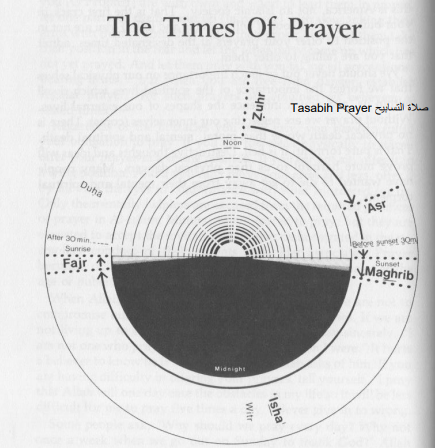 0
TIMES OF PRAYER
TIMES OF PRAYER
first to develop in the human being, the Muslim rises before the
sun and offers two rak'ahs in prayer to Allah, The Most High. A
rak'ah in prayer consists of changing positions from standing to
bowing down, to prostrating and sitting.
When praying, the Muslim makes obligatory physical move-
ments which signify obedience and submission to Allah, but these
physical movements are not ends in themselves. We must be grow-
ing spiritually also. In disciplining our physical bodies, our spiri-
tual drive and awareness become stronger. When the mind be-
comes more obedient to Allah, the burden on both the body and
the spirit is lessened. We must pray to Allah, not only out of grati-
tude and appreciation for our physical lives, but also out of fear of
losing things which are even more precious; our relationship with
Him, and the estimable character of our souls.
MORNING PRAYER
(Salatu-Fajr/ Subh)
The first obligatory prayer of the day is the Morning (Fajr)
prayer. It is offered after dawn, and before sunrise.130 The Morn-
ing obligatory prayer consists of two rak'ahs, and it is recited in an
audible voice. With each rak'ah we recite The Opening Chapter of
the Holy Qur'an, along with another chapter, or a number of con-
secutive verses. It was the practice (sunnah) of Prophet Muham-
mad jg to silently offer a non-obligatory prayer of two rak'ahs
before he said the Morning obligatory prayer. Therefore we do the
same. (Whenever we pray silently we should form the words of the
prayer with our tongues.) It is forbidden to offer any sunnah (non-
obligatory) prayer during the first thirty minutes after sunrise and
before sunset.
NOON PRAYER
(Salatuz-Zuhr)
The second obligatory prayer of the day is the Noon (Zuhr)
prayer. It is said immediately after the sun has passed its zenith
and has begun to decline, or when the shadow changes from the
west to the east. It is forbidden to offer the Noon prayer when the
sun is at its zenith. The Noon prayer consists of four rak'ahs which
are recited silently. In the first two we recite The Opening Chapter
of the Holy Qur'an, along with another chapter or a number of
consecutive verses. In the third and fourth rak'ahs The Opening
Chapter is offered without any additional recitations. It was the
practice of Prophet Muhammad SS to silently offer a prayer of two
or four rak'ahs before he said the Noon obligatory prayer, and a
silent prayer of two rak'ahs after.
Offering a prayer of four rak'ahs shows the necessity for univer-
sal awareness. When we understand the need to discipline our
bodies and our attitudes we can begin to make progress. Once we
discipline ourselves physically and spiritually, the next thing we
have to do is achieve harmony with the Will of Allah in the univer-
sal order.
Allah has established a universal order which calls for us to live
in peace with each other all over the earth, and to recognize,
respect and follow truth wherever we find it.
AFTERNOON PRAYER
(Salatul-'Asr)
The third obligatory prayer of the day is the Afternoon (Asr)
prayer. It is offered when the sun is midway through its course of
setting, and its time extends until just before the sun sets. The
Afternoon prayer, which consists of four rak'ahs, is offered si-
lently. In the first two rak'ahs the prayer is offered by reciting The
Opening Chapter of the Holy Qur'an, along with another chapter
or a number of consecutive verses. In the third and fourth rak'ahs
The Opening Chapter is offered without any additional recita-
tions. It was the practice of Prophet Muhammad SB to offer a
prayer of two or four rak'ahs before offering the 'Asr prayer.131
62
63
TIMES OF PRAYER
TIMES OF PRAYER
SUNSET PRAYER
(Salatul-Maghrib)
The fourth obligatory prayer of the day is the Sunset (Maghrib)
prayer.132 It must be offered after the sun sets, and before the
twilight, or ruddy glow upon the horizon disappears. The Magh-
rib prayer consists of three rak'ahs. In the first two rak'ahs the
prayer is offered by audibly reciting The Opening Chapter of the
Holy Qur'an, along with another chapter or a number of con-
secutive verses. In the third rak'ah The Opening Chapter is offered
silently, and without any additional recitations. After we have
completed the Maghrib prayer it is advisable that we perform a
silent prayer of two additional rak'ahs, as was the practice of Pro-
phet Muhammad jg.
Offering the Maghrib prayer after sunset shows the way we
have to start over again if the light of understanding declines in
our society. In order to be re-enlightened we must undergo a three
stage development. That is the only thing that will save us. If there
ever comes a time when the light of the Muslim society goes out,
we pray that Allah will re-enlighten us mentally, morally and
spiritually.
The night is symbolic of darkness and the need for rest and re-
juvenation. Darkness makes us come together. As long as we have
some light we may remain selfishly independent. We might try to
use our little light to gain an advantage over others. But if the light
goes out and total darkness prevails, people start to fear being
alone, and they begin to sense the need for trust among them-
selves.
Imagine you and your enemy sleeping in the same room, with
no light. In a situation such as that you would wish that your
enemy were a friend. If the world's light has gone out we all have
to ask Allah for another day. We will need not only the three stage
development (mental, moral and spiritual), but we will also need
renewed vision in the right direction and the return of our institu-
tional and academic processes.
In the hour of total darkness, social (family) conscience is inten-
sified to be given natural priority over private interest. Hence,
Allah is The Absolute Ruler over both the spiritual and social
phenomena. We should always be aware that Allah is The
Ultimate Ruler, and that He is in constant charge in secular and
private matters, just as He is in the matter of creating and main-
taining the universe.
NIGHT PRAYER
(Salatul-Isha)
The fifth, and last obligatory prayer is the Night (Isha) prayer.
Its time begins with the disappearance of the twilight. Preferably,
it should be offered before midnight. The Night prayer consists of
four rak'ahs. In the first two rak'ahs we audibly recite The Open-
ing Chapter of the Holy Qur'an, along with another chapter or a
number of consecutive verses. In the third and fourth rak'ahs The
Opening Chapter is offered silently, without any additional recita-
tions. It was the practice of Prophet Muhammad to offer a
prayer of two or four rak'ahs before offering the Night prayer, and
an additional prayer consisting of two rak'ahs afterwards. He
would then offer two rak'ahs (Shaf), and he would close with the
Witr prayer.
64
65
TIMES OF PRAYER
DAILY PRAYERS sunnah prayers obligatory prayers3 sunnah prayers
Number of rak'ahs Number of rak'ahs Number of rak'ahs
NAME OF TIME OF before obligatory after obligatory
PRAYER PRAYER prayer (Silent) Audible Silent prayer (Silent)
From dawn until sunrise From immediately past noon until mid-afternoon Between mid- afternoon until just before sunset From immediately after sunset until dark After dark and just before dawn
0
TIMES OF PRAYER
TIMES OF PRAYER
first to develop in the human being, the Muslim rises before the
sun and offers two rak'ahs in prayer to Allah, The Most High. A
rak'ah in prayer consists of changing positions from standing to
bowing down, to prostrating and sitting.
When praying, the Muslim makes obligatory physical move-
ments which signify obedience and submission to Allah, but these
physical movements are not ends in themselves. We must be grow-
ing spiritually also. In disciplining our physical bodies, our spiri-
tual drive and awareness become stronger. When the mind be-
comes more obedient to Allah, the burden on both the body and
the spirit is lessened. We must pray to Allah, not only out of grati-
tude and appreciation for our physical lives, but also out of fear of
losing things which are even more precious; our relationship with
Him, and the estimable character of our souls.
MORNING PRAYER
(Salatu-Fajr/ Subh)
The first obligatory prayer of the day is the Morning (Fajr)
prayer. It is offered after dawn, and before sunrise.130 The Morn-
ing obligatory prayer consists of two rak'ahs, and it is recited in an
audible voice. With each rak'ah we recite The Opening Chapter of
the Holy Qur'an, along with another chapter, or a number of con-
secutive verses. It was the practice (sunnah) of Prophet Muham-
mad jg to silently offer a non-obligatory prayer of two rak'ahs
before he said the Morning obligatory prayer. Therefore we do the
same. (Whenever we pray silently we should form the words of the
prayer with our tongues.) It is forbidden to offer any sunnah (non-
obligatory) prayer during the first thirty minutes after sunrise and
before sunset.
NOON PRAYER
(Salatuz-Zuhr)
The second obligatory prayer of the day is the Noon (Zuhr)
prayer. It is said immediately after the sun has passed its zenith
and has begun to decline, or when the shadow changes from the
west to the east. It is forbidden to offer the Noon prayer when the
sun is at its zenith. The Noon prayer consists of four rak'ahs which
are recited silently. In the first two we recite The Opening Chapter
of the Holy Qur'an, along with another chapter or a number of
consecutive verses. In the third and fourth rak'ahs The Opening
Chapter is offered without any additional recitations. It was the
practice of Prophet Muhammad SS to silently offer a prayer of two
or four rak'ahs before he said the Noon obligatory prayer, and a
silent prayer of two rak'ahs after.
Offering a prayer of four rak'ahs shows the necessity for univer-
sal awareness. When we understand the need to discipline our
bodies and our attitudes we can begin to make progress. Once we
discipline ourselves physically and spiritually, the next thing we
have to do is achieve harmony with the Will of Allah in the univer-
sal order.
Allah has established a universal order which calls for us to live
in peace with each other all over the earth, and to recognize,
respect and follow truth wherever we find it.
AFTERNOON PRAYER
(Salatul-'Asr)
The third obligatory prayer of the day is the Afternoon (Asr)
prayer. It is offered when the sun is midway through its course of
setting, and its time extends until just before the sun sets. The
Afternoon prayer, which consists of four rak'ahs, is offered si-
lently. In the first two rak'ahs the prayer is offered by reciting The
Opening Chapter of the Holy Qur'an, along with another chapter
or a number of consecutive verses. In the third and fourth rak'ahs
The Opening Chapter is offered without any additional recita-
tions. It was the practice of Prophet Muhammad SB to offer a
prayer of two or four rak'ahs before offering the 'Asr prayer.131
62
63
TIMES OF PRAYER
TIMES OF PRAYER
SUNSET PRAYER
(Salatul-Maghrib)
The fourth obligatory prayer of the day is the Sunset (Maghrib)
prayer.132 It must be offered after the sun sets, and before the
twilight, or ruddy glow upon the horizon disappears. The Magh-
rib prayer consists of three rak'ahs. In the first two rak'ahs the
prayer is offered by audibly reciting The Opening Chapter of the
Holy Qur'an, along with another chapter or a number of con-
secutive verses. In the third rak'ah The Opening Chapter is offered
silently, and without any additional recitations. After we have
completed the Maghrib prayer it is advisable that we perform a
silent prayer of two additional rak'ahs, as was the practice of Pro-
phet Muhammad jg.
Offering the Maghrib prayer after sunset shows the way we
have to start over again if the light of understanding declines in
our society. In order to be re-enlightened we must undergo a three
stage development. That is the only thing that will save us. If there
ever comes a time when the light of the Muslim society goes out,
we pray that Allah will re-enlighten us mentally, morally and
spiritually.
The night is symbolic of darkness and the need for rest and re-
juvenation. Darkness makes us come together. As long as we have
some light we may remain selfishly independent. We might try to
use our little light to gain an advantage over others. But if the light
goes out and total darkness prevails, people start to fear being
alone, and they begin to sense the need for trust among them-
selves.
Imagine you and your enemy sleeping in the same room, with
no light. In a situation such as that you would wish that your
enemy were a friend. If the world's light has gone out we all have
to ask Allah for another day. We will need not only the three stage
development (mental, moral and spiritual), but we will also need
renewed vision in the right direction and the return of our institu-
tional and academic processes.
In the hour of total darkness, social (family) conscience is inten-
sified to be given natural priority over private interest. Hence,
Allah is The Absolute Ruler over both the spiritual and social
phenomena. We should always be aware that Allah is The
Ultimate Ruler, and that He is in constant charge in secular and
private matters, just as He is in the matter of creating and main-
taining the universe.
NIGHT PRAYER
(Salatul-Isha)
The fifth, and last obligatory prayer is the Night (Isha) prayer.
Its time begins with the disappearance of the twilight. Preferably,
it should be offered before midnight. The Night prayer consists of
four rak'ahs. In the first two rak'ahs we audibly recite The Open-
ing Chapter of the Holy Qur'an, along with another chapter or a
number of consecutive verses. In the third and fourth rak'ahs The
Opening Chapter is offered silently, without any additional recita-
tions. It was the practice of Prophet Muhammad to offer a
prayer of two or four rak'ahs before offering the Night prayer, and
an additional prayer consisting of two rak'ahs afterwards. He
would then offer two rak'ahs (Shaf), and he would close with the
Witr prayer.
64
65
TIMES OF PRAYER
DAILY PRAYERS sunnah prayers obligatory prayers3 sunnah prayers
Number of rak'ahs Number of rak'ahs Number of rak'ahs
NAME OF TIME OF before obligatory after obligatory
PRAYER PRAYER prayer (Silent) Audible Silent prayer (Silent)
From dawn until sunrise From immediately past noon until mid-afternoon Between mid- afternoon until just before sunset From immediately after sunset until dark After dark and just before dawn
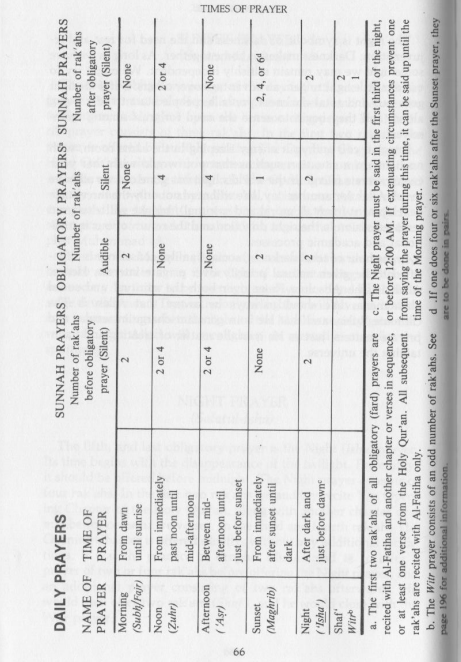 In the Name Allah,
The Most Gracious, The Most Compassionate
ABLUTION
(Wudu')
O you who believe! When you prepare for prayer, wash
your faces, and your hands (and arms] to the elbows;
rub your heads and [wash] your feet to the ankles. If
you are in a state of ceremonial impurity, bathe your
whole body. But if you are ill or on a journey, or one of
you comes from offices of nature, or you have been in
contact with women, and you find no water, then take
for yourselves clean sand or earth, and rub therewith
your faces and hands. Allah does not wish to place you
in a difficulty, but to make you clean and to complete
His Favor to you that you may be grateful.133
Ablution is the washing and cleaning of certain parts of the
body for prayer. The ritual of ablution, as taught to us in Al-
Islam, is one of the essential steps in conditioning the mind and
heart to be in the state of cleanliness, righteousness and obedience
to Allah.
Before we discuss ablution we must first understand the mean-
ing of ritualism and the symbolic language which surrounds it.
The use of symbolic language in religion is a practice that comes
from ancient customs and traditions which have withstood the test
66
67
ABLUTION
ABLUTION
of time. Language itself began as symbols and pictures, and slowly
evolved into words.
When we examine the history of any religious movement,
whether it be Judaism, Christianity or Al-Islam, we may see more
traditional symbolism and ritualism than enlightened religion.
When the Jews, Christians and Muslims meet for their religious
services they all practice their own rituals. The Holy Qur'an says,
"And for every nation have we appointed a ritual.''134
Ritual is ceremonial procedure established in accordance with
prescribed rules and customs. It involves the standardization of
certain physical steps in the religious ceremony such as sprinkling
water, breaking bread, drinking and saying certain things repeat-
edly. Such acts have meaning, and they should be interpreted for
the benefit of those performing the rituals. Ritual is akin to habit,
and to many people religion has been mostly a ritualistic habit.
Some people can tell you about their ritualistic habits, but they are
in the dark when it comes to explaining their origins or meanings.
The significance of the rituals associated with prayer in Al-Islam
is in the subtle way they affect our consciousness, without our
conscious recognition of everything they represent. Our rituals are
not designed to appeal to wild imaginations or to inspire supersti-
tions; they are designed to appeal to our intellects and our curiosi-
ty-
When people perform rituals without understanding them they
are placing themselves in spiritual darkness, and Satan can come
into that darkness and rule. This is what Jesus and all of the pro-
phets spoke of when they said darkness was ruling.135 Satan hides
in symbolism and rituals because such things need interpretation.
Without it they are like lights under a cover. The ritualism in Al-
Islam is designed to bring understanding, but it also has to be in-
terpreted. Praise and thanks to Allah, The Most High, for blessing
me with the knowledge to bring you this understanding.
Before the coming of Prophet Muhammad jg, the truth had
been obscured in symbolism and ritualism to such an extent that it
could no longer be discovered without Light from Allah. It was
Allah who gave Prophet Muhammad the Holy Qur'an, the
Light which dispels darkness. The Holy Qur'an contains the keys
which open the locks of confusion, and it gives meaning to our
lives.
In the Holy Qur'an Allah clearly tells us that belief in supersti-
tion, witchcraft, magic, astrology and other such things is a cor-
ruption of religion. Such beliefs cannot be tolerated among
Muslims. He says, "Say: I seek refuge in the Lord of the Dawn.
From the mischief of created things. From the mischief of darkness
as it overspreads. From the mischief of those who practice secret
arts, and from the mischief of the envious one as he practices
envy."136
This chapter does not refer to Allah's Creation as evil. It refers
to the danger of ignorance and superstition within that which He
created. Things taken to extremes can cause evil. Evil can come in-
to us when our minds misinterpret what we see. Superstitions, ig-
norance and wickedness can come into our lives when we lack pro-
per understanding of Allah's Creation. When the Holy Qur'an tells
us we should ask Allah's Protection from these evils, it is telling us
that a Muslim cannot believe in them. We can have no fear of
darkness because we cannot believe that darkness carries demons
or special evils. Darkness forces us to be cautious simply because it
restricts our physical vision. In the darkness of ignorance we also
have to be careful. When we do not know about something we
must use caution in dealing with it. If we do not, we may be led to
accept falsehoods or to participate in crime and superstition.
Allah tells us to seek His Protection, "From the mischief of
darkness as it overspreads." At that moment when we do not see
the Light of Al-Islam, we cannot act. If we are asked to participate
in a conversation, but we are unaware of the guidance provided by
the Holy Qur'an and Hadith, we must be silent. If the Light of Al-
Islam shows us that the conversation is wrong, we are obligated to
speak out against it.
This is not a superstitious religion. We are not asking people to
believe in something beyond human grasp, or beyond human
perception. We are simply asking people to do what is natural and
comfortable for a good thinking person. Allah has given us Al-
Islam to lead us to make the best use of our natural human poten-
tial. When our moral discernment allows us to find rational
answers for our questions about life, we learn i.o rid ourselves of
superstitions and to avoid degrading desires. This is what we are
68
69
ABLUTION
ABLUTION
taught in the Holy Qur'an wherein it says, "This is a clear message
for the people in order that they may be warned thereby, and that
they may know that He is only One God, and that men of under-
standing may take heed.''137
The Bible says, "Blessed is he that reads and understands,"138
and, "Behold, the days come, saith the Lord God, that I will send a
famine in the land, not a famine of bread, nor a thirst for water,
but of hearing the words of the Lord. And they shall wander from
sea to sea, and from the north even to the east, they shall run to
and fro and seek the word of the Lord, and shall not find it.''139 It
also says, "The words are closed up and sealed till the times of the
end."140
What does it mean for words to be sealed? It means locked up,
fixed so that people cannot get their true meanings. No religious
leader will deny this. Christian leadership will tell you, "Yes, they
are sealed." Jewish leadership will tell you, "Yes, they are sealed."
The Bible says that the people will come searching for guidance
and that they will go to the learned and say, "Read this, I pray
thee.' And he [that is learned] saith, 'I cannot, for it is sealed.' And
the book is delivered to him that is not learned, saying, 'Read this,
I pray thee.' And he saith, 'I am not learned.' Therefore the Lord
said, 'Forasmuch a? this people draw near Me with their mouths,
and with their lips do honor Me, but have removed their hearts far
from Me, and fear toward Me is taught by the precept of men.
Therefore, behold, I will proceed to do a marvelous work and a
wonder; for the wisdom of their wise men shall perish, and the
understanding of their prudent men shall be hidden. Woe unto
them that seek deep to hide their counsel from the Lord, and their
works are in the dark, and they say, 'Who seeth us? And who
knoweth us?”'141
The world's religious leadership will tell you, "Even we have lost
much of the true interpretation of the scripture." The Bible is now
being contradicted by scientific findings. That is why there is so
much controversy among the religious leadership of the world.
Today, however, there is a serious and sincere effort to bring
together the leadership of the great religions of Judaism, Chris-
tianity and Al-Islam.
When we gain a proper understanding of the function of reli-
gious ritual and symbolism we can appreciate the full significance
of the physical steps of ablution. When we learn to interpret their
meanings we can see how these steps are designed to help us grow
in accordance with the principles of Al-Islam.
Before making an ablution we should test the water we are using
to be sure that it is pure. It should be odorless, colorless and
tasteless. The ablution is not acceptable if we use dirty water. That
would not be ablution; it would be pollution. If ablution is made
with water that is in a container, one should dip or pour water
from the container, never using the same water twice. If a person is
physically dirty, and clear water alone will not render him clean,
he must first wash the parts of the body that are to be cleaned in
ablution with some type of cleaner such as soap, etc.
Allah, The Most High, tells us in the Holy Qur'an, that when
water suitable for ablution cannot be found, " then take
good clean sand or earth and rub your faces and your hands there-
with."142 When we are performing ablution in this way it is called
tayammum. Things which can be used to make tayammum are:
dry earth, dust, sand, any natural stone, natural gypsum, salt,
marble, ice, or brick which has not been manufactured by fire.
If one is in a place where one of the above is accessible, he may
rub it with his hands and perform tayammum. However, one
should be able to find water if he is in a city. There is no excuse for
not using water when it is reasonably available. After performing
tayammum one should not delay going to prayer.
External cleanliness brings about the desire for inner cleanliness.
Prayer in Al-Islam is a higher form of ablution because it affects
the mind directly. In instructing his followers to pray, Prophet
Muhammad Sg said, "If there were a river at the door of anyone of
you and he washed in it five times a day, would you notice any
dirt on him?" They said, "Not a trace of dirt would be left." Pro-
phet Muhammad added, "That is the example of the five
prayers by which Allah annuls evil deeds.''143
Five is a number which is symbolically used to represent the ra-
tional sense. If one devotes his full mind, heart and all of his senses
to Allah for the purpose of bringing about external and internal
cleanliness, and if he follows Al-Islam he will become clean. Ablu-
tion is a state of physical and mental cleanliness.
70
71
ABLUTION
ABLUTION
It is not necessary to make ablution before every prayer unless
the previous ablution has been broken, except when performing
tayammum, which applies only to the single prayer which it
precedes. When one is uncertain whether or not the previous ablu-
tion was broken, the state of ablution remains in effect. Uncleanli-
ness and a number of other things can break the ablution. The
same occurrences which nullify ablution also nullify tayammum.
PERFORMING ABLUTION
Before making ablution we must mentally confirm our intention
so that our minds and hearts will not be influenced by the false
values set by society. Make your ablution In the Name Allah,
knowing that when we become attentive with both heart and
mind, we can better answer the call to obey Allah and His
Messenger. We say, audibly or silently, "I am about to make my
ablution for Allah, The Guardian Evolver, The Cherisher and Sus-
tainer of all the worlds.'' We then say, "In the Name Allah, The
Most Gracious, The Most Compassionate." We state our intention
to give reverence, respect, humility and obedience to Allah, The
Most High, so that the physical action of ablution becomes a con-
scious one, and not just a routine exercise.
We begin our ablution by washing the right hand three times to
remind us of our duty to uphold that which is right.144 We are not
to act physically, mentally or spiritually in a corrupt way. The
hands are used to symbolize action, and the right hand is symbolic
of our conscious acts. In order to correct our unconscious actions
we must first discipline our conscious actions. We depend upon
our hands to help us be productive in business, defense, literature
and many other areas.
Next, we wash the left hand three times. The left hand is sym-
bolic of our impulsive or unconscious acts. These acts are subject
to negative influences when our conscious acts are not rightly
oriented. Washing the left hand reminds us of our responsibility to
give help to those who are oppressed and culturally blind. Prophet
Muhammad said to his followers, "Help your brother whether
he is an oppressor or he is an oppressed one." When the people
asked Prophet Muhammad sK how they could help their brother if
he were an oppressor, he answered, "By preventing him from op-
pressing others."145 IThrough appealing to his conscience.]
We should be positively influenced by people who have more
strength or understanding than ourselves. Those with less moral
and spiritual knowledge should voluntarily support those with
greater knowledge; those who have good moral characters,
stronger faith, and who courageously resist injustices and corrupt
influences.
After cleaning our hands, we wash out our mouth three times.
The mouth symbolizes moral discernment. Even if you do no harm
to others with your hands, you may still hurt them with your
tongue. With our mouths we can injure others mentally, morally
and spiritually. A person cannot do shameful, filthy acts and not
be affected by them. The corrupt influences we allow to come into
our lives affect us psychologically.146 When a man restrains
himself from doing harmful things, his words will begin to reflect
restraint and thoughtfulness.
Prophet Muhammad sB taught that the thing which gets a per-
son into hell or paradise quickest is his tongue. The Muslim who
protects the honor and safety of his brothers and sisters with his
hand and his tongue can receive salvation. A person who lies is
often trying to defend his incorrect actions. Should he govern his
actions, his way of speaking will show it. When he corrects his ac-
tions his mouth will automatically become more creditable. If he is
not ready to discipline his thoughts and actions his mouth can be
washed out a thousand times a day and still he will lie.
After cleaning the mouth, we clean the nostrils three times. The
nose symbolically represents desires and aspirations. If we work
on our actions and our speech to discipline them, we will force our
desires to come under control. If we force ourselves to speak the
truth we deny our negative desires a medium of expression.
The nose is also symbolic of the intuitive spirit of the human be-
ing. You have heard the common expressions, "I can smell it in the
air," and "I can smell something cooking." These expressions do
not refer to the physical sense of smell. They relate to a kind of in-
72
73
ABLUTION
ABLUTION
tuitive awareness. This intuitive awareness is not something on
which we can fully rely. Intuition means that which comes to us
through feeling or instinct. Intuitive awareness comes automatical-
ly, without our minds perceiving the process. It will not, however,
guarantee intellectual enlightenment unless it is rationally assisted
by the Signs of Allah.
Throughout the ages millions of misinformed people have look-
ed for magical ways to solve their problems, and they have been
victimized by occultists and soothsayers. Over-dependence on in-
tuition can lead to superstition. Superstition comes into our lives
when we do not get a proper understanding of reality. When we
get enough true answers to our questions about life we will not be
interested in fantasy.
We are never to think of ourselves as being divine, or of a
foreign or spooky dimension. Many people think that they can
connect themselves with Allah by ignoring all that is in the world.
Some even isolate themselves physically and spiritually, thinking
they will come into divine essence and presence. Such persons are
apt to neglect their duty in society. Sometimes you cannot get
them back to reality. They just go off somewhere and dry up like a
plant without water.
Thus far we have checked our actions by the washing of the
hands. We then gave attention to our mouths in speaking the truth
and in keeping our words and thoughts clean. Next, we washed
the nose to symbolize the removal of superstitions and unclean
desires. When we clean up our actions and desires, and also
develop our spiritual awareness, we become conscious that we are
not perfect and that we are ever in need of Allah's Help.
After washing the nose, we wash our face three times. The face
symbolizes a person's character. Just as an evil can be created by
our mouths or our hands, a facial expression can also start an evil
to work. When we say, "Do not pay any attention to him, there is
another face that he is not showing you," we mean that his real
character is hidden. A two-faced person can never make himself
presentable to Allah.
After washing the face, we wash the arms three times up to the
elbows, starting with the right arm. The arm is a symbol of power.
We are not to use our power to force others to our way of think-
ing. Some people are unable to discipline themselves, yet they are
ready to use their power to force others to submit to their wills. By
the same token, nations and communities are sometimes guilty of
using their power in the form of wealth, or knowledge of warfare,
science, psychology, religion, etc., to dominate and exploit others.
In washing the arms three times we are reminded that power is
given in three ways: physically, mentally and spiritually. Power
can interrupt, corrupt and disrupt our physical, mental and
spiritual lives. After washing the right arm, we wash the left to
reinforce the principle so that it will become a habit for us.
After washing the arms, we wipe the hair once. The hair is a
symbol of sub-skin intelligence, and wiping it is symbolic of keep-
ing our emotional senses clean. Emotions are subject to the in-
fluence of instinctive intelligence. Once a society develops to a
civilized level, the most important things for its leaders to do are to
preserve its knowledge and to safeguard it from distortions and
impurities. Once its knowledge is corrupted, a society will soon
become corrupt. Right knowledge keeps a society on the path of
growth and development.
After wiping the hair, we wipe the ears simultaneously, cleaning
them only once. The ear is an open door to our minds and hearts.
It is symbolic of another form of desire, the desire of the intellect
and the heart to know. When cleaning the ears we should be con-
scious that we are to protect ourselves against suggestions and in-
fluences which could corrupt our minds. If something is not in
agreement with the Holy Qur'an and Hadith, we want to stop it
right at the door.
Our ears are not interpreters; they only receive information
under the influences of sentiment and logic. When we listen, it is
because we desire to know something in order to satisfy our minds
and hearts. Sometimes people may plant things in the ear which
can disrupt and unseat the mind and heart. Once something comes
into our ears, it is up to us to use our intelligence to see if it is good
or evil, logical or illogical. Once we recognize evil, we must fight
its influence in all forms.
According to the Holy Qur'an and the Bible, Adam and Eve lost
their place in the Garden of Eden because they were tempted to
listen to the deceiving whispers of Satan.147 In ignorance, they let
74
75
ABLUTION
ABLUTION
their hearts and intellects take diverging paths, and the attention
of their ears became imbalanced between the requirements of logic
and sentiment. Most people are impulse-directed-burden-bearers
without skill. That which comes into our ears must be consciously
examined. This is something to which we have to devote our entire
being.
We clean the feet after cleaning the hair and ears. Symbolically
speaking, the body represents the structure of society, and the feet
represent the innate spiritual intelligence of the people or masses.
Society stands upon the emotional stability of the people. You
cannot tell the masses to be clean and upright, and to fight evil in-
fluences in all forms before involving both heart and intellect in
the cause of truth and justice.
For the individual the feet represent habit-formed convictions
and morals. Think of the expressions, "I stand on my faith and
convictions," "Walk of life," and "What road do you follow?"
Your walk of life, or the road you follow, forms your habits. You
do not have to think consciously about your habits in order to
form them. You speak a certain way, walk a certain way and per-
form certain social functions because they have become your way
of life. Society has passed these habits on to you. They are both
emotionally and rationally based.
It is essential that we understand and live in accordance with the
symbolic meaning associated with the ritual of ablution. The con-
stant repetition of its steps should reinforce our awareness of the
way Allah directs us toward the life He intends for us, and it
should remind us of our need to constantly reorient ourselves in
accordance with the principles it illustrates. The symbolism of
ablution shows us that no matter what the situation is, we are re-
quired to maintain a clean, rational attitude.
In order for our unconscious actions to be properly oriented,
our thoughts and conscious actions must first be disciplined to
uphold that which is right. Once we have disciplined ourselves
physically we become able to practice moral discernment and
clean, creditable speech. When we reach this point in our develop-
ment we hope that our character is acceptable to Allah. Through
these steps we learn to understand our own potential and how to
use it properly, so that we can protect the purity of our knowledge
and wisdom. Next, we learn to protect our minds and hearts from
evil influences and suggestions, and to correct our personal habits
so that they will conform to Al-Islam. Once we have progressed in
this endeavor, we can better live the lives of upright Muslims in a
continuous state of mental, moral and spiritual ablution.
Before going further let us review the steps of ablution and the
order in which they are to be performed. Before beginning the
ablution we state our intention by saying in our hearts, "I am
about to make my ablution for Allah, The Guardian Evolver, The
Cherisher and Sustainer of all the worlds." It is then obligatory to
say, "In the Name Allah, The Most Gracious, The Most Com-
passionate," and begin the ablution. Only clear water is used when
performing ablution. The steps of ablution are performed in the
following manner:
The hands are washed three times to the wrists, beginning with
the right hand. The hands should be rubbed, while at the same
time permitting the water to reach between the fingers.
The mouth is washed out by rinsing three times, using fresh
water each time. It was the practice of Prophet Muhammad sf, to
brush his teeth before prayer if a long period of time had elapsed
since his last ablution.
The nostrils are rinsed out three times, rinsing the right nostril
first, or both at the same time.
The face is washed three times, from the top of the forehead to
the underside of the chin, and from ear to ear. Water must also
penetrate the beard and the wrinkles around the eyes.
The arms are washed three times to the elbows, beginning with
the right arm.
The head is wiped over once, starting from the top of the
forehead and going back down to the neck. Both ears are then
wiped once, simultaneously, with fresh water.148 If the hands are
not damp after wiping the head, moisten them before wiping the
ears. With wet fingers, follow the track inside the ears. Bring the
fingers up, then down along the back grooves inside of the ears,
(starting in the inner auditory canal, and tracing the concha and
the antihelix) to the openings and the lobes. To wipe the back of
the ears, put the thumbs behind the ear lobes and push them up to
the top, then down the back of the ears.
76
77
ABLUTION
ABLUTION
The feet are washed three times up to and including the ankles,
starting with the right foot. Water must penetrate between the
toes. Under certain conditions wiping over the foot coverings is
permissible.149 However, the feet are to be clean.
If you are in a bathroom after finishing the ablution it is com-
mendable to recite the Shahadah (silently to yourself): I bear
witness that there is no god but Allah, and that Prophet Muham-
mad 5^ is His Servant and.Messenger. O Allah, make me of those
who are repentant, and make me of those who are purified. Ex-
alted are You, O Allah. With Your Praise I ask Your Forgiveness
and I return to You.
While making ablution one should refrain from talking and
from wasting water. Once you begin ablution you must complete
it in one continuous sequence.
ACTS WHICH NULLIFY ABLUTION
The following acts nullify ablution. In such cases the ablution
must be performed again:
Emission of any solid, liquid or gas from the anus or genitals.
(When any waste is excreted from the body, the anus and/or
genitals are wiped and cleaned with clear water.)
In case of emission of semen while asleep or awake, ablution
and an obligatory [full] bath become necessary.
Intentional direct touching of unclothed sex organs.
Temporary insanity, fainting spells or hysteria.
Being under the influence of any substance which befogs the
mind.
Falling asleep and losing consciousness of activity in one's sur-
roundings.
Women having a flowing emission of blood or secretion.
Women are forbidden to fast or to offer obligatory prayers dur-
ing their menstrual periods. Upon completion of the menses an
obligatory bath and ablution are necessary.
ACTS WHICH DO NOT NULLIFY ABLUTION
Touching a person of the opposite sex without the thought of in-
timate sexual relations, such as a husband holding the hand of his
wife, or kissing her affectionately. (If one is sexually aroused from
such contact the ablution is nullified.)
If one is praying and blood begins to flow from a previous in-
jury, the ablution is not nullified.
When a person has begun praying but is unable to maintain a
state of purity because of continual emission of impure fluid due to
illness or disease, he or she is not to join congregational prayers.
When the condition occurs while the worshipper is praying alone
it is not necessary to stop praying and perform the ablution again.
However, fresh ablution must be performed for every prayer.
Such cases include the following:
Having infected eyes which emit impure fluid continuously.
Suffering from dribbling of urine.
Having frequent release of wind due to some ailment.
Constant emission of semen or prostatic fluid.
HOW TO PERFORM TAYAMMUM
One should have in mind the intention to perform tayammum.
One should begin by saying, "In the Name Allah, The Most
Gracious, The Most Compassionate."
Both hands should be struck on clean earth, sand or stone, etc.
Both hands may be blown to remove excess dust.
The face should be wiped once with both hands.
Both hands are then rubbed against each other, wiping the right
hand first.
78
79
ABLUTION
ABLUTION
WHEN TO PERFORM TAYAMMUM
Tayammum is performed when water is not available at the
time of prayer, or when the amount of water available is insuffi-
cient to perform an ablution or a complete bath. [If there is not
enough water to perform a complete ablution, use whatever water
is available, and complete the ablution by tayammum when it runs
out.]
When the use of water will increase the chance of illness, or
delay its cure.
When the quantity of water is small and its immediate use is
essential for cooking or drinking (by humans or domesticated
animals. Animals for shows, exhibitions, etc., are excluded.).
When water is unobtainable because of some danger to health,
or because of some other major reason.
SUPPLICATIONS DURING ABLUTION
It is recommended that the following supplications be offered
while performing ablution.
WHEN WASHING HANDS: O Allah, I ask of You good for-
tune and blessing, and I seek refuge in You from misfortune and
destruction!
WHEN GARGLING: O Allah, help me in the recitation of Your
Book, and in remembering You most, and in offering You thanks!
WHEN POURING WATER FOR THE NOSTRILS: O Allah,
comfort me with the smell of heaven under the circumstance that
You are pleased with me!
WHEN SNIFFING WATER: O Allah, I seek refuge in You from
the smells of the fire [of hell], and from the disgrace of the abode!
WHEN WASHING THE FACE: O Allah, brighten my face on
the day when You will brighten the faces of those who are dear to
You, and do not blacken my face on the day when You will
blacken the faces of Your foes!
WHEN WASHING THE RIGHT HAND: O Allah, give me the
record of my deeds in my right hand and subject me to an easy
judgment!
WHEN WASHING THE LEFT HAND: O Allah, I seek refuge in
You that I may not be given the record of my deeds in my left hand
or from behind my back!
WHEN WIPING THE HEAD: O Allah, give me the shade of
shelter under Your Throne, on the day when there will be no shade
other than the shade of Your Throne!
WHEN WIPING THE EARS: O Allah, make me one of those
who listens to an utterance and follows what is best in it! O Allah,
make me listen to the pronouncement of the heavens with the vir-
tuous people!
WHEN WIPING THE NECK: O Allah, remove my neck from
hell-fire. I seek Your Refuge from the fetters and shackles!
WHEN WASHING THE RIGHT FOOT: O Allah! Let my feet
stick to the right path.
WHEN WASHING THE LEFT FOOT: O Allah, I seek refuge so
that my feet do not slip on the bridge on the day when the feet of
the hypocrites slip in Hell!
80
81
In the Name Allah,
The Most Gracious, The Most Compassionate
ADHAN
(Announcement)
It is important for every Muslim to know and understand the
great significance and origin of the Adhan, which literally means
announcement. The Adhan is the Call to Prayer which is made
before every congregational prayer service. It is proclaimed from
hundreds of thousands of masjids all over the world, and from
wherever else there is a gathering for congregational prayer.
The Adhan is more than just a simple call for people to assem-
ble. It is an essential declaration of the principles of Al-Islam, and
a compact summary of the central teachings of the Holy Qur'an
and Sunnah. It beautifully ties together the fundamentals upon
which Al-lslam rests: belief in the Oneness of Allah, the fact that
there is no power greater than He, and that Prophet Muhammad
si brought the Final Message of Allah to the world. So profound
are the words chosen for the Adhan that if one's understanding
were limited to it, and if one abided by its instructions, he would
have a firm grasp of the fundamentals of Al-Islam.
The main purpose for the loud announcement of the Adhan in
every masjid is to make available to everyone a brief and easily in-
telligible description of Al-Islam. The Adhan presents the Message
of Allah every morning, noon, afternoon, evening and night.
There are many traditional accounts of Islamic history which
reveal the origin and inspiration for the Adhan. Since the Muslims'
83
ADHAN
ADHAN
initial gatherings at Makkah, prayer had always been said in con-
gregation, but only after Prophet Muhammad immigrated to
Madinah in A.H. 1 (A.D. 622), was the Adhan permanently incor-
porated into Islamic ritual.
It has been reported in Hadith that after Prophet Muhammad 5g
arrived in Madinah, his followers gathered and sought to know
the times of prayer and how they should be summoned to prayer.
Some suggested that a fire be lit at the times of prayer, and others
suggested ringing a bell as do the Christians.150 When these pro-
posals were brought to Prophet Muhammad , he delayed in giv-
ing a response.
It was during this period that one of his followers, 'Abdullah ibn
Zayd, came to him and said, "I saw in a dream a person wearing
green clothes. In his hand was a bell, so 1 said to him, 'O Slave of
Allah, please sell me your bell.' The person replied, 'What would
you do with it?' I replied, 'I would use it in order to gather the peo-
ple for prayer.' So the man said, 'May I guide you to a better way
than this?' I replied, 'Yes.' So he called [out] with his loudest voice,
'Allahu Akbar, Allahu Akbar. . . etc,' until he finished the Adhan.
Then he moved from the place where he called the Adhan and cal-
led the Iqamah [second call] of the prayer." Prophet Muhammad
*8 responded, "Surely this was a good dream (ra'yah) of truth. Go
to Bilal, tell him what you heard and tell him to call it." When
'Umar heard the Adhan he came to Prophet Muhammad sS and
said, "I have seen a dream like this." Prophet Muhammad jg said
[to him], "Al Hamdulillah."151 Ringing bells and lighting fires can-
not compare with the impact of a human voice announcing the
great and significant principles of Al-Islam five times daily.
After the Muslims' conquest of Makkah, Prophet Muhammad
ig told Bilal to climb to the top of the Ka'bah, the Sacred House of
the Muslims, and call the people to prayer. With calm reigning, he
said in effect, "Bilal, tell the world, tell this nation that has been
brought from chaos and turmoil into tranquility and peace that
Allah is the Greatest." And Bilal climbed on top of our honored
Kab'ah and cried out, "Allah is the Greatest. Come to prayer,
come to success." Bilal thereafter gave the Call to Prayer. Thus he
became the first Mu'adhdhin (Caller who summons to prayer) in
Al-Islam. It should be noted that Prophet Muhammad 38 also
designated 'Abdullah ibn umm Maktum, who was blind, and Abu
Muhdhurah as the second and third Mu'adhdhins in Al-Islam.
Prophet Muhammad sg, the leader of the most rapidly growing
religion on earth, a spiritual world revolution that now encom-
passes more than one billion people, chose Bilal as the first
Mu'adhdhin to call the Morning prayer (just after dawn and before
sunrise). This is a revealing historical fact and a source of
everlasting inspiration to a people who have been totally uprooted
from their natural growth in the life of humanity. The role per-
sonified by (characteristic of) Bilal contains all the elements essen-
tial for survival, struggle and progress.
We of the American Muslim Mission are saying, "Allah is the
Greatest. There is no god but Allah; make no images. Get rid of all
images that attempt to portray the Divine." We are the Mu'adh-
dhin in America, calling the people's attention to The One True
God, Allah.
According to tradition the person selected to make the Adhan
must be an adult male who has earned the respect of his communi-
ty. To make the announcement the Caller faces in the direction of
the Ka'bah, which is located in the center of the Sacred Masjid in
Makkah, Arabia. It was in this direction, approximately sixteen
months after Prophet Muhammad's flight from Makkah to
Madinah, that the Muslims were ordered to turn when offering
prayer.152 We are not turning in this direction to worship anything
except Allah, The Creator.
When announcing the Adhan, the Caller assumes the standing
position (See Illustration, page 127.) and raises his hands to his
ears. With hands cupped, palms forward and thumbs under his ear
lobes, he makes the following announcement in a loud, chanting
voice:
Allah is The Greatest, Allah is The Greatest. Allah is The
Greatest, Allah is The Greatest. I bear witness that there is no god
except Allah. I bear witness that there is no god except Allah. I
bear witness that Muhammad is the Messenger of Allah. I bear
witness that Muhammad is the Messenger of Allah. (Turning his
head to the right he says) Come to prayer, come to prayer. (Turn-
ing his head to the left he says) Come to success, come to success.
(Turning his head once again in the direction of the Ka'bah he
84
85
ADHAN
ADHAN
says) Allah is The Greatest, Allah is The Greatest. There is no god
except Allah.
After the Caller has finished the First Call, he and the followers
should offer the following prayer:
O Allah, Lord of this perfect call, and of the prayer to be offered
presently, grant Muhammad the way of approach to You, and
also eminence. And elevate him to the glorious position which You
have promised him, and afford us his intercession on the Day of
Judgment, for You never go back on Your Promise.153
If time permits the following prayer is also said silently:
O Allah, praise and venerate Muhammad and the followers of
Muhammad, as You praised and venerated Abraham and the fol-
lowers of Abraham. O Allah, bless Muhammad and the followers
of Muhammad, as You blessed Abraham and the followers of
Abraham.311 In the worlds, surely You are Praised and Magnified.
For the Morning prayer only, after the Caller says, "Come to
success," the following words are said, "Prayer is better than sleep.
Prayer is better than sleep."
When the Adhan is proclaimed the immediate responsibility of
every Muslim is to prepare for prayer. The Adhan is never to be
taken lightly. Upon hearing it a Muslim should make every effort
to join the congregational prayer. It is commendable to repeat the
words of the Adhan after the Caller. Prophet Muhammad said,
"When the Caller says, 'Allah is The Greatest, Allah is The
Greatest,' one should make the response, 'Allah is the Greatest,
Allah is The Greatest.' When the Caller says, 'I bear witness that
there is no god except Allah,' one should make a response, 'I bear
witness that there is no god except Allah.' When the Caller says, 'I
bear witness that Muhammad is the Messenger of Allah,' one
should respond, 'I bear witness that Muhammad is the Messenger
of Allah.' When the Caller says, 'Come to prayer,' one should
make a response, 'There is no movement and no power except by
Allah.' When the Caller says, 'Come to success,' one should res-
pond, 'There is no movement and no power except by Allah.' And
when the Caller says, 'Allah is The Greatest, Allah is The
Greatest,' then make a response, 'Allah is The Greatest, Allah is
The Greatest.' When the Caller says, 'There is no god except
Allah,' and if this is a response from the heart, 'There is no god ex-
cept Allah,' he will enter Paradise."154
'Abdullah b. 'Amr b. al 'As reported the Messenger of Allah jg
as saying, "When you hear the Mu'adhdhin, repeat what he says,
then invoke a blessing on me, for everyone who invokes a blessing
on me will receive ten blessings from Allah; then beg from Allah
the position of intercession, which is a rank in Paradise fitting for
only one of Allah's Servants, and I hope that I may be that one. If
anyone asks that I be given the position of intercession, he will be
assured of my intercession."155
When the Caller says, "Allah is The Greatest," he is telling the
world that he bows before no one as an object of worship in his life
except Allah, The Most High. When he says, "I bear witness that
there is no god except Allah, and I bear witness that Muhammad is
the Messenger of Allah," he is declaring the Unity of Allah; that He
is One Alone, and that Muhammad is not a divinity, but a ser-
vant of Allah.
Prophet Muhammad ?§ obligated all of us to protect the purity
of our religion by never forgetting that he was neither a god nor an
angel, but a human messenger for human beings on earth. The Ho-
ly Qur'an states, "If there were settled on earth angels walking
about in peace and quiet, We would certainly have sent down
from the heavens an angel for a messenger." There is no better ex-
ample for man than another man who is courageous, righteous
and Divinely Guided.
After bearing witness to the Unity of Allah, and to the pro-
phethood of Muhammad the Caller turns his face to the right
and says, "Come to prayer." The word "come" is translated from
the Arabic word, "hayya," which means to rush, to come lively, or
to come with life. In saying, "Come to prayer," we are being called
to life, and to a spiritual awakening which will purify and dignify
us; one that will help us rise to heights which can be attained only
through prayer and submission to Allah.
When the Caller turns his face to the left and announces, "Come
to success," we are once again told to come lively, but this time to
prosperity and salvation. Salvation is in cultivating the inner soul
and spiritual potential. Since self-development is attained through
prayer, we are being called together so that we can plow up our
substance and plant the seed of truth in our being. As it grows it
86
87
ADHAN
ADHAN
will increase our wealth and make us humanly, intellectually,
morally and spiritually rich. It will allow us to know how to truly
measure the wealth outside of ourselves. Until we have cultivated
ourselves, we will never be able to utilize our natural resources
properly.
The Caller then repeats, "Allah is The Greatest, Allah is The
Greatest. Inhere is no god except Allah." The world witnesses our
call that Allah is the greatest force in our lives, and that nothing
deserves to be worshipped except Him alone.
not turned to the right or left when announcing, "Come to
prayer," or "Come to success." The Caller announces, "Prayer is
commencing," to alert the congregation that prayer is about to
begin. At this point the congregation stands and forms straight
lines for the prayer service. The members of the congregation will
not be out of order if they stand before the pronouncement,
"Prayer is commencing."
IQAMAH
The Iqamah156 is to be made to the assembled congregation just
before the Imam begins the congregational prayer. After the
Mu'adhdhin has made the Adhan there should be an interval
before the Iqamah is announced, during which time a Muslim
prepares for the prayer service.157 The interval between these two
calls should allow the followers at least sufficient time to finish a
meal (if they are eating), make ablution, go to the masjid and per-
form sunnah prayer.
The sentences of the Adhan are delivered in a leisurely
manner,158 while the delivery of the Iqamah is marked by quick-
ness. The Iqamah is also pronounced in a comparatively lower
tone of voice. The person who makes the Adhan is generally the
one who announces the Iqamah, however it is acceptable for
someone else to make the Iqamah. The Iqamah is said as follows:
Allah is The Greatest, Allah is The Greatest.
I bear witness that there is no god except Allah.
I bear witness that Muhammad is the Messenger of Allah.
Come to prayer.
Come to success.
Prayer is commencing, prayer is commencing.
Allah is The Greatest, Allah is The Greatest.
There is no god except Allah.159
When making the Iqamah both hands remain at the sides, as in
the standing position. (See Illustration, page 100.) Also, the face is
88
89
In the Name Allah.
The Most Gracious, The Most Compassionate
PERFORMANCE OF PRAYER
Prayer in Al-Islam has a form and a spirit. It is observed in the
form of physical and conscious acts of worship involving both the
mind and the body, and its spirit lives in the heart of the believer.
To keep the spirit of prayer alive, an outward form is essential.
This outward form of prayer is not an end in itself, but a means to
purify oneself of evil inclinations. Thus, in Al-Islam a form for the
institution of prayer was revealed to Prophet Muhammad M by
Allah.1W
Prayer is a physical and spiritual exercise. It is not only reciting
words in praise of Allah, The Most High; it also involves a mental
attitude. The first condition of a prayerful mind is humility (a feel-
ing of submission). This feeling must be maintained while praying.
When praying, the mind must be clean, and functioning in a
healthy and natural way. Those who are grounded in faith are
humble in their prayers. They are conscious of their defects and
deficiencies before Allah, and they feel small in His Presence. Such
people are referred to as mu'minun or mi’mineen.
Human beings have a natural tendency to feel ashamed of their
deficiencies or bad manners. When a young girl or boy does some-
thing unbecoming in the presence of their parents or other grown-
ups, they usually blush or show signs of shyness or fear. Shyness is
a quality displayed by persons who feel timid or bashful before
91
PERFORMANCE OF PRAYER
PERFORMANCE OF PRAYER
others. They feel that something is lacking within themselves, and
that they are inadequate in some sense.
When a Muslim stands before Allah in prayer, he feels shyness.
He comes to Allah with his human weaknesses and strengths, and
he wishes that he could be more presentable before Him. His
awareness of his faults, sins and infirmities forces him to be shy
when standing before Allah. He is humble, meek, and he feels a bit
of shame. These are qualities of those who have the right attitude
while praying.
There are others who just make a show of prayer. They feel
nothing; they are just reciting. They observe the formalities of
prayer, but their hearts and minds are not conscious of what they
are saying and doing. We must be aware of such people, because
many who are like that can be saved. What they must realize is
that it is not proper for a Muslim to pray to Allah with an attitude
which is independent, proud, arrogant or egotistical. The creation
of the proper state of mind for prayer is aided by the atmosphere
surrounding the worshipper, as well as by the particular positions
he adopts.
When teaching one of his followers how to pray, Prophet
Muhammad jg instructed, "When you stand for prayer say, 'Allah
is The Greatest,' then recite from the Holy Qur'an some of that
which you know by heart, then bow till you feel at ease. Then
raise your head and stand up straight, then prostrate until you feel
at ease during your prostration, then sit with calmness until you
feel at ease [do not hurry], and do the.same in all your prayers."161
It is also reported that Prophet Muhammad jg said, "Whoever
does not recite Al-Fatiha in his prayer, his prayer is invalid."162
Before reciting Al-Fatiha we make two statements, the first is, "I
seek refuge in Allah from Satan the accursed."163 The second is
"In the Name Allah, The Most Gracious, The Most Compas-
sionate."164 In the first statement we ask for Allah's Help so that
Satan will not cause our prayer to be rejected by Allah by distrac-
ting our minds with worldly thoughts. The purpose of the second
phrase is to make us contemplate the boundless Gifts of Allah. It
appears before every chapter of the Holy Qur'an except the ninth,
and it is included twice in Chapter 27. Thus it is found 114 times in
the Holy Qur'an.
"Bismillah (In the Name Allah —In the Name of Allah)" is the
first phrase which a Muslim child should learn, and a believer
should commence every act with it. We should never be absent
minded when it comes to Allah. When we say, "With the Name
Allah," we are thinking of Allah and we are showing our under-
standing that we should always seek His Support first. Through
the continual repetition of this phrase we express our faith in Allah
in a manner unapproached by members of any other religion.
It has been reported by Alshu 'Bi that Prophet Muhammad jg
began his actions and writings with the statement, "In the Name of
You O God," until Chapter 11, verse 41 of the Holy Qur'an was
revealed. It says that Noah called his followers to sail in the ark by
saying, "Embark therein! In the Name Allah " At that time
Prophet Muhammad ag began to say, "In the Name Allah."
Later he added, "The Most Merciful (The Most Gracious)" when
Chapter 17, verse 110 was revealed. It says, "Say: Call Allah or
call The Merciful (The Most Gracious) " When Prophet
Muhammad sS received Chapter 27, verse 30, which says, "Lo! it
is from Solomon, and lo! it is: In the Name Allah, The Most
Merciful, (The Most Compassionate)," he began using, "With the
Name Allah (In the Name of Allah), The Most Merciful (The Most
Gracious), The Most Compassionate."
"In the Name Allah, The Most Gracious, The Most Compas-
sionate," is considered to be a verse of the Holy Qur'an by some
and not by others when it occurs at the beginning of a chapter.
There are equal arguments concerning whether or not it is a verse
of Al-Fatiha. Both opinions are valid. Those who do not consider
it to be a verse recite it by moving the tongue silently, but those
who consider it to be a verse recite it audibly before saying Al-
Fatiha in their prayer.
Abu Hurayrah reported that Prophet Muhammad sg said Allah
The Mighty and Most Sublime says, "I have divided the prayer Al-
Fatiha165 into two halves between Me and My Slave, and My Slave
will receive what he asks for. When My Slave says, 'Praise be to
Allah, The Lord166 of all the worlds,' Allah the Most High says,
'My Slave has praised me.' And when he (the slave) says, The
Most Gracious, The Most Compassionate,' Allah The Most High
says, 'My Slave has praised me.' And when he (the slave) says,
92
93
PERFORMANCE OF PRAYER
PERFORMANCE OF PRAYER
'Master of the Day of Judgment,' Allah The Most High says, 'My
Slave has glorified Me.' And sometimes Allah would say, 'My
Slave entrusted [his affairs] to Me.' And when he (the slave) says,
'You do we worship, and Your Aid we seek,' Allah says, 'This is
between Me and My Slave, and My Slave will receive what he asks
for.' Then when he (the slave) says, 'Guide us on the straight way,
the way of those on whom You have bestowed Your Grace. Those
whose [portion] is not wrath, and who go not astray.' Allah The
Most High says, 'This is for My Slave, and My Slave will receive
what he asks for.'"167
As previously stated, the recitation of Al-Fatiha has been made
obligatory in every rak'ah of prayer.168 This constant recitation
will keep us aware of the object of our worship.169 The first three
verses of The Opening Chapter (Al-Fatiha) make a clear statement
that the Praise and Thanks are all for Allah, and they make us con-
scious that we are to glorify Him first, before asking for His Help.
When we praise Allah, we acknowledge our awareness that He is
All-Powerful and in Control of all things. All Praise is due to
Allah,170 The Guardian Evolver, Cherisher and Sustainer of all the
worlds.171 Only Allah stands to be praised. If we fall in love with
and accept praise, it will destroy us. Acknowledging the fact that
Allah is the Lord of the worlds indicates our awareness that He is
the Lord of all the worlds within and without, Who created
everything and gave everything its nature. There is no god but
Allah. He is The One Who raises up all things stage by stage, until
they reach their completion.
Allah is The Most Gracious, The Most Compassionate. Highly
Glorified is He Who is responsible for all benefits of nature. Allah
is The One Who avails us of all of these benefits. He bestows His
Mercy (Compassion) upon believers and non-believers, in this
world and in the Hereafter. The Holy Qur'an says, "If you would
count up the favors of Allah, never would you be able to number
them."172 Allah has sustained His Creation, and He has given us
blessings in abundance. His Generosity is so great that He is The
Most Benevolent.
Allah is The Master (Owner)173 of the Day of Judgment, when
all people will receive the consequences of their good and bad
deeds. This Day is also referred to as the Day of Resurrection and
the Day of Reward and Punishment. We are not sent into this
world to act on our own, without regard for those who have
authority over us and others. We have moral responsibility and
we are answerable to Allah for all our deeds. Allah in His Infinite
Mercy will Judge us according to our conduct toward ourselves
and others during our worldly lives. We should fear Allah's Judg-
ment and hope for His Mercy. Nothing compares with His Love
and Mercy. Allah's Help will come if we have faith, which includes
hope and the ability to strive steadfastly toward the goal; patience;
obedience; discipline; and unity; and if our attitudes and actions
are in the spirit of righteousness and justice. If we fail, Allah's Mer-
cy is always open to us, but His Mercy is also open to our enemies
and to those who seem to us to be His Enemies. Thus Allah is the
only One we worship, and the only One we supplicate (beg and
pray to) for help.
By saying that we worship Allah alone, we are saying that we
know our nature is to give ourselves to something or someone as
servants and slaves, and that we choose to give complete obe-
dience to Allah as His Slaves. The Holy Qur'an tells us that Allah,
The Most Generous, has bought the believers, and no one else can
buy them.174 No one else can pay a price equal to the Blessings of
Allah. We should offer complete devotion and absolute submis-
sion to the Will of Allah. A man may submit to other men, to a
woman, to his children or to his job or field of study, but the mo-
ment he becomes a slave by giving himself to anything else, he is
guilty of associating it with Allah and His Rule.
Allah told Prophet Muhammad Sg to say, "Truly, my prayer
and my service of sacrifice, my life and my death, are [all] for
Allah."175 Thus, we ask Him to Help us worship Him. We know
that when we receive assistance from people, they are merely the
vessels through whom Allah helps us. By asking Allah to aid us we
are admitting that we are incapable of doing anything without His
Help. Therefore we must strive to know and understand Allah's
Will, so that we may act accordingly.
The last three verses are our supplication (asking) for Allah's
Help. Abu Dharr al-Ghifari reported that Prophet Muhammad si
said that Allah says, "O My Servants, all of you are astray except
for those whom I have guided, so seek guidance of Me and I shall
94
95
PERFORMANCE OF PRAYER
PERFORMANCE OF PRAYER
guide you." Now we ask Allah to, "Guide us on the straight way,
the way of those on whom You have bestowed Your Grace. Those
whose [portion] is not wrath, and who go not astray." This is our
greatest concern. No one can give us complete guidance on a
straight path176 through this complicated life we live other than
Allah, The Creator and Designer of the universe. He Alone knows
where all paths lead. We ask Allah to guide us along His Path
throughout our lives, and to allow us to die the deaths of Muslims.
We do not want to follow the paths of those who earn Allah's
Anger; those who rebel against Allah and refuse to conform to His
Way. They are the ones upon whom wrath descends. This verse
does not ascribe wrath to Allah because we earn wrath by our-
selves. Abu Dharr al-Ghifari reported Prophet Muhammad iS as
saying that Allah says, "O My Servants, I have forbidden oppres-
sion for Myself and have made it forbidden amongst you, so do
not oppress one another." Sin is a form of oppression which one
brings upon oneself by disobeying Allah's Word.
We do not want to follow the path of those who go astray; those
who err and miss the mark. If someone aims at something and
misses his mark, he has missed unintentionally. If his aim is to
please Allah, but he has been led astray, he has missed the mark in
the blindness of ignorance. When he finds he has fallen into sin or
error, the God-fearing man does not whine or despair. Instead he
asks for Allah's Forgiveness and his faith gives him hope. If he is
sincere he will be able to abandon his wrong conduct and make
amends.
It has been reported by Abu Hurayrah that Prophet Muhammad
said, "The Imam says, 'Not the path of those who earn Your
Wrath, nor of those who go astray. Amen.' Then one must say,
Amen,' for if one's utterance of Amen coincides with that of the
angels, his past sins will be forgiven."
The Holy Qur'an says, "The believers must [eventually] win
through, those who humble themselves in their prayers."177 This
means that the believer is careful not to offend his Creator in any
way. When he stands, bends, prostrates or sits he makes every ef-
fort to assume his position correctly.178 He would never assume the
standing position in a proud or arrogant manner before his Maker.
Should he bend so much in trying to submit to Allah that he
becomes conscious he is bending out of form, he will straighten
himself to the correct form out of love and fear of Allah.
Perform your prayer with humility and patience, and advise
your family to do the same. The Holy Qur'an teaches, "Enjoin
prayer on your people, and be constant therein. We do not ask
you to provide sustenance: We provide it for you. But the [fruit
of] the Hereafter is for righteousness.''17’ Allah does not ask for
subsistence from us. It is He Who is The Provider and Sustainer of
all the worlds. Therefore, we seek His Assistance through patience
and prayer.
The different positions taken in prayer have definite effects on
the mind. Together they combine to make the spiritual experience
of prayer perfect. This form of prayer which Allah has given us
helps us physically, mentally and spiritually.
Even if the worshipper does not understand the Arabic language
in which the prayer is offered, the positions will inspire his heart
with true awe of Allah's Greatness. This awe increases as he learns
to understand the words of the prayers. (Once the words of the
prayers are learned in English, it is commendable to learn them in
Arabic.) As the worshipper stands up, then bows down with heels
raised, toes touching the ground, and places his hands, knees,
forehead and nose on the ground, the great Majesty and Glory of
his Creator are brought to his mind, and he realizes that he is but a
minute part of this great creation. Prayer is more than reciting,
standing, bowing, sitting and prostration. In addition it is sur-
rendering oneself to Allah's Greatness by obeying and following
His Word.
We begin the prayer service by standing and facing in the direc-
tion of the Ka'bah. When Prophet Muhammad first received the
Revelation, the direction the Muslims faced when praying was
towards Jerusalem. However, later in his mission, he was directed
by Allah to turn his face to the Ka'bah.
Prophet Muhammad sg is told in the Holy Qur'an, "The fools
among the people will say, 'What has turned them from the qiblah
(direction) to which they were accustomed? 'Say,' To Allah belong
both east and west. He guides whom He will to a way that is
straight.'"180 The Holy Qur'an also says, "We see the turning of
your face [for guidance] to the heavens. Now shall We turn you to
96
97
PERFORMANCE OF PRAYER
a qiblah that shall please you. Turn then your face in the direction
of the Sacred Masjid.181 Wherever you are, turn your face in that
direction."182
Here in America we turn in a northeasterly direction to face the
Ka'bah, but from country to country the direction of the Ka'bah
naturally varies. For example, those living in China, India, Paki-
stan and other countries in the East turn their faces towards the
west, while those in Russia turn their faces towards southwest.
Muslims in Britain and neighboring countries will turn their faces
towards the southeast, etc.
Pages 100-121 give detailed descriptions and illustrations to
demonstrate the steps of prayer.
In the Name Allah, The Most Gracious, The Most Compassionate
PRAYER ILLUSTRATIONS
AND INSTRUCTIONS
please note all texts in pictures are in the
STEP(s) in documents below. The PDF versions is only in English
9
In the Name Allah,
The Most Gracious, The Most Compassionate
ABLUTION
(Wudu')
O you who believe! When you prepare for prayer, wash
your faces, and your hands (and arms] to the elbows;
rub your heads and [wash] your feet to the ankles. If
you are in a state of ceremonial impurity, bathe your
whole body. But if you are ill or on a journey, or one of
you comes from offices of nature, or you have been in
contact with women, and you find no water, then take
for yourselves clean sand or earth, and rub therewith
your faces and hands. Allah does not wish to place you
in a difficulty, but to make you clean and to complete
His Favor to you that you may be grateful.133
Ablution is the washing and cleaning of certain parts of the
body for prayer. The ritual of ablution, as taught to us in Al-
Islam, is one of the essential steps in conditioning the mind and
heart to be in the state of cleanliness, righteousness and obedience
to Allah.
Before we discuss ablution we must first understand the mean-
ing of ritualism and the symbolic language which surrounds it.
The use of symbolic language in religion is a practice that comes
from ancient customs and traditions which have withstood the test
66
67
ABLUTION
ABLUTION
of time. Language itself began as symbols and pictures, and slowly
evolved into words.
When we examine the history of any religious movement,
whether it be Judaism, Christianity or Al-Islam, we may see more
traditional symbolism and ritualism than enlightened religion.
When the Jews, Christians and Muslims meet for their religious
services they all practice their own rituals. The Holy Qur'an says,
"And for every nation have we appointed a ritual.''134
Ritual is ceremonial procedure established in accordance with
prescribed rules and customs. It involves the standardization of
certain physical steps in the religious ceremony such as sprinkling
water, breaking bread, drinking and saying certain things repeat-
edly. Such acts have meaning, and they should be interpreted for
the benefit of those performing the rituals. Ritual is akin to habit,
and to many people religion has been mostly a ritualistic habit.
Some people can tell you about their ritualistic habits, but they are
in the dark when it comes to explaining their origins or meanings.
The significance of the rituals associated with prayer in Al-Islam
is in the subtle way they affect our consciousness, without our
conscious recognition of everything they represent. Our rituals are
not designed to appeal to wild imaginations or to inspire supersti-
tions; they are designed to appeal to our intellects and our curiosi-
ty-
When people perform rituals without understanding them they
are placing themselves in spiritual darkness, and Satan can come
into that darkness and rule. This is what Jesus and all of the pro-
phets spoke of when they said darkness was ruling.135 Satan hides
in symbolism and rituals because such things need interpretation.
Without it they are like lights under a cover. The ritualism in Al-
Islam is designed to bring understanding, but it also has to be in-
terpreted. Praise and thanks to Allah, The Most High, for blessing
me with the knowledge to bring you this understanding.
Before the coming of Prophet Muhammad jg, the truth had
been obscured in symbolism and ritualism to such an extent that it
could no longer be discovered without Light from Allah. It was
Allah who gave Prophet Muhammad the Holy Qur'an, the
Light which dispels darkness. The Holy Qur'an contains the keys
which open the locks of confusion, and it gives meaning to our
lives.
In the Holy Qur'an Allah clearly tells us that belief in supersti-
tion, witchcraft, magic, astrology and other such things is a cor-
ruption of religion. Such beliefs cannot be tolerated among
Muslims. He says, "Say: I seek refuge in the Lord of the Dawn.
From the mischief of created things. From the mischief of darkness
as it overspreads. From the mischief of those who practice secret
arts, and from the mischief of the envious one as he practices
envy."136
This chapter does not refer to Allah's Creation as evil. It refers
to the danger of ignorance and superstition within that which He
created. Things taken to extremes can cause evil. Evil can come in-
to us when our minds misinterpret what we see. Superstitions, ig-
norance and wickedness can come into our lives when we lack pro-
per understanding of Allah's Creation. When the Holy Qur'an tells
us we should ask Allah's Protection from these evils, it is telling us
that a Muslim cannot believe in them. We can have no fear of
darkness because we cannot believe that darkness carries demons
or special evils. Darkness forces us to be cautious simply because it
restricts our physical vision. In the darkness of ignorance we also
have to be careful. When we do not know about something we
must use caution in dealing with it. If we do not, we may be led to
accept falsehoods or to participate in crime and superstition.
Allah tells us to seek His Protection, "From the mischief of
darkness as it overspreads." At that moment when we do not see
the Light of Al-Islam, we cannot act. If we are asked to participate
in a conversation, but we are unaware of the guidance provided by
the Holy Qur'an and Hadith, we must be silent. If the Light of Al-
Islam shows us that the conversation is wrong, we are obligated to
speak out against it.
This is not a superstitious religion. We are not asking people to
believe in something beyond human grasp, or beyond human
perception. We are simply asking people to do what is natural and
comfortable for a good thinking person. Allah has given us Al-
Islam to lead us to make the best use of our natural human poten-
tial. When our moral discernment allows us to find rational
answers for our questions about life, we learn i.o rid ourselves of
superstitions and to avoid degrading desires. This is what we are
68
69
ABLUTION
ABLUTION
taught in the Holy Qur'an wherein it says, "This is a clear message
for the people in order that they may be warned thereby, and that
they may know that He is only One God, and that men of under-
standing may take heed.''137
The Bible says, "Blessed is he that reads and understands,"138
and, "Behold, the days come, saith the Lord God, that I will send a
famine in the land, not a famine of bread, nor a thirst for water,
but of hearing the words of the Lord. And they shall wander from
sea to sea, and from the north even to the east, they shall run to
and fro and seek the word of the Lord, and shall not find it.''139 It
also says, "The words are closed up and sealed till the times of the
end."140
What does it mean for words to be sealed? It means locked up,
fixed so that people cannot get their true meanings. No religious
leader will deny this. Christian leadership will tell you, "Yes, they
are sealed." Jewish leadership will tell you, "Yes, they are sealed."
The Bible says that the people will come searching for guidance
and that they will go to the learned and say, "Read this, I pray
thee.' And he [that is learned] saith, 'I cannot, for it is sealed.' And
the book is delivered to him that is not learned, saying, 'Read this,
I pray thee.' And he saith, 'I am not learned.' Therefore the Lord
said, 'Forasmuch a? this people draw near Me with their mouths,
and with their lips do honor Me, but have removed their hearts far
from Me, and fear toward Me is taught by the precept of men.
Therefore, behold, I will proceed to do a marvelous work and a
wonder; for the wisdom of their wise men shall perish, and the
understanding of their prudent men shall be hidden. Woe unto
them that seek deep to hide their counsel from the Lord, and their
works are in the dark, and they say, 'Who seeth us? And who
knoweth us?”'141
The world's religious leadership will tell you, "Even we have lost
much of the true interpretation of the scripture." The Bible is now
being contradicted by scientific findings. That is why there is so
much controversy among the religious leadership of the world.
Today, however, there is a serious and sincere effort to bring
together the leadership of the great religions of Judaism, Chris-
tianity and Al-Islam.
When we gain a proper understanding of the function of reli-
gious ritual and symbolism we can appreciate the full significance
of the physical steps of ablution. When we learn to interpret their
meanings we can see how these steps are designed to help us grow
in accordance with the principles of Al-Islam.
Before making an ablution we should test the water we are using
to be sure that it is pure. It should be odorless, colorless and
tasteless. The ablution is not acceptable if we use dirty water. That
would not be ablution; it would be pollution. If ablution is made
with water that is in a container, one should dip or pour water
from the container, never using the same water twice. If a person is
physically dirty, and clear water alone will not render him clean,
he must first wash the parts of the body that are to be cleaned in
ablution with some type of cleaner such as soap, etc.
Allah, The Most High, tells us in the Holy Qur'an, that when
water suitable for ablution cannot be found, " then take
good clean sand or earth and rub your faces and your hands there-
with."142 When we are performing ablution in this way it is called
tayammum. Things which can be used to make tayammum are:
dry earth, dust, sand, any natural stone, natural gypsum, salt,
marble, ice, or brick which has not been manufactured by fire.
If one is in a place where one of the above is accessible, he may
rub it with his hands and perform tayammum. However, one
should be able to find water if he is in a city. There is no excuse for
not using water when it is reasonably available. After performing
tayammum one should not delay going to prayer.
External cleanliness brings about the desire for inner cleanliness.
Prayer in Al-Islam is a higher form of ablution because it affects
the mind directly. In instructing his followers to pray, Prophet
Muhammad Sg said, "If there were a river at the door of anyone of
you and he washed in it five times a day, would you notice any
dirt on him?" They said, "Not a trace of dirt would be left." Pro-
phet Muhammad added, "That is the example of the five
prayers by which Allah annuls evil deeds.''143
Five is a number which is symbolically used to represent the ra-
tional sense. If one devotes his full mind, heart and all of his senses
to Allah for the purpose of bringing about external and internal
cleanliness, and if he follows Al-Islam he will become clean. Ablu-
tion is a state of physical and mental cleanliness.
70
71
ABLUTION
ABLUTION
It is not necessary to make ablution before every prayer unless
the previous ablution has been broken, except when performing
tayammum, which applies only to the single prayer which it
precedes. When one is uncertain whether or not the previous ablu-
tion was broken, the state of ablution remains in effect. Uncleanli-
ness and a number of other things can break the ablution. The
same occurrences which nullify ablution also nullify tayammum.
PERFORMING ABLUTION
Before making ablution we must mentally confirm our intention
so that our minds and hearts will not be influenced by the false
values set by society. Make your ablution In the Name Allah,
knowing that when we become attentive with both heart and
mind, we can better answer the call to obey Allah and His
Messenger. We say, audibly or silently, "I am about to make my
ablution for Allah, The Guardian Evolver, The Cherisher and Sus-
tainer of all the worlds.'' We then say, "In the Name Allah, The
Most Gracious, The Most Compassionate." We state our intention
to give reverence, respect, humility and obedience to Allah, The
Most High, so that the physical action of ablution becomes a con-
scious one, and not just a routine exercise.
We begin our ablution by washing the right hand three times to
remind us of our duty to uphold that which is right.144 We are not
to act physically, mentally or spiritually in a corrupt way. The
hands are used to symbolize action, and the right hand is symbolic
of our conscious acts. In order to correct our unconscious actions
we must first discipline our conscious actions. We depend upon
our hands to help us be productive in business, defense, literature
and many other areas.
Next, we wash the left hand three times. The left hand is sym-
bolic of our impulsive or unconscious acts. These acts are subject
to negative influences when our conscious acts are not rightly
oriented. Washing the left hand reminds us of our responsibility to
give help to those who are oppressed and culturally blind. Prophet
Muhammad said to his followers, "Help your brother whether
he is an oppressor or he is an oppressed one." When the people
asked Prophet Muhammad sK how they could help their brother if
he were an oppressor, he answered, "By preventing him from op-
pressing others."145 IThrough appealing to his conscience.]
We should be positively influenced by people who have more
strength or understanding than ourselves. Those with less moral
and spiritual knowledge should voluntarily support those with
greater knowledge; those who have good moral characters,
stronger faith, and who courageously resist injustices and corrupt
influences.
After cleaning our hands, we wash out our mouth three times.
The mouth symbolizes moral discernment. Even if you do no harm
to others with your hands, you may still hurt them with your
tongue. With our mouths we can injure others mentally, morally
and spiritually. A person cannot do shameful, filthy acts and not
be affected by them. The corrupt influences we allow to come into
our lives affect us psychologically.146 When a man restrains
himself from doing harmful things, his words will begin to reflect
restraint and thoughtfulness.
Prophet Muhammad sB taught that the thing which gets a per-
son into hell or paradise quickest is his tongue. The Muslim who
protects the honor and safety of his brothers and sisters with his
hand and his tongue can receive salvation. A person who lies is
often trying to defend his incorrect actions. Should he govern his
actions, his way of speaking will show it. When he corrects his ac-
tions his mouth will automatically become more creditable. If he is
not ready to discipline his thoughts and actions his mouth can be
washed out a thousand times a day and still he will lie.
After cleaning the mouth, we clean the nostrils three times. The
nose symbolically represents desires and aspirations. If we work
on our actions and our speech to discipline them, we will force our
desires to come under control. If we force ourselves to speak the
truth we deny our negative desires a medium of expression.
The nose is also symbolic of the intuitive spirit of the human be-
ing. You have heard the common expressions, "I can smell it in the
air," and "I can smell something cooking." These expressions do
not refer to the physical sense of smell. They relate to a kind of in-
72
73
ABLUTION
ABLUTION
tuitive awareness. This intuitive awareness is not something on
which we can fully rely. Intuition means that which comes to us
through feeling or instinct. Intuitive awareness comes automatical-
ly, without our minds perceiving the process. It will not, however,
guarantee intellectual enlightenment unless it is rationally assisted
by the Signs of Allah.
Throughout the ages millions of misinformed people have look-
ed for magical ways to solve their problems, and they have been
victimized by occultists and soothsayers. Over-dependence on in-
tuition can lead to superstition. Superstition comes into our lives
when we do not get a proper understanding of reality. When we
get enough true answers to our questions about life we will not be
interested in fantasy.
We are never to think of ourselves as being divine, or of a
foreign or spooky dimension. Many people think that they can
connect themselves with Allah by ignoring all that is in the world.
Some even isolate themselves physically and spiritually, thinking
they will come into divine essence and presence. Such persons are
apt to neglect their duty in society. Sometimes you cannot get
them back to reality. They just go off somewhere and dry up like a
plant without water.
Thus far we have checked our actions by the washing of the
hands. We then gave attention to our mouths in speaking the truth
and in keeping our words and thoughts clean. Next, we washed
the nose to symbolize the removal of superstitions and unclean
desires. When we clean up our actions and desires, and also
develop our spiritual awareness, we become conscious that we are
not perfect and that we are ever in need of Allah's Help.
After washing the nose, we wash our face three times. The face
symbolizes a person's character. Just as an evil can be created by
our mouths or our hands, a facial expression can also start an evil
to work. When we say, "Do not pay any attention to him, there is
another face that he is not showing you," we mean that his real
character is hidden. A two-faced person can never make himself
presentable to Allah.
After washing the face, we wash the arms three times up to the
elbows, starting with the right arm. The arm is a symbol of power.
We are not to use our power to force others to our way of think-
ing. Some people are unable to discipline themselves, yet they are
ready to use their power to force others to submit to their wills. By
the same token, nations and communities are sometimes guilty of
using their power in the form of wealth, or knowledge of warfare,
science, psychology, religion, etc., to dominate and exploit others.
In washing the arms three times we are reminded that power is
given in three ways: physically, mentally and spiritually. Power
can interrupt, corrupt and disrupt our physical, mental and
spiritual lives. After washing the right arm, we wash the left to
reinforce the principle so that it will become a habit for us.
After washing the arms, we wipe the hair once. The hair is a
symbol of sub-skin intelligence, and wiping it is symbolic of keep-
ing our emotional senses clean. Emotions are subject to the in-
fluence of instinctive intelligence. Once a society develops to a
civilized level, the most important things for its leaders to do are to
preserve its knowledge and to safeguard it from distortions and
impurities. Once its knowledge is corrupted, a society will soon
become corrupt. Right knowledge keeps a society on the path of
growth and development.
After wiping the hair, we wipe the ears simultaneously, cleaning
them only once. The ear is an open door to our minds and hearts.
It is symbolic of another form of desire, the desire of the intellect
and the heart to know. When cleaning the ears we should be con-
scious that we are to protect ourselves against suggestions and in-
fluences which could corrupt our minds. If something is not in
agreement with the Holy Qur'an and Hadith, we want to stop it
right at the door.
Our ears are not interpreters; they only receive information
under the influences of sentiment and logic. When we listen, it is
because we desire to know something in order to satisfy our minds
and hearts. Sometimes people may plant things in the ear which
can disrupt and unseat the mind and heart. Once something comes
into our ears, it is up to us to use our intelligence to see if it is good
or evil, logical or illogical. Once we recognize evil, we must fight
its influence in all forms.
According to the Holy Qur'an and the Bible, Adam and Eve lost
their place in the Garden of Eden because they were tempted to
listen to the deceiving whispers of Satan.147 In ignorance, they let
74
75
ABLUTION
ABLUTION
their hearts and intellects take diverging paths, and the attention
of their ears became imbalanced between the requirements of logic
and sentiment. Most people are impulse-directed-burden-bearers
without skill. That which comes into our ears must be consciously
examined. This is something to which we have to devote our entire
being.
We clean the feet after cleaning the hair and ears. Symbolically
speaking, the body represents the structure of society, and the feet
represent the innate spiritual intelligence of the people or masses.
Society stands upon the emotional stability of the people. You
cannot tell the masses to be clean and upright, and to fight evil in-
fluences in all forms before involving both heart and intellect in
the cause of truth and justice.
For the individual the feet represent habit-formed convictions
and morals. Think of the expressions, "I stand on my faith and
convictions," "Walk of life," and "What road do you follow?"
Your walk of life, or the road you follow, forms your habits. You
do not have to think consciously about your habits in order to
form them. You speak a certain way, walk a certain way and per-
form certain social functions because they have become your way
of life. Society has passed these habits on to you. They are both
emotionally and rationally based.
It is essential that we understand and live in accordance with the
symbolic meaning associated with the ritual of ablution. The con-
stant repetition of its steps should reinforce our awareness of the
way Allah directs us toward the life He intends for us, and it
should remind us of our need to constantly reorient ourselves in
accordance with the principles it illustrates. The symbolism of
ablution shows us that no matter what the situation is, we are re-
quired to maintain a clean, rational attitude.
In order for our unconscious actions to be properly oriented,
our thoughts and conscious actions must first be disciplined to
uphold that which is right. Once we have disciplined ourselves
physically we become able to practice moral discernment and
clean, creditable speech. When we reach this point in our develop-
ment we hope that our character is acceptable to Allah. Through
these steps we learn to understand our own potential and how to
use it properly, so that we can protect the purity of our knowledge
and wisdom. Next, we learn to protect our minds and hearts from
evil influences and suggestions, and to correct our personal habits
so that they will conform to Al-Islam. Once we have progressed in
this endeavor, we can better live the lives of upright Muslims in a
continuous state of mental, moral and spiritual ablution.
Before going further let us review the steps of ablution and the
order in which they are to be performed. Before beginning the
ablution we state our intention by saying in our hearts, "I am
about to make my ablution for Allah, The Guardian Evolver, The
Cherisher and Sustainer of all the worlds." It is then obligatory to
say, "In the Name Allah, The Most Gracious, The Most Com-
passionate," and begin the ablution. Only clear water is used when
performing ablution. The steps of ablution are performed in the
following manner:
The hands are washed three times to the wrists, beginning with
the right hand. The hands should be rubbed, while at the same
time permitting the water to reach between the fingers.
The mouth is washed out by rinsing three times, using fresh
water each time. It was the practice of Prophet Muhammad sf, to
brush his teeth before prayer if a long period of time had elapsed
since his last ablution.
The nostrils are rinsed out three times, rinsing the right nostril
first, or both at the same time.
The face is washed three times, from the top of the forehead to
the underside of the chin, and from ear to ear. Water must also
penetrate the beard and the wrinkles around the eyes.
The arms are washed three times to the elbows, beginning with
the right arm.
The head is wiped over once, starting from the top of the
forehead and going back down to the neck. Both ears are then
wiped once, simultaneously, with fresh water.148 If the hands are
not damp after wiping the head, moisten them before wiping the
ears. With wet fingers, follow the track inside the ears. Bring the
fingers up, then down along the back grooves inside of the ears,
(starting in the inner auditory canal, and tracing the concha and
the antihelix) to the openings and the lobes. To wipe the back of
the ears, put the thumbs behind the ear lobes and push them up to
the top, then down the back of the ears.
76
77
ABLUTION
ABLUTION
The feet are washed three times up to and including the ankles,
starting with the right foot. Water must penetrate between the
toes. Under certain conditions wiping over the foot coverings is
permissible.149 However, the feet are to be clean.
If you are in a bathroom after finishing the ablution it is com-
mendable to recite the Shahadah (silently to yourself): I bear
witness that there is no god but Allah, and that Prophet Muham-
mad 5^ is His Servant and.Messenger. O Allah, make me of those
who are repentant, and make me of those who are purified. Ex-
alted are You, O Allah. With Your Praise I ask Your Forgiveness
and I return to You.
While making ablution one should refrain from talking and
from wasting water. Once you begin ablution you must complete
it in one continuous sequence.
ACTS WHICH NULLIFY ABLUTION
The following acts nullify ablution. In such cases the ablution
must be performed again:
Emission of any solid, liquid or gas from the anus or genitals.
(When any waste is excreted from the body, the anus and/or
genitals are wiped and cleaned with clear water.)
In case of emission of semen while asleep or awake, ablution
and an obligatory [full] bath become necessary.
Intentional direct touching of unclothed sex organs.
Temporary insanity, fainting spells or hysteria.
Being under the influence of any substance which befogs the
mind.
Falling asleep and losing consciousness of activity in one's sur-
roundings.
Women having a flowing emission of blood or secretion.
Women are forbidden to fast or to offer obligatory prayers dur-
ing their menstrual periods. Upon completion of the menses an
obligatory bath and ablution are necessary.
ACTS WHICH DO NOT NULLIFY ABLUTION
Touching a person of the opposite sex without the thought of in-
timate sexual relations, such as a husband holding the hand of his
wife, or kissing her affectionately. (If one is sexually aroused from
such contact the ablution is nullified.)
If one is praying and blood begins to flow from a previous in-
jury, the ablution is not nullified.
When a person has begun praying but is unable to maintain a
state of purity because of continual emission of impure fluid due to
illness or disease, he or she is not to join congregational prayers.
When the condition occurs while the worshipper is praying alone
it is not necessary to stop praying and perform the ablution again.
However, fresh ablution must be performed for every prayer.
Such cases include the following:
Having infected eyes which emit impure fluid continuously.
Suffering from dribbling of urine.
Having frequent release of wind due to some ailment.
Constant emission of semen or prostatic fluid.
HOW TO PERFORM TAYAMMUM
One should have in mind the intention to perform tayammum.
One should begin by saying, "In the Name Allah, The Most
Gracious, The Most Compassionate."
Both hands should be struck on clean earth, sand or stone, etc.
Both hands may be blown to remove excess dust.
The face should be wiped once with both hands.
Both hands are then rubbed against each other, wiping the right
hand first.
78
79
ABLUTION
ABLUTION
WHEN TO PERFORM TAYAMMUM
Tayammum is performed when water is not available at the
time of prayer, or when the amount of water available is insuffi-
cient to perform an ablution or a complete bath. [If there is not
enough water to perform a complete ablution, use whatever water
is available, and complete the ablution by tayammum when it runs
out.]
When the use of water will increase the chance of illness, or
delay its cure.
When the quantity of water is small and its immediate use is
essential for cooking or drinking (by humans or domesticated
animals. Animals for shows, exhibitions, etc., are excluded.).
When water is unobtainable because of some danger to health,
or because of some other major reason.
SUPPLICATIONS DURING ABLUTION
It is recommended that the following supplications be offered
while performing ablution.
WHEN WASHING HANDS: O Allah, I ask of You good for-
tune and blessing, and I seek refuge in You from misfortune and
destruction!
WHEN GARGLING: O Allah, help me in the recitation of Your
Book, and in remembering You most, and in offering You thanks!
WHEN POURING WATER FOR THE NOSTRILS: O Allah,
comfort me with the smell of heaven under the circumstance that
You are pleased with me!
WHEN SNIFFING WATER: O Allah, I seek refuge in You from
the smells of the fire [of hell], and from the disgrace of the abode!
WHEN WASHING THE FACE: O Allah, brighten my face on
the day when You will brighten the faces of those who are dear to
You, and do not blacken my face on the day when You will
blacken the faces of Your foes!
WHEN WASHING THE RIGHT HAND: O Allah, give me the
record of my deeds in my right hand and subject me to an easy
judgment!
WHEN WASHING THE LEFT HAND: O Allah, I seek refuge in
You that I may not be given the record of my deeds in my left hand
or from behind my back!
WHEN WIPING THE HEAD: O Allah, give me the shade of
shelter under Your Throne, on the day when there will be no shade
other than the shade of Your Throne!
WHEN WIPING THE EARS: O Allah, make me one of those
who listens to an utterance and follows what is best in it! O Allah,
make me listen to the pronouncement of the heavens with the vir-
tuous people!
WHEN WIPING THE NECK: O Allah, remove my neck from
hell-fire. I seek Your Refuge from the fetters and shackles!
WHEN WASHING THE RIGHT FOOT: O Allah! Let my feet
stick to the right path.
WHEN WASHING THE LEFT FOOT: O Allah, I seek refuge so
that my feet do not slip on the bridge on the day when the feet of
the hypocrites slip in Hell!
80
81
In the Name Allah,
The Most Gracious, The Most Compassionate
ADHAN
(Announcement)
It is important for every Muslim to know and understand the
great significance and origin of the Adhan, which literally means
announcement. The Adhan is the Call to Prayer which is made
before every congregational prayer service. It is proclaimed from
hundreds of thousands of masjids all over the world, and from
wherever else there is a gathering for congregational prayer.
The Adhan is more than just a simple call for people to assem-
ble. It is an essential declaration of the principles of Al-Islam, and
a compact summary of the central teachings of the Holy Qur'an
and Sunnah. It beautifully ties together the fundamentals upon
which Al-lslam rests: belief in the Oneness of Allah, the fact that
there is no power greater than He, and that Prophet Muhammad
si brought the Final Message of Allah to the world. So profound
are the words chosen for the Adhan that if one's understanding
were limited to it, and if one abided by its instructions, he would
have a firm grasp of the fundamentals of Al-Islam.
The main purpose for the loud announcement of the Adhan in
every masjid is to make available to everyone a brief and easily in-
telligible description of Al-Islam. The Adhan presents the Message
of Allah every morning, noon, afternoon, evening and night.
There are many traditional accounts of Islamic history which
reveal the origin and inspiration for the Adhan. Since the Muslims'
83
ADHAN
ADHAN
initial gatherings at Makkah, prayer had always been said in con-
gregation, but only after Prophet Muhammad immigrated to
Madinah in A.H. 1 (A.D. 622), was the Adhan permanently incor-
porated into Islamic ritual.
It has been reported in Hadith that after Prophet Muhammad 5g
arrived in Madinah, his followers gathered and sought to know
the times of prayer and how they should be summoned to prayer.
Some suggested that a fire be lit at the times of prayer, and others
suggested ringing a bell as do the Christians.150 When these pro-
posals were brought to Prophet Muhammad , he delayed in giv-
ing a response.
It was during this period that one of his followers, 'Abdullah ibn
Zayd, came to him and said, "I saw in a dream a person wearing
green clothes. In his hand was a bell, so 1 said to him, 'O Slave of
Allah, please sell me your bell.' The person replied, 'What would
you do with it?' I replied, 'I would use it in order to gather the peo-
ple for prayer.' So the man said, 'May I guide you to a better way
than this?' I replied, 'Yes.' So he called [out] with his loudest voice,
'Allahu Akbar, Allahu Akbar. . . etc,' until he finished the Adhan.
Then he moved from the place where he called the Adhan and cal-
led the Iqamah [second call] of the prayer." Prophet Muhammad
*8 responded, "Surely this was a good dream (ra'yah) of truth. Go
to Bilal, tell him what you heard and tell him to call it." When
'Umar heard the Adhan he came to Prophet Muhammad sS and
said, "I have seen a dream like this." Prophet Muhammad jg said
[to him], "Al Hamdulillah."151 Ringing bells and lighting fires can-
not compare with the impact of a human voice announcing the
great and significant principles of Al-Islam five times daily.
After the Muslims' conquest of Makkah, Prophet Muhammad
ig told Bilal to climb to the top of the Ka'bah, the Sacred House of
the Muslims, and call the people to prayer. With calm reigning, he
said in effect, "Bilal, tell the world, tell this nation that has been
brought from chaos and turmoil into tranquility and peace that
Allah is the Greatest." And Bilal climbed on top of our honored
Kab'ah and cried out, "Allah is the Greatest. Come to prayer,
come to success." Bilal thereafter gave the Call to Prayer. Thus he
became the first Mu'adhdhin (Caller who summons to prayer) in
Al-Islam. It should be noted that Prophet Muhammad 38 also
designated 'Abdullah ibn umm Maktum, who was blind, and Abu
Muhdhurah as the second and third Mu'adhdhins in Al-Islam.
Prophet Muhammad sg, the leader of the most rapidly growing
religion on earth, a spiritual world revolution that now encom-
passes more than one billion people, chose Bilal as the first
Mu'adhdhin to call the Morning prayer (just after dawn and before
sunrise). This is a revealing historical fact and a source of
everlasting inspiration to a people who have been totally uprooted
from their natural growth in the life of humanity. The role per-
sonified by (characteristic of) Bilal contains all the elements essen-
tial for survival, struggle and progress.
We of the American Muslim Mission are saying, "Allah is the
Greatest. There is no god but Allah; make no images. Get rid of all
images that attempt to portray the Divine." We are the Mu'adh-
dhin in America, calling the people's attention to The One True
God, Allah.
According to tradition the person selected to make the Adhan
must be an adult male who has earned the respect of his communi-
ty. To make the announcement the Caller faces in the direction of
the Ka'bah, which is located in the center of the Sacred Masjid in
Makkah, Arabia. It was in this direction, approximately sixteen
months after Prophet Muhammad's flight from Makkah to
Madinah, that the Muslims were ordered to turn when offering
prayer.152 We are not turning in this direction to worship anything
except Allah, The Creator.
When announcing the Adhan, the Caller assumes the standing
position (See Illustration, page 127.) and raises his hands to his
ears. With hands cupped, palms forward and thumbs under his ear
lobes, he makes the following announcement in a loud, chanting
voice:
Allah is The Greatest, Allah is The Greatest. Allah is The
Greatest, Allah is The Greatest. I bear witness that there is no god
except Allah. I bear witness that there is no god except Allah. I
bear witness that Muhammad is the Messenger of Allah. I bear
witness that Muhammad is the Messenger of Allah. (Turning his
head to the right he says) Come to prayer, come to prayer. (Turn-
ing his head to the left he says) Come to success, come to success.
(Turning his head once again in the direction of the Ka'bah he
84
85
ADHAN
ADHAN
says) Allah is The Greatest, Allah is The Greatest. There is no god
except Allah.
After the Caller has finished the First Call, he and the followers
should offer the following prayer:
O Allah, Lord of this perfect call, and of the prayer to be offered
presently, grant Muhammad the way of approach to You, and
also eminence. And elevate him to the glorious position which You
have promised him, and afford us his intercession on the Day of
Judgment, for You never go back on Your Promise.153
If time permits the following prayer is also said silently:
O Allah, praise and venerate Muhammad and the followers of
Muhammad, as You praised and venerated Abraham and the fol-
lowers of Abraham. O Allah, bless Muhammad and the followers
of Muhammad, as You blessed Abraham and the followers of
Abraham.311 In the worlds, surely You are Praised and Magnified.
For the Morning prayer only, after the Caller says, "Come to
success," the following words are said, "Prayer is better than sleep.
Prayer is better than sleep."
When the Adhan is proclaimed the immediate responsibility of
every Muslim is to prepare for prayer. The Adhan is never to be
taken lightly. Upon hearing it a Muslim should make every effort
to join the congregational prayer. It is commendable to repeat the
words of the Adhan after the Caller. Prophet Muhammad said,
"When the Caller says, 'Allah is The Greatest, Allah is The
Greatest,' one should make the response, 'Allah is the Greatest,
Allah is The Greatest.' When the Caller says, 'I bear witness that
there is no god except Allah,' one should make a response, 'I bear
witness that there is no god except Allah.' When the Caller says, 'I
bear witness that Muhammad is the Messenger of Allah,' one
should respond, 'I bear witness that Muhammad is the Messenger
of Allah.' When the Caller says, 'Come to prayer,' one should
make a response, 'There is no movement and no power except by
Allah.' When the Caller says, 'Come to success,' one should res-
pond, 'There is no movement and no power except by Allah.' And
when the Caller says, 'Allah is The Greatest, Allah is The
Greatest,' then make a response, 'Allah is The Greatest, Allah is
The Greatest.' When the Caller says, 'There is no god except
Allah,' and if this is a response from the heart, 'There is no god ex-
cept Allah,' he will enter Paradise."154
'Abdullah b. 'Amr b. al 'As reported the Messenger of Allah jg
as saying, "When you hear the Mu'adhdhin, repeat what he says,
then invoke a blessing on me, for everyone who invokes a blessing
on me will receive ten blessings from Allah; then beg from Allah
the position of intercession, which is a rank in Paradise fitting for
only one of Allah's Servants, and I hope that I may be that one. If
anyone asks that I be given the position of intercession, he will be
assured of my intercession."155
When the Caller says, "Allah is The Greatest," he is telling the
world that he bows before no one as an object of worship in his life
except Allah, The Most High. When he says, "I bear witness that
there is no god except Allah, and I bear witness that Muhammad is
the Messenger of Allah," he is declaring the Unity of Allah; that He
is One Alone, and that Muhammad is not a divinity, but a ser-
vant of Allah.
Prophet Muhammad ?§ obligated all of us to protect the purity
of our religion by never forgetting that he was neither a god nor an
angel, but a human messenger for human beings on earth. The Ho-
ly Qur'an states, "If there were settled on earth angels walking
about in peace and quiet, We would certainly have sent down
from the heavens an angel for a messenger." There is no better ex-
ample for man than another man who is courageous, righteous
and Divinely Guided.
After bearing witness to the Unity of Allah, and to the pro-
phethood of Muhammad the Caller turns his face to the right
and says, "Come to prayer." The word "come" is translated from
the Arabic word, "hayya," which means to rush, to come lively, or
to come with life. In saying, "Come to prayer," we are being called
to life, and to a spiritual awakening which will purify and dignify
us; one that will help us rise to heights which can be attained only
through prayer and submission to Allah.
When the Caller turns his face to the left and announces, "Come
to success," we are once again told to come lively, but this time to
prosperity and salvation. Salvation is in cultivating the inner soul
and spiritual potential. Since self-development is attained through
prayer, we are being called together so that we can plow up our
substance and plant the seed of truth in our being. As it grows it
86
87
ADHAN
ADHAN
will increase our wealth and make us humanly, intellectually,
morally and spiritually rich. It will allow us to know how to truly
measure the wealth outside of ourselves. Until we have cultivated
ourselves, we will never be able to utilize our natural resources
properly.
The Caller then repeats, "Allah is The Greatest, Allah is The
Greatest. Inhere is no god except Allah." The world witnesses our
call that Allah is the greatest force in our lives, and that nothing
deserves to be worshipped except Him alone.
not turned to the right or left when announcing, "Come to
prayer," or "Come to success." The Caller announces, "Prayer is
commencing," to alert the congregation that prayer is about to
begin. At this point the congregation stands and forms straight
lines for the prayer service. The members of the congregation will
not be out of order if they stand before the pronouncement,
"Prayer is commencing."
IQAMAH
The Iqamah156 is to be made to the assembled congregation just
before the Imam begins the congregational prayer. After the
Mu'adhdhin has made the Adhan there should be an interval
before the Iqamah is announced, during which time a Muslim
prepares for the prayer service.157 The interval between these two
calls should allow the followers at least sufficient time to finish a
meal (if they are eating), make ablution, go to the masjid and per-
form sunnah prayer.
The sentences of the Adhan are delivered in a leisurely
manner,158 while the delivery of the Iqamah is marked by quick-
ness. The Iqamah is also pronounced in a comparatively lower
tone of voice. The person who makes the Adhan is generally the
one who announces the Iqamah, however it is acceptable for
someone else to make the Iqamah. The Iqamah is said as follows:
Allah is The Greatest, Allah is The Greatest.
I bear witness that there is no god except Allah.
I bear witness that Muhammad is the Messenger of Allah.
Come to prayer.
Come to success.
Prayer is commencing, prayer is commencing.
Allah is The Greatest, Allah is The Greatest.
There is no god except Allah.159
When making the Iqamah both hands remain at the sides, as in
the standing position. (See Illustration, page 100.) Also, the face is
88
89
In the Name Allah.
The Most Gracious, The Most Compassionate
PERFORMANCE OF PRAYER
Prayer in Al-Islam has a form and a spirit. It is observed in the
form of physical and conscious acts of worship involving both the
mind and the body, and its spirit lives in the heart of the believer.
To keep the spirit of prayer alive, an outward form is essential.
This outward form of prayer is not an end in itself, but a means to
purify oneself of evil inclinations. Thus, in Al-Islam a form for the
institution of prayer was revealed to Prophet Muhammad M by
Allah.1W
Prayer is a physical and spiritual exercise. It is not only reciting
words in praise of Allah, The Most High; it also involves a mental
attitude. The first condition of a prayerful mind is humility (a feel-
ing of submission). This feeling must be maintained while praying.
When praying, the mind must be clean, and functioning in a
healthy and natural way. Those who are grounded in faith are
humble in their prayers. They are conscious of their defects and
deficiencies before Allah, and they feel small in His Presence. Such
people are referred to as mu'minun or mi’mineen.
Human beings have a natural tendency to feel ashamed of their
deficiencies or bad manners. When a young girl or boy does some-
thing unbecoming in the presence of their parents or other grown-
ups, they usually blush or show signs of shyness or fear. Shyness is
a quality displayed by persons who feel timid or bashful before
91
PERFORMANCE OF PRAYER
PERFORMANCE OF PRAYER
others. They feel that something is lacking within themselves, and
that they are inadequate in some sense.
When a Muslim stands before Allah in prayer, he feels shyness.
He comes to Allah with his human weaknesses and strengths, and
he wishes that he could be more presentable before Him. His
awareness of his faults, sins and infirmities forces him to be shy
when standing before Allah. He is humble, meek, and he feels a bit
of shame. These are qualities of those who have the right attitude
while praying.
There are others who just make a show of prayer. They feel
nothing; they are just reciting. They observe the formalities of
prayer, but their hearts and minds are not conscious of what they
are saying and doing. We must be aware of such people, because
many who are like that can be saved. What they must realize is
that it is not proper for a Muslim to pray to Allah with an attitude
which is independent, proud, arrogant or egotistical. The creation
of the proper state of mind for prayer is aided by the atmosphere
surrounding the worshipper, as well as by the particular positions
he adopts.
When teaching one of his followers how to pray, Prophet
Muhammad jg instructed, "When you stand for prayer say, 'Allah
is The Greatest,' then recite from the Holy Qur'an some of that
which you know by heart, then bow till you feel at ease. Then
raise your head and stand up straight, then prostrate until you feel
at ease during your prostration, then sit with calmness until you
feel at ease [do not hurry], and do the.same in all your prayers."161
It is also reported that Prophet Muhammad jg said, "Whoever
does not recite Al-Fatiha in his prayer, his prayer is invalid."162
Before reciting Al-Fatiha we make two statements, the first is, "I
seek refuge in Allah from Satan the accursed."163 The second is
"In the Name Allah, The Most Gracious, The Most Compas-
sionate."164 In the first statement we ask for Allah's Help so that
Satan will not cause our prayer to be rejected by Allah by distrac-
ting our minds with worldly thoughts. The purpose of the second
phrase is to make us contemplate the boundless Gifts of Allah. It
appears before every chapter of the Holy Qur'an except the ninth,
and it is included twice in Chapter 27. Thus it is found 114 times in
the Holy Qur'an.
"Bismillah (In the Name Allah —In the Name of Allah)" is the
first phrase which a Muslim child should learn, and a believer
should commence every act with it. We should never be absent
minded when it comes to Allah. When we say, "With the Name
Allah," we are thinking of Allah and we are showing our under-
standing that we should always seek His Support first. Through
the continual repetition of this phrase we express our faith in Allah
in a manner unapproached by members of any other religion.
It has been reported by Alshu 'Bi that Prophet Muhammad jg
began his actions and writings with the statement, "In the Name of
You O God," until Chapter 11, verse 41 of the Holy Qur'an was
revealed. It says that Noah called his followers to sail in the ark by
saying, "Embark therein! In the Name Allah " At that time
Prophet Muhammad ag began to say, "In the Name Allah."
Later he added, "The Most Merciful (The Most Gracious)" when
Chapter 17, verse 110 was revealed. It says, "Say: Call Allah or
call The Merciful (The Most Gracious) " When Prophet
Muhammad sS received Chapter 27, verse 30, which says, "Lo! it
is from Solomon, and lo! it is: In the Name Allah, The Most
Merciful, (The Most Compassionate)," he began using, "With the
Name Allah (In the Name of Allah), The Most Merciful (The Most
Gracious), The Most Compassionate."
"In the Name Allah, The Most Gracious, The Most Compas-
sionate," is considered to be a verse of the Holy Qur'an by some
and not by others when it occurs at the beginning of a chapter.
There are equal arguments concerning whether or not it is a verse
of Al-Fatiha. Both opinions are valid. Those who do not consider
it to be a verse recite it by moving the tongue silently, but those
who consider it to be a verse recite it audibly before saying Al-
Fatiha in their prayer.
Abu Hurayrah reported that Prophet Muhammad sg said Allah
The Mighty and Most Sublime says, "I have divided the prayer Al-
Fatiha165 into two halves between Me and My Slave, and My Slave
will receive what he asks for. When My Slave says, 'Praise be to
Allah, The Lord166 of all the worlds,' Allah the Most High says,
'My Slave has praised me.' And when he (the slave) says, The
Most Gracious, The Most Compassionate,' Allah The Most High
says, 'My Slave has praised me.' And when he (the slave) says,
92
93
PERFORMANCE OF PRAYER
PERFORMANCE OF PRAYER
'Master of the Day of Judgment,' Allah The Most High says, 'My
Slave has glorified Me.' And sometimes Allah would say, 'My
Slave entrusted [his affairs] to Me.' And when he (the slave) says,
'You do we worship, and Your Aid we seek,' Allah says, 'This is
between Me and My Slave, and My Slave will receive what he asks
for.' Then when he (the slave) says, 'Guide us on the straight way,
the way of those on whom You have bestowed Your Grace. Those
whose [portion] is not wrath, and who go not astray.' Allah The
Most High says, 'This is for My Slave, and My Slave will receive
what he asks for.'"167
As previously stated, the recitation of Al-Fatiha has been made
obligatory in every rak'ah of prayer.168 This constant recitation
will keep us aware of the object of our worship.169 The first three
verses of The Opening Chapter (Al-Fatiha) make a clear statement
that the Praise and Thanks are all for Allah, and they make us con-
scious that we are to glorify Him first, before asking for His Help.
When we praise Allah, we acknowledge our awareness that He is
All-Powerful and in Control of all things. All Praise is due to
Allah,170 The Guardian Evolver, Cherisher and Sustainer of all the
worlds.171 Only Allah stands to be praised. If we fall in love with
and accept praise, it will destroy us. Acknowledging the fact that
Allah is the Lord of the worlds indicates our awareness that He is
the Lord of all the worlds within and without, Who created
everything and gave everything its nature. There is no god but
Allah. He is The One Who raises up all things stage by stage, until
they reach their completion.
Allah is The Most Gracious, The Most Compassionate. Highly
Glorified is He Who is responsible for all benefits of nature. Allah
is The One Who avails us of all of these benefits. He bestows His
Mercy (Compassion) upon believers and non-believers, in this
world and in the Hereafter. The Holy Qur'an says, "If you would
count up the favors of Allah, never would you be able to number
them."172 Allah has sustained His Creation, and He has given us
blessings in abundance. His Generosity is so great that He is The
Most Benevolent.
Allah is The Master (Owner)173 of the Day of Judgment, when
all people will receive the consequences of their good and bad
deeds. This Day is also referred to as the Day of Resurrection and
the Day of Reward and Punishment. We are not sent into this
world to act on our own, without regard for those who have
authority over us and others. We have moral responsibility and
we are answerable to Allah for all our deeds. Allah in His Infinite
Mercy will Judge us according to our conduct toward ourselves
and others during our worldly lives. We should fear Allah's Judg-
ment and hope for His Mercy. Nothing compares with His Love
and Mercy. Allah's Help will come if we have faith, which includes
hope and the ability to strive steadfastly toward the goal; patience;
obedience; discipline; and unity; and if our attitudes and actions
are in the spirit of righteousness and justice. If we fail, Allah's Mer-
cy is always open to us, but His Mercy is also open to our enemies
and to those who seem to us to be His Enemies. Thus Allah is the
only One we worship, and the only One we supplicate (beg and
pray to) for help.
By saying that we worship Allah alone, we are saying that we
know our nature is to give ourselves to something or someone as
servants and slaves, and that we choose to give complete obe-
dience to Allah as His Slaves. The Holy Qur'an tells us that Allah,
The Most Generous, has bought the believers, and no one else can
buy them.174 No one else can pay a price equal to the Blessings of
Allah. We should offer complete devotion and absolute submis-
sion to the Will of Allah. A man may submit to other men, to a
woman, to his children or to his job or field of study, but the mo-
ment he becomes a slave by giving himself to anything else, he is
guilty of associating it with Allah and His Rule.
Allah told Prophet Muhammad Sg to say, "Truly, my prayer
and my service of sacrifice, my life and my death, are [all] for
Allah."175 Thus, we ask Him to Help us worship Him. We know
that when we receive assistance from people, they are merely the
vessels through whom Allah helps us. By asking Allah to aid us we
are admitting that we are incapable of doing anything without His
Help. Therefore we must strive to know and understand Allah's
Will, so that we may act accordingly.
The last three verses are our supplication (asking) for Allah's
Help. Abu Dharr al-Ghifari reported that Prophet Muhammad si
said that Allah says, "O My Servants, all of you are astray except
for those whom I have guided, so seek guidance of Me and I shall
94
95
PERFORMANCE OF PRAYER
PERFORMANCE OF PRAYER
guide you." Now we ask Allah to, "Guide us on the straight way,
the way of those on whom You have bestowed Your Grace. Those
whose [portion] is not wrath, and who go not astray." This is our
greatest concern. No one can give us complete guidance on a
straight path176 through this complicated life we live other than
Allah, The Creator and Designer of the universe. He Alone knows
where all paths lead. We ask Allah to guide us along His Path
throughout our lives, and to allow us to die the deaths of Muslims.
We do not want to follow the paths of those who earn Allah's
Anger; those who rebel against Allah and refuse to conform to His
Way. They are the ones upon whom wrath descends. This verse
does not ascribe wrath to Allah because we earn wrath by our-
selves. Abu Dharr al-Ghifari reported Prophet Muhammad iS as
saying that Allah says, "O My Servants, I have forbidden oppres-
sion for Myself and have made it forbidden amongst you, so do
not oppress one another." Sin is a form of oppression which one
brings upon oneself by disobeying Allah's Word.
We do not want to follow the path of those who go astray; those
who err and miss the mark. If someone aims at something and
misses his mark, he has missed unintentionally. If his aim is to
please Allah, but he has been led astray, he has missed the mark in
the blindness of ignorance. When he finds he has fallen into sin or
error, the God-fearing man does not whine or despair. Instead he
asks for Allah's Forgiveness and his faith gives him hope. If he is
sincere he will be able to abandon his wrong conduct and make
amends.
It has been reported by Abu Hurayrah that Prophet Muhammad
said, "The Imam says, 'Not the path of those who earn Your
Wrath, nor of those who go astray. Amen.' Then one must say,
Amen,' for if one's utterance of Amen coincides with that of the
angels, his past sins will be forgiven."
The Holy Qur'an says, "The believers must [eventually] win
through, those who humble themselves in their prayers."177 This
means that the believer is careful not to offend his Creator in any
way. When he stands, bends, prostrates or sits he makes every ef-
fort to assume his position correctly.178 He would never assume the
standing position in a proud or arrogant manner before his Maker.
Should he bend so much in trying to submit to Allah that he
becomes conscious he is bending out of form, he will straighten
himself to the correct form out of love and fear of Allah.
Perform your prayer with humility and patience, and advise
your family to do the same. The Holy Qur'an teaches, "Enjoin
prayer on your people, and be constant therein. We do not ask
you to provide sustenance: We provide it for you. But the [fruit
of] the Hereafter is for righteousness.''17’ Allah does not ask for
subsistence from us. It is He Who is The Provider and Sustainer of
all the worlds. Therefore, we seek His Assistance through patience
and prayer.
The different positions taken in prayer have definite effects on
the mind. Together they combine to make the spiritual experience
of prayer perfect. This form of prayer which Allah has given us
helps us physically, mentally and spiritually.
Even if the worshipper does not understand the Arabic language
in which the prayer is offered, the positions will inspire his heart
with true awe of Allah's Greatness. This awe increases as he learns
to understand the words of the prayers. (Once the words of the
prayers are learned in English, it is commendable to learn them in
Arabic.) As the worshipper stands up, then bows down with heels
raised, toes touching the ground, and places his hands, knees,
forehead and nose on the ground, the great Majesty and Glory of
his Creator are brought to his mind, and he realizes that he is but a
minute part of this great creation. Prayer is more than reciting,
standing, bowing, sitting and prostration. In addition it is sur-
rendering oneself to Allah's Greatness by obeying and following
His Word.
We begin the prayer service by standing and facing in the direc-
tion of the Ka'bah. When Prophet Muhammad first received the
Revelation, the direction the Muslims faced when praying was
towards Jerusalem. However, later in his mission, he was directed
by Allah to turn his face to the Ka'bah.
Prophet Muhammad sg is told in the Holy Qur'an, "The fools
among the people will say, 'What has turned them from the qiblah
(direction) to which they were accustomed? 'Say,' To Allah belong
both east and west. He guides whom He will to a way that is
straight.'"180 The Holy Qur'an also says, "We see the turning of
your face [for guidance] to the heavens. Now shall We turn you to
96
97
PERFORMANCE OF PRAYER
a qiblah that shall please you. Turn then your face in the direction
of the Sacred Masjid.181 Wherever you are, turn your face in that
direction."182
Here in America we turn in a northeasterly direction to face the
Ka'bah, but from country to country the direction of the Ka'bah
naturally varies. For example, those living in China, India, Paki-
stan and other countries in the East turn their faces towards the
west, while those in Russia turn their faces towards southwest.
Muslims in Britain and neighboring countries will turn their faces
towards the southeast, etc.
Pages 100-121 give detailed descriptions and illustrations to
demonstrate the steps of prayer.
In the Name Allah, The Most Gracious, The Most Compassionate
PRAYER ILLUSTRATIONS
AND INSTRUCTIONS
please note all texts in pictures are in the
STEP(s) in documents below. The PDF versions is only in English
9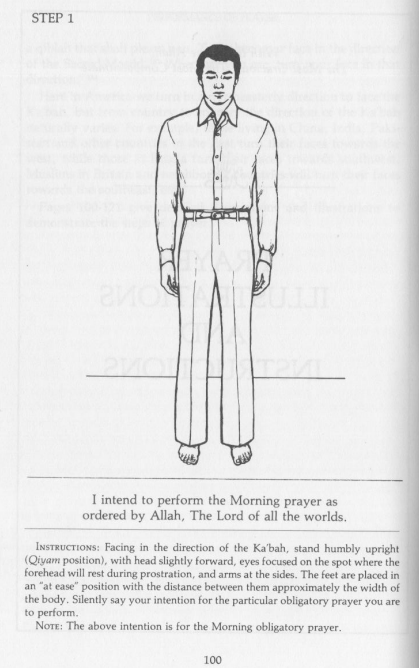 8
8
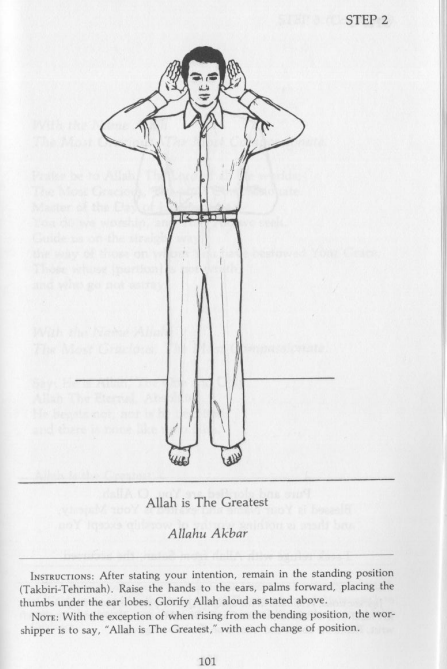
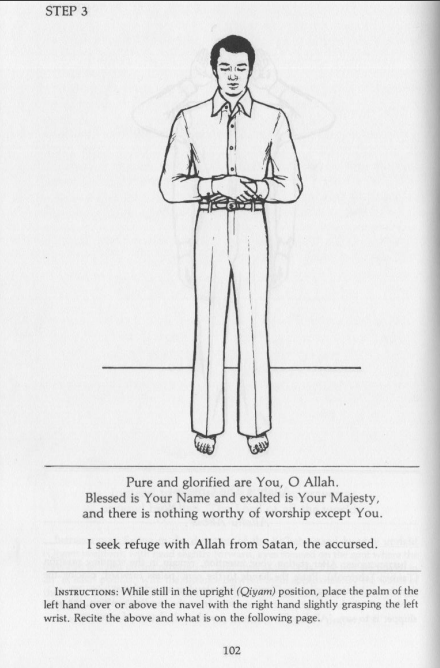
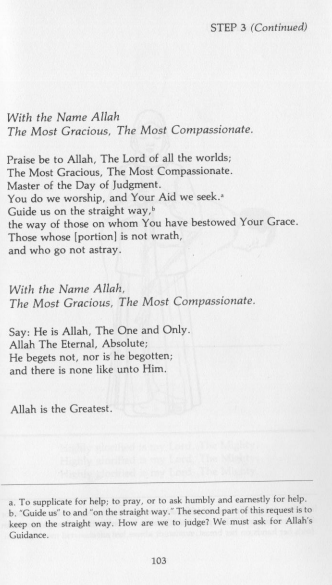
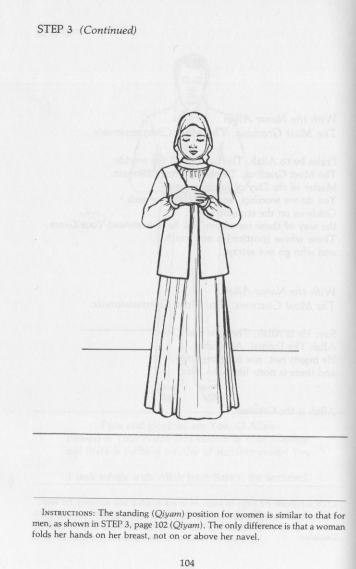
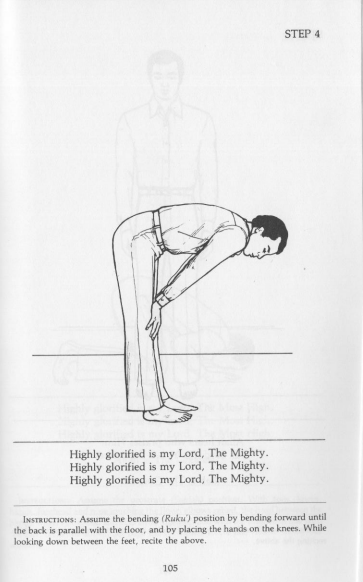
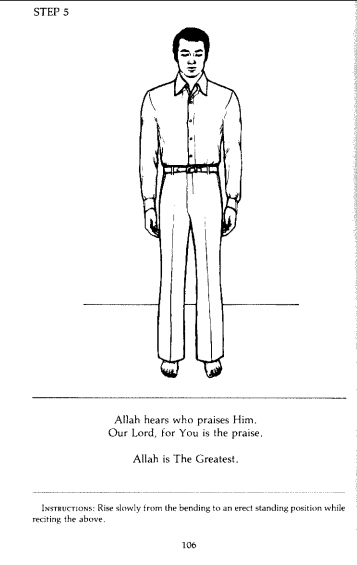
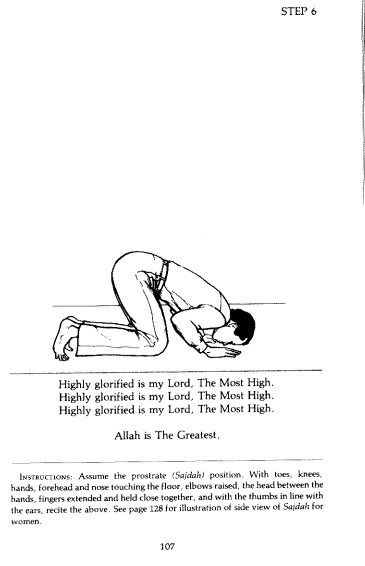
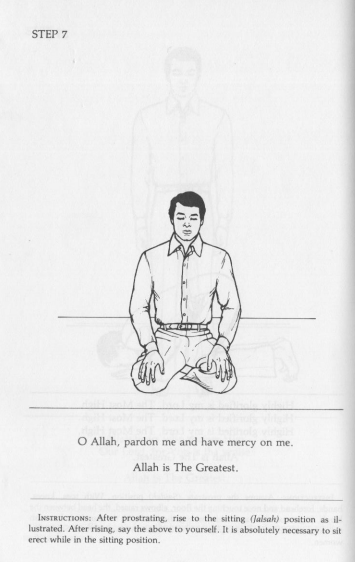
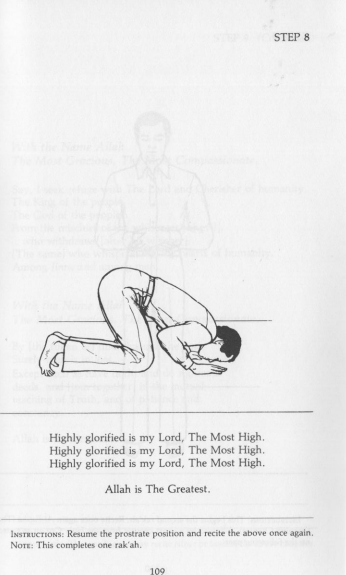
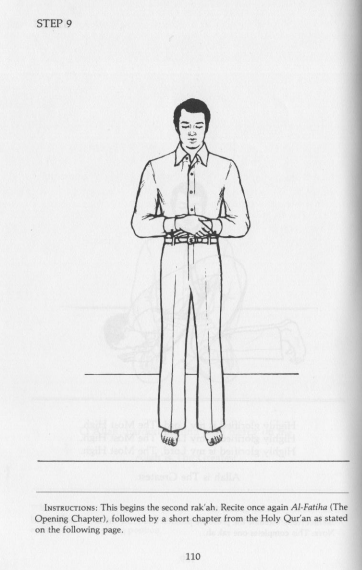
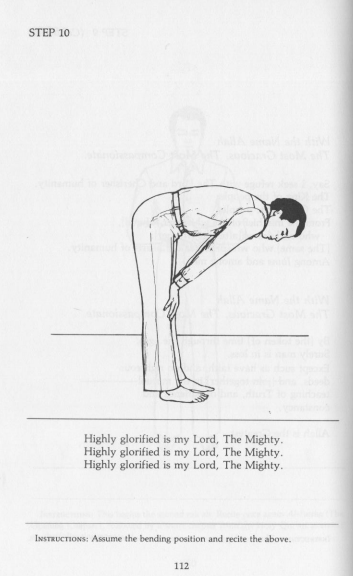
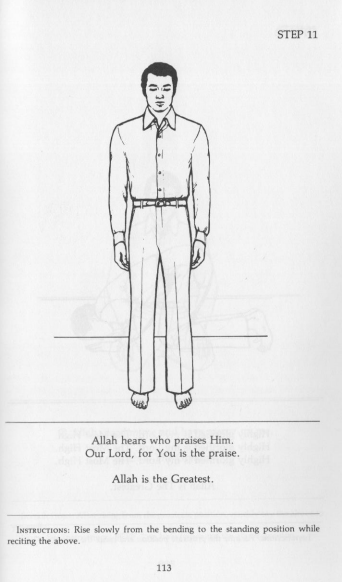
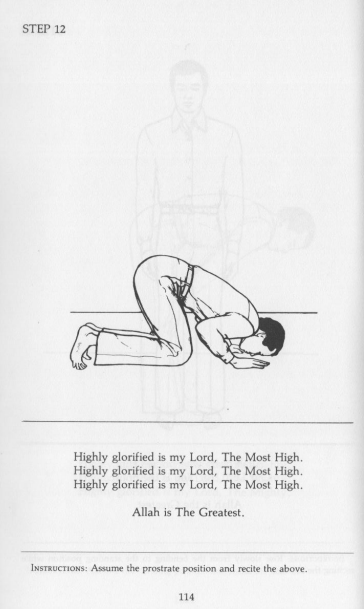
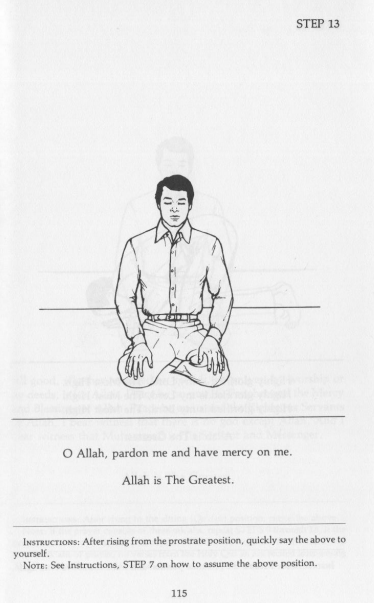
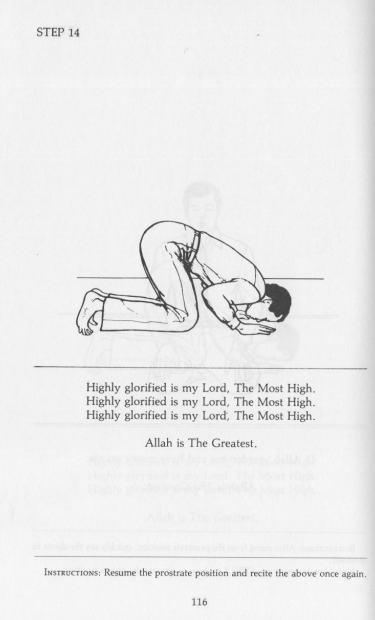
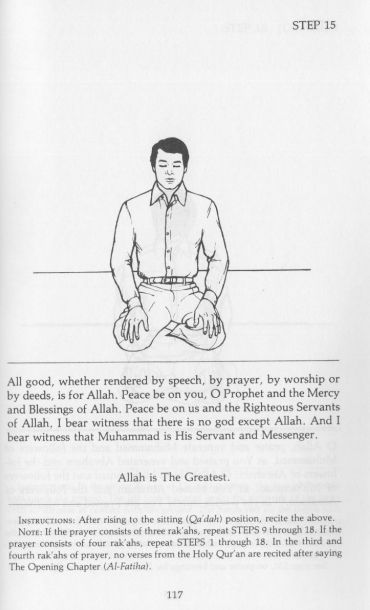
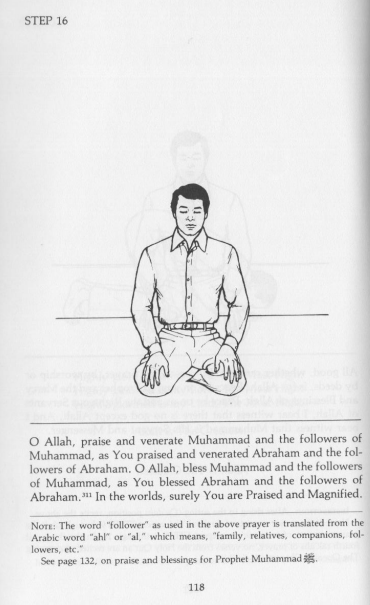
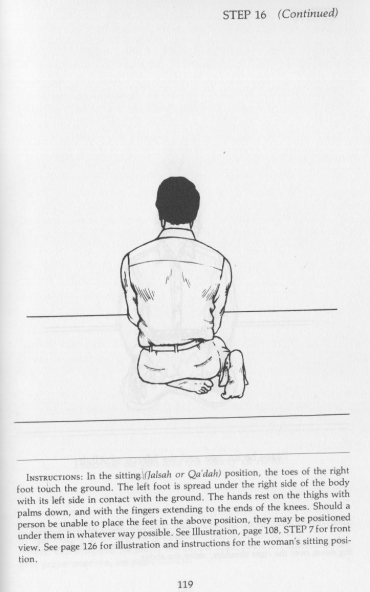
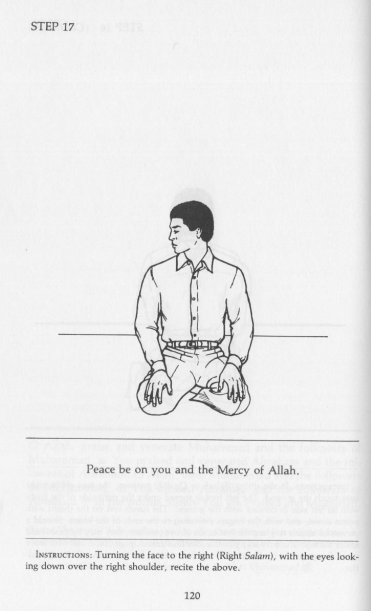
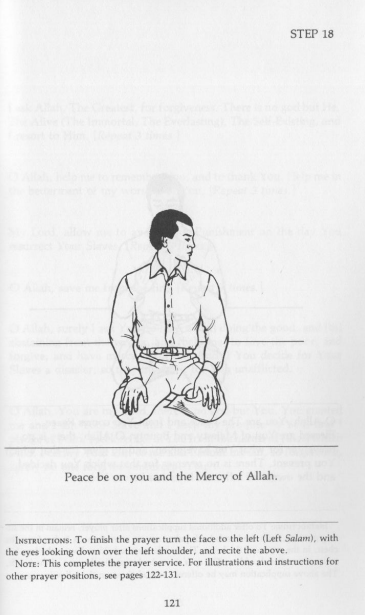
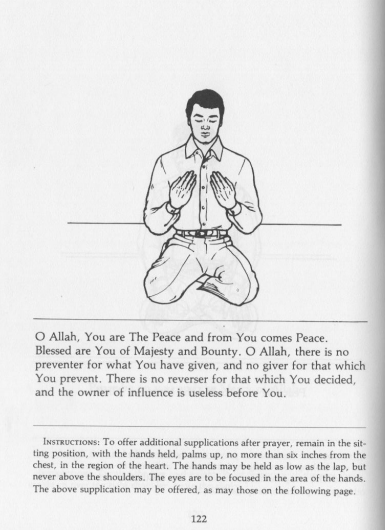
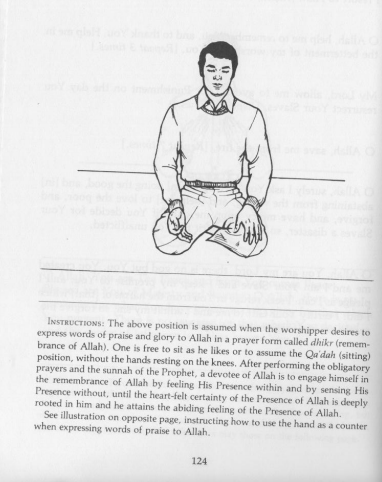
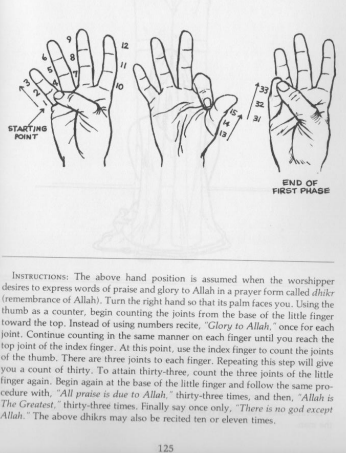
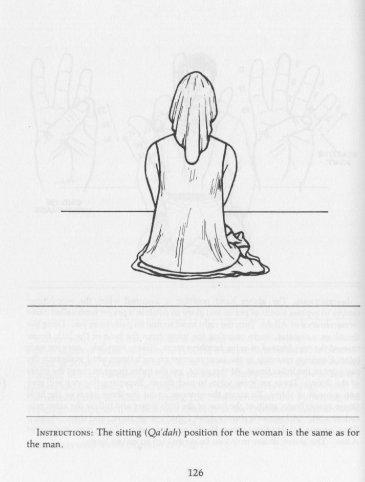
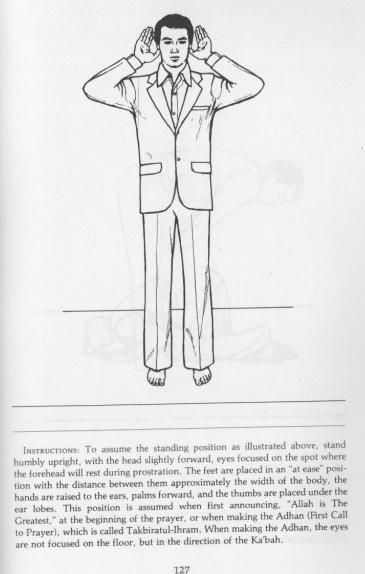
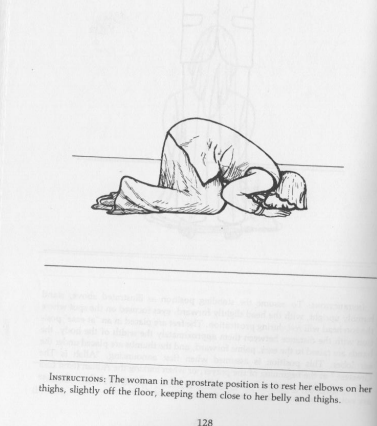
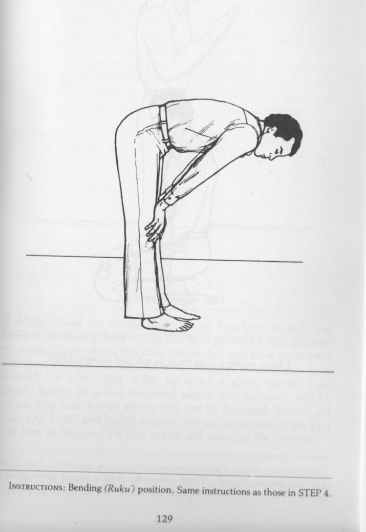
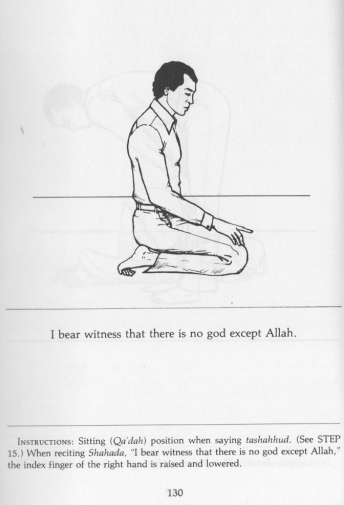
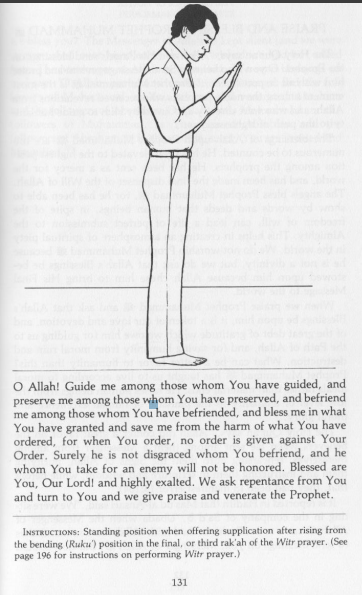 99
STEP 1
STEP 2
I intend to perform the Morning prayer as
ordered by Allah, The Lord of all the worlds.
Allahu Akbar
Instructions: Facing in the direction of the Ka’bah, stand humbly upright
(Qiyam position), with head slightly forward, eyes focused on the spot where the
forehead will rest during prostration, and arms at the sides. The feet are placed in
an "at ease" position with the distance between them approximately the width of
the body. Silently say your intention for the particular obligatory prayer you are
to perform.
Note: The above intention is for the Morning obligatory prayer.
Instructions: After stating your intention, remain in the standing position
(Takbiri-Tehrimah). Raise the hands to the ears, palms forward, placing the
thumbs under the ear lobes. Glorify Allah aloud as stated above.
Note: With the exception of when rising from the bending position, the wor-
shipper is to say, "Allah is The Greatest," with each change of position.
100
101
STEP 3
STEP 3 (Continued)
In the Name Allah
The Most Gracious, The Most Compassionate.
Praise be to Allah, The Lord of all the worlds;
The Most Gracious, The Most Compassionate.
Master of the Day of Judgment.
You do we worship, and Your Aid we seek/
Guide us on the straight way,b
the way of those on whom You have bestowed Your Grace.
Those whose [portion] is not wrath,
and who go not astray.
In the Name Allah,
The Most Gracious, The Most Compassionate.
Say: He is Allah, The One and Only.
Allah The Eternal, Absolute;
He begets not, nor is he begotten;
and there is none like unto Him.
Allah is the Greatest.
Pure and glorified are You, O Allah.
Blessed is Your Name and exalted is Your Majesty,
and there is nothing worthy of worship except You.
I seek refuge with Allah from Satan, the accursed.
Instructions: While still in the upright (Qiyam) position, place the palm of the
left hand over or above the navel with the right hand slightly grasping the left
wrist. Recite the above and what is on the following page.
a. To supplicate for help; to pray, or to ask humbly and earnestly for help.
b. "Guide us" to and "on the straight way." The second part of this request is to
keep on the straight way. How are we to judge? We must ask for Allah s
Guidance.
102
103
STEP 3 (Continued)
STEP 4
Highly glorified is my Lord, The Mighty.
Highly glorified is my Lord, The Mighty.
Highly glorified is my Lord, The Mighty.
Instructions: The standing (Qiyam) position for women is similar to that for
men, as shown in STEP 3, page 102 (Qfyam). The only difference is that a woman
folds her hands on her breast, not on or above her navel.
Instructions: Assume the bending (Ruku) position by bending forward until
the back is parallel with the floor, and by placing the hands on the knees. While
looking down between the feet, recite the above.
104
105
STEP 5
STEP 6
Allah hears who praises Him.
Our Lord, for You is the praise.
Highly glorified is my Lord, The Most High.
Highly glorified is my Lord, The Most High.
Highly glorified is my Lord, The Most High.
Allah is The Greatest.
Allah is The Greatest.
Instructions: Rise slowly from the bending to an erect standing position while
1reciting the above.
Instructions: Assume the prostrate (Sajdah) position. With toes, knees,
hands, forehead and nose touching the floor, elbows raised, the head between the
hands, fingers extended and held close together, and with the thumbs in line with
the ears, recite the above. See page 128 for illustration of side view of Sajdah for
women.
106
107
STEP 7
STEP 8
O Allah, pardon me and have mercy on me.
Allah is The Greatest.
Highly glorified is my Lord, The Most High.
Highly glorified is my Lord, The Most High.
Highly glorified is my Lord, The Most High.
Allah is The Greatest.
Instructions: After prostrating, rise to the sitting (Jalsah) position as il-
lustrated. After rising, say the above to yourself. It is absolutely necessary to sit
erect while in the sitting position.
Instructions: Resume the prostrate position and recite the above once again.
Note: This completes one rak'ah.
108
109
STEP 9
STEP 9 (Continued)
In the Name Allah
The Most Gracious, The Most Compassionate.
Say, I seek refuge with The Lord and Cherisher of humanity.
The King of the people.
The God of the people.
From the mischief of the whisperer [of evil],
who withdraws [after his whisper],
[The same] who whispers into the hearts of humanity.
Among Jinns and among men.
In the Name Allah
The Most Gracious, The Most Compassionate.
By [the token of] time through the ages,
Surely man is in loss,
Except such as have faith, and do righteous
deeds, and [join together] in the mutual
teaching of Truth, and of patience and
constancy.
Allah is the Greatest.
Instructions: This begins the second rak'ah. Recite once again Al-Fatiha (The
Opening Chapter), followed by a short chapter from the Holy Qur’an as stated
on the following page.
Instructions: The worshipper may recite either or both of the above chapters.
110
Ill
STEP 10
STEP 11
Highly glorified is my Lord, The Mighty.
Highly glorified is my Lord, The Mighty.
Highly glorified is my Lord, The Mighty.
Allah hears who praises Him.
Our Lord, for You is the praise.
Allah is the Greatest.
Instructions: Assume the bending position and recite the above.
Instructions: Rise slowly from the bending to the standing position while
reciting the above.
112
113
STEP 12
STEP 13
Highly glorified is my Lord, The Most High.
Highly glorified is my Lord, The Most High.
Highly glorified is my Lord, The Most High.
O Allah, pardon me and have mercy on me.
Allah is The Greatest.
Allah is The Greatest.
Instructions: Assume the prostrate position and recite the above.
Instructions: After rising from the prostrate position, quickly say the above to
yourself.
Note: See Instructions, STEP 7 on how to assume the above position.
114
115
STEP 14
STEP 15
Highly glorified is my Lord, The Most High.
Highly glorified is my Lord, The Most High.
Highly glorified is my Lord, The Most High.
Allah is The Greatest.
All good, whether rendered by speech, by prayer, by worship or
by deeds, is for Allah. Peace be on you, O Prophet and the Mercy
and Blessings of Allah. Peace be on us and the Righteous Servants
of Allah. I bear witness that there is no god except Allah. And I
bear witness that Muhammad is His Servant and Messenger.
Allah is The Greatest.
Instructions: Resume the prostrate position and recite the above once again.
Instructions: After rising to the sitting (Qa'dah) position, recite the above.
Note: If the prayer consists of three rak'ahs, repeat STEPS 9 through 18. If the
prayer consists of four rak'ahs, repeat STEPS 1 through 18. In the third and
fourth rak'ahs of prayer, no verses from the Holy Qur'an are recited after saying
The Opening Chapter (Al-Fatiha).
116
117
STEP 16
STEP 16 (Continued)
O Allah, praise and venerate Muhammad and the followers of
Muhammad, as You praised and venerated Abraham and the fol-
lowers of Abraham. O Allah, bless Muhammad and the followers
of Muhammad, as You blessed Abraham and the followers of
Abraham.311 In the worlds, surely You are Praised and Magnified.
Note: The word "follower" as used in the above prayer is translated from the
Arabic word "ahi" or "al," which means, "family, relatives, companions, fol-
lowers, etc."
See page 132, on praise and blessings for Prophet Muhammad 3^5.
Instructions: In the sitting\(Jalsah or Qa'dah) position, the toes of the right
foot touch the ground. The left foot is spread under the right side of the body
with its left side in contact with the ground. The hands rest on the thighs with
palms down, and with the fingers extending to the ends of the knees. Should a
person be unable to place the feet in the above position, they may be positioned
under them in whatever way possible. See Illustration, page 108, STEP 7 for front
view. See page 126 for illustration and instructions for the woman’s sitting posi-
tion.
118
119
STEP 17
STEP 18
Peace be on you and the Mercy of Allah.
Peace be on you and the Mercy of Allah.
Instructions: Turning the face to the right (Right Salam), with the eyes look-
ing down over the right shoulder, recite the above.
Instructions: To finish the prayer turn the face to the left (Left Salam), with
the eyes looking down over the left shoulder, and recite the above.
Note: This completes the prayer service. For illustrations and instructions for
other prayer positions, see pages 122-131.
120
121
I ask Allah, The Greatest, for forgiveness. There is no god but He,
The Alive (The Immortal, The Everlasting), The Self-Existing, and
I resort to Him. [Repeat 3 times.]
O Allah, help me to remember You, and to thank You. Help me in
the betterment of my worship of You. [Repeat 3 times.]
My Lord, allow me to avoid Your Punishment on the day You
resurrect Your Slaves. [Repeat 3 times.]
O Allah, save me from the fire. [Repeat 7 times.]
O Allah, surely I ask You [to help me in] doing the good, and [in]
abstaining from the wrong, and [help me] to love the poor, and
forgive, and have mercy upon me. And if You decide for Your
Slaves a disaster, so take my spirit for You unafflicted.
O Allah, You are The Peace and from You comes Peace.
Blessed are You of Majesty and Bounty. O Allah, there is no
preventer for what You have given, and no giver for that which
You prevent. There is no reverser for that which You decided,
and the owner of influence is useless before You.
O Allah, You are my Lord, there is no god but You. You created
me and I am Your Slave and I keep my promise to You, and I
pledge as I can. I seek refuge in You from the harms of [that] which
I did. I certify Your Gift to me and I admit my sin, so forgive me,
surely no one forgives sins except You.
Instructions: To offer additional supplications after prayer, remain in the sit-
ting position, with the hands held, palms up, no more than six inches from the
chest, in the region of the heart. The hands may be held as low as the lap, but
never above the shoulders. The eyes are to be focused in the area of the hands.
The above supplication may be offered, as may those on the following page.
122
123
END OF
FIRST PHASE
Instructions: The above position is assumed when the worshipper desires to
express words of praise and glory to Allah in a prayer form called dhikr (remem-
brance of Allah). One is free to sit as he likes or to assume the Qa'dah (sitting)
position, without the hands resting on the knees. After performing the obligatory
prayers and the sunnah of the Prophet, a devotee of Allah is to engage himself in
the remembrance of Allah by feeling His Presence within and by sensing His
Presence without, until the heart-felt certainty of the Presence of Allah is deeply
rooted in him and he attains the abiding feeling of the Presence of Allah.
See illustration on opposite page, instructing how to use the hand as a counter
when expressing words of praise to Allah.
Instructions: The above hand position is assumed when the worshipper
desires to express words of praise and glory to Allah in a prayer form called dhikr
(remembrance of Allah). Turn the right hand so that its palm faces you. Using the
thumb as a counter, begin counting the joints from the base of the little finger
toward the top. Instead of using numbers recite, "Glory to Allah," once for each
joint. Continue counting in the same manner on each finger until you reach the
top joint of the index finger. At this point, use the index finger to count the joints
of the thumb. There are three joints to each finger. Repeating this step will give
you a count of thirty. To attain thirty-three, count the three joints of the little
finger again. Begin again at the base of the little finger and follow the same pro-
cedure with, "All praise is due to Allah, " thirty-three times, and then, "Allah is
The Greatest." thirty-three times. Finally say once only, "There is no god except
Allah." The above dhikrs may also be recited ten or eleven times.
124
125
Instructions: The sitting (Qa'dah) position for the woman is the same as for
the man.
Instructions: To assume the standing position as illustrated above, stand
humbly upright, with the head slightly forward, eyes focused on the spot where
the forehead will rest during prostration. The feet are placed in an "at ease" posi-
tion with the distance between them approximately the width of the body, the
hands are raised to the ears, palms forward, and the thumbs are placed under the
ear lobes. This position is assumed when first announcing, "Allah is The
Greatest," at the beginning of the prayer, or when making the Adhan (First Call
to Prayer), which is called Takbiratul-Ihram. When making the Adhan, the eyes
are not focused on the floor, but in the direction of the Ka'bah.
126
127
Instructions: The woman in the prostrate position is to rest her elbows on her
thighs, slightly off the floor, keeping them close to her belly and thighs.
Instructions: Bending (Ruku) position. Same instructions as those in STEP 4.
128
129
I bear witness that there is no god except Allah.
O Allah! Guide me among those whom You have guided, and
preserve me among those whom You have preserved, and befriend
me among those whom You have befriended, and bless me in what
You have granted and save me from the harm of what You have
ordered, for when You order, no order is given against Your
Order. Surely he is not disgraced whom You befriend, and he
whom You take for an enemy will not be honored. Blessed are
You, Our Lord! and highly exalted. We ask repentance from You
and turn to You and we give praise and venerate the Prophet.
Instructions: Sitting (Qa'dah) position when saying tashahhud. (See STEP
15.) When reciting Shahada, "I bear witness that there is no god except Allah,"
the index finger of the right hand is raised and lowered.
Instructions: Standing position when offering supplication after rising from
the bending (Ruku) position in the final, or third rak'ah of the Witr prayer. (See
page 196 for instructions on performing Witr prayer.)
130
131
PERFORMANCE OF PRAYER
PERFORMANCE OF PRAYER
PRAISE AND BLESSING PROPHET MUHAMMAD jg
The Holy Qur'an says, "Allah and His Angels send blessings on
the Prophet. O you who believe! Send blessings on him and praise
him with all respect (33:56)." Prophet Muhammad is the most
eminent among the noble prophets who received revelations from
Allah, and who were directly appointed by Him to guide humani-
ty to the path of righteousness.
The blessings of Allah upon Prophet Muhammad Sg are too
numerous to be counted. He has been elevated to the highest posi-
tion among the prophets. He has been sent as a mercy for the
world, and has been made the final dispenser of the Will of Allah.
The angels bless Prophet Muhammad 5W, for he has been able to
show by words and deeds that human beings, in spite of the
freedom of will, can lead a life of perfect submission to the
Almighty. This helps in creating an atmosphere of spiritual piety
in the world. We do not worship Prophet Muhammad sg because
he is not a divinity, but we do ask that Allah's Blessings be be-
stowed upon him because Allah chose him to bring His Final
Message to the world.
When we praise Prophet Muhammad and ask that Allah's
Blessings be upon him, it is a token of our love and devotion, and
of the great debt of gratitude which we owe him for guiding us to
the Path of Allah, and for saving humanity from moral ruin and
destruction. What can be a better favor to humanity than this?
Prophet Muhammad 5® has taught us to live according to moral
ideals rather than material ends. He raises human beings from the
low level of animality to the pinnacle of human excellence and
moral glory.
The Holy Qur'an says, "Allah did confer a great favor on the
believers when He sent among them a Messenger from among
themselves, rehearsing unto them the Signs of Allah, purifying
them and instructing them in scripture and wisdom, while before
that, they had been in manifest error (3:164)."
It is reported in Hadith that Mas'ud al-Ansari said, "We were sit-
ting in the company of Sa'd b. 'Ubada when the Messenger of
Allah St came to us. Bashir b. Sa'd said, 'Allah has commanded us
to send blessings on you, Messenger of Allah St! But how should
we bless you?' The Messenger of Allah St kept silent [and we were
so perturbed over his silence] that we wished we had not asked
him. The Messenger of Allah jg then said, '[To send blessings on
me] say, 'O Allah, praise and venerate Muhammad and the fol-
lowers of Muhammad, as You praised and venerated Abraham
and the followers of Abraham. O Allah, bless Muhammad and the
followers of Muhammad, as You blessed Abraham and the
followers of Abraham.311 In the worlds, surely You are Praised and
Magnified.""
132
133
In the Name Allah,
The Most Gracious, The Most Compassionate
In the Name Allah,
The Most Gracious, The Most Compassionate
Positioning in Congregational prayer.
CONGREGATIONAL PRAYER
And be steadfast in prayer, practice regular charity; and
bow down your head with those who bow down |to
Allah].183
Before Allah we all stand shoulder to shoulder, regardless of our
station in life, showing our gratitude and appreciation for the
many blessings that He continually bestows upon us. In Al-Islam
all are servants before Allah, regardless of social status. During
prostration the rich and the poor, the lettered and unlettered, the
ruled and the ruler all lay their heads at the feet of one another.
The feeling of brotherhood and humililty which results becomes a
part of our being and makes us better people in our daily lives.
Congregational prayer contributes to individual development,
as well as to the development of a unified society. In stressing the
importance and benefit of congregational prayer Prophet Muham-
mad sg said, "Prayer said in congregation is twenty-seven degrees
more excellent than prayer said by a single person.''18'1
Regular participation in congregational prayer strengthens and
sustains the believers in their religion. It is only right that we
should devote our minds completely to approaching Allah in a
134
135
CONGREGATIONAL PRAYER
CONGREGATIONAL PRAYER
spirit of reverence. Prayer teaches punctuality and builds charac-
ter. In addition, congregational prayer in Al-Islam is a powerful
force for the unification of humanity. When we enter the masjid,
we enter an atmosphere which makes us aware of our duty to re-
spect others, and which emphasizes the equality of all people.
The congregational prayer must be led by an Imam. Because the
Imam follows the footsteps of Prophet Muhammad sg, he must be
chosen with care. According to tradition he must be an adult male,
the most God-conscious among the people, and the most
knowledgeable and understanding of the Holy Qur'an and Hadith.
He must teach the message of the Holy Qur'an and Hadith, and he
must practice what he teaches. If some persons are equal in these
qualities, the one most knowledgeable in the Law of Al-Islam
should be selected. If some are equal in these, the one selected
should be the eldest among those who meet the above qualifica-
tions. 185
The Imam should be a person who is beloved and respected by
the people, who is free of any repulsive disease, who does not
commit any major sins and whose morals are the best among the
people. He must be a compassionate, sympathetic person, and he
should not unduly prolong the prayer service.186
When assembling for the congregational prayer, the first person
who enters the masjid should be seated facing in the direction of
the Ka'bah, directly behind the spot where the Imam stands
(mihrab)187 when leading prayer, and when delivering his Friday
(Jumu'ah) speech. The other persons coming for the service are to
form a line to the first person's right. Once this line has extended to
its limit, other members of the congregation line up to his left.
Each subsequent row is formed by following the same procedure.
If the Imam is late, a member of the congregation takes his place
and begins the prayer service.
If one enters a masjid for congregational prayer and finds the
front row filled, he should take an available place in a line to the
rear. Regardless of wealth, rank or political position, no one can
come in and take another's place. He or she must stand where a
place is available. This includes the resident Imam, if he joins the
prayer service after it has started. If a space should become
available, it should be filled immediately by someone from the
row behind it. A person should not perform congregational prayer
standing alone. If all rows are filled, he should form another row
in back by gently drawing someone from the row in front of him.
The minimum number of people needed to form a congregation
is two. When only two people are present at the time of prayer one
acts as Imam and leads the prayer while the other follows. The
person following stands behind the Imam and to his right. Should
a third person join after the prayer service has started, he should
(without talking) motion to the first follower to move back so that
they can form a row behind the Imam.
The people who follow the Imam in the congregational prayer
service are called followers (muqtadin), and their discipline is so
perfect that they are bound to follow him even though he may
make a mistake. Should the Imam make a mistake the followers
have a right to point it out. In such a case someone in the line
behind him should say, "Glory be to Allah (Subhana-llah)."188
However, the Imam is the final judge of any alleged mistakes, and
the followers, after having pointed out such, must continue to
follow him.
To announce that the congregational prayer is ready to begin,
someone, usually the Mu'adhdhin, will stand and announce the
Second Call (Iqamah). After the phrase, "Prayer is commencing,"
the members of the congregation stand, form their lines and
assume the proper position for prayer.
In Al-Islam we are one body, so we form our lines as straight as
possible.185 We stand shoulder to shoulder in one or more rows
(with our feet forming straight lines). Each person's arm should
lightly touch the arm of the person standing next to him. The feet
should be in an "at ease" position, and the distance between them
should approximate the width of the body at chest and shoulder
level. They should not be so far apart as to make it impossible for
the arms to touch the next person on the right or left (see illustra-
tion, page 134). The distance between the Imam and the first row,
and between the subsequent rows, is enough to allow everyone to
assume the prostrate position without having their heads touch the
feet of those in front of them.
After the congregation has been properly aligned, the Imam
makes the intention and then begins the service by raising both
136
137
CONGREGATIONAL PRAYER
CONGREGATIONAL PRAYER
hands to his ears and announcing in a loud voice, "Allahu Akbar
(Allah is The Greatest)." Following his lead, the members of the
congregation raise their hands to their ears and repeat to
themselves in a low voice, "Allah is The Greatest." The prayer of
anyone who neglects the responsibility of following the Imam in
the first pronouncement of "Allah is The Greatest," will not be
valid.
With each change of position, except when rising from the bend-
ing position, the Imam will say, "Allah is The Greatest." This pro-
nouncement is repeated by the congregation in a very low voice.
The congregation is never to say, "Allah is The Greatest," or
change position before the Imam.190 When the Imam says, "Allah
is The Greatest," one of those following him is to say it loudly only
if passing the signal to others who cannot hear it. (The signal
should be passed on until everyone in the congregation hears it.)
The Imam then recites silently, "Pure and glorified are You, O
Allah, Blessed is Your Name and exalted is Your Majesty, and
there is nothing worthy of worship except You. I seek refuge with
Allah from Satan, the accursed." He then recites The Opening
Chapter of the Holy Qur'an. At its conclusion, when he says, "Nor
of those who go astray," the congregation says, "Amen," in a low
voice. The Imam will then recite a chapter or excerpt from the Ho-
ly Qur’an, after which he will again say, "Allah is The Greatest,"
and assume the bending position, followed by the congregation.
While in the bending position the Imam recites silently three times
or more, "Highly glorified is my Lord,-The Mighty." He then rises
slowly. While rising he says aloud, "Allah hears him who praises
Him." The congregation, while rising slowly to the standing posi-
tion, responds in one low voice, "Our Lord, for You is the Praise."
The Imam repeats the same to himself silently.
After rising to the standing position the Imam will say, "Allah is
The Greatest," and assume the prostrate position. While in the
prostrate position he silently says, "Highly glorified is my Lord,
The Most High," three times or more. He then repeats audibly
while rising, "Allah is The Greatest," followed by the congrega-
tion. Next, he rises to the sitting position. While sitting he says
silently, "O Allah, pardon me and have mercy on me." After
assuming the sitting position for a brief moment he repeats
audibly, "Allah is The Greatest," resumes the prostrate position,
and repeats silently three times, "Highly glorified is my Lord, The
Most High." He once again announces audibly, "Allah is The
Greatest," and returns to the standing position. The congregation
follows the Imam's lead in all changes of position. It is best to
make the pronouncement, "Allah is The Greatest," throughout the
lull time of movement while changing positions.
This procedure is also followed in the second rak'ah, except that
after saying, "Allah is The Greatest," the fourth time in the pro-
strate position, the final sitting position is assumed to finish the
prayer. While sitting the Imam silently recites Tashahhud:191
All good, whether rendered by speech, by prayer, by worship
or by deeds, is for Allah. Peace be on you, O Prophet, and the
Mercy and Blessings of Allah. Peace be on us and the righteous
Servants of Allah. I bear witness that there is no god except Allah.
And I bear witness that Muhammad is His Servant and Messenger.
O Allah, praise and venerate Muhammad and the followers of
Muhammad, as You praised and venerated Abraham and the fol-
lowers of Abraham. O Allah, bless Muhammad and the followers
of Muhammad, as You blessed Abraham and the followers of
Abraham.311 In the worlds, surely You are Praised and Magnified.
The Imam finishes the prayer by turning his face to the right and
saying audibly, "As-salamu 'alaykum wa rahmatullah (Peace be
on you and the Mercy of Allah)." He then turns his face to the left
and repeats the same. This procedure is followed by the congrega-
tion, and it completes the two rak'ahs of the Dawn or Jumu ah
prayer service. After turning his face to the left and saying, Peace
be on you and the Mercy of Allah," the Imam will usually make a
supplication. This ends the obligatory prayer service.
After the Noon, Sunset and Night prayers are concluded, each
worshipper should separately perform a prayer of two or four
rak'ahs in the manner of Prophet Muhammad sg. Preferably, he
or she should not pray in the same spot in which the congrega-
tional prayer was performed.192
Every member of the congregation must make his or her inten-
tion before following the Imam in prayer. Any person who joins
the congregational prayer after it has started should make his in-
tention in the standing position. He should say silently, or very
139
138
CONGREGATIONAL PRAYER
CONGREGATIONAL PRAYER
softly, "I intend to perform the (name of) obligatory prayer as
ordered by Allah, the Lord of all the worlds." While still in the
standing position he then puts his hands to his ears and says,
"Allah is The Greatest," before joining the Imam in the prayer ser-
vice.
If the Imam is in the standing or bending position when a wor-
shipper joins, the worshipper will be credited for performing a
complete rak'ah of prayer. If the worshipper joins after the Imam
has finished the bending position, the worshipper will be con-
sidered to have missed the rak'ah. Any rak’ahs missed are to be
made up. When the Imam turns his face to the right and says, "As-
salamu 'alaykum wa rahmatullah (Peace be on you and the Mercy
of Allah)," the worshipper making up for missed rak'ahs stands
and offers them without offering the salams with the Imam.
Only if one has a valid Islamic reason may he be excused from
offering the obligatory prayers in congregation (see Essentials). In
such a case he will be allowed to perform them alone at their stated
times. Such permission is generally granted to the blind and the in-
firm, and to those who are hindered by unfavorable conditions
such as severe weather.193
Although women are not obligated to perform the daily con-
gregational prayers in the masjid, they are not forbidden to do so,
and they will be greatly benefited by participating in them when-
ever possible. Because of the protection of women in certain Mus-
lim countries, some people have questioned their right to attend
the masjid for prayer services. During the lifetime of Prophet
Muhammad 5g women freely participated in religious services. It
is reported that Prophet Muhammad 5§ said, "If the wife of any-
one of you asks permission (to go to the masjid],194 do not forbid
her." Prophet Muhammad also told his followers, "Don’t pre-
vent the female slaves of Allah from [attending] the masjid."195
When women and children are in attendance for the congrega-
tional prayer, they are to form separate rows at the rear of the
masjid. Children are to stand behind the men, and women must
stand behind the children.196 If there is only one woman in atten-
dance, she may stand alone behind the children. There are many
Hadiths which tell of women forming rows in back of men, and of
men retaining their seats until the women had left the prayer area
(musalla).197
The fact that women stand behind men is in no way meant to
imply an inferior status. This rule was created to prevent distrac-
tions which could detract from the performance and effectiveness
of the prayer service. No Muslim, man or woman, is allowed to
touch the body of a member of the opposite sex during prayer. If
men and women stand side by side in prayer they cannot possibly
avoid touching each other. Furthermore, if a woman is praying in
front of, or beside a man, it is very likely that some part of her
body may become uncovered in the course of changing positions.
In such a circumstance the man may observe the exposed part of
the woman's body, causing embarrassment to both, and creating a
distraction that could possibly lead to evil thoughts. To help the
followers concentrate their thoughts on prayer to Allah, The Most
High, Al-Islam has ordained separate sections for men and
women.
When only women are present it is permissible for them to hold
prayer with a female leading the service. The woman who leads
the service stands in the middle of the first row, one step in front of
the others.
A man may lead a congregation of women in prayer. However,
he may not lead one woman when no other men or women are
present, unless she is one whom it is unlawful for him to marry,
i.e., his mother, sister, etc.
THE FRIDAY PRAYER
(Salatul Jumu'ah)
The Holy Qur'an says, "O you who believe! When the call is
proclaimed to prayer on Friday [the day of assembly], hasten
earnestly to the remembrance of Allah, and leave off selling and
buying [business and traffic]. That is best for you if you but knew!
And when the prayer is finished, then may you disperse through
the land and seek the Bounty of Allah, and remember Allah often
[and without stint] that you may be prosperous."198
While most nations and religions set apart a special day of the
140
141
CONGREGATIONAL PRAYER
CONGREGATIONAL PRAYER
week for Divine Service, such as the sabbath for the worship of
Allah, every day is a day of worship in Al-Islam. However, there
is a time set aside during the week when all members of the Muslim
community are required to observe a lecture and prayer. That time
is Friday afternoon. All over the world Muslims of all ranks, na-
tionalities and classes join together at the masjids in their respec-
tive communities for a special Friday (Jumu'ah) prayer service.199
Though the Friday prayer service is a congregational prayer per-
formed during the period for the Noon prayer, it differs from the
ordinary congregational prayer in several ways. A special feature
of the Friday service is the khutbah, a speech in two parts which is
delivered by the Imam before the prayer is performed. For or-
dinary congregational prayer only two persons are necessary, but
for the Friday service, it is the opinion of some scholars that at
least twelve adult males besides the Imam are needed.
When attending the masjid for the Friday prayer, one should be
in a state of ablution. A complete bath is also a must for all who
attend the service.200 One should arrive at the masjid on Friday
before the Adhan, early enough to perform a prayer of two
rak'ahs before the Imam begins his khutbah.201
After the people have assembled in the masjid, the Mu’adhdhin
makes the Adhan. After the Adhan is finished, the Imam, who is
sitting, rises and delivers the first part of his khutbah. The
members of the congregation are enjoined to remain seated and
silent during the time the Imam is talking. It should be so quiet that
it seems as though the masjid is empty except for the feeling of
light and the spirit of brotherhood. Prophet Muhammad jg,
speaking on the importance of remaining silent during the Friday
khutbah said, "Whenever the Imam is delivering the khutbah, it is
essential for the audience to keep quiet and listen."202 Prophet
Muhammad sg also said, "If the Imam gives [a] khutbah, [you
should be quiet] so you can hear.''203
After the Imam finishes the first part of his khutbah, he sits
down for a few moments and offers supplication. At this time the
members of the congregation join him and offer their own private
supplications to Allah. After the Imam finishes his supplication, he
rises and delivers the second part of his khutbah. When he
finishes, someone in the congregation, usually the Mu'adhdhin,
stands and announces the Iqamah. At this time the congregation
stands and follows the Imam as he audibly offers the obligatory
prayer of two rak'ahs.
Muslims are drawn together by one force in their lives: the will
to obey and worship Allah. The coming together of Muslims as
members of one humanity first begins within our families and
communities and it grows as we become more aware of our
membership in a universal society based on one truth: There is no
god except Allah, and Muhammad is His Servant and Messenger.
The sequence of prayer services which brings Muslims together
regularly in Al-Islam did not occur by chance. It illustrates the
way Allah intends for humanity to grow. Muslims come together
to pray five times a day in the local masjid; once a week on Friday
for the Jumu'ah prayer service in the largest masjid in the com-
munity; during the Festival of Fastbreaking ('Idul-Fitr), which
comes at the end of Ramadan; during the Festival of Sacrifice
fldul-Adha), which comes at the end of the Pilgrimage to Mak-
kah; and during the Pilgrimage itself when Muslims from through-
out the world come together in the Sacred Masjid to worship Allah
in the spirit of peace and brotherhood. We are taught in the Holy
Qur'an, "Verily, this Brotherhood of yours is a single Brother-
hood, and I am your Lord and Cherisher: therefore serve Me [and
no other]."204
As Muslims we believe in the Oneness of Allah and the unity of
humanity, and we work together to achieve human dignity for all
people of the world. Allah is the only Truth and the only Reality
that can bring everybody together, pulling them from their fanati-
cal nationalism and racism. Al-Islam gives us a concept of human
dignity which embraces the whole world, and which brings every-
body to a plane of freedom, justice, and equality.
We need equality between Muslims and non-Muslims (Chris-
tians, Jews and others) in order to have peace on earth. In the Holy
Qur'an Allah tells us the conditions necessary for equality: "That
we worship none but Allah. That we associate no partners with
Him. That we erect not from among ourselves lords and patrons
other than Allah (3:64)."
Allah demands that we all respect the laws of social justice and
that we adopt a frame of mind which allows us to accept each
143
142
CONGREGATIONAL PRAYER
CONGREGATIONAL PRAYER
other and to do right by each other, so that we will not have im-
perialism, slavery, or racial discrimination. The people of the
world should demand a dialogue on divinity in religion between
their religious leaders. We must not worship Moses, Jesus or
Muhammad sg. We must invite all people to come into Allah's
Mercy and Blessings on terms of equality.
REGULATIONS RELATING TO JUMU'AH PRAYER
FORBIDDEN ACTS
Saying anything such as, "Allahu Akbar,” or "That's right," etc.,
during the Imam's lecture (khutbah). 205 It is permissible to say, "Al
Hamdulillah," silently.
Acting restless.
Eating or drinking.
Chewing gum.
Turning attention from the Qiblah.
Starting a non-obligatory prayer after one has sat down, once
the Imam begins his khutbah. When one enters during the khut-
bah, he can greet the masjid by praying two rak'ahs.208 If the
Imam sits down before the worshipper finishes his non-obligatory
prayer, the prayer may be continued, but it must be shortened.
Buying or selling anything from the time of the Adhan until the
end of the prayer.207 Any contract made during this period is void.
Starting travel at the time of the Jumu'ah prayer.
REASONS FOR NOT ATTENDING
Dangerous weather, i.e., very heavy rain which creates quag-
mires, etc.208
Sickness.
Having to attend to a close relative who is critically ill, such as
one's wife, etc.
Being fearful of going out because of the possibility of being
beaten, injured, captured or killed.
Blindness, if one has no guide to take him to the masjid.209
UNDESIRABLE ACTS
Wearing tight-fitting pants which show the imprint of the pri-
vate parts of the body.
Wearing any style or quality of clothing out of vanity. (Being
proud, which is forbidden in Al-Islam, is a major root for wrong
actions.) A woman is not to wear clothing that exposes her figure,
breasts, or any parts of her body other than the hands or face.210
Women are not to dress as men, nor are men to wear the attire of
women. If a woman wears slacks, she should wear an over-
garment which extends at least to the middle of the calf. Allah says
to Prophet Muhammad jg in the Holy Qur'an, "And say to the
believing women that they should lower their gaze and guard their
modesty; that they should not display their beauty and ornaments
except what [must ordinarily] appear thereof (Holy Qur'an
24:31).'' In the Holy Qur'an Allah also tells Prophet Muhammad
, "O Prophet! Tell your wives and daughters and the believing
women, that they should cast their outer garments over their per-
sons [when in public]. That is most convenient, that they should
be known [as such; and not molested. And Allah is Oft-Forgiving,
Most Merciful (33:59)."
Stepping over others before the Imam sits down to begin his
khutbah, unless one is taking an available space nearby.211
Sitting with the feet pointing in the direction of the Ka'bah.
Traveling after Fajr prayer on Friday.
Closing one's business on Friday for reasons other than to attend
the Jumu'ah service.
It is undesirable for a woman to attend the prayer service with
the deliberate intention of causing men to be distracted. Women
are to avoid doing anything which may be considered seductive,
such as wearing loud makeup, perfume, etc. Any woman blessed
by Allah with beauty which she knows will distract men should
seek a secluded place in the masjid.
144
145
In the Name Allah,
The Most Gracious, The Most Compassionate
THE 'ID FESTIVALS
In Al-Islam there are two great festivals of profound significance
for all Muslims. Both go under the name, 'Id,212 which means a
recurring happiness, and both are connected with the performance
of duty in the service of Allah. These festivals commemorate
remarkable achievements in the life of the individual, and the
rituals associated with them symbolize the aspirations of the
universal man.
The first festival is known as the Festival of Fastbreaking (Tdul-
Fitr). It is celebrated to commemorate the completion of the month
of Ramadan (during which fasting is obligatory for all Muslims
who are able), and it represents a personal victory of the spiritual
man over his blind, unrestrained appetites (desires and sensual
urges). The second is known as the Festival of Sacrifice ('Idul-
Adha), and it represents something greater than personal victory;
the victory of the social man, which is symbolized in the
Pilgrimage (Hajj) to Makkah.
The Festival of Sacrifice also commemorates the great act of
devotion performed by Prophet Abraham in showing his will-
ingness to sacrifice his son, Ishmael. By so doing he proved his
devotion to Allah to be complete. Instead of allowing Prophet
Abraham to sacrifice Ishmael, Allah revealed to him a lamb to be
given in a feast for the poor. The lesson conveyed by these events
is twofold: Allah is Merciful and Just; and the proof of devotion to
Him is justice and kindness toward all members of society.
Each ’Id is a day of achievement for the faithful believer who
147
THE ID FESTIVALS
THE ID FESTIVALS
observes the duties that are associated with it. Once he has
developed the ability to control himself and to discipline his
desires in order to please Allah, he can begin to enjoy the benefits
of a disciplined life. As his discipline becomes stronger, he will
hopefully become free from sin, fear, cowardice, vice, indecency,
jealousy, racism, greed, selfishness and all other forms of spiritual
enslavement.
The Holy Qur'an says, "By no means shall you attain
righteousness unless you give [freely] of that which you love."213
This is an eye opener to aid us along our path of personal struggle
against the opposition which comes to us from ourselves. Prophet
Muhammad jg said, "Surely Allah does not look to your image
and your wealth, but He looks to your hearts and your actions."214
The condition of a person's life in this world and the next depends
on the state of his heart. Until we can manage to be truthful within
our hearts, there is no hope for us. If we can put our hearts in the
right state we will have salvation.
Each 'Id is a day of forgiveness, and a day to show devotion to
Allah through prayer and praise of Him. During the congrega-
tional prayer which accompanies each 'Id, the Muslim who prays
sincerely and wholeheartedly for forgiveness and strength of faith
is assured Allah's Mercy. This spirit of mercy spreads among the
members of the community. In such a spiritual assembly any true
Muslim would feel ashamed before Allah to have enmity or ill feel-
ings towards others. He would find the strength in his heart to
forgive those who may have wronged him. Each 'Id, like each Fri-
day, is a day to pray for the deceased215, to visit their graves (to of-
fer Al-Fatiha and to ask forgiveness for them), to give consolation
to the grief stricken and to visit the sick to cheer them up. Thus the
remembrance of Allah on these days transcends all limits and
covers all aspects of human life.
The Festival of Fastbreaking takes place during the daylight
hours, immediately after the month of Ramadan.216 It was during
Ramadan that Allah began to bless Prophet Muhammad sg with
the Revelation of the Holy Qur'an, which was sent to correct and
complete the message of the previous scriptures. The Holy Qur'an
says, "The month of Ramadan in which was revealed the Holy
Qur'an, a guidance for mankind, and clear proofs of the guidance,
and the Criterion [of right and wrong]. And whosoever of you is
present, let him fast the month, and whosoever of you is sick or on
a journey, [let him fast the same] number of other days. Allah
desires ease for you; He desires no hardship for you, and [He
desires] that you should complete the period, and that you should
amplify praises of Allah for having guided you, and that perhaps
you may be thankful."217
To show our appreciation for the gift of renewed and purified
knowledge with which Allah has blessed the world, Muslims tradi-
tionally read the entire Holy Qur'an during Ramadan. Each day
we are to read one thirtieth of the Book so that we may complete it
within thirty days. Reading the Holy Qur'an in this manner pro-
vides us with additional blessings. The time, effort and attention
we give to understanding the truth within the Book give us the
reward of increased knowledge. Because the Holy Qur'an is the
greatest Book of truth, we receive more blessings by reading it dur-
ing Ramadan than we receive during any other month of our lives.
Fasting during the month of Ramadan trains us to control our
unbridled appetites so that we can present ourselves to Allah as
obedient, clean and upright people. Fasting did not begin with
Prophet Muhammad B. It was practiced by Jesus, Moses and the
rest of Allah's Prophets. Ramadan, which lasts for twenty-nine or
thirty days,218 is a month for purifying the human biological and
spiritual appetites. Just as the Holy Qur'an represents a purifica-
tion of the scriptures, the Ramadan fast represents the require-
ments necessary in our private lives for maintaining a stable and
decent society.
Allah, The Most High, told Prophet Muhammad $?., "Every act
of the son of Adam is for himself except fasting. It is surely for Me,
and 1 will give a reward for it. Fasting is a shield. When any one of
you is fasting on a day, he should neither indulge in obscene
language, nor raise his voice. If anyone reviles him or tries to quar-
rel with him, he should say, 'I am a person who is fasting.' By Him
in Whose Hand is the life of Prophet Muhammad 0%, the breath of
the observer of fast is sweeter to Allah on the Day of Judgment
than the fragrance of musk. The one who fasts has two [occasions]
of joy. When he breaks the fast, he is glad with the breaking of [the
fast], and when he meets his Lord, he is glad with his fast."21’
148
149
THE ID FESTIVALS
THE 'ID FESTIVALS
We do not fast to please ourselves or society, but to please
Allah. The Holy Qur'an says that the bond with Allah is the only
bond to insure all other bonds. It also says, ". . .Fasting is
prescribed to you as it was prescribed to those before you, that
you may [learn] self-restraint."220 Thus, fasting keeps us from
becoming enslaved to our carnal desires, and it helps us to control
our lives.
Throughout world history all societies that have come into real
religious experiences, whether they have been primitive or ad-
vanced, have begun by first trying to discipline the forces of their
individual spirituality. The victory over human appetites, which is
the primary message of the Ramadan fast and the festival that
follows, is a victory which brings us into clearer spiritual knowl-
edge and understanding. Muslims gather together on the blessed
day of the Festival of Fastbreaking to give praise and thanks to
Allah for the Holy Qur'an. The Light of Revelation given to Pro-
phet Muhammad brings the world into full understanding of
the life that Allah ordained for us. We thank Allah for providing
guidance designed to unite man on the principles of justice, peace,
equality, devotion to One God, and the doing of good to our
fellow man.
While celebrating the great 'Id festivals a Muslim attends the
Islamic prayer.221 He is also enjoined to remember and help his less
fortunate brothers and sisters through the giving of charity. On
the occasion of the Festival of Fastbreaking Muslims are required
to pay a tax known as Sadaqatul Fitr.222 This tax was organized
during the lifetime of Prophet Muhammad sgj, and it is imposed on
every individual who can afford it, whether they are male or
female, young or old (tax for the young must be paid by a parent).
Sadaqatul-Fitr must be paid prior to the prayer service223 so that
the less fortunate who are sincerely in need will be able to witness
the day in a festive and cheerful spirit. Any charity given after the
prayer service is not considered to be Sadaqatul Fitr.224
In his 'Id sermons, Prophet Muhammad jg urged Muslims to
voluntarily contribute whatever they could in addition to the
obligatory charities of the two 'Ids, to be used in the interest of the
general community. On these occasions it is advisable (though not
obligatory) for Muslims who are able to give a meal, or its value,
to the poor. A Muslim who has dependents is advised to provide
the same on behalf of himself and each of his dependents. For ex-
ample, a Muslim who has three dependents besides himself is en-
couraged to distribute four full meals, or their equivalent, to the
less fortunate. In many Muslim countries the wealthy offer their
sacrifices by slaughtering animals to feed the less fortunate in the
community. This distribution of food is a major part of the 'Id
festival. The gathering of Muslims in such a brotherly and joyous
atmosphere is a true demonstration of the social and humanitarian
spirit within the Islamic community. The 'Ids emphasize what
should be a continuous effort by Muslims.
The Festival of Sacrifice ('Idul-Adha), which comes three months
after Ramadan, on the tenth day of the twelfth month of the
Muslim calendar year (Dhul-Hijjah), represents the second great
hope for man and society. It follows the completion of the Pilgrim-
age to Makkah (Hajj), during the course of which Muslims re-
nounce worldly concerns in seeking the pleasure of Allah. This is
indeed the most significant day in the life of a Muslim because it
represents the way man makes a personal sacrifice for the benefit
of society by giving the best of himself in the service of Allah.
When we give of ourselves in this manner we are following the
way of Allah's Upright Servants, the prophets.
Once we have made our individual lives conform to what Allah
asks of us we want to see conformity with His Will throughout our
society. We have been given understanding which tells us we can-
not live at peace by ourselves. We can’t enjoy the blessings of a
spiritual life by ourselves. Every time we walk out of our doors we
encounter obstacles which threaten that life. This makes us want
to do something to change the world into a good place in which to
live the life Allah intends for us. This is why the victory of the
social man is greater than personal victory.
Making Pilgrimage is not a new practice. The Bible tells people
to journey together to a Holy Place. Just as we are told to travel
together to Makkah, 225 the center of our religion, Jews and Chris-
tians are instructed to travel to the City of Jerusalem.
When Prophet Abraham was persecuted by his father, who did
not believe in Allah, he left his home in the city of Hebron and
went to Arabia, where he and his son, Ishmael, began to look for a
150
151
THE ID FESTIVALS
THE ID FESTIVALS
suitable place to build a house of worship. They saw a burning star
fall from the sky, and Abraham interpreted this as a sign from
Allah that he should build the house on the spot where it landed. It
was here that he built the Ka'bah, using the fallen stone, known as
the "Black Stone" as its cornerstone. (In principle, Allah's House
was erected with the creation of Adam.)
Performing Pilgrimage (Hajj) to Makkah is one of the five basic
obligations of our religion. We are obligated to testify that there is
no god except Allah and that Prophet Muhammad is His Messen-
ger. We are obligated to pray to Allah. We are obligated to be
charitable. We are obligated to fast during the month of Ramadan,
and we are obligated to make the Hajj.
All Muslims who are financially able, and whose health allows
them to participate, are obligated to make the Pilgrimage at least
once during their lifetime, as soon as they are able. Prophet Mu-
hammad said, "One of the best jihad is the Hajj." This tells us
that Hajj is a struggle against the rebellion within ourselves. When
a Muslim makes the Hajj he usually leaves all of his cherished
possessions behind. He leaves his family, his wealth and the con-
veniences of his home. When he arrives in the Holy City of Mak-
kah he expects hardship. He expects no privacy. He expects to live
in a community setting with people from all over the world. He ex-
pects to meet others on the highest and lowest social levels. Thus
the Hajj demonstrates the universality inherent in the social life of
all people. The Hajj shows us that our dignity is in that which is
commonly shared between Muslims, and that which is commonly
shared by all. Our differences test our inner strength and therefore
subtly serve to promote the universal order and the social ex-
cellence which it necessitates. The message of the Hajj condemns
racial superiority, as well as the notion that races and nations are
to be assimilated. Though we unite around our deeper and more
essential bonds, we accept the fact that our different racial fea-
tures, colors, tongues and group personalities are also to be cher-
ished when formed intelligently and presented unpretentiously.
When a man is at home and he is confronted by a situation he
doesn't like, he can walk away from it. If he doesn't like the com-
pany he is in, he can leave it. If he gets bored with what he is do-
ing, he can do something else. But one has to follow strict rules
during the Pilgrimage. A Muslim may feel an urge to get away and
seek privacy, but he must stay where he is during the rituals of the
Hajj, even if he is near others whom he dislikes. Thus the Hajj is a
strong test of our ability to endure and to control ourselves for
Allah's Pleasure. It throws us into a personal challenge, and it
forces us to advance our abilities in order to successfully meet that
challenge. This is why nobody with an ounce of sense in his head
ever made the Pilgrimage without coming back victorious.
Among the greatest highlights of the Festival of Sacrifice is the
sacrifice of an animal, which takes place between the morning of
the first day, and sunset of the third day following the completion
of the Pilgrimage. Allah says in the Holy Qur'an, "It is not their
meat nor their blood that reaches Allah."226 Allah is reached by
our desire to be right, honorable, decent, just and sincere in life.
Allah does not ask for flesh or blood, He asks for obedience,
sincerity and honesty. The animal is only a symbol of something
within ourselves, but it is not wasted when it dies. It is used to feed
the poor. The Holy Qur'an teaches us that the meat of the slaugh-
tered animal is to be shared with the poor; with those who ask and
with those who are too self-conscious to ask.227
We must strive to make our spiritual and mental attitudes con-
form with that which Allah has ordained as right and good, and
we must strive to be obedient to Him. We must be conscious that
He sees everything, and that we are always accountable to Him.
Blood is symbolic of the life drives in man. Like everything else,
these drives should be made to yield obedience to Allah. It is in
recognition of this kind of sacrifice to Allah that we celebrate the
Festival of Sacrifice.
As previously stated, the Festival of Sacrifice commemorates the
great act of devotion to Allah performed by Prophet Abraham and
his son, Ishmael. In a dream Allah commanded Abraham to sacri-
fice Ishamel. Both courageously agreed to comply, but Allah did
not intend that Abraham should kill his son. He wanted to prove
Abraham's faith and strengthen it thereby.
The Holy Qur'an says, "And when [his son] was old enough to
walk with him (Abraham) said, 'O my dear son, 1 have seen in a
dream that I must sacrifice you. [The dreams of the prophets con-
vey the Orders of Allah.) So look, what do you think?' He
152
153
THE 'ID FESTIVALS
THE ID FESTIVALS
(Ishmael) said, 'O father! Do that which you are commanded.
Allah Willing, you shall find me of the steadfast.'"228
It has been reported that Ishamel told his father, "Sit upon my
shoulders so 1 do not harm you when the sharp blade strikes me,
and turn my face towards the ground, and do not slay me while
looking at my face least you should have mercy for me. Give the
greetings of peace to my mother, and give her my shirt in order
that it may make my death easier for her." It has also been
reported that Abraham tried to cut the back of his son's neck, but
was unable to because the knife slipped several times.
The Holy Qur'an says, "Then, when they had both submitted
their wills [to Allah], and he had laid him prostrate on his forehead
[for sacrifice], We called unto him, 'O Abraham! You have al-
ready fulfilled the vision.' Thus indeed do We reward those who
do right. For this was obviously a trial. And We ransomed him
with a great sacrifice [a great ram]."229
Another version of Abraham's great act of faith and obedience
tells us that as he was about to cut his son's throat in sacrifice, he
drew the knife once and missed. He drew it again, and again he
missed. Several times he tried and missed. But he felt God wanted
it, so he kept trying. Ishmael is reported to have said, "Take the
end of your turban and put it across your eyes so you won't see
me, then strike with the knife." But when Abraham looked down
his son wasn't there. A ram was there instead.
Allah was testing Abraham's willingness to sacrifice his son in
order to serve His Divine Order. When Allah stopped Abraham
from killing his son He ordered him to sacrifice the ram and feed it
to the poor. This ram represents Abraham's stability and sense of
security in knowledge and wealth. Through an open to all
sacrifice, he raised the living conditions of other people. Allah
does not want us to kill our children, but He does ask that our
faith and love be greater for Him than for our children. We should
be willing to sacrifice our desires, aspirations, inclinations and ap-
petites to His Cause. We should willingly relegate all of our sen-
timents to Him.
We celebrate during the Festival of Sacrifice because the world
needs the attitude of sacrifice to Allah to which it calls our atten-
tion, There will be no peace or justice in the world as long as we
are dominated by our blind appetites. We must learn to discipline
ourselves for Allah. Our self-discipline alone is not strong enough
to control us for long. The only force that can discipline us forever
is faithful obedience to Allah. This is what we need for a peaceful
world. Allah has guided us to realize our greatest hope in life. We
make the world better when we share with our fellow man, but
there is no peace or charity in a society which is controlled by its
appetites. We can only achieve peace when we want to dignify
ourselves as individuals for Allah's Sake. Our greatest victory on
earth will come only when we give the best of ourselves in the ser-
vice of Allah. We must tell our appetites to be dead to all except
that which Allah approves.
As we study the Hajj and focus on the full dimensions of this
great annual event, we see that it brings people together from all
points of the compass. Their languages, nationalities and cultures
are different, but they all come together for a single objective: to
worship Allah and to praise Him for revealing His Truth. It is only
through the Force of Allah and His Truth that all people can be
pulled from their fanatical nationalism and racism, in order that
they may better know and understand each other.
The diverse ethnic and social backgrounds of the Muslims who
perform the Pilgrimage to Makkah, and the steps, duties and sym-
bols associated with it together form a universal message which
relates positively to the social aspirations of the people of the
Book, and of all peace loving people throughout the world. This
message shows us how Allah brings us together to work for our
mutual benefit, and it tells us that there should be no slavery or
dictatorships.
During the Pilgrimage we sacrifice an animal that we ourselves
bought or raised. It must be an animal that we own, and not one
which belongs to someone else. This sacrifice symbolically in-
dicates that we, as individuals, are first responsible for ourselves.
The shedding of blood symbolizes our victory over the life drive of
the animal nature within us. We are not to be controlled by our
animal instincts, desires and appetites. We should rise to a higher
level. We should discipline the life drives of our animal inclina-
tions to yield obedience to Allah.
The sacrifice of an animal during the Hajj also represents man's
154
155
THE ’ID FESTIVALS
THE ID FESTIVALS
victory over the animal kingdom. At one time people had to hide
or lock themselves up to protect themselves from dangerous
animals, but now many of us live in cities where we are secure
from tigers, lions, snakes and other wild beasts. This is a sign from
Allah that He has raised the intellect of man above the instincts of
animals. He has dignified man above the animal kingdom.
The animals designated for sacrifice are the sheep, goat, cow
and camel. If none of these is available, other animals such as the
ox, ram, etc., are acceptable. When we study the nature of these ani-
mals we see how they characteristically reflect qualities of human
nature. The camel is a cool (not easily excited), dignified, wise,
prudent and alert animal. When it moves about it watches every
side. While running it is careful to look straight ahead to be certain
that its aim is straight. It knows there are few water holes in the
desert, so it stores up large quantities of water before traveling.
We see that the sheep has a peaceful nature. It is humble, sub-
missive and agreeable. The goat has an appetite for many different
things. Allah has evolved our intellects to give us a great appetite
for learning. The cow is contented, meditative, loyal and faithful.
If put out to pasture, it will patiently stay there. These animals
provide excellent examples of the positive social strengths Allah
has created in man.
THE 'ID CONGREGATION
During the 'Id festivals, Muslims gather in as large a congrega-
tion as possible to show reverence to Allah, our Guardian Evolver,
Cherisher and Sustainer of all the worlds, giving praise and thanks
to Him for enabling us to perform our duty. It is in this Divine Ser-
vice that the spiritual significance, which is the main feature of the
festival, is brought out.
A masjid may be used for the 'Id service, but an open space
(musalla) should be used if the congregation is too large to assem-
ble within a masjid. The preparation for the 'Id service is similar to
that made for the Friday (Jumu'ah) prayer service. Every worship-
per should go to the 'Id service in a state of ablution, looking his
best, and in high spirits. One must take a complete bath, put on his
or her best clothes and do whatever else is necessary to be neat and
tidy. One should not eat anything offensive (which will cause bad
breath) before going to the congregational prayer. Prophet
Muhammad said, "He who eats of this offensive plant uncook-
ed (garlic) must not approach our masjid till its odor is gone."230
Women are especially urged to be present at the 'Id gatherings.
Prophet Muhammad commanded the young, the menstruating
and those women taken to seclusion to attend. Women who have
their menses are to stay outside of the area where prayer is per-
formed, and they are not to participate in the prayer service, but
they are to repeat constantly, "Allah is the Greatest," along with
the rest of the Muslims.231
For the 'Id prayers there is neither Adhan nor Iqamah to call the
people to prayer.232 Instead, "Allah is the Greatest," is announced
a number of times. A special prayer is said aloud by the congrega-
tion at the place of assembly before the actual prayer service be-
gins. It is known as Takbirul-'ld, and it is offered as follows:
Allah is The Greatest, Allah is the Greatest.
There is no god except Allah.
Allah is the Greatest, and for Him The Praise.
Takbiru-l-'Id is said three times after each daily prayer following
Zuhr prayer on the ninth or tenth day of Dhul-Hijjah, up until the
Asr prayer on the fourth day following the Festival of Sacrifice
('Idul-Adha).
The 'Id prayers may be offered anytime after sunrise and before
noon.233 The service consists of only two rak'ahs in prayer. To
begin the prayer service the Imam stands in front of the congrega-
tion, facing in the direction of the Ka'bah, and makes his intention
to lead the prayers. He raises his hands to his ears and says aloud,
"Allahu Akbar," followed by the congregation. Then he continues
silently as follows:
Pure and glorified are You, O Allah.
Blessed is Your Name, and exalted is Your Majesty,
and there is nothing worthy of worship except You.
After saying the above, the Imam announces (aloud) six times,
"Allah is the Greatest," raising his hands and lowering them to his
sides after each announcement. After the sixth time, he remains in
157
156
THE 'ID FESTIVALS
THE 'ID FESTIVALS
the standing position (qiyam) and recites aloud The Opening
Chapter, Al-Fatiha, followed by another Qur'anic passage.254 He
then completes the first rak'ah in the usual manner.
In the second rak'ah the Imam recites The Opening Chapter
aloud, followed by another Qur'anic passage. Next he announces,
"Allah is the Greatest," five times, raising his hands and lowering
them to his sides after each announcement. He then says the
prayer in the usual manner. The congregation follows the Imam's
lead in all movements during the prayer service.
After completing the prayer service, the Imam delivers the 'Id
lecture, which is similar to the Friday (Jumu'ah) lecture.233 He may
deliver it in two parts, with a short recess in the sitting position, as
in the Friday lecture, or he may deliver it without a recess.
Regardless of how the Imam elects to deliver his lecture, he begins
by saying, "Allah is the Greatest," nine times before the first part,
and seven times before the second part.
It should be noted that the 'Id prayers cannot be substituted for
the obligatory Dawn or Noon prayer, nor can they be replaced by
any other prayer.236
REGULATIONS RELATED TO 'ID
It is necessary to partake of some food before departure for
the Festival of Fastbreaking ('Idul-Fitr) congregational prayer ser-
vice.237 However, one should not eat any food before departing for
the Festival of Sacrifice ('Idul-Adha) congregational prayer ser-
vice.
The 'Id prayer service is not to begin until one half hour after
sunrise. 238 Its time extends until just before the time of the Noon
(Zuhr) prayer, but it should not be delayed any longer than
necessary. There must be at least enough time to complete the Id
prayer before the announcement of Adhan for the Noon prayer.
The Festival of Sacrifice prayer is offered a little earlier in the day
than the Festival of Fastbreaking prayer.
It is undesirable to offer a voluntary prayer on the 'Id grounds
before or after the prayer service.239
It is forbidden to observe a fast on the 'Id days.
Anyone who misses the 'Id congregational prayer may offer it
alone or in a group, up until the time of Zuhr prayer. 240 If the time
of the Zuhr prayer has arrived, the 'Id prayer cannot be offered.
Mild entertainment and sports which do not include activities
which are forbidden by Al-Islam are permissible on 'Id days.241
Persons joining the 'Id prayer after it has started should first
make their intention silently, then say, "Allah is the Greatest," the
required number of times before joining the Imam. A worshipper
who joins while the Imam is reciting the Holy Qur'an in the stand-
ing position should first make his intention silently in the standing
position. He should then say, "Allah is the Greatest," the required
number of times, and then join the Imam. If the late-comer joins
the prayer while the Imam is in the bending position he should say,
"Allah is the Greatest," (once) while standing. He should then join
the rest of the congregation when they are in the bending position.
If he misses the standing and bending positions he must add one
rak'ah at the end of the prayer, before the Imam says, "As-salamu
'alaykum wa rahmatullah."
The 'Id prayer may be held in more than one place within a city.
Persons who cannot go to the 'Id grounds may offer the prayer
together in a place which meets their convenience.242
The recitation of the 'Id prayer must be audible.
During the Festival of Sacrifice, every Muslim who can afford to
do so should sacrifice an animal to be divided with relatives and
with the poor. In the case of a goat or sheep, one animal suffices
for a household. In the case of a cow or a camel, seven men may
join as partners. 243 However, believers are encouraged to sacrifice
more if their means will allow them to. If the number of sacrificed
animals and skins exceeds the needs of the population of the
Muslim community, the surplus may be preserved, or sold with
the proceeds being used for charitable purposes.
Animals sacrificed for the 'Id must be fully grown and free of
any apparent physical defects (blindness, lameness, etc.). Goats or
sheep must not be less than one year old. Cows must not be less
than three years, and camels must not be less than five years old.
The person slaughtering the animals should be a Muslim.
The period for sacrificing animals is immediately after the 'Id
prayer, and prior to the Zuhr prayer time. 244 If this cannot be done
the animal may be sacrificed before Zuhr time during the two days
158
159
THE 'ID FESTIVALS
which follow. 245 Because of the time needed to slay the sacrificial
animals it is necessary to make the khutbah of the Festival of
Sacrifice shorter than that of the Festival of Fastbreaking.
All parts of the sacrificed animal are to be given for charity. No
part is to be sold or given as a fee to the person who slays the
animal. The person who sacrifices the animal loses possession of it
once it is given to Allah in sacrifice.246
In the Name Allah,
The Most Gracious, The Most Compassionate
ALLAH
Praise be to Allah, The Creator (Al-Khaliq), Who is All-Power-
ful and Who rules alone; The Everlasting and Eternal, All-Know-
ing, Who guides His Servants toward the True Path. Allah trans-
cends everything. There is nothing like Him, nor does He resemble
anything; and He cannot be divided or measured. He is free from
change, rest, and all limitations of time and space. He does not in-
crease nor does He diminish; He is now as He has always been. He
is above heaven, earth and all creation. He is present everywhere,
and He is always nearer to every man or woman than their jugular
veins. Nothing is in Allah, nor can He be contained. Allah ex-
presses His Existence through His Creatures.
Allah is The Great Destroyer, The Lord of the entire universe
and everything in it. He is without fault or failure, sleep, disease or
death. He is unique and unrivaled in creation. He has determined
the provisions of life and death for every being, and nothing can
escape His Incomprehensible Power.
Allah says in the Holy Qur'an, "With Him are the keys of the
unseen, the treasures that none knows but He. He knows whatever
there is on the earth and in the sea. Not a leaf falls but with His
knowledge."247 Allah's Knowledge is without limit. Everything
happening between the deepest abyss on earth and the highest
heaven is known to Him. The smallest atom in the universe is
160
161
ALLAH
ALLAH
known to Him. He knows all that is open and secret, all thoughts
and every contrivance of the devil. His Knowledge is Eternal and
Perfect.
Nothing comes into being without the Power, Order, Permis-
sion and Will of Allah. Everything whether small or great, good or
evil, beneficial or harmful, true or false, known or unknown to us,
sinful or virtuous occurs by His Leave. Whatever Allah wills
comes into being, and what He does not will cannot exist. No man
may follow Allah's Commands without His Permission, nor may
any man escape Allah's Will. No one can rescind Allah's Com-
mands. Man, jinn, angel, and devil are all powerless to move a
single atom from its proper place without His Permission or Will,
for everything has a time appointed and a place fixed by Allah.
There is no obstacle to Allah's Will. It is unlimited, as are His other
Attributes.
All actions proceed from Allah. The world, human beings, jinn,
angels, and all things were created by Allah, and they exist by His
Power alone. Although Allah's Actions and Judgment are beyond
the understanding of man, Allah is Wise and Just. He brought
creation into existence because of His Wisdom and Justice, not
because of a sense of necessity. Thus, obedience to Allah as ex-
pressed through His Prophets, who conveyed His Injunctions and
Prohibitions, is enjoined upon all His Creatures.
The Holy Qur’an says, "The most beautiful names belong to
Allah: so call on Him by them."248 In Arabic "Allah" is an
unalterable proper noun. It is not masculine, feminine, or plural.
When any letter is omitted, those which remain still refer to Allah
and maintain the purity of His Name.
The Name Allah is rich in meaning, i.e., The Unseen, The Light,
The Highest, The Merciful, and The Most Merciful. Allah is Mer-
ciful to the believers and unbelievers alike, but in the Hereafter, He
is Most Merciful to the believers. Allah is The Worshipped One in
Whom both the common man and the elite take refuge. Although
He is above our comprehension and imagination, He is known to
us by His Attributes and Signs. Allah says in the Holy Qur'an, "No
just estimate have they made of Allah such as is due to Him
(39:67)."
Allah's Attributes are greater than those of His Creatures. He is
The All-Hearing (As-Sami), The All-Seeing (Al-Basir). The creep-
ing of a black ant on a black rock and the flight of a black moth in
the darkest night are seen and heard by Him. Nothing, however
scanty or subtle it may be, escapes His Sight and Hearing. Dis-
tance and nearness are the same to Allah, for He is The Aware (Al-
Khabir). Darkness cannot obstruct His Sight, for He sees without
eyes, just as He catches without hands and creates without in-
struments. The Holy Qur'an says, "Lol Nothing in the earth or in
the heavens is hidden from Allah."
Allah's Speech is unlike the speech of created beings. It is eternal
and it has nothing to do with sound, the movement of air, lips, or
tongue. The Holy Qur'an, the Bible, the Gospel and Psalms in
their pure form are books given by Allah to His Prophets. Though
the words of the Holy Qur'an may be recited, written on paper
and preserved in the human heart, the Holy Qur'an exists in eterni-
ty with Allah. Just as the Prophets of Allah heard His Words
without sound or language, so shall the righteous see Him without
body or form in the Hereafter.
When we study the Attributes of Allah, we can readily see how
they can influence the development of human character. We
should emulate the Divine Attributes which are fitting for us as
servants and slaves of Allah, and we should take the supreme
character as shown in the life of Prophet Muhammad as our ex-
ample.
Allah said to Prophet Muhammad "O My Servants, you will
not attain harming Me so as to harm Me, and you will not attain
benefitting Me so as to benefit Me. O My Servants, were the first
of you and the last of you, the human of you and the jinn of you to
be as pious as the most pious heart of any one man of you, that
would not increase My Kingdom in anything. O My Servants,
were the first of you and last of you, the human of you and the
jinn of you to be as wicked as the most wicked heart of any one
man of you, that would not decrease My Kingdom in anything. O
My Servants, were the first of you and the last of you, the human
of you and the jinn of you to rise up in one place and make a re-
quest of Me, and were I to give everyone what he requested, that
would not decrease what I have."
NINETY-NINE NAMES OF ALLAH
99
STEP 1
STEP 2
I intend to perform the Morning prayer as
ordered by Allah, The Lord of all the worlds.
Allahu Akbar
Instructions: Facing in the direction of the Ka’bah, stand humbly upright
(Qiyam position), with head slightly forward, eyes focused on the spot where the
forehead will rest during prostration, and arms at the sides. The feet are placed in
an "at ease" position with the distance between them approximately the width of
the body. Silently say your intention for the particular obligatory prayer you are
to perform.
Note: The above intention is for the Morning obligatory prayer.
Instructions: After stating your intention, remain in the standing position
(Takbiri-Tehrimah). Raise the hands to the ears, palms forward, placing the
thumbs under the ear lobes. Glorify Allah aloud as stated above.
Note: With the exception of when rising from the bending position, the wor-
shipper is to say, "Allah is The Greatest," with each change of position.
100
101
STEP 3
STEP 3 (Continued)
In the Name Allah
The Most Gracious, The Most Compassionate.
Praise be to Allah, The Lord of all the worlds;
The Most Gracious, The Most Compassionate.
Master of the Day of Judgment.
You do we worship, and Your Aid we seek/
Guide us on the straight way,b
the way of those on whom You have bestowed Your Grace.
Those whose [portion] is not wrath,
and who go not astray.
In the Name Allah,
The Most Gracious, The Most Compassionate.
Say: He is Allah, The One and Only.
Allah The Eternal, Absolute;
He begets not, nor is he begotten;
and there is none like unto Him.
Allah is the Greatest.
Pure and glorified are You, O Allah.
Blessed is Your Name and exalted is Your Majesty,
and there is nothing worthy of worship except You.
I seek refuge with Allah from Satan, the accursed.
Instructions: While still in the upright (Qiyam) position, place the palm of the
left hand over or above the navel with the right hand slightly grasping the left
wrist. Recite the above and what is on the following page.
a. To supplicate for help; to pray, or to ask humbly and earnestly for help.
b. "Guide us" to and "on the straight way." The second part of this request is to
keep on the straight way. How are we to judge? We must ask for Allah s
Guidance.
102
103
STEP 3 (Continued)
STEP 4
Highly glorified is my Lord, The Mighty.
Highly glorified is my Lord, The Mighty.
Highly glorified is my Lord, The Mighty.
Instructions: The standing (Qiyam) position for women is similar to that for
men, as shown in STEP 3, page 102 (Qfyam). The only difference is that a woman
folds her hands on her breast, not on or above her navel.
Instructions: Assume the bending (Ruku) position by bending forward until
the back is parallel with the floor, and by placing the hands on the knees. While
looking down between the feet, recite the above.
104
105
STEP 5
STEP 6
Allah hears who praises Him.
Our Lord, for You is the praise.
Highly glorified is my Lord, The Most High.
Highly glorified is my Lord, The Most High.
Highly glorified is my Lord, The Most High.
Allah is The Greatest.
Allah is The Greatest.
Instructions: Rise slowly from the bending to an erect standing position while
1reciting the above.
Instructions: Assume the prostrate (Sajdah) position. With toes, knees,
hands, forehead and nose touching the floor, elbows raised, the head between the
hands, fingers extended and held close together, and with the thumbs in line with
the ears, recite the above. See page 128 for illustration of side view of Sajdah for
women.
106
107
STEP 7
STEP 8
O Allah, pardon me and have mercy on me.
Allah is The Greatest.
Highly glorified is my Lord, The Most High.
Highly glorified is my Lord, The Most High.
Highly glorified is my Lord, The Most High.
Allah is The Greatest.
Instructions: After prostrating, rise to the sitting (Jalsah) position as il-
lustrated. After rising, say the above to yourself. It is absolutely necessary to sit
erect while in the sitting position.
Instructions: Resume the prostrate position and recite the above once again.
Note: This completes one rak'ah.
108
109
STEP 9
STEP 9 (Continued)
In the Name Allah
The Most Gracious, The Most Compassionate.
Say, I seek refuge with The Lord and Cherisher of humanity.
The King of the people.
The God of the people.
From the mischief of the whisperer [of evil],
who withdraws [after his whisper],
[The same] who whispers into the hearts of humanity.
Among Jinns and among men.
In the Name Allah
The Most Gracious, The Most Compassionate.
By [the token of] time through the ages,
Surely man is in loss,
Except such as have faith, and do righteous
deeds, and [join together] in the mutual
teaching of Truth, and of patience and
constancy.
Allah is the Greatest.
Instructions: This begins the second rak'ah. Recite once again Al-Fatiha (The
Opening Chapter), followed by a short chapter from the Holy Qur’an as stated
on the following page.
Instructions: The worshipper may recite either or both of the above chapters.
110
Ill
STEP 10
STEP 11
Highly glorified is my Lord, The Mighty.
Highly glorified is my Lord, The Mighty.
Highly glorified is my Lord, The Mighty.
Allah hears who praises Him.
Our Lord, for You is the praise.
Allah is the Greatest.
Instructions: Assume the bending position and recite the above.
Instructions: Rise slowly from the bending to the standing position while
reciting the above.
112
113
STEP 12
STEP 13
Highly glorified is my Lord, The Most High.
Highly glorified is my Lord, The Most High.
Highly glorified is my Lord, The Most High.
O Allah, pardon me and have mercy on me.
Allah is The Greatest.
Allah is The Greatest.
Instructions: Assume the prostrate position and recite the above.
Instructions: After rising from the prostrate position, quickly say the above to
yourself.
Note: See Instructions, STEP 7 on how to assume the above position.
114
115
STEP 14
STEP 15
Highly glorified is my Lord, The Most High.
Highly glorified is my Lord, The Most High.
Highly glorified is my Lord, The Most High.
Allah is The Greatest.
All good, whether rendered by speech, by prayer, by worship or
by deeds, is for Allah. Peace be on you, O Prophet and the Mercy
and Blessings of Allah. Peace be on us and the Righteous Servants
of Allah. I bear witness that there is no god except Allah. And I
bear witness that Muhammad is His Servant and Messenger.
Allah is The Greatest.
Instructions: Resume the prostrate position and recite the above once again.
Instructions: After rising to the sitting (Qa'dah) position, recite the above.
Note: If the prayer consists of three rak'ahs, repeat STEPS 9 through 18. If the
prayer consists of four rak'ahs, repeat STEPS 1 through 18. In the third and
fourth rak'ahs of prayer, no verses from the Holy Qur'an are recited after saying
The Opening Chapter (Al-Fatiha).
116
117
STEP 16
STEP 16 (Continued)
O Allah, praise and venerate Muhammad and the followers of
Muhammad, as You praised and venerated Abraham and the fol-
lowers of Abraham. O Allah, bless Muhammad and the followers
of Muhammad, as You blessed Abraham and the followers of
Abraham.311 In the worlds, surely You are Praised and Magnified.
Note: The word "follower" as used in the above prayer is translated from the
Arabic word "ahi" or "al," which means, "family, relatives, companions, fol-
lowers, etc."
See page 132, on praise and blessings for Prophet Muhammad 3^5.
Instructions: In the sitting\(Jalsah or Qa'dah) position, the toes of the right
foot touch the ground. The left foot is spread under the right side of the body
with its left side in contact with the ground. The hands rest on the thighs with
palms down, and with the fingers extending to the ends of the knees. Should a
person be unable to place the feet in the above position, they may be positioned
under them in whatever way possible. See Illustration, page 108, STEP 7 for front
view. See page 126 for illustration and instructions for the woman’s sitting posi-
tion.
118
119
STEP 17
STEP 18
Peace be on you and the Mercy of Allah.
Peace be on you and the Mercy of Allah.
Instructions: Turning the face to the right (Right Salam), with the eyes look-
ing down over the right shoulder, recite the above.
Instructions: To finish the prayer turn the face to the left (Left Salam), with
the eyes looking down over the left shoulder, and recite the above.
Note: This completes the prayer service. For illustrations and instructions for
other prayer positions, see pages 122-131.
120
121
I ask Allah, The Greatest, for forgiveness. There is no god but He,
The Alive (The Immortal, The Everlasting), The Self-Existing, and
I resort to Him. [Repeat 3 times.]
O Allah, help me to remember You, and to thank You. Help me in
the betterment of my worship of You. [Repeat 3 times.]
My Lord, allow me to avoid Your Punishment on the day You
resurrect Your Slaves. [Repeat 3 times.]
O Allah, save me from the fire. [Repeat 7 times.]
O Allah, surely I ask You [to help me in] doing the good, and [in]
abstaining from the wrong, and [help me] to love the poor, and
forgive, and have mercy upon me. And if You decide for Your
Slaves a disaster, so take my spirit for You unafflicted.
O Allah, You are The Peace and from You comes Peace.
Blessed are You of Majesty and Bounty. O Allah, there is no
preventer for what You have given, and no giver for that which
You prevent. There is no reverser for that which You decided,
and the owner of influence is useless before You.
O Allah, You are my Lord, there is no god but You. You created
me and I am Your Slave and I keep my promise to You, and I
pledge as I can. I seek refuge in You from the harms of [that] which
I did. I certify Your Gift to me and I admit my sin, so forgive me,
surely no one forgives sins except You.
Instructions: To offer additional supplications after prayer, remain in the sit-
ting position, with the hands held, palms up, no more than six inches from the
chest, in the region of the heart. The hands may be held as low as the lap, but
never above the shoulders. The eyes are to be focused in the area of the hands.
The above supplication may be offered, as may those on the following page.
122
123
END OF
FIRST PHASE
Instructions: The above position is assumed when the worshipper desires to
express words of praise and glory to Allah in a prayer form called dhikr (remem-
brance of Allah). One is free to sit as he likes or to assume the Qa'dah (sitting)
position, without the hands resting on the knees. After performing the obligatory
prayers and the sunnah of the Prophet, a devotee of Allah is to engage himself in
the remembrance of Allah by feeling His Presence within and by sensing His
Presence without, until the heart-felt certainty of the Presence of Allah is deeply
rooted in him and he attains the abiding feeling of the Presence of Allah.
See illustration on opposite page, instructing how to use the hand as a counter
when expressing words of praise to Allah.
Instructions: The above hand position is assumed when the worshipper
desires to express words of praise and glory to Allah in a prayer form called dhikr
(remembrance of Allah). Turn the right hand so that its palm faces you. Using the
thumb as a counter, begin counting the joints from the base of the little finger
toward the top. Instead of using numbers recite, "Glory to Allah," once for each
joint. Continue counting in the same manner on each finger until you reach the
top joint of the index finger. At this point, use the index finger to count the joints
of the thumb. There are three joints to each finger. Repeating this step will give
you a count of thirty. To attain thirty-three, count the three joints of the little
finger again. Begin again at the base of the little finger and follow the same pro-
cedure with, "All praise is due to Allah, " thirty-three times, and then, "Allah is
The Greatest." thirty-three times. Finally say once only, "There is no god except
Allah." The above dhikrs may also be recited ten or eleven times.
124
125
Instructions: The sitting (Qa'dah) position for the woman is the same as for
the man.
Instructions: To assume the standing position as illustrated above, stand
humbly upright, with the head slightly forward, eyes focused on the spot where
the forehead will rest during prostration. The feet are placed in an "at ease" posi-
tion with the distance between them approximately the width of the body, the
hands are raised to the ears, palms forward, and the thumbs are placed under the
ear lobes. This position is assumed when first announcing, "Allah is The
Greatest," at the beginning of the prayer, or when making the Adhan (First Call
to Prayer), which is called Takbiratul-Ihram. When making the Adhan, the eyes
are not focused on the floor, but in the direction of the Ka'bah.
126
127
Instructions: The woman in the prostrate position is to rest her elbows on her
thighs, slightly off the floor, keeping them close to her belly and thighs.
Instructions: Bending (Ruku) position. Same instructions as those in STEP 4.
128
129
I bear witness that there is no god except Allah.
O Allah! Guide me among those whom You have guided, and
preserve me among those whom You have preserved, and befriend
me among those whom You have befriended, and bless me in what
You have granted and save me from the harm of what You have
ordered, for when You order, no order is given against Your
Order. Surely he is not disgraced whom You befriend, and he
whom You take for an enemy will not be honored. Blessed are
You, Our Lord! and highly exalted. We ask repentance from You
and turn to You and we give praise and venerate the Prophet.
Instructions: Sitting (Qa'dah) position when saying tashahhud. (See STEP
15.) When reciting Shahada, "I bear witness that there is no god except Allah,"
the index finger of the right hand is raised and lowered.
Instructions: Standing position when offering supplication after rising from
the bending (Ruku) position in the final, or third rak'ah of the Witr prayer. (See
page 196 for instructions on performing Witr prayer.)
130
131
PERFORMANCE OF PRAYER
PERFORMANCE OF PRAYER
PRAISE AND BLESSING PROPHET MUHAMMAD jg
The Holy Qur'an says, "Allah and His Angels send blessings on
the Prophet. O you who believe! Send blessings on him and praise
him with all respect (33:56)." Prophet Muhammad is the most
eminent among the noble prophets who received revelations from
Allah, and who were directly appointed by Him to guide humani-
ty to the path of righteousness.
The blessings of Allah upon Prophet Muhammad Sg are too
numerous to be counted. He has been elevated to the highest posi-
tion among the prophets. He has been sent as a mercy for the
world, and has been made the final dispenser of the Will of Allah.
The angels bless Prophet Muhammad 5W, for he has been able to
show by words and deeds that human beings, in spite of the
freedom of will, can lead a life of perfect submission to the
Almighty. This helps in creating an atmosphere of spiritual piety
in the world. We do not worship Prophet Muhammad sg because
he is not a divinity, but we do ask that Allah's Blessings be be-
stowed upon him because Allah chose him to bring His Final
Message to the world.
When we praise Prophet Muhammad and ask that Allah's
Blessings be upon him, it is a token of our love and devotion, and
of the great debt of gratitude which we owe him for guiding us to
the Path of Allah, and for saving humanity from moral ruin and
destruction. What can be a better favor to humanity than this?
Prophet Muhammad 5® has taught us to live according to moral
ideals rather than material ends. He raises human beings from the
low level of animality to the pinnacle of human excellence and
moral glory.
The Holy Qur'an says, "Allah did confer a great favor on the
believers when He sent among them a Messenger from among
themselves, rehearsing unto them the Signs of Allah, purifying
them and instructing them in scripture and wisdom, while before
that, they had been in manifest error (3:164)."
It is reported in Hadith that Mas'ud al-Ansari said, "We were sit-
ting in the company of Sa'd b. 'Ubada when the Messenger of
Allah St came to us. Bashir b. Sa'd said, 'Allah has commanded us
to send blessings on you, Messenger of Allah St! But how should
we bless you?' The Messenger of Allah St kept silent [and we were
so perturbed over his silence] that we wished we had not asked
him. The Messenger of Allah jg then said, '[To send blessings on
me] say, 'O Allah, praise and venerate Muhammad and the fol-
lowers of Muhammad, as You praised and venerated Abraham
and the followers of Abraham. O Allah, bless Muhammad and the
followers of Muhammad, as You blessed Abraham and the
followers of Abraham.311 In the worlds, surely You are Praised and
Magnified.""
132
133
In the Name Allah,
The Most Gracious, The Most Compassionate
In the Name Allah,
The Most Gracious, The Most Compassionate
Positioning in Congregational prayer.
CONGREGATIONAL PRAYER
And be steadfast in prayer, practice regular charity; and
bow down your head with those who bow down |to
Allah].183
Before Allah we all stand shoulder to shoulder, regardless of our
station in life, showing our gratitude and appreciation for the
many blessings that He continually bestows upon us. In Al-Islam
all are servants before Allah, regardless of social status. During
prostration the rich and the poor, the lettered and unlettered, the
ruled and the ruler all lay their heads at the feet of one another.
The feeling of brotherhood and humililty which results becomes a
part of our being and makes us better people in our daily lives.
Congregational prayer contributes to individual development,
as well as to the development of a unified society. In stressing the
importance and benefit of congregational prayer Prophet Muham-
mad sg said, "Prayer said in congregation is twenty-seven degrees
more excellent than prayer said by a single person.''18'1
Regular participation in congregational prayer strengthens and
sustains the believers in their religion. It is only right that we
should devote our minds completely to approaching Allah in a
134
135
CONGREGATIONAL PRAYER
CONGREGATIONAL PRAYER
spirit of reverence. Prayer teaches punctuality and builds charac-
ter. In addition, congregational prayer in Al-Islam is a powerful
force for the unification of humanity. When we enter the masjid,
we enter an atmosphere which makes us aware of our duty to re-
spect others, and which emphasizes the equality of all people.
The congregational prayer must be led by an Imam. Because the
Imam follows the footsteps of Prophet Muhammad sg, he must be
chosen with care. According to tradition he must be an adult male,
the most God-conscious among the people, and the most
knowledgeable and understanding of the Holy Qur'an and Hadith.
He must teach the message of the Holy Qur'an and Hadith, and he
must practice what he teaches. If some persons are equal in these
qualities, the one most knowledgeable in the Law of Al-Islam
should be selected. If some are equal in these, the one selected
should be the eldest among those who meet the above qualifica-
tions. 185
The Imam should be a person who is beloved and respected by
the people, who is free of any repulsive disease, who does not
commit any major sins and whose morals are the best among the
people. He must be a compassionate, sympathetic person, and he
should not unduly prolong the prayer service.186
When assembling for the congregational prayer, the first person
who enters the masjid should be seated facing in the direction of
the Ka'bah, directly behind the spot where the Imam stands
(mihrab)187 when leading prayer, and when delivering his Friday
(Jumu'ah) speech. The other persons coming for the service are to
form a line to the first person's right. Once this line has extended to
its limit, other members of the congregation line up to his left.
Each subsequent row is formed by following the same procedure.
If the Imam is late, a member of the congregation takes his place
and begins the prayer service.
If one enters a masjid for congregational prayer and finds the
front row filled, he should take an available place in a line to the
rear. Regardless of wealth, rank or political position, no one can
come in and take another's place. He or she must stand where a
place is available. This includes the resident Imam, if he joins the
prayer service after it has started. If a space should become
available, it should be filled immediately by someone from the
row behind it. A person should not perform congregational prayer
standing alone. If all rows are filled, he should form another row
in back by gently drawing someone from the row in front of him.
The minimum number of people needed to form a congregation
is two. When only two people are present at the time of prayer one
acts as Imam and leads the prayer while the other follows. The
person following stands behind the Imam and to his right. Should
a third person join after the prayer service has started, he should
(without talking) motion to the first follower to move back so that
they can form a row behind the Imam.
The people who follow the Imam in the congregational prayer
service are called followers (muqtadin), and their discipline is so
perfect that they are bound to follow him even though he may
make a mistake. Should the Imam make a mistake the followers
have a right to point it out. In such a case someone in the line
behind him should say, "Glory be to Allah (Subhana-llah)."188
However, the Imam is the final judge of any alleged mistakes, and
the followers, after having pointed out such, must continue to
follow him.
To announce that the congregational prayer is ready to begin,
someone, usually the Mu'adhdhin, will stand and announce the
Second Call (Iqamah). After the phrase, "Prayer is commencing,"
the members of the congregation stand, form their lines and
assume the proper position for prayer.
In Al-Islam we are one body, so we form our lines as straight as
possible.185 We stand shoulder to shoulder in one or more rows
(with our feet forming straight lines). Each person's arm should
lightly touch the arm of the person standing next to him. The feet
should be in an "at ease" position, and the distance between them
should approximate the width of the body at chest and shoulder
level. They should not be so far apart as to make it impossible for
the arms to touch the next person on the right or left (see illustra-
tion, page 134). The distance between the Imam and the first row,
and between the subsequent rows, is enough to allow everyone to
assume the prostrate position without having their heads touch the
feet of those in front of them.
After the congregation has been properly aligned, the Imam
makes the intention and then begins the service by raising both
136
137
CONGREGATIONAL PRAYER
CONGREGATIONAL PRAYER
hands to his ears and announcing in a loud voice, "Allahu Akbar
(Allah is The Greatest)." Following his lead, the members of the
congregation raise their hands to their ears and repeat to
themselves in a low voice, "Allah is The Greatest." The prayer of
anyone who neglects the responsibility of following the Imam in
the first pronouncement of "Allah is The Greatest," will not be
valid.
With each change of position, except when rising from the bend-
ing position, the Imam will say, "Allah is The Greatest." This pro-
nouncement is repeated by the congregation in a very low voice.
The congregation is never to say, "Allah is The Greatest," or
change position before the Imam.190 When the Imam says, "Allah
is The Greatest," one of those following him is to say it loudly only
if passing the signal to others who cannot hear it. (The signal
should be passed on until everyone in the congregation hears it.)
The Imam then recites silently, "Pure and glorified are You, O
Allah, Blessed is Your Name and exalted is Your Majesty, and
there is nothing worthy of worship except You. I seek refuge with
Allah from Satan, the accursed." He then recites The Opening
Chapter of the Holy Qur'an. At its conclusion, when he says, "Nor
of those who go astray," the congregation says, "Amen," in a low
voice. The Imam will then recite a chapter or excerpt from the Ho-
ly Qur’an, after which he will again say, "Allah is The Greatest,"
and assume the bending position, followed by the congregation.
While in the bending position the Imam recites silently three times
or more, "Highly glorified is my Lord,-The Mighty." He then rises
slowly. While rising he says aloud, "Allah hears him who praises
Him." The congregation, while rising slowly to the standing posi-
tion, responds in one low voice, "Our Lord, for You is the Praise."
The Imam repeats the same to himself silently.
After rising to the standing position the Imam will say, "Allah is
The Greatest," and assume the prostrate position. While in the
prostrate position he silently says, "Highly glorified is my Lord,
The Most High," three times or more. He then repeats audibly
while rising, "Allah is The Greatest," followed by the congrega-
tion. Next, he rises to the sitting position. While sitting he says
silently, "O Allah, pardon me and have mercy on me." After
assuming the sitting position for a brief moment he repeats
audibly, "Allah is The Greatest," resumes the prostrate position,
and repeats silently three times, "Highly glorified is my Lord, The
Most High." He once again announces audibly, "Allah is The
Greatest," and returns to the standing position. The congregation
follows the Imam's lead in all changes of position. It is best to
make the pronouncement, "Allah is The Greatest," throughout the
lull time of movement while changing positions.
This procedure is also followed in the second rak'ah, except that
after saying, "Allah is The Greatest," the fourth time in the pro-
strate position, the final sitting position is assumed to finish the
prayer. While sitting the Imam silently recites Tashahhud:191
All good, whether rendered by speech, by prayer, by worship
or by deeds, is for Allah. Peace be on you, O Prophet, and the
Mercy and Blessings of Allah. Peace be on us and the righteous
Servants of Allah. I bear witness that there is no god except Allah.
And I bear witness that Muhammad is His Servant and Messenger.
O Allah, praise and venerate Muhammad and the followers of
Muhammad, as You praised and venerated Abraham and the fol-
lowers of Abraham. O Allah, bless Muhammad and the followers
of Muhammad, as You blessed Abraham and the followers of
Abraham.311 In the worlds, surely You are Praised and Magnified.
The Imam finishes the prayer by turning his face to the right and
saying audibly, "As-salamu 'alaykum wa rahmatullah (Peace be
on you and the Mercy of Allah)." He then turns his face to the left
and repeats the same. This procedure is followed by the congrega-
tion, and it completes the two rak'ahs of the Dawn or Jumu ah
prayer service. After turning his face to the left and saying, Peace
be on you and the Mercy of Allah," the Imam will usually make a
supplication. This ends the obligatory prayer service.
After the Noon, Sunset and Night prayers are concluded, each
worshipper should separately perform a prayer of two or four
rak'ahs in the manner of Prophet Muhammad sg. Preferably, he
or she should not pray in the same spot in which the congrega-
tional prayer was performed.192
Every member of the congregation must make his or her inten-
tion before following the Imam in prayer. Any person who joins
the congregational prayer after it has started should make his in-
tention in the standing position. He should say silently, or very
139
138
CONGREGATIONAL PRAYER
CONGREGATIONAL PRAYER
softly, "I intend to perform the (name of) obligatory prayer as
ordered by Allah, the Lord of all the worlds." While still in the
standing position he then puts his hands to his ears and says,
"Allah is The Greatest," before joining the Imam in the prayer ser-
vice.
If the Imam is in the standing or bending position when a wor-
shipper joins, the worshipper will be credited for performing a
complete rak'ah of prayer. If the worshipper joins after the Imam
has finished the bending position, the worshipper will be con-
sidered to have missed the rak'ah. Any rak’ahs missed are to be
made up. When the Imam turns his face to the right and says, "As-
salamu 'alaykum wa rahmatullah (Peace be on you and the Mercy
of Allah)," the worshipper making up for missed rak'ahs stands
and offers them without offering the salams with the Imam.
Only if one has a valid Islamic reason may he be excused from
offering the obligatory prayers in congregation (see Essentials). In
such a case he will be allowed to perform them alone at their stated
times. Such permission is generally granted to the blind and the in-
firm, and to those who are hindered by unfavorable conditions
such as severe weather.193
Although women are not obligated to perform the daily con-
gregational prayers in the masjid, they are not forbidden to do so,
and they will be greatly benefited by participating in them when-
ever possible. Because of the protection of women in certain Mus-
lim countries, some people have questioned their right to attend
the masjid for prayer services. During the lifetime of Prophet
Muhammad 5g women freely participated in religious services. It
is reported that Prophet Muhammad 5§ said, "If the wife of any-
one of you asks permission (to go to the masjid],194 do not forbid
her." Prophet Muhammad also told his followers, "Don’t pre-
vent the female slaves of Allah from [attending] the masjid."195
When women and children are in attendance for the congrega-
tional prayer, they are to form separate rows at the rear of the
masjid. Children are to stand behind the men, and women must
stand behind the children.196 If there is only one woman in atten-
dance, she may stand alone behind the children. There are many
Hadiths which tell of women forming rows in back of men, and of
men retaining their seats until the women had left the prayer area
(musalla).197
The fact that women stand behind men is in no way meant to
imply an inferior status. This rule was created to prevent distrac-
tions which could detract from the performance and effectiveness
of the prayer service. No Muslim, man or woman, is allowed to
touch the body of a member of the opposite sex during prayer. If
men and women stand side by side in prayer they cannot possibly
avoid touching each other. Furthermore, if a woman is praying in
front of, or beside a man, it is very likely that some part of her
body may become uncovered in the course of changing positions.
In such a circumstance the man may observe the exposed part of
the woman's body, causing embarrassment to both, and creating a
distraction that could possibly lead to evil thoughts. To help the
followers concentrate their thoughts on prayer to Allah, The Most
High, Al-Islam has ordained separate sections for men and
women.
When only women are present it is permissible for them to hold
prayer with a female leading the service. The woman who leads
the service stands in the middle of the first row, one step in front of
the others.
A man may lead a congregation of women in prayer. However,
he may not lead one woman when no other men or women are
present, unless she is one whom it is unlawful for him to marry,
i.e., his mother, sister, etc.
THE FRIDAY PRAYER
(Salatul Jumu'ah)
The Holy Qur'an says, "O you who believe! When the call is
proclaimed to prayer on Friday [the day of assembly], hasten
earnestly to the remembrance of Allah, and leave off selling and
buying [business and traffic]. That is best for you if you but knew!
And when the prayer is finished, then may you disperse through
the land and seek the Bounty of Allah, and remember Allah often
[and without stint] that you may be prosperous."198
While most nations and religions set apart a special day of the
140
141
CONGREGATIONAL PRAYER
CONGREGATIONAL PRAYER
week for Divine Service, such as the sabbath for the worship of
Allah, every day is a day of worship in Al-Islam. However, there
is a time set aside during the week when all members of the Muslim
community are required to observe a lecture and prayer. That time
is Friday afternoon. All over the world Muslims of all ranks, na-
tionalities and classes join together at the masjids in their respec-
tive communities for a special Friday (Jumu'ah) prayer service.199
Though the Friday prayer service is a congregational prayer per-
formed during the period for the Noon prayer, it differs from the
ordinary congregational prayer in several ways. A special feature
of the Friday service is the khutbah, a speech in two parts which is
delivered by the Imam before the prayer is performed. For or-
dinary congregational prayer only two persons are necessary, but
for the Friday service, it is the opinion of some scholars that at
least twelve adult males besides the Imam are needed.
When attending the masjid for the Friday prayer, one should be
in a state of ablution. A complete bath is also a must for all who
attend the service.200 One should arrive at the masjid on Friday
before the Adhan, early enough to perform a prayer of two
rak'ahs before the Imam begins his khutbah.201
After the people have assembled in the masjid, the Mu’adhdhin
makes the Adhan. After the Adhan is finished, the Imam, who is
sitting, rises and delivers the first part of his khutbah. The
members of the congregation are enjoined to remain seated and
silent during the time the Imam is talking. It should be so quiet that
it seems as though the masjid is empty except for the feeling of
light and the spirit of brotherhood. Prophet Muhammad jg,
speaking on the importance of remaining silent during the Friday
khutbah said, "Whenever the Imam is delivering the khutbah, it is
essential for the audience to keep quiet and listen."202 Prophet
Muhammad sg also said, "If the Imam gives [a] khutbah, [you
should be quiet] so you can hear.''203
After the Imam finishes the first part of his khutbah, he sits
down for a few moments and offers supplication. At this time the
members of the congregation join him and offer their own private
supplications to Allah. After the Imam finishes his supplication, he
rises and delivers the second part of his khutbah. When he
finishes, someone in the congregation, usually the Mu'adhdhin,
stands and announces the Iqamah. At this time the congregation
stands and follows the Imam as he audibly offers the obligatory
prayer of two rak'ahs.
Muslims are drawn together by one force in their lives: the will
to obey and worship Allah. The coming together of Muslims as
members of one humanity first begins within our families and
communities and it grows as we become more aware of our
membership in a universal society based on one truth: There is no
god except Allah, and Muhammad is His Servant and Messenger.
The sequence of prayer services which brings Muslims together
regularly in Al-Islam did not occur by chance. It illustrates the
way Allah intends for humanity to grow. Muslims come together
to pray five times a day in the local masjid; once a week on Friday
for the Jumu'ah prayer service in the largest masjid in the com-
munity; during the Festival of Fastbreaking ('Idul-Fitr), which
comes at the end of Ramadan; during the Festival of Sacrifice
fldul-Adha), which comes at the end of the Pilgrimage to Mak-
kah; and during the Pilgrimage itself when Muslims from through-
out the world come together in the Sacred Masjid to worship Allah
in the spirit of peace and brotherhood. We are taught in the Holy
Qur'an, "Verily, this Brotherhood of yours is a single Brother-
hood, and I am your Lord and Cherisher: therefore serve Me [and
no other]."204
As Muslims we believe in the Oneness of Allah and the unity of
humanity, and we work together to achieve human dignity for all
people of the world. Allah is the only Truth and the only Reality
that can bring everybody together, pulling them from their fanati-
cal nationalism and racism. Al-Islam gives us a concept of human
dignity which embraces the whole world, and which brings every-
body to a plane of freedom, justice, and equality.
We need equality between Muslims and non-Muslims (Chris-
tians, Jews and others) in order to have peace on earth. In the Holy
Qur'an Allah tells us the conditions necessary for equality: "That
we worship none but Allah. That we associate no partners with
Him. That we erect not from among ourselves lords and patrons
other than Allah (3:64)."
Allah demands that we all respect the laws of social justice and
that we adopt a frame of mind which allows us to accept each
143
142
CONGREGATIONAL PRAYER
CONGREGATIONAL PRAYER
other and to do right by each other, so that we will not have im-
perialism, slavery, or racial discrimination. The people of the
world should demand a dialogue on divinity in religion between
their religious leaders. We must not worship Moses, Jesus or
Muhammad sg. We must invite all people to come into Allah's
Mercy and Blessings on terms of equality.
REGULATIONS RELATING TO JUMU'AH PRAYER
FORBIDDEN ACTS
Saying anything such as, "Allahu Akbar,” or "That's right," etc.,
during the Imam's lecture (khutbah). 205 It is permissible to say, "Al
Hamdulillah," silently.
Acting restless.
Eating or drinking.
Chewing gum.
Turning attention from the Qiblah.
Starting a non-obligatory prayer after one has sat down, once
the Imam begins his khutbah. When one enters during the khut-
bah, he can greet the masjid by praying two rak'ahs.208 If the
Imam sits down before the worshipper finishes his non-obligatory
prayer, the prayer may be continued, but it must be shortened.
Buying or selling anything from the time of the Adhan until the
end of the prayer.207 Any contract made during this period is void.
Starting travel at the time of the Jumu'ah prayer.
REASONS FOR NOT ATTENDING
Dangerous weather, i.e., very heavy rain which creates quag-
mires, etc.208
Sickness.
Having to attend to a close relative who is critically ill, such as
one's wife, etc.
Being fearful of going out because of the possibility of being
beaten, injured, captured or killed.
Blindness, if one has no guide to take him to the masjid.209
UNDESIRABLE ACTS
Wearing tight-fitting pants which show the imprint of the pri-
vate parts of the body.
Wearing any style or quality of clothing out of vanity. (Being
proud, which is forbidden in Al-Islam, is a major root for wrong
actions.) A woman is not to wear clothing that exposes her figure,
breasts, or any parts of her body other than the hands or face.210
Women are not to dress as men, nor are men to wear the attire of
women. If a woman wears slacks, she should wear an over-
garment which extends at least to the middle of the calf. Allah says
to Prophet Muhammad jg in the Holy Qur'an, "And say to the
believing women that they should lower their gaze and guard their
modesty; that they should not display their beauty and ornaments
except what [must ordinarily] appear thereof (Holy Qur'an
24:31).'' In the Holy Qur'an Allah also tells Prophet Muhammad
, "O Prophet! Tell your wives and daughters and the believing
women, that they should cast their outer garments over their per-
sons [when in public]. That is most convenient, that they should
be known [as such; and not molested. And Allah is Oft-Forgiving,
Most Merciful (33:59)."
Stepping over others before the Imam sits down to begin his
khutbah, unless one is taking an available space nearby.211
Sitting with the feet pointing in the direction of the Ka'bah.
Traveling after Fajr prayer on Friday.
Closing one's business on Friday for reasons other than to attend
the Jumu'ah service.
It is undesirable for a woman to attend the prayer service with
the deliberate intention of causing men to be distracted. Women
are to avoid doing anything which may be considered seductive,
such as wearing loud makeup, perfume, etc. Any woman blessed
by Allah with beauty which she knows will distract men should
seek a secluded place in the masjid.
144
145
In the Name Allah,
The Most Gracious, The Most Compassionate
THE 'ID FESTIVALS
In Al-Islam there are two great festivals of profound significance
for all Muslims. Both go under the name, 'Id,212 which means a
recurring happiness, and both are connected with the performance
of duty in the service of Allah. These festivals commemorate
remarkable achievements in the life of the individual, and the
rituals associated with them symbolize the aspirations of the
universal man.
The first festival is known as the Festival of Fastbreaking (Tdul-
Fitr). It is celebrated to commemorate the completion of the month
of Ramadan (during which fasting is obligatory for all Muslims
who are able), and it represents a personal victory of the spiritual
man over his blind, unrestrained appetites (desires and sensual
urges). The second is known as the Festival of Sacrifice ('Idul-
Adha), and it represents something greater than personal victory;
the victory of the social man, which is symbolized in the
Pilgrimage (Hajj) to Makkah.
The Festival of Sacrifice also commemorates the great act of
devotion performed by Prophet Abraham in showing his will-
ingness to sacrifice his son, Ishmael. By so doing he proved his
devotion to Allah to be complete. Instead of allowing Prophet
Abraham to sacrifice Ishmael, Allah revealed to him a lamb to be
given in a feast for the poor. The lesson conveyed by these events
is twofold: Allah is Merciful and Just; and the proof of devotion to
Him is justice and kindness toward all members of society.
Each ’Id is a day of achievement for the faithful believer who
147
THE ID FESTIVALS
THE ID FESTIVALS
observes the duties that are associated with it. Once he has
developed the ability to control himself and to discipline his
desires in order to please Allah, he can begin to enjoy the benefits
of a disciplined life. As his discipline becomes stronger, he will
hopefully become free from sin, fear, cowardice, vice, indecency,
jealousy, racism, greed, selfishness and all other forms of spiritual
enslavement.
The Holy Qur'an says, "By no means shall you attain
righteousness unless you give [freely] of that which you love."213
This is an eye opener to aid us along our path of personal struggle
against the opposition which comes to us from ourselves. Prophet
Muhammad jg said, "Surely Allah does not look to your image
and your wealth, but He looks to your hearts and your actions."214
The condition of a person's life in this world and the next depends
on the state of his heart. Until we can manage to be truthful within
our hearts, there is no hope for us. If we can put our hearts in the
right state we will have salvation.
Each 'Id is a day of forgiveness, and a day to show devotion to
Allah through prayer and praise of Him. During the congrega-
tional prayer which accompanies each 'Id, the Muslim who prays
sincerely and wholeheartedly for forgiveness and strength of faith
is assured Allah's Mercy. This spirit of mercy spreads among the
members of the community. In such a spiritual assembly any true
Muslim would feel ashamed before Allah to have enmity or ill feel-
ings towards others. He would find the strength in his heart to
forgive those who may have wronged him. Each 'Id, like each Fri-
day, is a day to pray for the deceased215, to visit their graves (to of-
fer Al-Fatiha and to ask forgiveness for them), to give consolation
to the grief stricken and to visit the sick to cheer them up. Thus the
remembrance of Allah on these days transcends all limits and
covers all aspects of human life.
The Festival of Fastbreaking takes place during the daylight
hours, immediately after the month of Ramadan.216 It was during
Ramadan that Allah began to bless Prophet Muhammad sg with
the Revelation of the Holy Qur'an, which was sent to correct and
complete the message of the previous scriptures. The Holy Qur'an
says, "The month of Ramadan in which was revealed the Holy
Qur'an, a guidance for mankind, and clear proofs of the guidance,
and the Criterion [of right and wrong]. And whosoever of you is
present, let him fast the month, and whosoever of you is sick or on
a journey, [let him fast the same] number of other days. Allah
desires ease for you; He desires no hardship for you, and [He
desires] that you should complete the period, and that you should
amplify praises of Allah for having guided you, and that perhaps
you may be thankful."217
To show our appreciation for the gift of renewed and purified
knowledge with which Allah has blessed the world, Muslims tradi-
tionally read the entire Holy Qur'an during Ramadan. Each day
we are to read one thirtieth of the Book so that we may complete it
within thirty days. Reading the Holy Qur'an in this manner pro-
vides us with additional blessings. The time, effort and attention
we give to understanding the truth within the Book give us the
reward of increased knowledge. Because the Holy Qur'an is the
greatest Book of truth, we receive more blessings by reading it dur-
ing Ramadan than we receive during any other month of our lives.
Fasting during the month of Ramadan trains us to control our
unbridled appetites so that we can present ourselves to Allah as
obedient, clean and upright people. Fasting did not begin with
Prophet Muhammad B. It was practiced by Jesus, Moses and the
rest of Allah's Prophets. Ramadan, which lasts for twenty-nine or
thirty days,218 is a month for purifying the human biological and
spiritual appetites. Just as the Holy Qur'an represents a purifica-
tion of the scriptures, the Ramadan fast represents the require-
ments necessary in our private lives for maintaining a stable and
decent society.
Allah, The Most High, told Prophet Muhammad $?., "Every act
of the son of Adam is for himself except fasting. It is surely for Me,
and 1 will give a reward for it. Fasting is a shield. When any one of
you is fasting on a day, he should neither indulge in obscene
language, nor raise his voice. If anyone reviles him or tries to quar-
rel with him, he should say, 'I am a person who is fasting.' By Him
in Whose Hand is the life of Prophet Muhammad 0%, the breath of
the observer of fast is sweeter to Allah on the Day of Judgment
than the fragrance of musk. The one who fasts has two [occasions]
of joy. When he breaks the fast, he is glad with the breaking of [the
fast], and when he meets his Lord, he is glad with his fast."21’
148
149
THE ID FESTIVALS
THE 'ID FESTIVALS
We do not fast to please ourselves or society, but to please
Allah. The Holy Qur'an says that the bond with Allah is the only
bond to insure all other bonds. It also says, ". . .Fasting is
prescribed to you as it was prescribed to those before you, that
you may [learn] self-restraint."220 Thus, fasting keeps us from
becoming enslaved to our carnal desires, and it helps us to control
our lives.
Throughout world history all societies that have come into real
religious experiences, whether they have been primitive or ad-
vanced, have begun by first trying to discipline the forces of their
individual spirituality. The victory over human appetites, which is
the primary message of the Ramadan fast and the festival that
follows, is a victory which brings us into clearer spiritual knowl-
edge and understanding. Muslims gather together on the blessed
day of the Festival of Fastbreaking to give praise and thanks to
Allah for the Holy Qur'an. The Light of Revelation given to Pro-
phet Muhammad brings the world into full understanding of
the life that Allah ordained for us. We thank Allah for providing
guidance designed to unite man on the principles of justice, peace,
equality, devotion to One God, and the doing of good to our
fellow man.
While celebrating the great 'Id festivals a Muslim attends the
Islamic prayer.221 He is also enjoined to remember and help his less
fortunate brothers and sisters through the giving of charity. On
the occasion of the Festival of Fastbreaking Muslims are required
to pay a tax known as Sadaqatul Fitr.222 This tax was organized
during the lifetime of Prophet Muhammad sgj, and it is imposed on
every individual who can afford it, whether they are male or
female, young or old (tax for the young must be paid by a parent).
Sadaqatul-Fitr must be paid prior to the prayer service223 so that
the less fortunate who are sincerely in need will be able to witness
the day in a festive and cheerful spirit. Any charity given after the
prayer service is not considered to be Sadaqatul Fitr.224
In his 'Id sermons, Prophet Muhammad jg urged Muslims to
voluntarily contribute whatever they could in addition to the
obligatory charities of the two 'Ids, to be used in the interest of the
general community. On these occasions it is advisable (though not
obligatory) for Muslims who are able to give a meal, or its value,
to the poor. A Muslim who has dependents is advised to provide
the same on behalf of himself and each of his dependents. For ex-
ample, a Muslim who has three dependents besides himself is en-
couraged to distribute four full meals, or their equivalent, to the
less fortunate. In many Muslim countries the wealthy offer their
sacrifices by slaughtering animals to feed the less fortunate in the
community. This distribution of food is a major part of the 'Id
festival. The gathering of Muslims in such a brotherly and joyous
atmosphere is a true demonstration of the social and humanitarian
spirit within the Islamic community. The 'Ids emphasize what
should be a continuous effort by Muslims.
The Festival of Sacrifice ('Idul-Adha), which comes three months
after Ramadan, on the tenth day of the twelfth month of the
Muslim calendar year (Dhul-Hijjah), represents the second great
hope for man and society. It follows the completion of the Pilgrim-
age to Makkah (Hajj), during the course of which Muslims re-
nounce worldly concerns in seeking the pleasure of Allah. This is
indeed the most significant day in the life of a Muslim because it
represents the way man makes a personal sacrifice for the benefit
of society by giving the best of himself in the service of Allah.
When we give of ourselves in this manner we are following the
way of Allah's Upright Servants, the prophets.
Once we have made our individual lives conform to what Allah
asks of us we want to see conformity with His Will throughout our
society. We have been given understanding which tells us we can-
not live at peace by ourselves. We can’t enjoy the blessings of a
spiritual life by ourselves. Every time we walk out of our doors we
encounter obstacles which threaten that life. This makes us want
to do something to change the world into a good place in which to
live the life Allah intends for us. This is why the victory of the
social man is greater than personal victory.
Making Pilgrimage is not a new practice. The Bible tells people
to journey together to a Holy Place. Just as we are told to travel
together to Makkah, 225 the center of our religion, Jews and Chris-
tians are instructed to travel to the City of Jerusalem.
When Prophet Abraham was persecuted by his father, who did
not believe in Allah, he left his home in the city of Hebron and
went to Arabia, where he and his son, Ishmael, began to look for a
150
151
THE ID FESTIVALS
THE ID FESTIVALS
suitable place to build a house of worship. They saw a burning star
fall from the sky, and Abraham interpreted this as a sign from
Allah that he should build the house on the spot where it landed. It
was here that he built the Ka'bah, using the fallen stone, known as
the "Black Stone" as its cornerstone. (In principle, Allah's House
was erected with the creation of Adam.)
Performing Pilgrimage (Hajj) to Makkah is one of the five basic
obligations of our religion. We are obligated to testify that there is
no god except Allah and that Prophet Muhammad is His Messen-
ger. We are obligated to pray to Allah. We are obligated to be
charitable. We are obligated to fast during the month of Ramadan,
and we are obligated to make the Hajj.
All Muslims who are financially able, and whose health allows
them to participate, are obligated to make the Pilgrimage at least
once during their lifetime, as soon as they are able. Prophet Mu-
hammad said, "One of the best jihad is the Hajj." This tells us
that Hajj is a struggle against the rebellion within ourselves. When
a Muslim makes the Hajj he usually leaves all of his cherished
possessions behind. He leaves his family, his wealth and the con-
veniences of his home. When he arrives in the Holy City of Mak-
kah he expects hardship. He expects no privacy. He expects to live
in a community setting with people from all over the world. He ex-
pects to meet others on the highest and lowest social levels. Thus
the Hajj demonstrates the universality inherent in the social life of
all people. The Hajj shows us that our dignity is in that which is
commonly shared between Muslims, and that which is commonly
shared by all. Our differences test our inner strength and therefore
subtly serve to promote the universal order and the social ex-
cellence which it necessitates. The message of the Hajj condemns
racial superiority, as well as the notion that races and nations are
to be assimilated. Though we unite around our deeper and more
essential bonds, we accept the fact that our different racial fea-
tures, colors, tongues and group personalities are also to be cher-
ished when formed intelligently and presented unpretentiously.
When a man is at home and he is confronted by a situation he
doesn't like, he can walk away from it. If he doesn't like the com-
pany he is in, he can leave it. If he gets bored with what he is do-
ing, he can do something else. But one has to follow strict rules
during the Pilgrimage. A Muslim may feel an urge to get away and
seek privacy, but he must stay where he is during the rituals of the
Hajj, even if he is near others whom he dislikes. Thus the Hajj is a
strong test of our ability to endure and to control ourselves for
Allah's Pleasure. It throws us into a personal challenge, and it
forces us to advance our abilities in order to successfully meet that
challenge. This is why nobody with an ounce of sense in his head
ever made the Pilgrimage without coming back victorious.
Among the greatest highlights of the Festival of Sacrifice is the
sacrifice of an animal, which takes place between the morning of
the first day, and sunset of the third day following the completion
of the Pilgrimage. Allah says in the Holy Qur'an, "It is not their
meat nor their blood that reaches Allah."226 Allah is reached by
our desire to be right, honorable, decent, just and sincere in life.
Allah does not ask for flesh or blood, He asks for obedience,
sincerity and honesty. The animal is only a symbol of something
within ourselves, but it is not wasted when it dies. It is used to feed
the poor. The Holy Qur'an teaches us that the meat of the slaugh-
tered animal is to be shared with the poor; with those who ask and
with those who are too self-conscious to ask.227
We must strive to make our spiritual and mental attitudes con-
form with that which Allah has ordained as right and good, and
we must strive to be obedient to Him. We must be conscious that
He sees everything, and that we are always accountable to Him.
Blood is symbolic of the life drives in man. Like everything else,
these drives should be made to yield obedience to Allah. It is in
recognition of this kind of sacrifice to Allah that we celebrate the
Festival of Sacrifice.
As previously stated, the Festival of Sacrifice commemorates the
great act of devotion to Allah performed by Prophet Abraham and
his son, Ishmael. In a dream Allah commanded Abraham to sacri-
fice Ishamel. Both courageously agreed to comply, but Allah did
not intend that Abraham should kill his son. He wanted to prove
Abraham's faith and strengthen it thereby.
The Holy Qur'an says, "And when [his son] was old enough to
walk with him (Abraham) said, 'O my dear son, 1 have seen in a
dream that I must sacrifice you. [The dreams of the prophets con-
vey the Orders of Allah.) So look, what do you think?' He
152
153
THE 'ID FESTIVALS
THE ID FESTIVALS
(Ishmael) said, 'O father! Do that which you are commanded.
Allah Willing, you shall find me of the steadfast.'"228
It has been reported that Ishamel told his father, "Sit upon my
shoulders so 1 do not harm you when the sharp blade strikes me,
and turn my face towards the ground, and do not slay me while
looking at my face least you should have mercy for me. Give the
greetings of peace to my mother, and give her my shirt in order
that it may make my death easier for her." It has also been
reported that Abraham tried to cut the back of his son's neck, but
was unable to because the knife slipped several times.
The Holy Qur'an says, "Then, when they had both submitted
their wills [to Allah], and he had laid him prostrate on his forehead
[for sacrifice], We called unto him, 'O Abraham! You have al-
ready fulfilled the vision.' Thus indeed do We reward those who
do right. For this was obviously a trial. And We ransomed him
with a great sacrifice [a great ram]."229
Another version of Abraham's great act of faith and obedience
tells us that as he was about to cut his son's throat in sacrifice, he
drew the knife once and missed. He drew it again, and again he
missed. Several times he tried and missed. But he felt God wanted
it, so he kept trying. Ishmael is reported to have said, "Take the
end of your turban and put it across your eyes so you won't see
me, then strike with the knife." But when Abraham looked down
his son wasn't there. A ram was there instead.
Allah was testing Abraham's willingness to sacrifice his son in
order to serve His Divine Order. When Allah stopped Abraham
from killing his son He ordered him to sacrifice the ram and feed it
to the poor. This ram represents Abraham's stability and sense of
security in knowledge and wealth. Through an open to all
sacrifice, he raised the living conditions of other people. Allah
does not want us to kill our children, but He does ask that our
faith and love be greater for Him than for our children. We should
be willing to sacrifice our desires, aspirations, inclinations and ap-
petites to His Cause. We should willingly relegate all of our sen-
timents to Him.
We celebrate during the Festival of Sacrifice because the world
needs the attitude of sacrifice to Allah to which it calls our atten-
tion, There will be no peace or justice in the world as long as we
are dominated by our blind appetites. We must learn to discipline
ourselves for Allah. Our self-discipline alone is not strong enough
to control us for long. The only force that can discipline us forever
is faithful obedience to Allah. This is what we need for a peaceful
world. Allah has guided us to realize our greatest hope in life. We
make the world better when we share with our fellow man, but
there is no peace or charity in a society which is controlled by its
appetites. We can only achieve peace when we want to dignify
ourselves as individuals for Allah's Sake. Our greatest victory on
earth will come only when we give the best of ourselves in the ser-
vice of Allah. We must tell our appetites to be dead to all except
that which Allah approves.
As we study the Hajj and focus on the full dimensions of this
great annual event, we see that it brings people together from all
points of the compass. Their languages, nationalities and cultures
are different, but they all come together for a single objective: to
worship Allah and to praise Him for revealing His Truth. It is only
through the Force of Allah and His Truth that all people can be
pulled from their fanatical nationalism and racism, in order that
they may better know and understand each other.
The diverse ethnic and social backgrounds of the Muslims who
perform the Pilgrimage to Makkah, and the steps, duties and sym-
bols associated with it together form a universal message which
relates positively to the social aspirations of the people of the
Book, and of all peace loving people throughout the world. This
message shows us how Allah brings us together to work for our
mutual benefit, and it tells us that there should be no slavery or
dictatorships.
During the Pilgrimage we sacrifice an animal that we ourselves
bought or raised. It must be an animal that we own, and not one
which belongs to someone else. This sacrifice symbolically in-
dicates that we, as individuals, are first responsible for ourselves.
The shedding of blood symbolizes our victory over the life drive of
the animal nature within us. We are not to be controlled by our
animal instincts, desires and appetites. We should rise to a higher
level. We should discipline the life drives of our animal inclina-
tions to yield obedience to Allah.
The sacrifice of an animal during the Hajj also represents man's
154
155
THE ’ID FESTIVALS
THE ID FESTIVALS
victory over the animal kingdom. At one time people had to hide
or lock themselves up to protect themselves from dangerous
animals, but now many of us live in cities where we are secure
from tigers, lions, snakes and other wild beasts. This is a sign from
Allah that He has raised the intellect of man above the instincts of
animals. He has dignified man above the animal kingdom.
The animals designated for sacrifice are the sheep, goat, cow
and camel. If none of these is available, other animals such as the
ox, ram, etc., are acceptable. When we study the nature of these ani-
mals we see how they characteristically reflect qualities of human
nature. The camel is a cool (not easily excited), dignified, wise,
prudent and alert animal. When it moves about it watches every
side. While running it is careful to look straight ahead to be certain
that its aim is straight. It knows there are few water holes in the
desert, so it stores up large quantities of water before traveling.
We see that the sheep has a peaceful nature. It is humble, sub-
missive and agreeable. The goat has an appetite for many different
things. Allah has evolved our intellects to give us a great appetite
for learning. The cow is contented, meditative, loyal and faithful.
If put out to pasture, it will patiently stay there. These animals
provide excellent examples of the positive social strengths Allah
has created in man.
THE 'ID CONGREGATION
During the 'Id festivals, Muslims gather in as large a congrega-
tion as possible to show reverence to Allah, our Guardian Evolver,
Cherisher and Sustainer of all the worlds, giving praise and thanks
to Him for enabling us to perform our duty. It is in this Divine Ser-
vice that the spiritual significance, which is the main feature of the
festival, is brought out.
A masjid may be used for the 'Id service, but an open space
(musalla) should be used if the congregation is too large to assem-
ble within a masjid. The preparation for the 'Id service is similar to
that made for the Friday (Jumu'ah) prayer service. Every worship-
per should go to the 'Id service in a state of ablution, looking his
best, and in high spirits. One must take a complete bath, put on his
or her best clothes and do whatever else is necessary to be neat and
tidy. One should not eat anything offensive (which will cause bad
breath) before going to the congregational prayer. Prophet
Muhammad said, "He who eats of this offensive plant uncook-
ed (garlic) must not approach our masjid till its odor is gone."230
Women are especially urged to be present at the 'Id gatherings.
Prophet Muhammad commanded the young, the menstruating
and those women taken to seclusion to attend. Women who have
their menses are to stay outside of the area where prayer is per-
formed, and they are not to participate in the prayer service, but
they are to repeat constantly, "Allah is the Greatest," along with
the rest of the Muslims.231
For the 'Id prayers there is neither Adhan nor Iqamah to call the
people to prayer.232 Instead, "Allah is the Greatest," is announced
a number of times. A special prayer is said aloud by the congrega-
tion at the place of assembly before the actual prayer service be-
gins. It is known as Takbirul-'ld, and it is offered as follows:
Allah is The Greatest, Allah is the Greatest.
There is no god except Allah.
Allah is the Greatest, and for Him The Praise.
Takbiru-l-'Id is said three times after each daily prayer following
Zuhr prayer on the ninth or tenth day of Dhul-Hijjah, up until the
Asr prayer on the fourth day following the Festival of Sacrifice
('Idul-Adha).
The 'Id prayers may be offered anytime after sunrise and before
noon.233 The service consists of only two rak'ahs in prayer. To
begin the prayer service the Imam stands in front of the congrega-
tion, facing in the direction of the Ka'bah, and makes his intention
to lead the prayers. He raises his hands to his ears and says aloud,
"Allahu Akbar," followed by the congregation. Then he continues
silently as follows:
Pure and glorified are You, O Allah.
Blessed is Your Name, and exalted is Your Majesty,
and there is nothing worthy of worship except You.
After saying the above, the Imam announces (aloud) six times,
"Allah is the Greatest," raising his hands and lowering them to his
sides after each announcement. After the sixth time, he remains in
157
156
THE 'ID FESTIVALS
THE 'ID FESTIVALS
the standing position (qiyam) and recites aloud The Opening
Chapter, Al-Fatiha, followed by another Qur'anic passage.254 He
then completes the first rak'ah in the usual manner.
In the second rak'ah the Imam recites The Opening Chapter
aloud, followed by another Qur'anic passage. Next he announces,
"Allah is the Greatest," five times, raising his hands and lowering
them to his sides after each announcement. He then says the
prayer in the usual manner. The congregation follows the Imam's
lead in all movements during the prayer service.
After completing the prayer service, the Imam delivers the 'Id
lecture, which is similar to the Friday (Jumu'ah) lecture.233 He may
deliver it in two parts, with a short recess in the sitting position, as
in the Friday lecture, or he may deliver it without a recess.
Regardless of how the Imam elects to deliver his lecture, he begins
by saying, "Allah is the Greatest," nine times before the first part,
and seven times before the second part.
It should be noted that the 'Id prayers cannot be substituted for
the obligatory Dawn or Noon prayer, nor can they be replaced by
any other prayer.236
REGULATIONS RELATED TO 'ID
It is necessary to partake of some food before departure for
the Festival of Fastbreaking ('Idul-Fitr) congregational prayer ser-
vice.237 However, one should not eat any food before departing for
the Festival of Sacrifice ('Idul-Adha) congregational prayer ser-
vice.
The 'Id prayer service is not to begin until one half hour after
sunrise. 238 Its time extends until just before the time of the Noon
(Zuhr) prayer, but it should not be delayed any longer than
necessary. There must be at least enough time to complete the Id
prayer before the announcement of Adhan for the Noon prayer.
The Festival of Sacrifice prayer is offered a little earlier in the day
than the Festival of Fastbreaking prayer.
It is undesirable to offer a voluntary prayer on the 'Id grounds
before or after the prayer service.239
It is forbidden to observe a fast on the 'Id days.
Anyone who misses the 'Id congregational prayer may offer it
alone or in a group, up until the time of Zuhr prayer. 240 If the time
of the Zuhr prayer has arrived, the 'Id prayer cannot be offered.
Mild entertainment and sports which do not include activities
which are forbidden by Al-Islam are permissible on 'Id days.241
Persons joining the 'Id prayer after it has started should first
make their intention silently, then say, "Allah is the Greatest," the
required number of times before joining the Imam. A worshipper
who joins while the Imam is reciting the Holy Qur'an in the stand-
ing position should first make his intention silently in the standing
position. He should then say, "Allah is the Greatest," the required
number of times, and then join the Imam. If the late-comer joins
the prayer while the Imam is in the bending position he should say,
"Allah is the Greatest," (once) while standing. He should then join
the rest of the congregation when they are in the bending position.
If he misses the standing and bending positions he must add one
rak'ah at the end of the prayer, before the Imam says, "As-salamu
'alaykum wa rahmatullah."
The 'Id prayer may be held in more than one place within a city.
Persons who cannot go to the 'Id grounds may offer the prayer
together in a place which meets their convenience.242
The recitation of the 'Id prayer must be audible.
During the Festival of Sacrifice, every Muslim who can afford to
do so should sacrifice an animal to be divided with relatives and
with the poor. In the case of a goat or sheep, one animal suffices
for a household. In the case of a cow or a camel, seven men may
join as partners. 243 However, believers are encouraged to sacrifice
more if their means will allow them to. If the number of sacrificed
animals and skins exceeds the needs of the population of the
Muslim community, the surplus may be preserved, or sold with
the proceeds being used for charitable purposes.
Animals sacrificed for the 'Id must be fully grown and free of
any apparent physical defects (blindness, lameness, etc.). Goats or
sheep must not be less than one year old. Cows must not be less
than three years, and camels must not be less than five years old.
The person slaughtering the animals should be a Muslim.
The period for sacrificing animals is immediately after the 'Id
prayer, and prior to the Zuhr prayer time. 244 If this cannot be done
the animal may be sacrificed before Zuhr time during the two days
158
159
THE 'ID FESTIVALS
which follow. 245 Because of the time needed to slay the sacrificial
animals it is necessary to make the khutbah of the Festival of
Sacrifice shorter than that of the Festival of Fastbreaking.
All parts of the sacrificed animal are to be given for charity. No
part is to be sold or given as a fee to the person who slays the
animal. The person who sacrifices the animal loses possession of it
once it is given to Allah in sacrifice.246
In the Name Allah,
The Most Gracious, The Most Compassionate
ALLAH
Praise be to Allah, The Creator (Al-Khaliq), Who is All-Power-
ful and Who rules alone; The Everlasting and Eternal, All-Know-
ing, Who guides His Servants toward the True Path. Allah trans-
cends everything. There is nothing like Him, nor does He resemble
anything; and He cannot be divided or measured. He is free from
change, rest, and all limitations of time and space. He does not in-
crease nor does He diminish; He is now as He has always been. He
is above heaven, earth and all creation. He is present everywhere,
and He is always nearer to every man or woman than their jugular
veins. Nothing is in Allah, nor can He be contained. Allah ex-
presses His Existence through His Creatures.
Allah is The Great Destroyer, The Lord of the entire universe
and everything in it. He is without fault or failure, sleep, disease or
death. He is unique and unrivaled in creation. He has determined
the provisions of life and death for every being, and nothing can
escape His Incomprehensible Power.
Allah says in the Holy Qur'an, "With Him are the keys of the
unseen, the treasures that none knows but He. He knows whatever
there is on the earth and in the sea. Not a leaf falls but with His
knowledge."247 Allah's Knowledge is without limit. Everything
happening between the deepest abyss on earth and the highest
heaven is known to Him. The smallest atom in the universe is
160
161
ALLAH
ALLAH
known to Him. He knows all that is open and secret, all thoughts
and every contrivance of the devil. His Knowledge is Eternal and
Perfect.
Nothing comes into being without the Power, Order, Permis-
sion and Will of Allah. Everything whether small or great, good or
evil, beneficial or harmful, true or false, known or unknown to us,
sinful or virtuous occurs by His Leave. Whatever Allah wills
comes into being, and what He does not will cannot exist. No man
may follow Allah's Commands without His Permission, nor may
any man escape Allah's Will. No one can rescind Allah's Com-
mands. Man, jinn, angel, and devil are all powerless to move a
single atom from its proper place without His Permission or Will,
for everything has a time appointed and a place fixed by Allah.
There is no obstacle to Allah's Will. It is unlimited, as are His other
Attributes.
All actions proceed from Allah. The world, human beings, jinn,
angels, and all things were created by Allah, and they exist by His
Power alone. Although Allah's Actions and Judgment are beyond
the understanding of man, Allah is Wise and Just. He brought
creation into existence because of His Wisdom and Justice, not
because of a sense of necessity. Thus, obedience to Allah as ex-
pressed through His Prophets, who conveyed His Injunctions and
Prohibitions, is enjoined upon all His Creatures.
The Holy Qur’an says, "The most beautiful names belong to
Allah: so call on Him by them."248 In Arabic "Allah" is an
unalterable proper noun. It is not masculine, feminine, or plural.
When any letter is omitted, those which remain still refer to Allah
and maintain the purity of His Name.
The Name Allah is rich in meaning, i.e., The Unseen, The Light,
The Highest, The Merciful, and The Most Merciful. Allah is Mer-
ciful to the believers and unbelievers alike, but in the Hereafter, He
is Most Merciful to the believers. Allah is The Worshipped One in
Whom both the common man and the elite take refuge. Although
He is above our comprehension and imagination, He is known to
us by His Attributes and Signs. Allah says in the Holy Qur'an, "No
just estimate have they made of Allah such as is due to Him
(39:67)."
Allah's Attributes are greater than those of His Creatures. He is
The All-Hearing (As-Sami), The All-Seeing (Al-Basir). The creep-
ing of a black ant on a black rock and the flight of a black moth in
the darkest night are seen and heard by Him. Nothing, however
scanty or subtle it may be, escapes His Sight and Hearing. Dis-
tance and nearness are the same to Allah, for He is The Aware (Al-
Khabir). Darkness cannot obstruct His Sight, for He sees without
eyes, just as He catches without hands and creates without in-
struments. The Holy Qur'an says, "Lol Nothing in the earth or in
the heavens is hidden from Allah."
Allah's Speech is unlike the speech of created beings. It is eternal
and it has nothing to do with sound, the movement of air, lips, or
tongue. The Holy Qur'an, the Bible, the Gospel and Psalms in
their pure form are books given by Allah to His Prophets. Though
the words of the Holy Qur'an may be recited, written on paper
and preserved in the human heart, the Holy Qur'an exists in eterni-
ty with Allah. Just as the Prophets of Allah heard His Words
without sound or language, so shall the righteous see Him without
body or form in the Hereafter.
When we study the Attributes of Allah, we can readily see how
they can influence the development of human character. We
should emulate the Divine Attributes which are fitting for us as
servants and slaves of Allah, and we should take the supreme
character as shown in the life of Prophet Muhammad as our ex-
ample.
Allah said to Prophet Muhammad "O My Servants, you will
not attain harming Me so as to harm Me, and you will not attain
benefitting Me so as to benefit Me. O My Servants, were the first
of you and the last of you, the human of you and the jinn of you to
be as pious as the most pious heart of any one man of you, that
would not increase My Kingdom in anything. O My Servants,
were the first of you and last of you, the human of you and the
jinn of you to be as wicked as the most wicked heart of any one
man of you, that would not decrease My Kingdom in anything. O
My Servants, were the first of you and the last of you, the human
of you and the jinn of you to rise up in one place and make a re-
quest of Me, and were I to give everyone what he requested, that
would not decrease what I have."
NINETY-NINE NAMES OF ALLAH
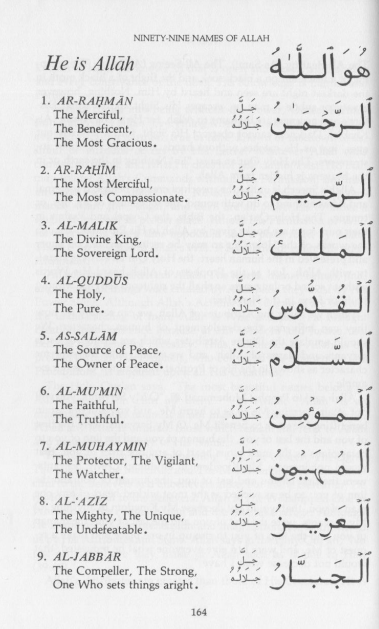
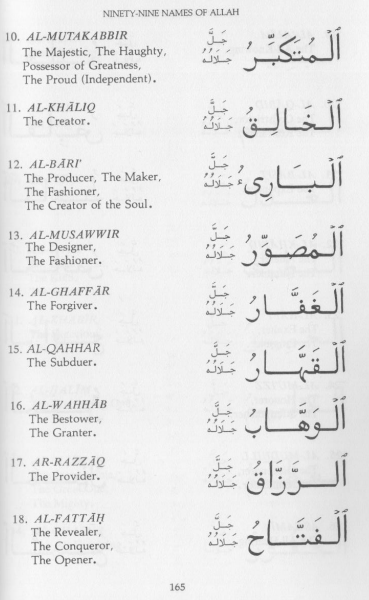
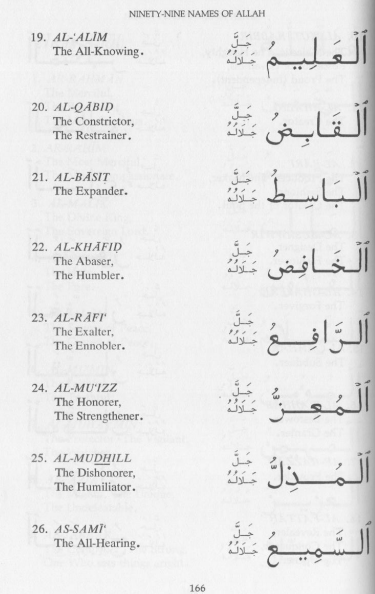
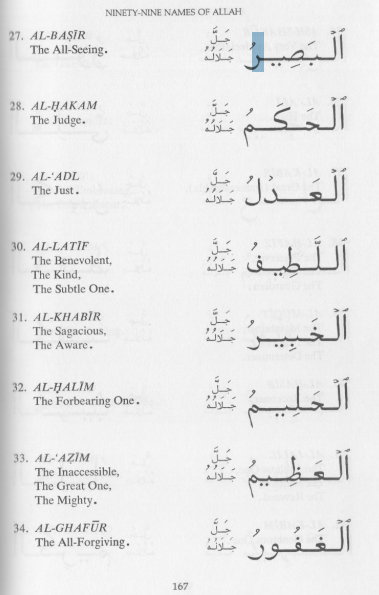
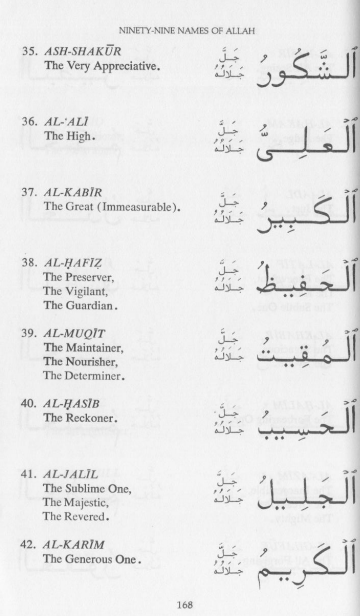
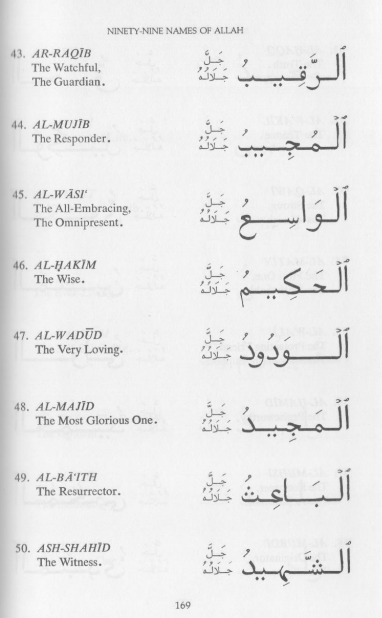
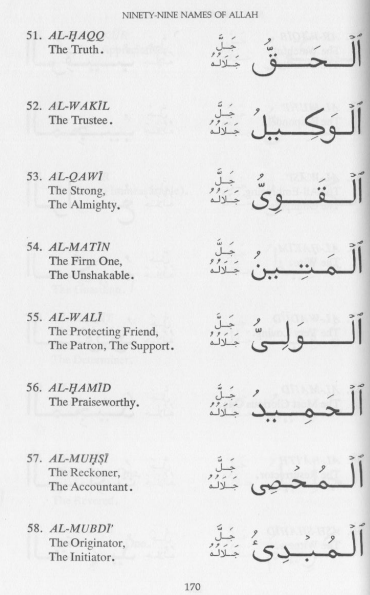
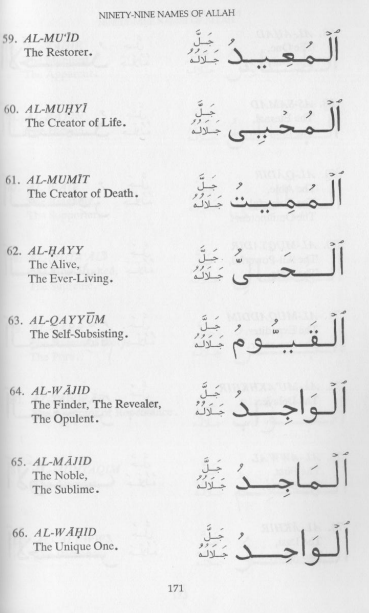
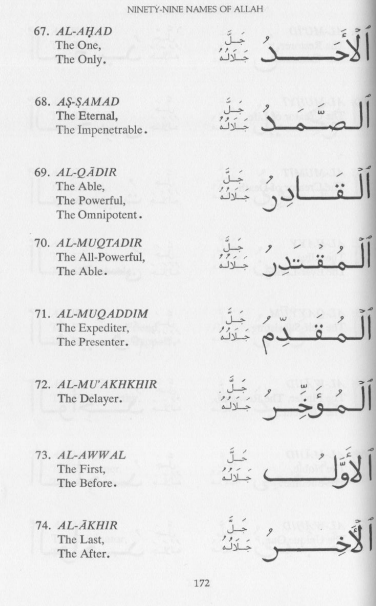
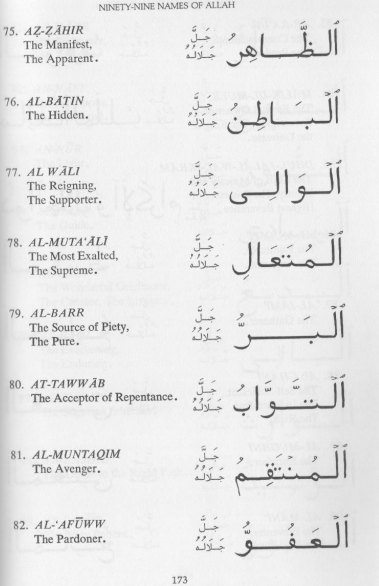
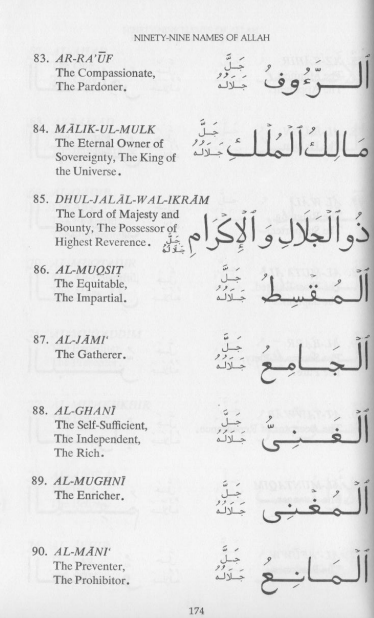
 NINETY-NINE NAMES OF ALLAH
He is Allah
1. AR-R AMMAN
The Merciful,
The Beneficent,
The Most Gracious.
2. AR-RAHlM
The Most Merciful,
The Most Compassionate.
3. AL-MALIK
The Divine King,
The Sovereign Lord.
4. AL-QUDDUS
The Holy,
The Pure.
5. AS-SALAM
The Source of Peace,
The Owner of Peace.
6. AL-MU’MIN
The Faithful,
The Truthful.
7. AL-MUHAYMIN
The Protector, The Vigilant,
The Watcher.
8. AL-'AZlZ
The Mighty, The Unique,
The Undefeatable.
9. AL-JABBAR
The Compeller, The Strong,
One Who sets things aright.
10. AL-MVTAKABBIR
The Majestic, The Haughty,
Possessor of Greatness,
The Proud (Independent).
11. AL-KHAL1Q
The Creator.
12. AL-BARF
The Producer, The Maker,
The Fashioner,
The Creator of the Soul.
13. AL-MUSAWWIR
The Designer,
The Fashioner.
14. AL-GHAFFAR
The Forgiver.
15. AL-QAHHAR
The Subduer.
16. AL-WAHHAB
The Bestower,
The Granter.
17. AR-RAZZAQ
The Provider.
18. AL-FATTAH
The Revealer,
The Conqueror,
The Opener.
164
165
NINETY-NINE NAMES OF ALLAH
NINETY-NINE NAMES OF ALLAH
19. AL-'ALlM
The All-Knowing.
27. AL-BAS/R
The All-Seeing.
20. AL-QABID
The Constrictor,
The Restrainer.
28. AL-I1AKAM
The Judge.
21. AL-BASIT
The Expander.
29. AL-’ADL
The Just.
22. AL-KHAFID
The Abaser,
The Humbler.
23. AL-RAFF
The Exalter,
The Ennobler.
24. AL-MUIZZ
The Honorer,
The Strengthener.
25. AL-MUDH1LL
The Dishonorer,
The Humiliator.
26. AS-SAML
The All-Hearing.
30. AL-LATiF
The Benevolent,
The Kind,
The Subtle One.
31. AL-KHABlR
The Sagacious,
The Aware.
32. AL-HALiM
The Forbearing One.
33. AL-AZlM
The Inaccessible,
The Great One,
The Mighty.
34. AL-GHAFUR
The All-Forgiving.
166
167
NINETY-NINE NAMES OF ALLAH
NINETY-NINE NAMES OF ALLAH
35. ASH-SHAKUR
The Very Appreciative.
36. AL-'ALl
The High.
43. AR-RAQIB
The Watchful,
The Guardian.
44. AL-MUJIB
The Responder.
37. AL-KABlR
The Great (Immeasurable).
38. AL-HAFlZ
The Preserver,
The Vigilant,
The Guardian.
39. AL-MUQ'IT
The Maintainer,
The Nourisher,
The Determiner.
40. AL-ljASlB
The Reckoner.
45. AL-WASF
The All-Embracing,
The Omnipresent.
46. AL-ljAKlM
The Wise.
47. AL-WADUD
The Very Loving.
48. AL-MAJlD
The Most Glorious One.
41. AL-JALIL
The Sublime One,
The Majestic,
The Revered.
42. AL-KARIM
The Generous One.
49. AL-BA‘ITH
The Resurrector.
50. ASH-SHAHID
The Witness.
168
169
NINETY-NINE NAMES OF ALLAH
NINETY-NINE NAMES OF ALLAH
51. AL-IjAQQ
The Truth.
52. AL-WAKlL
The Trustee.
53. AL-QAW1
The Strong,
The Almighty.
54. AL-MAT IN
The Firm One,
The Unshakable.
59. AL-MU‘iD
The Restorer.
60. AL-MUIIYl
The Creator of Life.
61. AL-MVMlT
The Creator of Death.
55. AL-WALl
The Protecting Friend,
The Patron, The Support
62. AL-HAYY
The Alive,
The Ever-Living.
63. AL-QAYYUM
The Self-Subsisting.
56. AL-TJAMiD
The Praiseworthy.
64. AL-WAJID
The Finder, The Revealer,
The Opulent.
57. AL-MUIJSi
The Reckoner,
The Accountant.
58. AL-MUBDT
The Originator,
The Initiator.
65. AL-MAJID
The Noble,
The Sublime.
66. JL-IP/Ifl/D
The Unique One.
170
171
NINETY-NINE NAMES OF ALLAH
NINETY-NINE NAMES OF ALLAH
67. AL-AH AD
The One,
The Only.
75. AZ-ZAHIR
The Manifest,
The Apparent.
68. AS-SAMAD
The Eternal,
The Impenetrable.
76. AL-BATIN
The Hidden.
69. AL-QADIR
The Able,
The Powerful, The Omnipotent.
70. AL-MUQTADIR
The All-Powerful,
The Able.
77. AL WALl
The Reigning,
The Supporter.
78. AL-MUTA'ALl
The Most Exalted,
The Supreme.
& u-JI J-jji
71. AL-MUQADDIM
The Expediter,
The Presenter.
79. AL-BARR
The Source of Piety,
The Pure.
72. AL-MU’AKHKHIR
The Delayer.
80. AT-TAWW AB
The Acceptor of Repentance.
73. AL-AWW AL
The First,
The Before.
81. AL-MUNTAQIM
The Avenger.
74. AL-AKH1R
The Last,
The After all.
82.
The Pardoner.
172
173
NINETY-NINE NAMES OF ALLAH
NINETY-NINE NAMES OF ALLAH
83. AR-RA’UF
The Compassionate,
The Pardoner.
84. MALIK-UL-MULK
The Eternal Owner of
Sovereignty, The King of
the Universe.
85.
DHUL-JALAL- W A L-IKRAM
The Lord of Majesty and «
Bounty, The Possessor of I
Highest Reverence,
86. AL-MUQSIT
The Equitable,
The Impartial.
87. AL-JAMF
The Gatherer.
91. AV-DARR
The Distresser,
The Afflicter.
92. AN-NAFF
The Propitious,
The Beneficial.
93. AN-NUR
The Light.
94. AL-HADi
The Guide.
88. AL-GHANl
The Self-Sufficient,
The Independent,
The Rich.
89. AL-MUGHN'I
The Enricher.
95. AL-BADV
The Wonderful Originator,
The Creator, The Inventor.
96. AL-BAQ1
The Everlasting,
The Enduring.
97. AL-WARITH
The Supreme Inheritor.
98. AR-RASH1D
The Guide to the Right Path.
90. AL-MANF
The Preventer,
The Prohibitor.
99. AS-SABUR
The Very Patient.
In the Name Allah,
The Most Gracious, The Most Compassionate
SUPPLICATIONS OF
PROPHET MUHAMMAD $
Allah, there is no god except Him. The Ever-Living, The Self-
Subsisting. Alif, Lam, Mim, Allah, there is no god except Him.
The Ever-Living, the Self-Subsisting. And downcast will be the
face before [Allah] the Ever-Living, the Self-Subsisting.
O Allah, You are The Most Forgiving. You love forgiveness, so
forgive me. O Allah, Turner of hearts, turn my heart to Your
Religion.
O Allah, endow us with Your Love, and with the love of deeds
which let us be close to Your Love.
O Ever-Living, O Self-Subsisting, of Your Mercy we appeal to
Your Mercy for help in abundance. Set right all our affairs and en-
trust us not to ourselves, even for the twinkling of an eye; for if
You entrust us to ourselves, You in fact entrust us to [risk of]
weakness and faultiness, sin and offence.
O Allah, nothing is easy save that which You make so, and You
make the difficult easy whensoever You like.
There is no god except Allah, The Forebearing, The
Magnanimous. There is no god but He, The Master of the Greatest
Throne. O Merciful of mercifuls, we ask of you the qualities which
make us eligible for Your Grace, [and we ask You] for Your Firm
Forgiveness; and for the opportunity to win from every good act,
SUPPLICATIONS OF PROPHET MUHAMMAD
to be saved from every sin, and to win Paradise and safety from
Hell. Don't let us have a sin unless You forgive it, O Merciful of
mercifuls. Remove worries, O Merciful of mercifuls; and fulfill all
of my wants which meet Your Pleasure.
O Allah, plan for us and do not plan against us.
O Allah, increase us and decrease us not, and choose us rather
than choose against us.
GENERAL SUPPLICATION
O Allah, I ask You for forgiveness in this world and in the
Hereafter.
O Allah, forgive me and turn to me; You are Most Forgiving
and Merciful!
O Allah, I did a grave wrong to myself and none except You
forgives sins, so grant me forgiveness from Yourself, and take pity
upon me. You are The Most Forgiving, Most Merciful!
O Lord, help me in remembering You, in thanking You, in im-
proving my worship of You, in expressing gratitude to You, and in
worshipping You in the best of manners!
O Allah, You are the Most Forgiving. You love forgiveness, so
forgive me.
O Allah, I seek Your Refuge from the knowledge that brings no
good, from the heart that has no fear, from the supplication that
cannot be accepted, and from the self that cannot be satisfied!
Our Lord, make our hearts not deviate after You have guided
us, and grant us mercy. Surely You are The Most Liberal Giver!
My Lord, make me keep up prayer, and also my offspring. O,
Our Lord, accept my prayer!
FOR MORNING: We enter upon the morning, and so does the
creation of Allah, Lord of the worlds.
O Allah, I beg of You the good of this day, the victory thereof,
the help thereof, the light thereof, the blessing thereof, and the
guidance thereof. And I seek refuge in You from the evil therein, ’
and the evil thereafter!
SUPPLICATIONS OF PROPHET MUHAMMAD
O Allah, I beg of you useful knowledge, abounding sustenance,
commendable conduct and the cure for all ailments.
AT DUSK: We enter upon the evening, and so does the creation
of Allah, Lord of the worlds.
O Allah, I beg of You the good of this night, the opening
thereof, the victory thereof, the light thereof, the blessing thereof,
and the guidance thereof. And I seek refuge in You from the evil
therein, and the evil thereafter [in the evening]!
AT THE CALL FOR EVENING: O Allah, this is the hour of the
advent of Your Night, and the departure of Your Day, and the
sounds of Your Heralds, so grant me forgiveness!
AT TIME FOR BED: In Your Name O Allah, do I die and live.
GOING TO BED: O Allah! I give my soul into Your Charge, I
turn my face to You, I entrust my affairs into Your Hands, and I
seek refuge for my back in You, make my humble petition to You
and fear You. There is no refuge or deliverance except in You. I
believe in Your Book, which You have revealed, and in Your Pro-
phet, whom You have sent.
AT TAHAJJUD: O Allah! praise be to You. You are the Guar-
dian of the heavens and the earth, and of those therein. Praise be
to You. You are the Light of the heavens and the earth, and of
those therein. Unto You belongs the praise. You are the King of the
heavens and the earth, and of those therein. You are True, true is
Your Promise, true is our meeting with You, true is Your Word,
true is Heaven, and true is Hell. True are the prophets, true is
Muhammad, and true is the Hour of Judgment. O Allah! unto You
do I surrender; in You do I have faith; upon You do I rely; unto
You do 1 turn. With Your help do I contend; and from You do I
seek judgment. So forgive me for that which I expedite, that which
1 defer, that which I conceal, and that which I reveal. And also for
that (sin) of mine of which You are the Deferrer. There is no god
save You, and there is no god other than You.
W/TR SUPPLICATION: O Allah! You do we serve, and to You
do we pray and prostrate ourselves, and to You do we betake
ourselves. We are quick to obey You, and we hope for Your Mer-
cy, and we fear Your punishment, for Your punishment overtakes
the unbelievers.
ON AWAKENING: I seek refuge through the complete words
178
179
SUPPLICATIONS OF PROPHET MUHAMMAD
SUPPLICATIONS OF PROPHET MUHAMMAD
of Allah, from His anger, His punishment, the mischief of His
created beings and from the evil suggestions of the devils, lest they
should come to me.
RISING FROM SLEEP: All praise is due to Allah, Who raised us
to life after He had caused us to die; and to Him is the rising [after
death].
There is no god except Allah; He is One, there is no associate
with Him; His is the kingdom, for Him is praise, and He has power
over all things.
BEGINNING ABLUTION (WUDU): In the Name Allah, The
Exalted. Praise be to Him for [keeping me faithful] to the religion
of Al-Islam.
WHEN LEAVING OR ENTERING THE HOME: O Allah, grant
me forgiveness for my sins, grant me expansion in my house, and
bless my sustenance!
AT THE END OF ABLUTION (WUDU): I bear witness there is
no god except Allah, and I bear witness that Muhammad is His
Messenger. O Allah, make me of those who are repentant; and
make me of those who are purified. Exalted are You, O Allah. I
praise You, ask Your Forgiveness and turn back to You.
AFTER HEARING THE FIRST CALL (ADHAN): O Allah,
Lord of this perfect call, and of the prayer to be offered presently,
grant Muhammad the way of approach to You, and also emi-
nence. And elevate him to the glorious position which You have
promised him, for You never go back on Your Promise!
WHEN ENTERING THE MASJID: O Allah, open the gates of
Your Mercy to me! (Enter the masjid with the right leg first.)
WHEN STEPPING OUT OF THE MASJID: O Allah, I beg of
You Your Bounty. (Exit from the masjid with the left leg first.)
AFTER MORNING AND EVENING PRAYERS: O Allah, pro-
tect me from the Fire [of Hell]! (Repeat 7 times.)
WHEN BREAKING THE FAST: O Allah, it is for You that I
observed this fast, and it is with Your Sustenance that I break it!
The thirst was no more; moistened were the veins, and the reward
became due, so willed Allah.
WHEN BREAKING THE FAST AT THE TABLE OF
ANOTHER: May the fasting people break [their fast] with you,
and may the pious eat your food, and may the angels beg
forgiveness by you.
BEGINNING THE MEAL: In the Name Allah.
FINISHING THE MEAL: In the Name Allah, praise be to
Allah Who fed us, gave us drink and made us Muslims.
IN INTIMATE RELATIONS WITH MATE: With the Name
Allah. O Allah, guard us against Satan, and keep Satan away
from what You grant us!
O Allah, do not let Satan take any part of the child which You
have destined for me! [Say this in the heart.]
SETTING OUT ON A JOURNEY: O Allah, make this journey
easy for us, and shorten the distance thereof for us.
O Allah, You are our Companion in this journey and Guardian
in [our] household!
O Allah, I seek refuge in You from the toil of this journey, from
beholding a miserable sight, and from ill return in my wealth,
household, or my children.
RETURNING FROM A JOURNEY: \Ne are returners, penitents,
worshippers of our Lord, and we are thankful.
WHEN ENTERING A CITY: O Allah, prevent harm from com-
ing to me from its dwellers and prevent harm from coming from
me to them.
O Allah, bless us in this [township], O Allah, provide us with
the fruits thereof and cause us to be loved by the folk thereof. And
cause the righteous folk thereof to be loved by us!
AT TIMES OF DISTRESS: Allah is sufficient for us. He is an ex-
cellent Agent, and we repose our trust in Allah.
ON RECEIVING NEWS OF SOMEONE'S DEATH: Surely we
belong to Allah, and to Him we are returning.
Surely we are for Allah, and to Him we return! O Allah, I ask
You for the reward of my hardship. Reward me and compensate
me by replacing it with goodness!
WHEN OVERWHELMED BY A TYRANT: O Allah, let Your
Sustenance suffice us against them, as You desire.
O Allah, place Yourself in front of them. I seek refuge in You
from their mischief!
SEEKING RELIEF FROM HARDSHIP: O Allah, there is
nothing easy except that which You make so. And You make the
unpleasant easy, whenever You like!
180
181
SUPPLICATIONS OF PROPHET MUHAMMAD
SUPPLICATIONS OF PROPHET MUHAMMAD
FOR FORGIVENESS: O Allah, the extent of Your Forgiveness is
far wider than the extent of my sins, and the extent of Your Mercy
is a matter of greater hope for me than my deed!
WHEN IT THUNDERS: O Allah, slay us not with Your Wrath
and destroy us not with Your Punishment, but forgive us before!
CONDOLENCE ON THE DEATH OF A BABY: Surely every-
thing that Allah has taken away, and that He has given belongs to
Allah. Allah is with him for an appointed time; so forebear and ex-
pect a reward for the parent!
FOR RELIEF FROM INDEBTEDNESS: O Allah, let Your
Sublimity suffice me against things which are unlawful unto You.
Make me, by Your Grace, dependent on none except You!
WHEN INFLUENCED BY EVIL: In the Name Allah, The
Most Gracious, The Most Compassionate. Say: I seek refuge with
the Lord of the Dawn, from the mischief of created things. From
the mischief of darkness as it overspreads; from the mischief of
those who practice secret arts; and from the mischief of the en-
vious one as he practices envy (Surah 113: 1-5).
In the Name Allah, Most Gracious, Most Compassionate.
Say: 1 seek refuge with the Lord and Cherisher of humanity, The
King [Ruler] of humanity. The God [Judge] of humanity, from the
harm of the whisperer [who whispers evil], into the hearts of
humanity, among jinns and among men (Surah 114:1-6).
Note: Recite the above three times.
DHIKR AFTER PRAYERS: O Allah! You are the Peace, and
from You comes peace; blessed are You, O Lord of Glory and
Honor!
WHEN PLACING THE DEAD IN GRAVES: With the Name
Allah, and according to the Religion of the Messenger of Allah.
VISITING THE MUSLIM GRAVEYARD: Peace be on you, O
dwellers of the graves! May Allah grant you forgiveness. You have
gone before us, and we are following you.
SLAUGHTERING OF ANIMALS: In the Name Allah; Allah
is The Greatest.
VISITING THE SICK: Take away the sickness, O Lord, of all
people, and restore them to health! You are the Healer. There is no
healing but the healing which You give. Grant recovery which
leaves n6 ailment behind.
PRAYER AT ANY TIME: O Allah! I seek from You steadfast-
ness in action, and strong determination in guidance. And I seek
from You gratefulness for Your Favors and excellence for Your
Service. And I seek from You a sound mind and a truthful tongue.
And I seek from You the good which You Know, and I seek refuge
with You from the evil of what You Know, and I beg of You Your
Pardon for what You Know.
SUPPLICATION ON HARD TIMES
Authentic narrators have reported that Prophet Muhammad is
recited the following supplication in the Morning Prayer:
O Allah! Guide me among those whom You have guided, and
preserve me among those whom You have preserved, and befriend
me among those whom You have befriended, and bless me with
what You have granted, and save me from the harm of what You
have ordered; for when You order, no order is given against Your
Order. Surely he is not disgraced whom You befriend. Blessed are
You, Our Lord! and highly exalted. We ask repentance from You
and turn to You, and we praise and venerate the Prophet.
In offering this prayer the Imam and his followers stand erect
after the bending position of the second step, keeping their arms at
their sides. The Imam recites the prayer and the followers say,
"Amen," at the proper juncture. Then all prostrate themselves.
'SUPPLICATION FOR DIVINE GUIDANCE
(istikharah)
When one intends to do anything, he should first offer two steps
of voluntary prayer, then recite the following:
O Allah, I beg Your Advice through Your Knowledge and Abili-
ty; through Your Power. And I beg Your Favors from Your Infi-
nite Bounty; for You have Power, 1 have none. You Know, I know
not; and You are the Great Knower of things unseen! O Allah!
182
183
SUPPLICATIONS OF PROPHET MUHAMMAD
SUPPLICATIONS OF PROPHET MUHAMMAD
You know whether this affair is good for me with respect to my
faith, the means of my sustenance and in the end [of my affair, re-
cent and future]. Make it easy for me, and bless it for me. And if
You know that this affair is evil for me with respect to my faith,
the means of my sustenance and in the end, then turn it away from
me and turn me away from it, and proportion the good for me
wherever it is; then grant me satisfaction in it. Surely You are
Able, above everything.
PRAYERS FOR THE DEAD
O Allah! forgive our living ones and dead ones, and those of us
who are present and those who are absent, and our young ones
and old ones, and our males and females.
O Allah! cause whoever among us is kept alive by you, to live
in submission to You, and make whoever you cause to die, die in
llslamic] faith.
O Allah! Do not deprive us of his reward [for patience on his
loss], and do not make us subject to tribulations after him.
MARRIAGE SERMON
SEEKING DIVINE HELP TO MEMORIZE
THE HOLY QUR'AN
O Allah, be Gracious to me by enabling me to give up sins
altogether for as long as You grant me life and have mercy upon
me, lest I should concern myself with anything which is of no
[good] consequence to me! And grant me the goodness of sight
which will cause You to be well pleased with me! O Allah,
Originator of the heavens and the earth, Lord of majesty, glory,
and of might incomprehensible, I ask You, O Allah, O Beneficent
Lord, by Your Majesty and the light of Your Countenance, to
cause my heart to retain the Scripture just as You have taught [it to
me]. And grant me the ability to recite it in such a manner as will
cause You to be well pleased with me. O Allah, Originator of the
heavens and the earth, Lord of majesty, glory, and of might in-
comprehensible, I ask You, O Beneficent Lord, by Your Majesty,
and the light of Your Countenance, to illuminate my sight with
Your Scripture, to set my tongue free, to comfort my heart
therewith, to open my bosom therewith, and to wash my body
therewith. For indeed, none helps me in [the path of] truth besides
You, and none favors me besides You. There is no strength or
power save in Allah, the Exalted, the Magnificent.
All praise is due to Allah; we praise Him, we ask Him for help,
we ask for His Protection, and we seek refuge in Allah from the
mischief of our souls, and from the evil of our deeds. Whoever
Allah guides can be led astray by none, and whoever Allah finds in
error can be guided by none; and I bear witness that there is no
god except Allah, and that Muhammad is His Servant and
Messenger. O You who believe! be careful of your duty to Allah
with the care which is due to Him, and do not die unless you are
Muslims. O people! be careful of your duty to your Lord, Who
created you from a single being, and of the same created its mate,
and spread from these two many men and women; and be careful
of your duty to Allah, by whom you demand one of another your
rights, and [of your duty] to the ties of relationship. Surely Allah
watches over you. O you who believe! be careful of your duty to
Allah, and speak the right word. He would put your deeds into a
right state for you, and forgive you your faults. And whoever
obeys Allah and His Messenger indeed achieves a mighty success.
May Allah shower His Blessings, and may He bless you and unite
you two in goodness.
184
185
In the Name Allah,
The Most Gracious, The Most Compassionate
ESSENTIALS FOR PRAYER
KEY WORDS WHICH DESCRIBE MUSLIM ACTIONS
Fard or Wajib: Obligatory or compulsory. One gains merit for
doing such a thing. One who neglects it is subject to punishment.
Haram: Forbidden or prevented. One. who avoids such things
gains merit. One who does them will be punished.
Makruh: Hated or disliked. One gains merit for avoiding such a
thing; however there is no punishment for doing it.
Mustahabb: Recommended or advisable. One gains merit for
doing such a thing. There is no punishment if one does not do it.
Ja'iz: Permitted (conceivable). One is free to do or not do such
things. One gains merit for doing such a thing with the intention of
pleasing Allah.
ESSENTIAL REQUIREMENTS
In order for the Muslim's prayer to be accepted by Allah and to
be beneficial to the person who offers it, certain requirements must
be met:
The worshipper must be in a state of ablution. If one is physical-
ly dirty, and clear water is insufficient for cleaning, the affected
parts of the body must be washed with water and a cleanser such
as soap, etc., before performing ablution.
Every effort must be made to remove filth from the body and
clothing.
The worshipper must take a complete bath if he or she is in a
187
ESSENTIALS FOR PRAYER
ESSENTIALS FOR PRAYER
state of impurity. To clean the body of dirt and minor impurities,
and to keep oneself ready for prayer, a Muslim must wash the
private parts of the body with water whenever impure matter is
released. The washing and drying should be done with a clean,
non-transparent cloth, or with any other sanitary material that
will serve the purpose. One should use the left hand when remov-
ing body wastes (impurities).24’
The male worshipper's body must be fully covered between the
navel and knees.250 The whole body of the female must be covered
except for the hands and face.251
The worshipper must observe the times and rules prescribed for
the respective prayers.
The place where the worshipper prostrates in prayer must be
clean.
The worshipper must stand so that his chest and face are in the
direction of the Ka'bah.252
The worshipper must make the intention in his or her mind
before offering the obligatory prayer.
The worshipper raises both hands to the ears and pronounces,
"Allahu Akbar," before proceeding with the prayer service. 253 This
is called "Takbirah Ihram," and it is one of the basics of prayer.
WHEN PRAYER BECOMES OBLIGATORY
Prayer is obligatory for every Muslim who is relatively mature
and at or beyond the age of puberty, provided he or she is sane
and in a normal state of mind. Children should be taught to pray
at the age of seven, and they should be urged to do so at the age of
ten.
OBLIGATORY ACTS OF WORSHIP
Once we begin an act of worship to Allah [including nonoblig-
atory prayers, the performance of Hajj or Umrah (journey to Mak-
kah for Hajj), etc.] we are obligated to complete it. The Holy
Qur'an says, "Fulfill the covenant of Allah when you have entered
into it, and break not your oaths after you have confirmed them;
indeed you have made Allah your surety; for Allah knows all that
you do."254
COMBINING PRAYERS
It has been reported that Prophet Muhammad combined the
Noon and Afternoon prayers, and the Evening and Night
prayers.255 He observed these prayers together when travelling. It
is permissible for believers to do the same, and to combine prayers
due to illness. It should be remembered that this is the exception
and not the rule.
In combining prayers, the Noon and Afternoon prayers are of-
fered one followed by the other, as are the Evening and Night
prayers. Combined prayers can be said at the time of the earlier
prayer, or at the time of the latter.256 Combined prayers should not
be compounded into one single prayer. Each must be performed
separately, and a short interval should transpire between them.257
Before saying each prayer one is advised to say the Iqamah, as was
the practice of Prophet Muhammad jg.
OBSERVING (INTENTIONALLY) DELAYED OR
(UNINTENTIONALLY) MISSED PRAYERS
Every Muslim should offer the obligatory prayers when they are
due. Anyone who is able, but who fails to do so is committing a
sin. It is not a sin, however, if one fails to offer the prayer at its
prescribed time due to unavoidable circumstances (such as unin-
tentionally oversleeping). Prophet Muhammad 5=8 said, "He who
sleeps (through) the prayer or he (who) forgets should observe it
immediately when he remembers it.''258 Every person missing an
obligatory prayer must make it up, except for women in confine-
ment (childbirth), women who are menstruating, and people who
are insane or unconscious. Delayed prayers are to be offered as
soon as possible after the time when they are due. Missed
obligatory prayers must be offered as soon as possible, at any time
within 24 hours of their regular time, even during sunrise or
189
188
ESSENTIALS FOR PRAYER
ESSENTIALS FOR PRAYER
sunset. Prophet Muhammad jg said, "Whoever could do one
rak'ah (of the Fajr prayer] before sunrise [and one after sunrise],
has done the [Fajr] prayer. And whoever could do one rak'ah of
the 'Asr prayer before sunset [and three after sunset], has done the
[Asr] prayer."25’
When making up for missed prayers, only the obligatory prayer
is offered, except in the case of the Dawn prayer. When making up
for the Dawn prayer, the sunnah prayer is offered first, then the
obligatory prayer. Anyone who gets up late for the Dawn prayer
should offer it even though the sun is rising. Missed prayers should
not be offered before a prayer that is presently due unless sufficient
time is available for the completion of both. For example, if one
has missed the Noon prayer and only enough time remains to offer
four rak'ahs before the sun sets, the Noon prayer should not be of-
fered with the Afternoon prayer. It should instead be offered
before saying the Evening (Maghrib) prayer.
If more than one prayer has been missed, they may all be offered
one after the other. In the case of missed prayers there is no need
for Adhan, because the Adhan is to be said only at the time of the
prayer presently due. When offering the prayers someone should
say the Iqamah before each one to make certain that they are
separate and independent of each other. Before saying the prayer,
one should say silently, "I intend to perform the missed obligatory
[name of] prayer as a debt to Allah, The Most High."
SHORTENING PRAYER
There are conditions under which one can shorten certain
obligatory prayers.260 If a person travels forty-eight miles or more
from his or her city of residence, the obligatory prayers of four
rak'ahs, the Noon, Afternoon and Night prayers, should be
shortened to two rak'ahs.261 In the case of the Morning and Eve-
ning prayers, the number of rak'ahs remains the same. Under nor-
mal circumstances full prayers are obligatory after eighteen days.
If one's intention is to remain away eighteen days or less, but he
or she is forced to stay longer because of unforeseen circum-
stances, prayers can still be shortened (at the discretion of the wor-
shipper) until returning to the place of permanent residence, enter-
ing the residence of one's wife, or returning to the city from which
one began his or her travels.
Prayers are not to be shortened until the traveler is outside the
limits of the city from which he is departing. Under the cir-
cumstances of traveling mentioned above, one is exempt from all
voluntary prayers except the sunnah prayers which are offered
before the Morning and Witr prayers.262
The allowances are not applied to that which is unlawful. Short-
ened prayers are unacceptable if one embarks on a trip that is for
unlawful purposes, or for objectives which are in opposition to the
principles of Al-Islam.
MODIFICATION OF PRAYER POSITIONS
It is permissible for a worshipper who is sick and unable to say
his prayers in a sitting position to offer them while standing. If he
is unable to pray standing or sitting, he may offer prayer while ly-
ing on his side.263 If he is unable to turn in the direction of the
Ka'bah, he may offer prayer in whatever direction he is facing.264
CORRECTING MISTAKES IN PRAYER
Prophet Muhammad said, "When anyone of you is in doubt
about his prayer, he should cast aside his doubt and base his
prayer on what he is sure of, then perform two prostrations before
saying, 'As-salamu alaykum wa rahmatullah.'"265 If one makes a
mistake in prayer, or if one is doubtful about the number of
rak'ahs performed, he or she should perform two prostrations, like
the ordinary prostrations made during prayer, before saying, "As-
salamu alaykum wa rahmatullah" (Peace be upon you and the
Mercy of Allah). If a worshipper is late and misses any rak'ah, he
or she must offer it before making the double prostration. If the
Imam makes a mistake during congregational prayer he must per-
form the two prostrations, and the congregation must follow him.
190
191
ESSENTIALS FOR PRAYER
ESSENTIALS FOR PRAYER
After the Imam says, "As-salamu alaykum wa rahmatullah," the
second time, the late worshipper is to stand and complete his
prayer. However, if the Imam offers the two prostrations before
he says the salams, the late worshipper is to follow the Imam in
performing them.
THE ADHAN AND THE IQAMAH
It is essential for Muslims to go to the masjid upon hearing the
Call to Prayer (Adhan). However, one may say prayers away
from the masjid if there is a valid reason for doing so. Under nor-
mal circumstances a worshipper who is in the masjid when Adhan
or Iqamah is announced may leave before prayer to make ablu-
tion, after which he or she must immediately return. Worshippers
may also leave the masjid after Adhan if they are responsible for
administering to a sick person. It is not permissible to leave the
masjid after the Adhan or the Iqamah for any other reasons until
the prayer service has been completed.2bb
DETERMINING DIRECTION OF THE KA'BAH
Facing in the direction of the Ka'bah when performing prayer is
a religious duty which must not be dispensed with unless cir-
cumstances make it impossible.267 If a person cannot determine the
direction of the Ka'bah, he should ask someone who knows to
point it out to him. If there is no one available to ask, one must
pray facing in the direction he thinks is correct. If the worshipper
learns that the direction was incorrect after completing the prayer,
he is not obligated to perform the prayer again if its time is over,
but he is required to face in the proper direction in the future. If
one is not facing in the direction of the Ka'bah, and someone
points out the correct direction during his prayer, the worshipper
must stop praying, face in the correct direction and begin the
prayer again.
ACTS WHICH INVALIDATE PRAYER
Should a worshipper commit any of the following acts during
prayer, the prayer becomes invalid, and it must be repeated:
Failing to make the intention, or failing to say the first "Allahu
Akbar," or "As-salamu alaykum wa rahmatullah," at the end of
the prayer.
Making any noticeable act, movement or statement other than
those prescribed for prayer, i.e., leaving one's place during the
prayer to correct others, turning one's chest away from the direc-
tion of the Ka'bah, eating, drinking, talking, laughing, coughing
or moaning unnecessarily, etc.
Doing anything which nullifies the ablution, unless one has a
continuing illness which affects him more than two-thirds of the
time during prayer.
Failing to recite Al-Fatiha in every rak'ah, or failing to assume
any of the prayer positions (whether one is leading as Imam, or
following an Imam).
ACTS TO AVOID IN PRAYER
Prayer is a condition in which one is in contact with Allah. It
calls for the utmost degree of sincerity, dignity, concentration and
control of the body. Any acts which tend to disturb this condition
are considered undesirable. The following acts are undesirable and
should be avoided:
Fumbling with one's clothing or body.
Placing one's hands on the hips or back.
Snapping one's fingers, or intertwining the fingers of one hand
with those of the other.
Resting on the forearms or elbows during prostration (for a
man).
Yawning deliberately, or failing to make an effort to suppress a
yawn when possible.
Standing up for prayer when one has a strong urge to defecate,
urinate or release wind.
192
193
ESSENTIALS FOR PRAYER
ESSENTIALS FOR PRAYER
Praying in garments, or on a mat, decorated with pictures of
animals or human beings.
Standing in a back row for congregational prayer when there is
an available place in a row in front.
Prostrating oneself by touching only the forehead or the nose to
the ground.
Raising the feet off the ground during prostration. If the feet are
raised during the entire prostration the prayer becomes void.
Turning the face to the right or left, except while offering salams
at the end of the prayer.268
Closing the eyes or looking up. Closing the eyes is undesirable,
but there is no punishment if one closes them while trying to con-
centrate.
Gesturing with the eye, the eyebrow or the hands.
Praying before a fire. Praying in a graveyard in the direction of,
or above a tomb. If one prays in a graveyard, the place of pros-
tration must be clean. The use of a mat or rug is permissible.
Praying when the sun is at its zenith.
WOMEN'S PRAYER POSITIONS
Women's prayer positions are the same as those for men, except
for the following variations:
A woman folds her hands on her breast, not on or under her
navel. (See illustration, page 104.)
In assuming the bending position a woman is to bend only until
her hands reach her knees, touching them gently. At the same
time, her elbows should be in close contact with her sides.
In the prostrating position a woman is to keep her abdomen in
contact with her thighs, and her elbows resting on her thighs. (See
illustration, page 128.)
scent.269
Cutting the nails and moustache, shaving the pubic hair, and
plucking the hair from the armpits. (If the hair is difficult to pluck,
it may be shaved.)
One should silently say, "Al Hamdulillah," when he or she
sneezes.270
Should one hear the whispers of Satan, he or she should say, "1
seek refuge with Allah, and ask for His Forgiveness."
Coming to the masjid early.271 (For each step taken to the masjid
with one foot merit is recorded, for every step taken with the other
a sin is annulled.)272
INTENTIONS BEFORE PRAYER
There are four kinds of intentions for the obligatory prayers.
They are said silently.
When leading any of the obligatory prayers as Imam the inten-
tion should be, "I intend to perform the [name of] obligatory
prayer in congregation as ordered by Allah."
When following the Imam in prayer, the intention should be, "I
intend to perform the [name of] obligatory prayer, as ordered by
Allah, the Lord of all the worlds, in this group, following this Im-
am."
When praying as an individual, the intention should be, '1 in-
tend to perform the [name of] obligatory prayer, as ordered by
Allah, the Lord of all the worlds."
The intention made when making up for missed prayers is, "I in-
tend to perform the missed [name of] obligatory prayer as a debt
to Allah, The Most High."
One should follow the intention with the first "Allahu Akbar."
Then he or she should begin the prayer service.
RECOMMENDED ACTS
FOR JUMU'AH PRAYER SERVICE
Taking a shower, putting on nice clothes and (for men) using
TARAWIH PRAYER
The Tarawih273 prayer has a special characteristic, and it is an
essential and integral part of the month of Ramadan. During this
195
194
ESSENTIALS FOR PRAYER
ESSENTIALS FOR PRAYER
month it is offered nightly in place of the Tahajjud prayer. The
Tarawih prayer consists of eight rak'ahs, with two salutations
(salams) offered after every two rak’ahs.274 It may be offered in-
dividually or in groups, but it is preferable that it be said in con-
gregation. It is commendable to complete the entire Holy Qur’an
during Ramadan by reciting one of its thirty parts during Tarawih
prayer each night. After reciting The Opening Chapter in each
rak'ah the worshipper recites consecutive verses from each part,
finishing the part in the eighth rak'ah.
SHAF' AND WITR
Witr, which literally means "odd number," is a prayer which is a
sunnah (practice) of Prophet Muhammad jg. Its time starts after
the performance of Isha prayer, and it ends before the time of the
Dawn (Fajr) prayer. Prophet Muhammad sg said, "Make Witr as
your last prayer at night."277 It is better to offer the Witr prayer
during the latter part of the night, after offering Tahajjud prayer,
as the last prayer before the Dawn prayer. However, if one feels he
will be unable to offer the Tahajjud prayer due to sleeping the en-
tire night, he may offer Witr after the Night prayer. Aishah, the
wife of Prophet Muhammad i§,, reported that when Prophet
Muhammad sg observed Tahajjud prayer, he would first perform
four rak'ahs in prayer, then perform four more rak'ahs in prayer
before he observed the three rak'ahs of Witr. Only during the
month of Ramadan is Witr prayer to be offered in congregation.
Witr is, in fact, one rak'ah with which the worshipper makes the
number of rak'ahs in his prayer odd, but it is not observed alone.
It is observed along with the last pair of rak'ahs concluding the
Night prayer.
Witr is usually preceded with two rak'ahs of Shaf' prayer. After
reciting Al-Fatiha in the first Shaf' rak'ah, recite surah 87. After
reciting Al-Fatiha in the second rak'ah, recite surah 109 or 112. It is
acceptable to recite surah 112 in both Shaf' rak'ahs. To perform
Witr say Al-Fatiha and recite the last three chapters of the Holy
Qur'an.
In the Witr rak'ah, after rising from the bending position and
before prostration, one can make the following supplication,
known as "Du'a ul-Qunut":278
O Allah! Guide me among those whom You have guided, and
preserve me among those whom You have preserved, and befriend
me among those whom You have befriended, and bless me in what
You have granted, and save me from the harm of what You have
Judged, for when You Order, no order is given against Your
Order. Surely he who You befriend is not disgraced. Blessed are
You, our Lord! and highly exalted. We ask forgiveness from You
and turn to You; and may Allah praise and venerate the Prophet.
TAHAJJUD PRAYER
Another voluntary prayer spoken of in the Holy Qur'an is
Tahajjud.275 Allah tells Prophet Muhammad sg, "And pray in the
small watches of the night: [it would be] an additional prayer [or
spiritual profit] for you. Soon will your Lord raise you to a station
of honor and glory.''276
The Tahajjud prayer is offered between midnight and dawn,
after the worshipper has had some sleep. It may consist of two or
more rak'ahs, offered in pairs. The Tahajjud prayer is concluded
with two rak'ahs of Shaf', and one rak'ah of Witr prayer. If a wor-
shipper is offering the Tahajjud prayer and not enough time re-
mains to complete the Witr before the time of the Dawn prayer, he
may stop and offer the Witr rak'ah after any pair of rak'ahs.
DUHA PRAYER
Abu Dharr reported that Prophet Muhammad jg said, "In the
morning charity is due from every bone in the body of everyone of
you. Every utterance of Allah's Glorification (Glory to Allah, The
Most High) is an act of charity. Every utterance of praise of Allah
(The Praise is for Allah) is an act of charity. Every utterance of
profession of His Oneness (There is no god except Allah) is an act
of charity. Every utterance of profession of His Greatness (Allah is
the Greatest) is an act of charity. Enjoining good is an act of chari-
196
197
ESSENTIALS FOR PRAYER
ESSENTIALS FOR PRAYER
ty; and two rak'ahs in prayer which one prays in the forenoon will
suffice."27’
The prayer said at this time is called Duha (Forenoon). Duha is
the time when the sun is high above the horizon. The Duha prayer
usually consists of between two and eight rak’ahs. It is reported
that Mu'adha asked Aishah how many rak'ahs in prayer Prophet
Muhammad performed at forenoon, and that she replied, "Four
rak'ahs, but sometimes as many as he pleased."280
Just as the Tahajjud prayer is recommended between the Night
(Isha) and the Morning (Fajr) prayers, the Duha prayer is recom-
mended in the interval between the Morning and Noon (Zuhr)
prayers. Duha prayers are of two kinds: Ishraq, which is observed
in the earlier hours of the morning, and Chast, which is observed
later in the morning when the sun is higher in the heavens. It is bet-
ter to perform the Duha prayer in the latter part of the morning.
Zaid b. Arqam reported Prophet Muhammad xs as saying, "The
prayer of those seeking forgiveness should be observed when the
young weaned camels feel the heat of the sun."281
Prophet Muhammad 3® did not observe Duha prayer in the
masjid. He observed it in his house, hidden from the view of men,
but he abandoned it at times. Had he observed it regularly in
public, the people would have followed him, and it would have
been treated as an obligatory prayer. Prophet Muhammad jg did
not intend to put unnecessary burdens upon the people. He
wanted them to elevate their souls by developing religious devo-
tion and piety of their own accord.
Abu Abdullah reported that Abu Hurayrah said, "The Prophet
jg advised me to offer two rak'ahs in prayer of Duha [to be offered
after sunrise and before midday]."282 Abu Hurayrah also reported,
"My friend (the Prophet) advised me to do three things, and I shall
not leave them till I die. These are: to fast three days every month;
to offer the Duha prayer; and to offer Witr before sleeping."283
WHEN NON-OBLIGATORY PRAYER IS FORBIDDEN
The Muslim is forbidden to offer voluntary prayers during the
following periods:
When the sun is touching the horizon (at sunrise and sunset).28,1
When the sun is at its zenith, except on Fridays preceding
Jumu'ah prayer.
During the period of menstruation or confinement due to child-
birth.
One half hour after sunrise and before sunset.
OBLIGATORY BATH (GHUSL) FOR PRAYER285
The Holy Qur'an warns us against approaching prayer in a
physically or mentally unclean state when it says, "O you who
believe! Approach not prayer with a mind befogged, until you can
understand all that you say, nor in a state of ceremonial impurity
until after washing your whole body. If you are ill [and water may
be harmful], or on a journey [and there is no water], or one of you
comes from offices of nature, or you have been in contact with
women, and you find no water, then take for yourselves clean
earth [and rub therewith your faces and hands]."286
Muslims are commanded to keep themselves clean and free of
impurities at all times. It was the practice of Prophet Muhammad
Jfe to take a bath before the Friday and 'Id prayers.
If you take a bath and come out of the dirty water of the tub
without rinsing your body with clean, clear water, you cannot
possibly be clean. Even though a glass has been washed in soapy
water, it is not clean enough to drink from until it has been thor-
oughly rinsed with clear water. In the same manner you must thor-
oughly rinse your body and head with clear water before leaving
the bathtub in order to insure cleanliness. Special care should be
taken to rinse the areas of the wrinkles around the eyes, the
stomach (if one is overweight), and the private parts, especially if
one does not sit during the bath. If water fails to reach any parts of
the body the bath is not valid.
A complete bath becomes obligatory under the following con-
ditions:
After sexual intercourse, even if semen is not ejected. Any
degree of penetration makes bathing obligatory.
Upon discharge of semen due to sexual excitement, or after one
has had a wet dream. If semen has been discharged and one cannot
recall having a dream, bathing is still obligatory. However, if
198
199
ESSENTIALS FOR PRAYER
ESSENTIALS FOR PRAYER
semen is discharged due to illness, bathing is not obligatory, but
washing the areas of discharge is.
Upon completion of the menses, or after childbirth (post-natal
bleeding).287
A person who has had a discharge as a result of sexual activity
or a dream, etc., is called junub.288 A Muslim who is junub should
not perform prayer, circumambulate the Ka’bah in Makkah,
physically handle or read from the Holy Qur'an, or enter a masjid.
Only by taking an obligatory bath, or by performing tayammum
does the condition of junub cease. Recitation of the Holy Qur'an
from memory by a person in a state of junub, or during menstrua-
tion or post-natal bleeding is permissible.
PERFORMING OBLIGATORY BATH
To perform the obligatory bath one must first have in mind the
intention to clean the body of all impurities. Aishah reported,
"When the Messenger of Allah bathed because of sexual inter-
course, he first washed his hands. He then poured water with his
right hand on his left hand and washed his private parts. He then
performed ablution as is done for prayer. He then took some water
and put it on his fingers and moved them through the roots of his
hair, and when he found that these had been properly moistened,
then poured three handfuls on his head. He then poured water
over his body and subsequently washed his feet."289
Concerning the washing of a woman's hair when taking an
obligatory bath, Umm Salama reported: "I said, 'Messenger of
Allah, I am a woman who has closely plaited hair on my head.
Should I undo it for taking a bath, because of sexual intercourse?'
He said, 'No, but pour water on your hair until it penetrates [to the
scalp], using your fingers.'" Women must be certain that water
reaches all parts of the hair and scalp.290
GENERAL IMPURITIES
Before offering prayer the following impurities must be removed
from the body, clothing and the place where the worshipper is to
prostrate himself:
Blood of nearly every kind, including menstrual and post-natal
blood. (If one's clothes have a blood spot the size of 50 cent coin or
•.mailer, it is permissible to say prayer in them.)
Human stool, urine, puss and vomit. In the case of urine from
an unweaned male child, cleaning the clothes by pouring water on
the affected spot is sufficient. Urine from a female child, whether
unweaned or not, must be washed from the clothes and from the
place where one prostrates in prayer.
Any secreted matter from a carnivorous animal or bird which is
not acceptable for eating. (A believer's prayer will not be in-
validated if the clothes are left stained from such secretions after
cleaning with pure water.)
Prostatic fluid excreted due to sexual excitement. (In case of
secretion, the private parts and the affected clothing must be clean-
ed, and an obligatory bath must be taken.)
Any thick, white fluid that is secreted due to illness.
Wine, liquor and other intoxicants.
PROCEDURE FOR REMOVING IMPURITIES
Impurities on the body or clothing are to be cleaned by washing
with water. It is excusable if a light mark is left on the garment
after washing due to difficulty in removing an impurity. An exam-
ple of such a mark would be the remains of a blood stain. Other
exceptions are:
Street mud that may soil the feet or clothing while one is walk-
ing in places where it is difficult to avoid.
If a person is not aware of an impurity on his body or garment,
or if he forgot about it and did not remove it before prayer, his
prayer is still valid and it need not be repeated. If he should
remember such an impurity during prayer, however, he must stop
praying, remove the impurity and offer the prayer again from the
beginning.
If a person cannot identify what caused his garment to be wet,
200
201
ESSENTIALS FOR PRAYER
ESSENTIALS FOR PRAYER
< especially at night, there is no need to worry or even inquire about
it unless the garment has an odor; then it must be washed.
There are certain minor impurities which need not be removed
from the body or clothing. They include blood from lice, bedbugs
and other small insects, and small quantities of the blood of
humans or other animals. Worshippers may offer prayer if they
are nicked while shaving, or if a small amount of animal blood gets
on them while they are cooking food. Blood from the liver or
spleen, and the blood of fish are also considered to be clean.
PROPER TOILET USE
The following instructions reflect the Islamic attitude concern-
ing cleanliness, decency and concern for public health:
Any article bearing the name "Allah" should not be taken into
the toilet except in instances where one may lose it if it is left out-
side. If such an article is taken in, it must be covered.
Privacy should be maintained when using the toilet.
It is proper to recite, "O Allah! I seek Your Protection from that
which is impure and unclean [from the male and female devils],"
when entering the toilet.
When entering the toilet, the left foot should enter first.
Silence should be maintained while using the toilet.
It is improper to relieve oneself in meeting places, or in other
areas customarily used for public gatherings.
One should not urinate in the standing position if impurities
might splatter on the clothes.
The left hand should be used when cleaning oneself of im-
purities.
After using the toilet both hands should be washed. If water and
soap are not available, one may clean the hands by rubbing them
with clean soil or sand.
When leaving the toilet, the right foot should exit first.
While leaving the toilet one should say, "All praise is due to
Allah Who has removed impurity from me and exempted me."
SUTRAH
During the lifetime of Prophet Muhammad jg it was common
lor a worshipper to place a stick, or something similar, in front of
himself while offering prayer in an open place where people were
walking. This object was about the thickness of a finger, and its
length was equal to the distance from the finger tip to the elbow. It
was placed in front of the area where one puts his head in prostra-
lion. It was called a sutrah,29’ and it was respected as a barrier by
others who came near the praying person. To cross between a per-
son and his sutrah was forbidden (haram). If a worshipper failed
Io put a sutrah in front of himself in an area where people were
passing, he was guilty if someone passed in front of him while he
prayed. However, if he placed a sutrah in front the person violat-
ing the barrier became guilty.
The sutrah also served as a weapon against harmful reptiles, in-
sects, and dangerous animals. If one was threatened by such a
i feature while praying, it was permissible to strike out to the right
or left to kill it. Once the threat was removed the worshipper con-
tinued the prayer. If it became necessary for the worshipper to
turn his chest away from the direction of the Ka'bah to kill a harm-
ful creature, his prayer was invalidated and it had to be performed
again from the beginning.
The sutrah was placed only far enough in front of the worship-
per to allow him to prostrate without touching it, or at a distance
equal to the length of his arm when outstretched from the sitting
position. When observing congregational prayer only the Imam
placed a sutrah in front of himself. It thus sufficed for the whole
congregation.
While praying, a worshipper can extend his arm to stop anyone
who attempts to cross in front of him. It is permissible to walk past
a worshipper as long as one is beyond the reach of his or her
outstretched arm. Prophet Muhammad sg said, "When anyone of
you prays, he should not let anyone pass in front of him [even if
there is no sutrah], and should try to turn him away as far as poss-
ible. But, if he refuses to go, he should be turned away forcibly,
for he is a devil."292 It is also a well known fact that when a wor-
shipper placed something in front of himself such as the back of a
202
203
ESSENTIALS FOR PRAYER
ESSENTIALS FOR PRAYER
saddle, he could pray without caring who passed on the other side
of it.293 Evidence of the practice of using the sutrah can be seen
around us today whenever we see a worshipper praying near one
of the walls or pillars of the masjid. He does this to prevent others
from passing in front of him during his prayers.
THE MASJID
The Arabic word masjid, which has been translated into English
as mosque, means a place where one worships Allah, or where one
prostrates. The importance of the masjid in the life of a Muslim is
seen historically in the fact that the first building constructed by
Prophet Muhammad after his arrival in Madinah was the Pro-
phet's Masjid (which he began constructing during the second
week after his arrival).
The masjid occupies the central place in the life of a Muslim. It is
here that religious and other activities concerning the education
and welfare of the community take place.294 Therefore, a Muslim
has a natural inclination towards the masjid.
The Muslim should have the utmost respect for the masjid;
never regarding it as just another building. His body and clothing
must be clean when he attends it, and he should never enter the
prayer area (musalla) before taking off his shoes. No one should
enter the masjid in a state that requires the taking of an obligatory
bath. Upon entering one should recite, "O Allah, open to me the
gates of Your Mercy," and upon leaving, "O Allah, I beg of Your
Bounty."295
The Holy Qur'an says, "And the places of worship |masjid] are
for Allah [alone]: So invoke not anyone along with Allah (72:18)."
Thus the masjid is not the property of any person, though its
management must necessarily be in the hands of someone, such as
the builder or a person appointed by him. Once a masjid has been
built it cannot be diverted to any other use.
Places of worship are considered sacred by all faiths and
denominations; however, Al-Islam has given them a special place
of distinction, and provides specific instructions concerning their
use and upkeep. The Holy Qur'an says, "In houses which Allah
has permitted to be raised to honor for the celebration of His
Name. Glorified is He in the mornings and in the evenings [again
and again], by men who neither traffic or merchandise can divert
from the remembrance of Allah, or from regular prayer, or from
the practice of regular charity: their [only] fear is for the Day when
hearts and eyes will be transformed" (Holy Qur'an 24:36, 37).
The doors of a masjid are open to all Muslims throughout the
entire world. No one may claim it as his personal property. In fact,
no place may be reserved in it for any individual. All Muslims
have an equal right to worship in it without discrimination. The
Holy Qur'an says, "Do not send away those who call on their Lord
morning and evening, seeking His Face. You are not accountable
for them, and they are not accountable for you, that you should
turn them away, and thus be [one] of the unjust (6:52)." The Holy
Qur'an also says, "And who is more unjust than he who forbids
that Allah's Name should be celebrated in places for the worship of
Allah? (2:114)." Thus there are no distinctions of race, color or
class in the masjids of Allah.
Allah says in the Holy Qur'an, "And purify My House for those
who compass it round, or stand up, or bow, or prostrate them-
selves [therein in prayer]." Accordingly, the masjid should be kept
clean, and there should be nothing offensive to the worshipper
within it.
Prophet Muhammad is proclaimed that the masjid should be
kept clean, that a Muslim is free to occupy a space in any part of
the masjid, that one who comes first to the masjid should find his
place in the first row, and that no one should talk loudly in the
masjid.
One should pray quietly with devotion, and in a touching tone
in the masjid. Prophet Muhammad -s instructed his followers to
sit in a circle while in the masjid, so as not to disturb others, and he
forbade them to enter the masjid while running or walking at a fast
pace.
In stressing the importance of showing respect for the masjid,
Prophet Muhammad it said, "When any one among you enters
the masjid, he should not sit until he has observed a prayer of two
rak'ahs."296 A worshipper should not talk to anyone before he says
his prayer, or before he sits down. Offering prayer upon entering
204
205
ESSENTIALS FOR PRAYER
ESSENTIALS FOR PRAYER
the masjid elevates one's spiritual consciousness, bringing about
the realization that one is in an atmosphere of religious devotion to
Allah. It also helps to relieve the mind of worldly thoughts.
The masjid plays a very important role in Al-Islam. If any house
on earth can be called Allah's House, it is the masjid. Activities
such as the Call to Prayer five times a day, and the mention of
Allah's Name in the daily congregational prayer and in the prayers
of individual believers make the masjid a true house of worship.
Prophet Muhammad said, "The servant is constantly in prayer
as long as he is in a place of worship waiting for the prayer [ to be
observed in congregation], and the angels invoke [blessings upon
him in these words]: 'O Allah! pardon him. O Allah! show mercy
to him,' [and they continue to do so] until he returns [from the
masjid having completed the prayer] or his ablution breaks."2’7
The masjid serves as a training place where Muslims put the
teachings of equality and the fraternity of humanity into practice.
No other religion has been as successful in establishing a living
brotherhood of man as Al-Islam. The masjid gives Muslims a place
to meet at least five times a day in a spirit of equality and true
brotherhood.298 In the masjid all Muslims stand in a row before
their Creator, knowing no differences of color or rank, all follow-
ing the lead of the Imam. All differences and distinctions are
obliterated during the time of prayer. Thus the masjid brings
Muslims physically and spiritually closer to one another.
In the masjid Muslims are informed about matters of impor-
tance to the community. Though the masjid is primarily a place of
worship, its use for purposes other than the saying of prayers does
not detract from its sacred character. Such activities as buying,
selling and trading are undesirable within the masjid, except in
matters of importance to the nation or community, but selling is
permissible outside of the masjid.
We meet in congregation in the masjid to seek aid from Allah,
and to ask Forgiveness from Him. We come to bear witness that
nothing deserves worship and prayer except Him alone, that He
has no equals or partners in His Rule, and that Prophet Muham-
mad Sjg is His Servant and Messenger. Relationships between peo-
ple are very important in Al-Islam. Meetings and conventions
where people worship Allah and exchange ideas within the masjid
are of the utmost importance because they bring us close to each
other in faith and trust.
It is in Allah that we put our complete faith and trust, and we
praise and thank Him for revealing the Holy Qur'an to Prophet
Muhammad as a guidance to the believers, and as a mercy to all
people. We thank our Guardian Evolver, Cherisher and Sustainer
for giving us that which is excellent and good in this world, we ask
Him to save us from the punishment of the fire, and we ask Him to
bless us in the next life.
CLASPING OF THE HANDS IN PRAYER
The practice of Prophet Muhammad SS was to place his right
hand on top of his left when standing in prayer. All schools of
jurisprudence follow this practice, except for a small branch of the
Maliki school; its members stand with their arms at their sides.
When we observe others practicing this method we should not
consider them wrong. The positioning of the hands is not
obligatory, nor does it affect the validity of prayer. We may ad-
vise others of our practice in a spirit of brotherhood and respect,
but we must allow them to determine the way they will follow.
ANNOUNCING THE CALL TO PRAYER
The presentation of the Call to Prayer (Adhan) has been re-
ported in'different forms, all of which are sound. Some masjids an-
nounce "Allahu Akbar," four times, while others announce it
twice. In the same manner, some masjids announce "Prayer is
commencing," once during the Iqamah, while others announce it
more than once.
PRAYER DURING THE FRIDAY KHUTBAH
The practice of Prophet Muhammad ss was to offer two rak'ahs
in prayer to greet the masjid when entering it. When we are
following his example we offer our two rak'ahs (before or during
206
207
ESSENTIALS FOR PRAYER
the khutbah) before we sit down.
If a worshipper has missed any obligatory prayer which has
already been offered by the Imam, he should remain standing and
offer it before sitting down, or he may stand and offer it when he
remembers.
It is reported that Prophet Muhammad never offered non-ob-
ligatory prayers after the Adhan had been called. However, any-
one who offers a non-obligatory prayer after the Adhan is not to
be stopped.
All activity in the masjid must stop when the Mu'adhdhin
(Caller) makes the Adhan (as in the Holy Masjids of Makkah and
Madinah).
PRAYER BEFORE ’ID
The 'Id prayer is a sunnah prayer; it is not obligatory. Therefore
a Muslim offers only his greeting to the masjid before it. No prayer
precedes the 'Id prayer when it is offered in an open area.
Seek by the means Allah has made available to you the promised
life, but don't forget your share in this material world.
Imam Warithuddin Muhammad
PROSTRATION
One may descend upon the knees first, and then upon the
hands, or vice versa.
THE FRIDAY KHUTBAH
Although sitting in rows for the Friday khutbah is approved, it
is not obligatory. Prophet Muhammad sg ordered that we do not
talk except in the remembrance of Allah (in a soft tone), when
answering a question asked by the Imam, etc. Therefore speaking
during the Friday khutbah is prohibited.
209
208
In the Name Allah,
The Most Gracious, The Most Compassionate
APPENDIX I
FUNERAL REGULATIONS
(Salatul-Janazah)
O Allah, Creator of the heavens and the earth! You
are my Protector in this world and in the Hereafter.
Take my soul |at death] as [a Muslim] one submitting to
Your Will, and unite me with the righteous.300
In the Name Allah, The Most Gracious, The Most Compas-
sionate. All praise is due to Allah, The Guardian Evolver, Cher-
isher and Sustainer of all the worlds. We ask that His Blessings and
His Peace be upon His Righteous Servants, the prophets from Ab-
raham to Muhammad the last prophet. Glory to Allah for cre-
ating everything that lives on earth, and for giving us our human-
ity. Blessed is He in Whose Power is sovereignty, for He is able to
do all things. He has created life and death that He may try us to
determine which or us is best in conduct. He is the Mighty, The
Forgiving. Allah determines the length of our mortal lives, and no
one dies except by His Leave. Allah provides the rewards of this
world and the Hereafter for the thankful.
Praise be to Allah for spreading the earth before us as a place to
live and to serve Him, to earn a livelihood for our comfort, and to
dignify our mortal bodies after death. In death the earth receives
its treasures, the physical elements from which we were created.
From the earth we were taken, into the earth we will return, and
211
APPENDIX I
FUNERAL REGULATIONS
from it we will have another resurrection. Every one of us will'
taste a mortal death, and on the Day of Resurrection we will be |
judged according to our deeds. Those of us who are spared the fire
of Hell and allowed to enter Paradise by Allah's Mercy will indeed |
be blessed.
Allah, The Most Exalted, has honored humanity above all His
Creatures, and He has favored the believers whom He has guided I
to the faith of Al-Islam. Allah, The Creator of life and death, tells j
us in the Holy Qur'an, "How can you reject the faith in Allah? See-
ing that you were without life, and He gave you life. Then will He I
cause you to die, and will again bring you to life. And again to
Him will you return."301 j
Just as the Muslim is welcomed into this world at birth by the 1
purification of his body, and by the joyful exclamations of, "There
is no deity except Allah," and "Allah is the Greatest," and just as
the entire earth is made a dwelling place for him, so also is he
honored in death by the washing and shrouding of his body, and
by the offering of prayer for him. To confer this honor upon the
deceased is obligatory for all Muslims who are around him at
death. Allah tells us in the Holy Qur'an, "Every soul shall have a
taste of death. In the end, to Us shall you be brought back. But
those who believe and work deeds of righteousness, to them shall |
We give a home in Heaven, lofty mansions beneath which flow
rivers, to dwell therein forever. An excellent reward for those who |
do [good]."302
When it becomes obvious to a Muslim that he is dying, it is [
recommended that he turn himself in the direction of the Ka'bah
(Qiblah). If it becomes obvious to others who are in his presence j
that death is near, and if he is unable to turn himself towards the
Ka'bah, those present should turn him in that direction. This can
be done by placing the dying person on his right side, with his face
and toes in the direction of the Ka'bah. The dying person should
then be encouraged to recite the Kalimah ("There is no deity except
Allah"), 303 so that these words will be his last. Those who are pres-
ent are to do this by softly repeating the Kalimah. However, the
dying person should not be compelled to say the Kalimah if its
recitation has a disquieting effect on him.
The dying person's family members, friends and neighbors
should be contacted so they may be present to help, and to en-
courage him in the spirit of the faith. Many prayers should be of-
fered, and readings from the Holy Qur'an should be recited,
especially Chapter 36, "Ya Sin," and Chapter 67, "Dominion."
These recitations must be offered softly so that the dying person is
not disturbed. Immediately after the person dies, his eyes are to be
closed by pulling his big toe. While closing the eyes, the following
supplication is made: O, Allah! make his/her affair light for
him/her, and render easy what he/she is going to face after this,
and bless him/her with Your Vision, and make his/her new abode
better for him/her than the one he/she has left behind.
After the eyes are closed, the jaws are bound so as not to sag,
and an iron object, no more than two inches in diameter, is placed
upon the abdomen (stomach area) to keep it from becoming in-
flated. If possible, all the deceased person's joints should be loos-
ened by moving them occasionally to keep the body from becom-
ing stiff. This will facilitate its washing and shrouding. The spirit
and the body are the total of the human being. It is therefore for-
bidden in Al-Islam to break any part of the body of the deceased,
or to open the stomach. Prophet Muhammad said, "Breaking
the bone of the dead person is like breaking the bone of the living."
It is also forbidden to embalm the body, unless this procedure is
required by the laws of one's country. It is hated (makruh) to put
the body in a freezer because the liquids in the body expand when
they are frozen, damaging the bones and internal organs.
Prophet Muhammad ss said, "Honor the deceased person by
hurrying to bury him." Muslims are instructed to bury their
deceased as soon as possible, before the body begins to decom-
pose. It should be noted that Jewish funeral homes do not use the
embalming process. Some of them welcome Muslims and provide
facilities where the ritual of washing and shrouding may be per-
formed according to Islamic rules. It is a collective obligation upon
■ill Muslims in the community to hurry to open their own Islamic
funeral homes, and to build an Islamic cemetery. If money in the
Islamic treasury is not sufficient for this, the balance of the cost
has to be paid by the rich Muslims of the community.
APPENDIX I
FUNERAL REGULATIONS
WASHING (Ghusl)
The washing and shrouding of the deceased is an obligatory du-
ty enjoined upon all Muslims in the community. However, if it is
performed by some, the other members are cleared of the obliga-
tion. The person selected to wash and shroud the deceased should
be one who was chosen by the deceased, if possible. The person
should be an adult Muslim who is in possession of his or her
senses, and who is honest, trustworthy and well acquainted with
the rules for washing the deceased in accordance with the practices
of Prophet Muhammad jig. If the deceased is a male, the person
selected should be the closest male Muslim relative. If the deceased
is a female, the person selected should be the closest female
Muslim relative. If the relatives are non-Muslim it is the duty of
other Muslims to wash and shroud the body of the deceased. At
least three people must participate in the washing of the deceased;
the person responsible and two assistants.
It is permissible for a husband to wash the body of his wife, and
for a wife to wash the body of her husband. If the deceased is a
child, the washing may be done by either a male or female adult.304
There is no need to wash or pray over the body of a stillborn in-
fant.
The deceased must be washed in a secluded, private place.305
After the body has been covered with a sheet of white cloth, all
clothing is removed from it, and it is placed upon a high table to be
washed. After the clothing has been removed, the deceased must
be covered from the navel to the knees. The private parts of the
deceased should never be exposed or viewed, and the washer
should always be gentle in handling the body. One who inten-
tionally looks upon the private parts of the deceased is cursed.
Prophet Muhammad jg said, "Do not look at the thigh (upper leg)
of the living or dead person."
If the deceased has any diseases or visible physical imperfec-
tions, it is compulsory for the persons washing the body to keep
them concealed. It is recommended to have incense or some other
fragrant, non-alcoholic substance available. The water used
should be lukewarm, pure, colorless and odorless. A cleaning
agent such as soap should be used to cleanse the body before it is
rinsed with pure water. In the final washing of the body a non-
alcoholic perfume is to be added to the water.
Before washing the deceased the washer must make his inten-
tion. The body is then placed on its back, and the abdomen
(stomach area) is gently pressed so that any waste material may be
discharged. (See Illustration, page 222.) The washer's left hand
must be covered or wrapped with a non-transparent material
before washing the deceased, and it should be used when removing
.my unclean matter from the body. Cotton is placed in the open-
ings of the ears, nose and anus of the deceased after all unclean
matter has been removed. The washer, using the left hand beneath
the sheet which covers the area from the navel to the knees,
washes the private parts first.
After the private parts have been cleaned, the rest of the body is
washed, starting with the right side. The parts that are washed in
ablution are cleaned first.306 One should not put water into the
mouth, nose or ears of the deceased. The washing of the body at
least once is obligatory, however the body should be washed three
limes, or an odd number of times up to seven. If impurities come
out of the body during washing, the procedure must be repeated
until all impurities have been expelled. If the last washing was even
numbered the body must be washed once more so that the final
wash is an odd number.
Alter ablution the hair of the head is thoroughly washed with
soap. Next, the body is turned on its left side and washed from the
neck to the foot, in front first, then in back. It is then turned on its
i ight side and washed in the same manner. After washing, the hair
.ind the body are rinsed.
Aller the final rinse the entire body is dried with a clean towel.
I he hair should be combed and brushed. A woman’s hair is to be
braided into three braids. A man’s hair and beard should be well
groomed. The nails are not to be cut, nor is the hair under the arm-
pits to be removed. Both male and female are to be groomed
humbly, without the use of cosmetics.
APPENDIX I
FUNERAL REGULATIONS
THE SHROUD
After the above has been completed, the body is shrouded for
burial. The deceased person's shrouding, preparation for burial,
and the burial itself must be paid for from his or her private assets,
even if someone has a rightful claim to them. If the deceased has
no such assets, the shroud must be provided by whomever sup-
ported him or her in life. If the deceased's supporter cannot pay the
expense, the shroud is paid for from the Muslim public treasury. If
the assets of the public treasury are not sufficient, the responsi-
bility falls collectively upon those Muslims who can afford to pay.
Cotton garments are to be used in shrouding. For a man, two
white cotton sheets and a loose, sleeveless, collarless shirt, which
covers the body from the neck to the feet, are prescribed. The first
sheet is called the lower garment, and it covers the entire body
from the head to the feet. It should be approximately two feet
wider than the deceased after wrapping. The second sheet is called
the winding sheet, and it is approximately two feet longer and two
feet wider than the deceased after wrapping. Moderation should
be observed in measuring the sheets to avoid using an excessive
amount of material.
To begin shrouding a man the large winding sheet is spread out
and the lower garment is placed on it. The deceased is placed in the
shirt, with his arms lying along his sides. A turban is made for him
and placed upon his head. The body is then placed upon the lower
garment, which is folded over his left side first, and then over his
right side. The large winding sheet is then folded over in the same
manner. After folding, the garments are tied at the top of the head,
at the hips and at the bottom of the feet. They are not untied until
after the deceased has been placed in the grave, or before the coffin
is sealed for burial. (See illustrations 10-13, page 231-234.)
In shrouding a woman it is proper to use a long, loose sleeveless
dress, which covers the body from the neck to the feet, and three
sheets. The first sheet is called the lower garment, and it covers the
entire body from the head to the feet. It is at least two feet wider
than the deceased. The second is a breast wrapper, or bodice,
which covers the breast and thighs. The third is at least two feet
longer and two feet wider than the deceased. A wrapper which will
completely cover the head and face, or a hood without a face
opening is also prescribed.
To begin the shrouding the large sheet is spread, and the lower
garment is placed on top of it. Next, the body is placed in the
sleeveless dress, and the head cover is placed over the head. The
body is then placed on the lower garment, which is wrapped
around with the right side overlapping the left. The breast wrapper
Is wrapped around the body from the breast to the thighs in the
same manner. Finally, the large sheet is folded over the left side of
the body first, and then over the right. After the large sheet has
been folded over the body it is tied at the top of the head, at the
waist and at the bottom of the feet. It is untied only after the body
is placed in the grave, or before the coffin is sealed for burial. (See
Illustrations 10-13, page 231-234.)
After the body has been washed, scented and wrapped, it is
placed in a coffin or bier (mahmal) and carried to the place of
prayer. It is forbidden to use a coffin or bier which is expensive, or
which has the color red on it. The body is to be placed in a grave
dug in mud or stone. It is never placed in anything built of wood
or iron. The body is placed in the coffin on its right side in such a
manner that the face of the deceased will be towards the Ka'bah
when the prayer service is performed.
A prayer to Allah is offered for every deceased Muslim,
regardless of age, except in the case of a stillborn child. Such a
child should be buried by the parents without any funeral ritual.
The funeral service in Al-Islam is called Salatul-Janazah, and par-
ticipation in it is regarded as a collective pious obligation for
neighboring Muslims who can assist in the ceremony. If the prayer
is offered by some members of the community the others are
cleared of this responsibility. But if it is offered by none, the whole
community is involved in sin.
It is forbidden for Muslims to participate in a funeral service or
to offer prayers for an unbeliever (associate others with Allah), ex-
cept in the case of a relative. In such a situation the Muslim does
not offer supplications, ask mercy or attend prayer sessions for the
deceased relatives. However, it is permissible to visit the family.
While the unbelievers are alive we should ask Allah to turn their
hearts to Him, so that He may grant them mercy, forgiveness for
216
217
APPENDIX I
FUNERAL REGULATIONS
their sins, and salvation from the chastisement of Hell.
The prayer for mercy may be offered at the masjid, or at any
other clean premises of a size suitable for the simple, dignified
ritual.307 An open space or the gravesite may be an acceptable
location. All participants in the prayer service must be in a state of
ablution.
The person who leads the prayer (preferably one who was
selected by the deceased) is usually very well known and close to
Allah, The person selected by the deceased must not be immoral or
a heretic. The deceased's father, grandfather, great-grandfather,
son, grandson, great-grandson, or closest male relative on the side
of a male descendent may offer the prayer.
If a Muslim is buried without being given an obligatory washing
(ghusl), the body must be dug up and washed; then prayers must
be said over the deceased. If the body has been buried for a long
time and has deteriorated, the grave is opened and water is poured
over the entire body until it is fully covered. Prayer is then offered
for the deceased, and the grave is closed.
To perform the prayer service the coffin is placed in front of the
Imam, who stands at the deceased's middle in the case of a female,
and at the head if the deceased is a male.308 The deceased is placed
on his or her side, with the feet to the Imam's left. The Imam faces
in the direction of the Ka'bah. Members of the congregation also
face the Ka'bah and form lines behind him. The number of lines
formed should be relative to the number of persons taking part in
the service. The general practice is to have at least three rows. For
example, if there are six people attending the service, they can
make three rows by standing two to a row. If the number of
people present is very small a single row will suffice. The entire
service is offered from the standing position. The Imam begins the
prayer service by silently making the intention, ''I intend to pray
the funeral prayer upon (name of deceased)."
After stating the intention, he raises both hands to his ears and
says, "Allah is the Greatest," at which time the congregation fol-
lows his lead. They also follow as he lowers his hands and places
the right hand over the left, as in the standing (qiyam) position.309
Next, the Imam and the congregation recite silently:
Pure and glorified are You, O Allah, Blessed is Your Name and
exalted is Your Majesty, and there is nothing worthy of worship
except You. I seek refuge with Allah from Satan, the accursed.
This is followed by The Opening Chapter of the Holy Qur'an,
nilently:
In the Name Allah, The Most Gracious, The Most Compas-
sionate. Praise be to Allah, The Lord of all the worlds. The Most
(Jracious, The Most Compassionate. Master of the Day of Judg-
ment. You do we worship, and Your Aid we seek. Guide us on the
straight way, the way of those on whom you have bestowed Your
(irace. Those whose portion is not wrath, and who go not astray.
Amen.
After the Imam finishes The Opening Chapter, the congregation
follows as he raises his hands to his ears again and announces,
"Allah is the Greatest."310 The Imam and the congregation then
recite silently:
O Allah, praise and venerate Muhammad and the followers of
Muhammad, as You praised and venerated Abraham and the fol-
lowers of Abraham. O Allah, bless Muhammad and the followers
of Muhammad, as You blessed Abraham and the followers of
Abraham.311 Surely You are Praised and Magnified.
The congregation follows the Imam as he raises his hands to his
cars and announces for the third time, "Allah is the Greatest."
Next, the Imam and the congregation offer private prayers to
Allah for the forgiveness of the deceased. Different prayers are
reported to have been offered by Prophet Muhammad £0, and it
seems that prayers of any form are permissible; however, the
following is preferable:
O Allah, forgive him/her, and have mercy upon him/her, and
pardon his/her sins, and honor his/her arrival, and widen his/her
tomb and give him/her proof, and save him/her from the disaster
of the tomb. And replace his/her house with a house better than
his/her house and relatives better than his/her relatives. O Allah,
do not prevent us his/her reward, and do not make us subject to
trial after him/her (by disaster).
The Imam raises his hands to his ears and announces for the
fourth time, "Allah is the Greatest." The congregation follows, and
then says silently:
O Allah! forgive our living ones and dead ones, and those of us
218
219
--------------------I
FUNERAL REGULATIONS
APPENDIX I
who are present, and those who are absent, and our young ones
and old ones, and our males, and females. O Allah! whosoever
among us is kept alive by You, cause him to live in submission to
You, and whosoever You cause to die, make him die in (Islamic)
faith. O Allah! Do not deprive us of his reward, (for patience on
his loss) and do not make us subject to trial after him (by disaster).
To conclude the service the congregation repeats after the
Imam as he turns his face to the right and says, "Peace be on you
and the Mercy of Allah," and as he turns his face to the left and
repeats, "Peace be on you and the Mercy of Allah."
In the case of a deceased child under the age of puberty the ser-
vice has one difference. After saying, "Allah is the Greatest," the
worshippers recite, "O Allah, let him/her be an introduction for
his/her family. O Allah, do not deprive us of the reward for pa-
tience on his/her loss, and do not make us subject to disaster after
him/her. O Allah, make him/her our forerunner, and make
him/her for us a reward and a treasure, and make him/her for us a
pleader, and accept his/her pleading."
If the service is not being held at the gravesite, the body is then
carried to the grave and buried. The right side of the deceased is
placed in the grave facing in the direction of the Ka'bah. If the
body is placed in the grave without a coffin, a niche (recess) should
be made in the side wall of the grave. The niche should be slightly
longer than the deceased, and high enough to allow the body to be
placed on its right side. It should be at the bottom of the grave, in
the side wall which is opposite the Ka'bah. For example, if the
Ka'bah is to the northeast, the niche should be dug in the south-
west wall of the grave. (See Illustration 11, page 232.)
When placed in the niche, the body should be close to the wall
of the grave so as not to fall on its face, and it should be supported
from behind by a pile of earth to keep it from rolling over on its
back. The niche should be of sufficient size to hold the body com-
fortably. Once the body has been placed in the niche, a wall is
erected in front of it to prevent dirt from falling on it.3’2
If the earth is too soft for making a niche, a trench is dug for the
body in the floor of the grave. As in the case of the niche, the
trench should be slightly longer than the deceased, and deep
enough to allow the body to be placed on its right side. After the
220
body has been placed in the trench so that it faces the Ka'bah, the
trench is roofed over to prevent dirt from falling upon it. The
length of the grave should be in accordance with the size of the
body, and the depth is usually four to six feet. In the United States
the legal depth for burial is approximately six feet. (See illustra-
tions 11-13, pages 232-234.)
While the body is being lowered into the grave the worshippers
recite, "In the Name Allah, and according to the Millah (belief
and religion) of the Messenger of Allah, may Allah praise and
venerate him and grant him perfect peace. Allah, surely our com-
panion has come to You, leaving the world behind his/her back
and he/she is very poor for what You have. O Allah, give him/her
confidence when he/she will be asked, and don't try him/her in
his/her tomb, which is above his/her ability, and join him/her
with our Holy Prophet, the praises, and veneration and peace be
upon him." This is to be repeated until the tomb is closed. The
open grave is then filled in, a prayer is offered for the deceased,313
and the people depart. It is forbidden to sit on the grave.
The tearing of clothing, wailing, lamenting and complaining
over one's misfortune because of the death are forbidden. Anyone
who does these things is committing a sin. If the deceased has
willed that others do such things for him or her, the burden of sin
falls upon the deceased. Once a person has died, prayers and sup-
plications are offered, and the most positive aspects of his or her
life are remembered thereafter. Prophet Muhammad said,
"Remember the good of your deceased and refrain from talking
about their bad [qualities]." Prophet Muhammad's example en-
courages us to occasionally visit the graves of the departed, and to
pray to Allah for them.
Before a Muslim dies, he must make arrangements to distribute
his wealth between his Muslim children according to the Islamic
system of inheritance, as defined in the Holy Qur'an and
Sunnah.314 If a person has no Muslim beneficiaries, he must leave
his wealth in a trust for the completion of Islamic projects such as
the construction of masjids, the spreading of the faith of Al-Islam,
and the feeding of poor and destitute Muslims.
The following pages, 222-234, illustrate the washing, shrouding
and burial of the deceased.
221
ILLUSTRATION 1
NINETY-NINE NAMES OF ALLAH
He is Allah
1. AR-R AMMAN
The Merciful,
The Beneficent,
The Most Gracious.
2. AR-RAHlM
The Most Merciful,
The Most Compassionate.
3. AL-MALIK
The Divine King,
The Sovereign Lord.
4. AL-QUDDUS
The Holy,
The Pure.
5. AS-SALAM
The Source of Peace,
The Owner of Peace.
6. AL-MU’MIN
The Faithful,
The Truthful.
7. AL-MUHAYMIN
The Protector, The Vigilant,
The Watcher.
8. AL-'AZlZ
The Mighty, The Unique,
The Undefeatable.
9. AL-JABBAR
The Compeller, The Strong,
One Who sets things aright.
10. AL-MVTAKABBIR
The Majestic, The Haughty,
Possessor of Greatness,
The Proud (Independent).
11. AL-KHAL1Q
The Creator.
12. AL-BARF
The Producer, The Maker,
The Fashioner,
The Creator of the Soul.
13. AL-MUSAWWIR
The Designer,
The Fashioner.
14. AL-GHAFFAR
The Forgiver.
15. AL-QAHHAR
The Subduer.
16. AL-WAHHAB
The Bestower,
The Granter.
17. AR-RAZZAQ
The Provider.
18. AL-FATTAH
The Revealer,
The Conqueror,
The Opener.
164
165
NINETY-NINE NAMES OF ALLAH
NINETY-NINE NAMES OF ALLAH
19. AL-'ALlM
The All-Knowing.
27. AL-BAS/R
The All-Seeing.
20. AL-QABID
The Constrictor,
The Restrainer.
28. AL-I1AKAM
The Judge.
21. AL-BASIT
The Expander.
29. AL-’ADL
The Just.
22. AL-KHAFID
The Abaser,
The Humbler.
23. AL-RAFF
The Exalter,
The Ennobler.
24. AL-MUIZZ
The Honorer,
The Strengthener.
25. AL-MUDH1LL
The Dishonorer,
The Humiliator.
26. AS-SAML
The All-Hearing.
30. AL-LATiF
The Benevolent,
The Kind,
The Subtle One.
31. AL-KHABlR
The Sagacious,
The Aware.
32. AL-HALiM
The Forbearing One.
33. AL-AZlM
The Inaccessible,
The Great One,
The Mighty.
34. AL-GHAFUR
The All-Forgiving.
166
167
NINETY-NINE NAMES OF ALLAH
NINETY-NINE NAMES OF ALLAH
35. ASH-SHAKUR
The Very Appreciative.
36. AL-'ALl
The High.
43. AR-RAQIB
The Watchful,
The Guardian.
44. AL-MUJIB
The Responder.
37. AL-KABlR
The Great (Immeasurable).
38. AL-HAFlZ
The Preserver,
The Vigilant,
The Guardian.
39. AL-MUQ'IT
The Maintainer,
The Nourisher,
The Determiner.
40. AL-ljASlB
The Reckoner.
45. AL-WASF
The All-Embracing,
The Omnipresent.
46. AL-ljAKlM
The Wise.
47. AL-WADUD
The Very Loving.
48. AL-MAJlD
The Most Glorious One.
41. AL-JALIL
The Sublime One,
The Majestic,
The Revered.
42. AL-KARIM
The Generous One.
49. AL-BA‘ITH
The Resurrector.
50. ASH-SHAHID
The Witness.
168
169
NINETY-NINE NAMES OF ALLAH
NINETY-NINE NAMES OF ALLAH
51. AL-IjAQQ
The Truth.
52. AL-WAKlL
The Trustee.
53. AL-QAW1
The Strong,
The Almighty.
54. AL-MAT IN
The Firm One,
The Unshakable.
59. AL-MU‘iD
The Restorer.
60. AL-MUIIYl
The Creator of Life.
61. AL-MVMlT
The Creator of Death.
55. AL-WALl
The Protecting Friend,
The Patron, The Support
62. AL-HAYY
The Alive,
The Ever-Living.
63. AL-QAYYUM
The Self-Subsisting.
56. AL-TJAMiD
The Praiseworthy.
64. AL-WAJID
The Finder, The Revealer,
The Opulent.
57. AL-MUIJSi
The Reckoner,
The Accountant.
58. AL-MUBDT
The Originator,
The Initiator.
65. AL-MAJID
The Noble,
The Sublime.
66. JL-IP/Ifl/D
The Unique One.
170
171
NINETY-NINE NAMES OF ALLAH
NINETY-NINE NAMES OF ALLAH
67. AL-AH AD
The One,
The Only.
75. AZ-ZAHIR
The Manifest,
The Apparent.
68. AS-SAMAD
The Eternal,
The Impenetrable.
76. AL-BATIN
The Hidden.
69. AL-QADIR
The Able,
The Powerful, The Omnipotent.
70. AL-MUQTADIR
The All-Powerful,
The Able.
77. AL WALl
The Reigning,
The Supporter.
78. AL-MUTA'ALl
The Most Exalted,
The Supreme.
& u-JI J-jji
71. AL-MUQADDIM
The Expediter,
The Presenter.
79. AL-BARR
The Source of Piety,
The Pure.
72. AL-MU’AKHKHIR
The Delayer.
80. AT-TAWW AB
The Acceptor of Repentance.
73. AL-AWW AL
The First,
The Before.
81. AL-MUNTAQIM
The Avenger.
74. AL-AKH1R
The Last,
The After all.
82.
The Pardoner.
172
173
NINETY-NINE NAMES OF ALLAH
NINETY-NINE NAMES OF ALLAH
83. AR-RA’UF
The Compassionate,
The Pardoner.
84. MALIK-UL-MULK
The Eternal Owner of
Sovereignty, The King of
the Universe.
85.
DHUL-JALAL- W A L-IKRAM
The Lord of Majesty and «
Bounty, The Possessor of I
Highest Reverence,
86. AL-MUQSIT
The Equitable,
The Impartial.
87. AL-JAMF
The Gatherer.
91. AV-DARR
The Distresser,
The Afflicter.
92. AN-NAFF
The Propitious,
The Beneficial.
93. AN-NUR
The Light.
94. AL-HADi
The Guide.
88. AL-GHANl
The Self-Sufficient,
The Independent,
The Rich.
89. AL-MUGHN'I
The Enricher.
95. AL-BADV
The Wonderful Originator,
The Creator, The Inventor.
96. AL-BAQ1
The Everlasting,
The Enduring.
97. AL-WARITH
The Supreme Inheritor.
98. AR-RASH1D
The Guide to the Right Path.
90. AL-MANF
The Preventer,
The Prohibitor.
99. AS-SABUR
The Very Patient.
In the Name Allah,
The Most Gracious, The Most Compassionate
SUPPLICATIONS OF
PROPHET MUHAMMAD $
Allah, there is no god except Him. The Ever-Living, The Self-
Subsisting. Alif, Lam, Mim, Allah, there is no god except Him.
The Ever-Living, the Self-Subsisting. And downcast will be the
face before [Allah] the Ever-Living, the Self-Subsisting.
O Allah, You are The Most Forgiving. You love forgiveness, so
forgive me. O Allah, Turner of hearts, turn my heart to Your
Religion.
O Allah, endow us with Your Love, and with the love of deeds
which let us be close to Your Love.
O Ever-Living, O Self-Subsisting, of Your Mercy we appeal to
Your Mercy for help in abundance. Set right all our affairs and en-
trust us not to ourselves, even for the twinkling of an eye; for if
You entrust us to ourselves, You in fact entrust us to [risk of]
weakness and faultiness, sin and offence.
O Allah, nothing is easy save that which You make so, and You
make the difficult easy whensoever You like.
There is no god except Allah, The Forebearing, The
Magnanimous. There is no god but He, The Master of the Greatest
Throne. O Merciful of mercifuls, we ask of you the qualities which
make us eligible for Your Grace, [and we ask You] for Your Firm
Forgiveness; and for the opportunity to win from every good act,
SUPPLICATIONS OF PROPHET MUHAMMAD
to be saved from every sin, and to win Paradise and safety from
Hell. Don't let us have a sin unless You forgive it, O Merciful of
mercifuls. Remove worries, O Merciful of mercifuls; and fulfill all
of my wants which meet Your Pleasure.
O Allah, plan for us and do not plan against us.
O Allah, increase us and decrease us not, and choose us rather
than choose against us.
GENERAL SUPPLICATION
O Allah, I ask You for forgiveness in this world and in the
Hereafter.
O Allah, forgive me and turn to me; You are Most Forgiving
and Merciful!
O Allah, I did a grave wrong to myself and none except You
forgives sins, so grant me forgiveness from Yourself, and take pity
upon me. You are The Most Forgiving, Most Merciful!
O Lord, help me in remembering You, in thanking You, in im-
proving my worship of You, in expressing gratitude to You, and in
worshipping You in the best of manners!
O Allah, You are the Most Forgiving. You love forgiveness, so
forgive me.
O Allah, I seek Your Refuge from the knowledge that brings no
good, from the heart that has no fear, from the supplication that
cannot be accepted, and from the self that cannot be satisfied!
Our Lord, make our hearts not deviate after You have guided
us, and grant us mercy. Surely You are The Most Liberal Giver!
My Lord, make me keep up prayer, and also my offspring. O,
Our Lord, accept my prayer!
FOR MORNING: We enter upon the morning, and so does the
creation of Allah, Lord of the worlds.
O Allah, I beg of You the good of this day, the victory thereof,
the help thereof, the light thereof, the blessing thereof, and the
guidance thereof. And I seek refuge in You from the evil therein, ’
and the evil thereafter!
SUPPLICATIONS OF PROPHET MUHAMMAD
O Allah, I beg of you useful knowledge, abounding sustenance,
commendable conduct and the cure for all ailments.
AT DUSK: We enter upon the evening, and so does the creation
of Allah, Lord of the worlds.
O Allah, I beg of You the good of this night, the opening
thereof, the victory thereof, the light thereof, the blessing thereof,
and the guidance thereof. And I seek refuge in You from the evil
therein, and the evil thereafter [in the evening]!
AT THE CALL FOR EVENING: O Allah, this is the hour of the
advent of Your Night, and the departure of Your Day, and the
sounds of Your Heralds, so grant me forgiveness!
AT TIME FOR BED: In Your Name O Allah, do I die and live.
GOING TO BED: O Allah! I give my soul into Your Charge, I
turn my face to You, I entrust my affairs into Your Hands, and I
seek refuge for my back in You, make my humble petition to You
and fear You. There is no refuge or deliverance except in You. I
believe in Your Book, which You have revealed, and in Your Pro-
phet, whom You have sent.
AT TAHAJJUD: O Allah! praise be to You. You are the Guar-
dian of the heavens and the earth, and of those therein. Praise be
to You. You are the Light of the heavens and the earth, and of
those therein. Unto You belongs the praise. You are the King of the
heavens and the earth, and of those therein. You are True, true is
Your Promise, true is our meeting with You, true is Your Word,
true is Heaven, and true is Hell. True are the prophets, true is
Muhammad, and true is the Hour of Judgment. O Allah! unto You
do I surrender; in You do I have faith; upon You do I rely; unto
You do 1 turn. With Your help do I contend; and from You do I
seek judgment. So forgive me for that which I expedite, that which
1 defer, that which I conceal, and that which I reveal. And also for
that (sin) of mine of which You are the Deferrer. There is no god
save You, and there is no god other than You.
W/TR SUPPLICATION: O Allah! You do we serve, and to You
do we pray and prostrate ourselves, and to You do we betake
ourselves. We are quick to obey You, and we hope for Your Mer-
cy, and we fear Your punishment, for Your punishment overtakes
the unbelievers.
ON AWAKENING: I seek refuge through the complete words
178
179
SUPPLICATIONS OF PROPHET MUHAMMAD
SUPPLICATIONS OF PROPHET MUHAMMAD
of Allah, from His anger, His punishment, the mischief of His
created beings and from the evil suggestions of the devils, lest they
should come to me.
RISING FROM SLEEP: All praise is due to Allah, Who raised us
to life after He had caused us to die; and to Him is the rising [after
death].
There is no god except Allah; He is One, there is no associate
with Him; His is the kingdom, for Him is praise, and He has power
over all things.
BEGINNING ABLUTION (WUDU): In the Name Allah, The
Exalted. Praise be to Him for [keeping me faithful] to the religion
of Al-Islam.
WHEN LEAVING OR ENTERING THE HOME: O Allah, grant
me forgiveness for my sins, grant me expansion in my house, and
bless my sustenance!
AT THE END OF ABLUTION (WUDU): I bear witness there is
no god except Allah, and I bear witness that Muhammad is His
Messenger. O Allah, make me of those who are repentant; and
make me of those who are purified. Exalted are You, O Allah. I
praise You, ask Your Forgiveness and turn back to You.
AFTER HEARING THE FIRST CALL (ADHAN): O Allah,
Lord of this perfect call, and of the prayer to be offered presently,
grant Muhammad the way of approach to You, and also emi-
nence. And elevate him to the glorious position which You have
promised him, for You never go back on Your Promise!
WHEN ENTERING THE MASJID: O Allah, open the gates of
Your Mercy to me! (Enter the masjid with the right leg first.)
WHEN STEPPING OUT OF THE MASJID: O Allah, I beg of
You Your Bounty. (Exit from the masjid with the left leg first.)
AFTER MORNING AND EVENING PRAYERS: O Allah, pro-
tect me from the Fire [of Hell]! (Repeat 7 times.)
WHEN BREAKING THE FAST: O Allah, it is for You that I
observed this fast, and it is with Your Sustenance that I break it!
The thirst was no more; moistened were the veins, and the reward
became due, so willed Allah.
WHEN BREAKING THE FAST AT THE TABLE OF
ANOTHER: May the fasting people break [their fast] with you,
and may the pious eat your food, and may the angels beg
forgiveness by you.
BEGINNING THE MEAL: In the Name Allah.
FINISHING THE MEAL: In the Name Allah, praise be to
Allah Who fed us, gave us drink and made us Muslims.
IN INTIMATE RELATIONS WITH MATE: With the Name
Allah. O Allah, guard us against Satan, and keep Satan away
from what You grant us!
O Allah, do not let Satan take any part of the child which You
have destined for me! [Say this in the heart.]
SETTING OUT ON A JOURNEY: O Allah, make this journey
easy for us, and shorten the distance thereof for us.
O Allah, You are our Companion in this journey and Guardian
in [our] household!
O Allah, I seek refuge in You from the toil of this journey, from
beholding a miserable sight, and from ill return in my wealth,
household, or my children.
RETURNING FROM A JOURNEY: \Ne are returners, penitents,
worshippers of our Lord, and we are thankful.
WHEN ENTERING A CITY: O Allah, prevent harm from com-
ing to me from its dwellers and prevent harm from coming from
me to them.
O Allah, bless us in this [township], O Allah, provide us with
the fruits thereof and cause us to be loved by the folk thereof. And
cause the righteous folk thereof to be loved by us!
AT TIMES OF DISTRESS: Allah is sufficient for us. He is an ex-
cellent Agent, and we repose our trust in Allah.
ON RECEIVING NEWS OF SOMEONE'S DEATH: Surely we
belong to Allah, and to Him we are returning.
Surely we are for Allah, and to Him we return! O Allah, I ask
You for the reward of my hardship. Reward me and compensate
me by replacing it with goodness!
WHEN OVERWHELMED BY A TYRANT: O Allah, let Your
Sustenance suffice us against them, as You desire.
O Allah, place Yourself in front of them. I seek refuge in You
from their mischief!
SEEKING RELIEF FROM HARDSHIP: O Allah, there is
nothing easy except that which You make so. And You make the
unpleasant easy, whenever You like!
180
181
SUPPLICATIONS OF PROPHET MUHAMMAD
SUPPLICATIONS OF PROPHET MUHAMMAD
FOR FORGIVENESS: O Allah, the extent of Your Forgiveness is
far wider than the extent of my sins, and the extent of Your Mercy
is a matter of greater hope for me than my deed!
WHEN IT THUNDERS: O Allah, slay us not with Your Wrath
and destroy us not with Your Punishment, but forgive us before!
CONDOLENCE ON THE DEATH OF A BABY: Surely every-
thing that Allah has taken away, and that He has given belongs to
Allah. Allah is with him for an appointed time; so forebear and ex-
pect a reward for the parent!
FOR RELIEF FROM INDEBTEDNESS: O Allah, let Your
Sublimity suffice me against things which are unlawful unto You.
Make me, by Your Grace, dependent on none except You!
WHEN INFLUENCED BY EVIL: In the Name Allah, The
Most Gracious, The Most Compassionate. Say: I seek refuge with
the Lord of the Dawn, from the mischief of created things. From
the mischief of darkness as it overspreads; from the mischief of
those who practice secret arts; and from the mischief of the en-
vious one as he practices envy (Surah 113: 1-5).
In the Name Allah, Most Gracious, Most Compassionate.
Say: 1 seek refuge with the Lord and Cherisher of humanity, The
King [Ruler] of humanity. The God [Judge] of humanity, from the
harm of the whisperer [who whispers evil], into the hearts of
humanity, among jinns and among men (Surah 114:1-6).
Note: Recite the above three times.
DHIKR AFTER PRAYERS: O Allah! You are the Peace, and
from You comes peace; blessed are You, O Lord of Glory and
Honor!
WHEN PLACING THE DEAD IN GRAVES: With the Name
Allah, and according to the Religion of the Messenger of Allah.
VISITING THE MUSLIM GRAVEYARD: Peace be on you, O
dwellers of the graves! May Allah grant you forgiveness. You have
gone before us, and we are following you.
SLAUGHTERING OF ANIMALS: In the Name Allah; Allah
is The Greatest.
VISITING THE SICK: Take away the sickness, O Lord, of all
people, and restore them to health! You are the Healer. There is no
healing but the healing which You give. Grant recovery which
leaves n6 ailment behind.
PRAYER AT ANY TIME: O Allah! I seek from You steadfast-
ness in action, and strong determination in guidance. And I seek
from You gratefulness for Your Favors and excellence for Your
Service. And I seek from You a sound mind and a truthful tongue.
And I seek from You the good which You Know, and I seek refuge
with You from the evil of what You Know, and I beg of You Your
Pardon for what You Know.
SUPPLICATION ON HARD TIMES
Authentic narrators have reported that Prophet Muhammad is
recited the following supplication in the Morning Prayer:
O Allah! Guide me among those whom You have guided, and
preserve me among those whom You have preserved, and befriend
me among those whom You have befriended, and bless me with
what You have granted, and save me from the harm of what You
have ordered; for when You order, no order is given against Your
Order. Surely he is not disgraced whom You befriend. Blessed are
You, Our Lord! and highly exalted. We ask repentance from You
and turn to You, and we praise and venerate the Prophet.
In offering this prayer the Imam and his followers stand erect
after the bending position of the second step, keeping their arms at
their sides. The Imam recites the prayer and the followers say,
"Amen," at the proper juncture. Then all prostrate themselves.
'SUPPLICATION FOR DIVINE GUIDANCE
(istikharah)
When one intends to do anything, he should first offer two steps
of voluntary prayer, then recite the following:
O Allah, I beg Your Advice through Your Knowledge and Abili-
ty; through Your Power. And I beg Your Favors from Your Infi-
nite Bounty; for You have Power, 1 have none. You Know, I know
not; and You are the Great Knower of things unseen! O Allah!
182
183
SUPPLICATIONS OF PROPHET MUHAMMAD
SUPPLICATIONS OF PROPHET MUHAMMAD
You know whether this affair is good for me with respect to my
faith, the means of my sustenance and in the end [of my affair, re-
cent and future]. Make it easy for me, and bless it for me. And if
You know that this affair is evil for me with respect to my faith,
the means of my sustenance and in the end, then turn it away from
me and turn me away from it, and proportion the good for me
wherever it is; then grant me satisfaction in it. Surely You are
Able, above everything.
PRAYERS FOR THE DEAD
O Allah! forgive our living ones and dead ones, and those of us
who are present and those who are absent, and our young ones
and old ones, and our males and females.
O Allah! cause whoever among us is kept alive by you, to live
in submission to You, and make whoever you cause to die, die in
llslamic] faith.
O Allah! Do not deprive us of his reward [for patience on his
loss], and do not make us subject to tribulations after him.
MARRIAGE SERMON
SEEKING DIVINE HELP TO MEMORIZE
THE HOLY QUR'AN
O Allah, be Gracious to me by enabling me to give up sins
altogether for as long as You grant me life and have mercy upon
me, lest I should concern myself with anything which is of no
[good] consequence to me! And grant me the goodness of sight
which will cause You to be well pleased with me! O Allah,
Originator of the heavens and the earth, Lord of majesty, glory,
and of might incomprehensible, I ask You, O Allah, O Beneficent
Lord, by Your Majesty and the light of Your Countenance, to
cause my heart to retain the Scripture just as You have taught [it to
me]. And grant me the ability to recite it in such a manner as will
cause You to be well pleased with me. O Allah, Originator of the
heavens and the earth, Lord of majesty, glory, and of might in-
comprehensible, I ask You, O Beneficent Lord, by Your Majesty,
and the light of Your Countenance, to illuminate my sight with
Your Scripture, to set my tongue free, to comfort my heart
therewith, to open my bosom therewith, and to wash my body
therewith. For indeed, none helps me in [the path of] truth besides
You, and none favors me besides You. There is no strength or
power save in Allah, the Exalted, the Magnificent.
All praise is due to Allah; we praise Him, we ask Him for help,
we ask for His Protection, and we seek refuge in Allah from the
mischief of our souls, and from the evil of our deeds. Whoever
Allah guides can be led astray by none, and whoever Allah finds in
error can be guided by none; and I bear witness that there is no
god except Allah, and that Muhammad is His Servant and
Messenger. O You who believe! be careful of your duty to Allah
with the care which is due to Him, and do not die unless you are
Muslims. O people! be careful of your duty to your Lord, Who
created you from a single being, and of the same created its mate,
and spread from these two many men and women; and be careful
of your duty to Allah, by whom you demand one of another your
rights, and [of your duty] to the ties of relationship. Surely Allah
watches over you. O you who believe! be careful of your duty to
Allah, and speak the right word. He would put your deeds into a
right state for you, and forgive you your faults. And whoever
obeys Allah and His Messenger indeed achieves a mighty success.
May Allah shower His Blessings, and may He bless you and unite
you two in goodness.
184
185
In the Name Allah,
The Most Gracious, The Most Compassionate
ESSENTIALS FOR PRAYER
KEY WORDS WHICH DESCRIBE MUSLIM ACTIONS
Fard or Wajib: Obligatory or compulsory. One gains merit for
doing such a thing. One who neglects it is subject to punishment.
Haram: Forbidden or prevented. One. who avoids such things
gains merit. One who does them will be punished.
Makruh: Hated or disliked. One gains merit for avoiding such a
thing; however there is no punishment for doing it.
Mustahabb: Recommended or advisable. One gains merit for
doing such a thing. There is no punishment if one does not do it.
Ja'iz: Permitted (conceivable). One is free to do or not do such
things. One gains merit for doing such a thing with the intention of
pleasing Allah.
ESSENTIAL REQUIREMENTS
In order for the Muslim's prayer to be accepted by Allah and to
be beneficial to the person who offers it, certain requirements must
be met:
The worshipper must be in a state of ablution. If one is physical-
ly dirty, and clear water is insufficient for cleaning, the affected
parts of the body must be washed with water and a cleanser such
as soap, etc., before performing ablution.
Every effort must be made to remove filth from the body and
clothing.
The worshipper must take a complete bath if he or she is in a
187
ESSENTIALS FOR PRAYER
ESSENTIALS FOR PRAYER
state of impurity. To clean the body of dirt and minor impurities,
and to keep oneself ready for prayer, a Muslim must wash the
private parts of the body with water whenever impure matter is
released. The washing and drying should be done with a clean,
non-transparent cloth, or with any other sanitary material that
will serve the purpose. One should use the left hand when remov-
ing body wastes (impurities).24’
The male worshipper's body must be fully covered between the
navel and knees.250 The whole body of the female must be covered
except for the hands and face.251
The worshipper must observe the times and rules prescribed for
the respective prayers.
The place where the worshipper prostrates in prayer must be
clean.
The worshipper must stand so that his chest and face are in the
direction of the Ka'bah.252
The worshipper must make the intention in his or her mind
before offering the obligatory prayer.
The worshipper raises both hands to the ears and pronounces,
"Allahu Akbar," before proceeding with the prayer service. 253 This
is called "Takbirah Ihram," and it is one of the basics of prayer.
WHEN PRAYER BECOMES OBLIGATORY
Prayer is obligatory for every Muslim who is relatively mature
and at or beyond the age of puberty, provided he or she is sane
and in a normal state of mind. Children should be taught to pray
at the age of seven, and they should be urged to do so at the age of
ten.
OBLIGATORY ACTS OF WORSHIP
Once we begin an act of worship to Allah [including nonoblig-
atory prayers, the performance of Hajj or Umrah (journey to Mak-
kah for Hajj), etc.] we are obligated to complete it. The Holy
Qur'an says, "Fulfill the covenant of Allah when you have entered
into it, and break not your oaths after you have confirmed them;
indeed you have made Allah your surety; for Allah knows all that
you do."254
COMBINING PRAYERS
It has been reported that Prophet Muhammad combined the
Noon and Afternoon prayers, and the Evening and Night
prayers.255 He observed these prayers together when travelling. It
is permissible for believers to do the same, and to combine prayers
due to illness. It should be remembered that this is the exception
and not the rule.
In combining prayers, the Noon and Afternoon prayers are of-
fered one followed by the other, as are the Evening and Night
prayers. Combined prayers can be said at the time of the earlier
prayer, or at the time of the latter.256 Combined prayers should not
be compounded into one single prayer. Each must be performed
separately, and a short interval should transpire between them.257
Before saying each prayer one is advised to say the Iqamah, as was
the practice of Prophet Muhammad jg.
OBSERVING (INTENTIONALLY) DELAYED OR
(UNINTENTIONALLY) MISSED PRAYERS
Every Muslim should offer the obligatory prayers when they are
due. Anyone who is able, but who fails to do so is committing a
sin. It is not a sin, however, if one fails to offer the prayer at its
prescribed time due to unavoidable circumstances (such as unin-
tentionally oversleeping). Prophet Muhammad 5=8 said, "He who
sleeps (through) the prayer or he (who) forgets should observe it
immediately when he remembers it.''258 Every person missing an
obligatory prayer must make it up, except for women in confine-
ment (childbirth), women who are menstruating, and people who
are insane or unconscious. Delayed prayers are to be offered as
soon as possible after the time when they are due. Missed
obligatory prayers must be offered as soon as possible, at any time
within 24 hours of their regular time, even during sunrise or
189
188
ESSENTIALS FOR PRAYER
ESSENTIALS FOR PRAYER
sunset. Prophet Muhammad jg said, "Whoever could do one
rak'ah (of the Fajr prayer] before sunrise [and one after sunrise],
has done the [Fajr] prayer. And whoever could do one rak'ah of
the 'Asr prayer before sunset [and three after sunset], has done the
[Asr] prayer."25’
When making up for missed prayers, only the obligatory prayer
is offered, except in the case of the Dawn prayer. When making up
for the Dawn prayer, the sunnah prayer is offered first, then the
obligatory prayer. Anyone who gets up late for the Dawn prayer
should offer it even though the sun is rising. Missed prayers should
not be offered before a prayer that is presently due unless sufficient
time is available for the completion of both. For example, if one
has missed the Noon prayer and only enough time remains to offer
four rak'ahs before the sun sets, the Noon prayer should not be of-
fered with the Afternoon prayer. It should instead be offered
before saying the Evening (Maghrib) prayer.
If more than one prayer has been missed, they may all be offered
one after the other. In the case of missed prayers there is no need
for Adhan, because the Adhan is to be said only at the time of the
prayer presently due. When offering the prayers someone should
say the Iqamah before each one to make certain that they are
separate and independent of each other. Before saying the prayer,
one should say silently, "I intend to perform the missed obligatory
[name of] prayer as a debt to Allah, The Most High."
SHORTENING PRAYER
There are conditions under which one can shorten certain
obligatory prayers.260 If a person travels forty-eight miles or more
from his or her city of residence, the obligatory prayers of four
rak'ahs, the Noon, Afternoon and Night prayers, should be
shortened to two rak'ahs.261 In the case of the Morning and Eve-
ning prayers, the number of rak'ahs remains the same. Under nor-
mal circumstances full prayers are obligatory after eighteen days.
If one's intention is to remain away eighteen days or less, but he
or she is forced to stay longer because of unforeseen circum-
stances, prayers can still be shortened (at the discretion of the wor-
shipper) until returning to the place of permanent residence, enter-
ing the residence of one's wife, or returning to the city from which
one began his or her travels.
Prayers are not to be shortened until the traveler is outside the
limits of the city from which he is departing. Under the cir-
cumstances of traveling mentioned above, one is exempt from all
voluntary prayers except the sunnah prayers which are offered
before the Morning and Witr prayers.262
The allowances are not applied to that which is unlawful. Short-
ened prayers are unacceptable if one embarks on a trip that is for
unlawful purposes, or for objectives which are in opposition to the
principles of Al-Islam.
MODIFICATION OF PRAYER POSITIONS
It is permissible for a worshipper who is sick and unable to say
his prayers in a sitting position to offer them while standing. If he
is unable to pray standing or sitting, he may offer prayer while ly-
ing on his side.263 If he is unable to turn in the direction of the
Ka'bah, he may offer prayer in whatever direction he is facing.264
CORRECTING MISTAKES IN PRAYER
Prophet Muhammad said, "When anyone of you is in doubt
about his prayer, he should cast aside his doubt and base his
prayer on what he is sure of, then perform two prostrations before
saying, 'As-salamu alaykum wa rahmatullah.'"265 If one makes a
mistake in prayer, or if one is doubtful about the number of
rak'ahs performed, he or she should perform two prostrations, like
the ordinary prostrations made during prayer, before saying, "As-
salamu alaykum wa rahmatullah" (Peace be upon you and the
Mercy of Allah). If a worshipper is late and misses any rak'ah, he
or she must offer it before making the double prostration. If the
Imam makes a mistake during congregational prayer he must per-
form the two prostrations, and the congregation must follow him.
190
191
ESSENTIALS FOR PRAYER
ESSENTIALS FOR PRAYER
After the Imam says, "As-salamu alaykum wa rahmatullah," the
second time, the late worshipper is to stand and complete his
prayer. However, if the Imam offers the two prostrations before
he says the salams, the late worshipper is to follow the Imam in
performing them.
THE ADHAN AND THE IQAMAH
It is essential for Muslims to go to the masjid upon hearing the
Call to Prayer (Adhan). However, one may say prayers away
from the masjid if there is a valid reason for doing so. Under nor-
mal circumstances a worshipper who is in the masjid when Adhan
or Iqamah is announced may leave before prayer to make ablu-
tion, after which he or she must immediately return. Worshippers
may also leave the masjid after Adhan if they are responsible for
administering to a sick person. It is not permissible to leave the
masjid after the Adhan or the Iqamah for any other reasons until
the prayer service has been completed.2bb
DETERMINING DIRECTION OF THE KA'BAH
Facing in the direction of the Ka'bah when performing prayer is
a religious duty which must not be dispensed with unless cir-
cumstances make it impossible.267 If a person cannot determine the
direction of the Ka'bah, he should ask someone who knows to
point it out to him. If there is no one available to ask, one must
pray facing in the direction he thinks is correct. If the worshipper
learns that the direction was incorrect after completing the prayer,
he is not obligated to perform the prayer again if its time is over,
but he is required to face in the proper direction in the future. If
one is not facing in the direction of the Ka'bah, and someone
points out the correct direction during his prayer, the worshipper
must stop praying, face in the correct direction and begin the
prayer again.
ACTS WHICH INVALIDATE PRAYER
Should a worshipper commit any of the following acts during
prayer, the prayer becomes invalid, and it must be repeated:
Failing to make the intention, or failing to say the first "Allahu
Akbar," or "As-salamu alaykum wa rahmatullah," at the end of
the prayer.
Making any noticeable act, movement or statement other than
those prescribed for prayer, i.e., leaving one's place during the
prayer to correct others, turning one's chest away from the direc-
tion of the Ka'bah, eating, drinking, talking, laughing, coughing
or moaning unnecessarily, etc.
Doing anything which nullifies the ablution, unless one has a
continuing illness which affects him more than two-thirds of the
time during prayer.
Failing to recite Al-Fatiha in every rak'ah, or failing to assume
any of the prayer positions (whether one is leading as Imam, or
following an Imam).
ACTS TO AVOID IN PRAYER
Prayer is a condition in which one is in contact with Allah. It
calls for the utmost degree of sincerity, dignity, concentration and
control of the body. Any acts which tend to disturb this condition
are considered undesirable. The following acts are undesirable and
should be avoided:
Fumbling with one's clothing or body.
Placing one's hands on the hips or back.
Snapping one's fingers, or intertwining the fingers of one hand
with those of the other.
Resting on the forearms or elbows during prostration (for a
man).
Yawning deliberately, or failing to make an effort to suppress a
yawn when possible.
Standing up for prayer when one has a strong urge to defecate,
urinate or release wind.
192
193
ESSENTIALS FOR PRAYER
ESSENTIALS FOR PRAYER
Praying in garments, or on a mat, decorated with pictures of
animals or human beings.
Standing in a back row for congregational prayer when there is
an available place in a row in front.
Prostrating oneself by touching only the forehead or the nose to
the ground.
Raising the feet off the ground during prostration. If the feet are
raised during the entire prostration the prayer becomes void.
Turning the face to the right or left, except while offering salams
at the end of the prayer.268
Closing the eyes or looking up. Closing the eyes is undesirable,
but there is no punishment if one closes them while trying to con-
centrate.
Gesturing with the eye, the eyebrow or the hands.
Praying before a fire. Praying in a graveyard in the direction of,
or above a tomb. If one prays in a graveyard, the place of pros-
tration must be clean. The use of a mat or rug is permissible.
Praying when the sun is at its zenith.
WOMEN'S PRAYER POSITIONS
Women's prayer positions are the same as those for men, except
for the following variations:
A woman folds her hands on her breast, not on or under her
navel. (See illustration, page 104.)
In assuming the bending position a woman is to bend only until
her hands reach her knees, touching them gently. At the same
time, her elbows should be in close contact with her sides.
In the prostrating position a woman is to keep her abdomen in
contact with her thighs, and her elbows resting on her thighs. (See
illustration, page 128.)
scent.269
Cutting the nails and moustache, shaving the pubic hair, and
plucking the hair from the armpits. (If the hair is difficult to pluck,
it may be shaved.)
One should silently say, "Al Hamdulillah," when he or she
sneezes.270
Should one hear the whispers of Satan, he or she should say, "1
seek refuge with Allah, and ask for His Forgiveness."
Coming to the masjid early.271 (For each step taken to the masjid
with one foot merit is recorded, for every step taken with the other
a sin is annulled.)272
INTENTIONS BEFORE PRAYER
There are four kinds of intentions for the obligatory prayers.
They are said silently.
When leading any of the obligatory prayers as Imam the inten-
tion should be, "I intend to perform the [name of] obligatory
prayer in congregation as ordered by Allah."
When following the Imam in prayer, the intention should be, "I
intend to perform the [name of] obligatory prayer, as ordered by
Allah, the Lord of all the worlds, in this group, following this Im-
am."
When praying as an individual, the intention should be, '1 in-
tend to perform the [name of] obligatory prayer, as ordered by
Allah, the Lord of all the worlds."
The intention made when making up for missed prayers is, "I in-
tend to perform the missed [name of] obligatory prayer as a debt
to Allah, The Most High."
One should follow the intention with the first "Allahu Akbar."
Then he or she should begin the prayer service.
RECOMMENDED ACTS
FOR JUMU'AH PRAYER SERVICE
Taking a shower, putting on nice clothes and (for men) using
TARAWIH PRAYER
The Tarawih273 prayer has a special characteristic, and it is an
essential and integral part of the month of Ramadan. During this
195
194
ESSENTIALS FOR PRAYER
ESSENTIALS FOR PRAYER
month it is offered nightly in place of the Tahajjud prayer. The
Tarawih prayer consists of eight rak'ahs, with two salutations
(salams) offered after every two rak’ahs.274 It may be offered in-
dividually or in groups, but it is preferable that it be said in con-
gregation. It is commendable to complete the entire Holy Qur’an
during Ramadan by reciting one of its thirty parts during Tarawih
prayer each night. After reciting The Opening Chapter in each
rak'ah the worshipper recites consecutive verses from each part,
finishing the part in the eighth rak'ah.
SHAF' AND WITR
Witr, which literally means "odd number," is a prayer which is a
sunnah (practice) of Prophet Muhammad jg. Its time starts after
the performance of Isha prayer, and it ends before the time of the
Dawn (Fajr) prayer. Prophet Muhammad sg said, "Make Witr as
your last prayer at night."277 It is better to offer the Witr prayer
during the latter part of the night, after offering Tahajjud prayer,
as the last prayer before the Dawn prayer. However, if one feels he
will be unable to offer the Tahajjud prayer due to sleeping the en-
tire night, he may offer Witr after the Night prayer. Aishah, the
wife of Prophet Muhammad i§,, reported that when Prophet
Muhammad sg observed Tahajjud prayer, he would first perform
four rak'ahs in prayer, then perform four more rak'ahs in prayer
before he observed the three rak'ahs of Witr. Only during the
month of Ramadan is Witr prayer to be offered in congregation.
Witr is, in fact, one rak'ah with which the worshipper makes the
number of rak'ahs in his prayer odd, but it is not observed alone.
It is observed along with the last pair of rak'ahs concluding the
Night prayer.
Witr is usually preceded with two rak'ahs of Shaf' prayer. After
reciting Al-Fatiha in the first Shaf' rak'ah, recite surah 87. After
reciting Al-Fatiha in the second rak'ah, recite surah 109 or 112. It is
acceptable to recite surah 112 in both Shaf' rak'ahs. To perform
Witr say Al-Fatiha and recite the last three chapters of the Holy
Qur'an.
In the Witr rak'ah, after rising from the bending position and
before prostration, one can make the following supplication,
known as "Du'a ul-Qunut":278
O Allah! Guide me among those whom You have guided, and
preserve me among those whom You have preserved, and befriend
me among those whom You have befriended, and bless me in what
You have granted, and save me from the harm of what You have
Judged, for when You Order, no order is given against Your
Order. Surely he who You befriend is not disgraced. Blessed are
You, our Lord! and highly exalted. We ask forgiveness from You
and turn to You; and may Allah praise and venerate the Prophet.
TAHAJJUD PRAYER
Another voluntary prayer spoken of in the Holy Qur'an is
Tahajjud.275 Allah tells Prophet Muhammad sg, "And pray in the
small watches of the night: [it would be] an additional prayer [or
spiritual profit] for you. Soon will your Lord raise you to a station
of honor and glory.''276
The Tahajjud prayer is offered between midnight and dawn,
after the worshipper has had some sleep. It may consist of two or
more rak'ahs, offered in pairs. The Tahajjud prayer is concluded
with two rak'ahs of Shaf', and one rak'ah of Witr prayer. If a wor-
shipper is offering the Tahajjud prayer and not enough time re-
mains to complete the Witr before the time of the Dawn prayer, he
may stop and offer the Witr rak'ah after any pair of rak'ahs.
DUHA PRAYER
Abu Dharr reported that Prophet Muhammad jg said, "In the
morning charity is due from every bone in the body of everyone of
you. Every utterance of Allah's Glorification (Glory to Allah, The
Most High) is an act of charity. Every utterance of praise of Allah
(The Praise is for Allah) is an act of charity. Every utterance of
profession of His Oneness (There is no god except Allah) is an act
of charity. Every utterance of profession of His Greatness (Allah is
the Greatest) is an act of charity. Enjoining good is an act of chari-
196
197
ESSENTIALS FOR PRAYER
ESSENTIALS FOR PRAYER
ty; and two rak'ahs in prayer which one prays in the forenoon will
suffice."27’
The prayer said at this time is called Duha (Forenoon). Duha is
the time when the sun is high above the horizon. The Duha prayer
usually consists of between two and eight rak’ahs. It is reported
that Mu'adha asked Aishah how many rak'ahs in prayer Prophet
Muhammad performed at forenoon, and that she replied, "Four
rak'ahs, but sometimes as many as he pleased."280
Just as the Tahajjud prayer is recommended between the Night
(Isha) and the Morning (Fajr) prayers, the Duha prayer is recom-
mended in the interval between the Morning and Noon (Zuhr)
prayers. Duha prayers are of two kinds: Ishraq, which is observed
in the earlier hours of the morning, and Chast, which is observed
later in the morning when the sun is higher in the heavens. It is bet-
ter to perform the Duha prayer in the latter part of the morning.
Zaid b. Arqam reported Prophet Muhammad xs as saying, "The
prayer of those seeking forgiveness should be observed when the
young weaned camels feel the heat of the sun."281
Prophet Muhammad 3® did not observe Duha prayer in the
masjid. He observed it in his house, hidden from the view of men,
but he abandoned it at times. Had he observed it regularly in
public, the people would have followed him, and it would have
been treated as an obligatory prayer. Prophet Muhammad jg did
not intend to put unnecessary burdens upon the people. He
wanted them to elevate their souls by developing religious devo-
tion and piety of their own accord.
Abu Abdullah reported that Abu Hurayrah said, "The Prophet
jg advised me to offer two rak'ahs in prayer of Duha [to be offered
after sunrise and before midday]."282 Abu Hurayrah also reported,
"My friend (the Prophet) advised me to do three things, and I shall
not leave them till I die. These are: to fast three days every month;
to offer the Duha prayer; and to offer Witr before sleeping."283
WHEN NON-OBLIGATORY PRAYER IS FORBIDDEN
The Muslim is forbidden to offer voluntary prayers during the
following periods:
When the sun is touching the horizon (at sunrise and sunset).28,1
When the sun is at its zenith, except on Fridays preceding
Jumu'ah prayer.
During the period of menstruation or confinement due to child-
birth.
One half hour after sunrise and before sunset.
OBLIGATORY BATH (GHUSL) FOR PRAYER285
The Holy Qur'an warns us against approaching prayer in a
physically or mentally unclean state when it says, "O you who
believe! Approach not prayer with a mind befogged, until you can
understand all that you say, nor in a state of ceremonial impurity
until after washing your whole body. If you are ill [and water may
be harmful], or on a journey [and there is no water], or one of you
comes from offices of nature, or you have been in contact with
women, and you find no water, then take for yourselves clean
earth [and rub therewith your faces and hands]."286
Muslims are commanded to keep themselves clean and free of
impurities at all times. It was the practice of Prophet Muhammad
Jfe to take a bath before the Friday and 'Id prayers.
If you take a bath and come out of the dirty water of the tub
without rinsing your body with clean, clear water, you cannot
possibly be clean. Even though a glass has been washed in soapy
water, it is not clean enough to drink from until it has been thor-
oughly rinsed with clear water. In the same manner you must thor-
oughly rinse your body and head with clear water before leaving
the bathtub in order to insure cleanliness. Special care should be
taken to rinse the areas of the wrinkles around the eyes, the
stomach (if one is overweight), and the private parts, especially if
one does not sit during the bath. If water fails to reach any parts of
the body the bath is not valid.
A complete bath becomes obligatory under the following con-
ditions:
After sexual intercourse, even if semen is not ejected. Any
degree of penetration makes bathing obligatory.
Upon discharge of semen due to sexual excitement, or after one
has had a wet dream. If semen has been discharged and one cannot
recall having a dream, bathing is still obligatory. However, if
198
199
ESSENTIALS FOR PRAYER
ESSENTIALS FOR PRAYER
semen is discharged due to illness, bathing is not obligatory, but
washing the areas of discharge is.
Upon completion of the menses, or after childbirth (post-natal
bleeding).287
A person who has had a discharge as a result of sexual activity
or a dream, etc., is called junub.288 A Muslim who is junub should
not perform prayer, circumambulate the Ka’bah in Makkah,
physically handle or read from the Holy Qur'an, or enter a masjid.
Only by taking an obligatory bath, or by performing tayammum
does the condition of junub cease. Recitation of the Holy Qur'an
from memory by a person in a state of junub, or during menstrua-
tion or post-natal bleeding is permissible.
PERFORMING OBLIGATORY BATH
To perform the obligatory bath one must first have in mind the
intention to clean the body of all impurities. Aishah reported,
"When the Messenger of Allah bathed because of sexual inter-
course, he first washed his hands. He then poured water with his
right hand on his left hand and washed his private parts. He then
performed ablution as is done for prayer. He then took some water
and put it on his fingers and moved them through the roots of his
hair, and when he found that these had been properly moistened,
then poured three handfuls on his head. He then poured water
over his body and subsequently washed his feet."289
Concerning the washing of a woman's hair when taking an
obligatory bath, Umm Salama reported: "I said, 'Messenger of
Allah, I am a woman who has closely plaited hair on my head.
Should I undo it for taking a bath, because of sexual intercourse?'
He said, 'No, but pour water on your hair until it penetrates [to the
scalp], using your fingers.'" Women must be certain that water
reaches all parts of the hair and scalp.290
GENERAL IMPURITIES
Before offering prayer the following impurities must be removed
from the body, clothing and the place where the worshipper is to
prostrate himself:
Blood of nearly every kind, including menstrual and post-natal
blood. (If one's clothes have a blood spot the size of 50 cent coin or
•.mailer, it is permissible to say prayer in them.)
Human stool, urine, puss and vomit. In the case of urine from
an unweaned male child, cleaning the clothes by pouring water on
the affected spot is sufficient. Urine from a female child, whether
unweaned or not, must be washed from the clothes and from the
place where one prostrates in prayer.
Any secreted matter from a carnivorous animal or bird which is
not acceptable for eating. (A believer's prayer will not be in-
validated if the clothes are left stained from such secretions after
cleaning with pure water.)
Prostatic fluid excreted due to sexual excitement. (In case of
secretion, the private parts and the affected clothing must be clean-
ed, and an obligatory bath must be taken.)
Any thick, white fluid that is secreted due to illness.
Wine, liquor and other intoxicants.
PROCEDURE FOR REMOVING IMPURITIES
Impurities on the body or clothing are to be cleaned by washing
with water. It is excusable if a light mark is left on the garment
after washing due to difficulty in removing an impurity. An exam-
ple of such a mark would be the remains of a blood stain. Other
exceptions are:
Street mud that may soil the feet or clothing while one is walk-
ing in places where it is difficult to avoid.
If a person is not aware of an impurity on his body or garment,
or if he forgot about it and did not remove it before prayer, his
prayer is still valid and it need not be repeated. If he should
remember such an impurity during prayer, however, he must stop
praying, remove the impurity and offer the prayer again from the
beginning.
If a person cannot identify what caused his garment to be wet,
200
201
ESSENTIALS FOR PRAYER
ESSENTIALS FOR PRAYER
< especially at night, there is no need to worry or even inquire about
it unless the garment has an odor; then it must be washed.
There are certain minor impurities which need not be removed
from the body or clothing. They include blood from lice, bedbugs
and other small insects, and small quantities of the blood of
humans or other animals. Worshippers may offer prayer if they
are nicked while shaving, or if a small amount of animal blood gets
on them while they are cooking food. Blood from the liver or
spleen, and the blood of fish are also considered to be clean.
PROPER TOILET USE
The following instructions reflect the Islamic attitude concern-
ing cleanliness, decency and concern for public health:
Any article bearing the name "Allah" should not be taken into
the toilet except in instances where one may lose it if it is left out-
side. If such an article is taken in, it must be covered.
Privacy should be maintained when using the toilet.
It is proper to recite, "O Allah! I seek Your Protection from that
which is impure and unclean [from the male and female devils],"
when entering the toilet.
When entering the toilet, the left foot should enter first.
Silence should be maintained while using the toilet.
It is improper to relieve oneself in meeting places, or in other
areas customarily used for public gatherings.
One should not urinate in the standing position if impurities
might splatter on the clothes.
The left hand should be used when cleaning oneself of im-
purities.
After using the toilet both hands should be washed. If water and
soap are not available, one may clean the hands by rubbing them
with clean soil or sand.
When leaving the toilet, the right foot should exit first.
While leaving the toilet one should say, "All praise is due to
Allah Who has removed impurity from me and exempted me."
SUTRAH
During the lifetime of Prophet Muhammad jg it was common
lor a worshipper to place a stick, or something similar, in front of
himself while offering prayer in an open place where people were
walking. This object was about the thickness of a finger, and its
length was equal to the distance from the finger tip to the elbow. It
was placed in front of the area where one puts his head in prostra-
lion. It was called a sutrah,29’ and it was respected as a barrier by
others who came near the praying person. To cross between a per-
son and his sutrah was forbidden (haram). If a worshipper failed
Io put a sutrah in front of himself in an area where people were
passing, he was guilty if someone passed in front of him while he
prayed. However, if he placed a sutrah in front the person violat-
ing the barrier became guilty.
The sutrah also served as a weapon against harmful reptiles, in-
sects, and dangerous animals. If one was threatened by such a
i feature while praying, it was permissible to strike out to the right
or left to kill it. Once the threat was removed the worshipper con-
tinued the prayer. If it became necessary for the worshipper to
turn his chest away from the direction of the Ka'bah to kill a harm-
ful creature, his prayer was invalidated and it had to be performed
again from the beginning.
The sutrah was placed only far enough in front of the worship-
per to allow him to prostrate without touching it, or at a distance
equal to the length of his arm when outstretched from the sitting
position. When observing congregational prayer only the Imam
placed a sutrah in front of himself. It thus sufficed for the whole
congregation.
While praying, a worshipper can extend his arm to stop anyone
who attempts to cross in front of him. It is permissible to walk past
a worshipper as long as one is beyond the reach of his or her
outstretched arm. Prophet Muhammad sg said, "When anyone of
you prays, he should not let anyone pass in front of him [even if
there is no sutrah], and should try to turn him away as far as poss-
ible. But, if he refuses to go, he should be turned away forcibly,
for he is a devil."292 It is also a well known fact that when a wor-
shipper placed something in front of himself such as the back of a
202
203
ESSENTIALS FOR PRAYER
ESSENTIALS FOR PRAYER
saddle, he could pray without caring who passed on the other side
of it.293 Evidence of the practice of using the sutrah can be seen
around us today whenever we see a worshipper praying near one
of the walls or pillars of the masjid. He does this to prevent others
from passing in front of him during his prayers.
THE MASJID
The Arabic word masjid, which has been translated into English
as mosque, means a place where one worships Allah, or where one
prostrates. The importance of the masjid in the life of a Muslim is
seen historically in the fact that the first building constructed by
Prophet Muhammad after his arrival in Madinah was the Pro-
phet's Masjid (which he began constructing during the second
week after his arrival).
The masjid occupies the central place in the life of a Muslim. It is
here that religious and other activities concerning the education
and welfare of the community take place.294 Therefore, a Muslim
has a natural inclination towards the masjid.
The Muslim should have the utmost respect for the masjid;
never regarding it as just another building. His body and clothing
must be clean when he attends it, and he should never enter the
prayer area (musalla) before taking off his shoes. No one should
enter the masjid in a state that requires the taking of an obligatory
bath. Upon entering one should recite, "O Allah, open to me the
gates of Your Mercy," and upon leaving, "O Allah, I beg of Your
Bounty."295
The Holy Qur'an says, "And the places of worship |masjid] are
for Allah [alone]: So invoke not anyone along with Allah (72:18)."
Thus the masjid is not the property of any person, though its
management must necessarily be in the hands of someone, such as
the builder or a person appointed by him. Once a masjid has been
built it cannot be diverted to any other use.
Places of worship are considered sacred by all faiths and
denominations; however, Al-Islam has given them a special place
of distinction, and provides specific instructions concerning their
use and upkeep. The Holy Qur'an says, "In houses which Allah
has permitted to be raised to honor for the celebration of His
Name. Glorified is He in the mornings and in the evenings [again
and again], by men who neither traffic or merchandise can divert
from the remembrance of Allah, or from regular prayer, or from
the practice of regular charity: their [only] fear is for the Day when
hearts and eyes will be transformed" (Holy Qur'an 24:36, 37).
The doors of a masjid are open to all Muslims throughout the
entire world. No one may claim it as his personal property. In fact,
no place may be reserved in it for any individual. All Muslims
have an equal right to worship in it without discrimination. The
Holy Qur'an says, "Do not send away those who call on their Lord
morning and evening, seeking His Face. You are not accountable
for them, and they are not accountable for you, that you should
turn them away, and thus be [one] of the unjust (6:52)." The Holy
Qur'an also says, "And who is more unjust than he who forbids
that Allah's Name should be celebrated in places for the worship of
Allah? (2:114)." Thus there are no distinctions of race, color or
class in the masjids of Allah.
Allah says in the Holy Qur'an, "And purify My House for those
who compass it round, or stand up, or bow, or prostrate them-
selves [therein in prayer]." Accordingly, the masjid should be kept
clean, and there should be nothing offensive to the worshipper
within it.
Prophet Muhammad is proclaimed that the masjid should be
kept clean, that a Muslim is free to occupy a space in any part of
the masjid, that one who comes first to the masjid should find his
place in the first row, and that no one should talk loudly in the
masjid.
One should pray quietly with devotion, and in a touching tone
in the masjid. Prophet Muhammad -s instructed his followers to
sit in a circle while in the masjid, so as not to disturb others, and he
forbade them to enter the masjid while running or walking at a fast
pace.
In stressing the importance of showing respect for the masjid,
Prophet Muhammad it said, "When any one among you enters
the masjid, he should not sit until he has observed a prayer of two
rak'ahs."296 A worshipper should not talk to anyone before he says
his prayer, or before he sits down. Offering prayer upon entering
204
205
ESSENTIALS FOR PRAYER
ESSENTIALS FOR PRAYER
the masjid elevates one's spiritual consciousness, bringing about
the realization that one is in an atmosphere of religious devotion to
Allah. It also helps to relieve the mind of worldly thoughts.
The masjid plays a very important role in Al-Islam. If any house
on earth can be called Allah's House, it is the masjid. Activities
such as the Call to Prayer five times a day, and the mention of
Allah's Name in the daily congregational prayer and in the prayers
of individual believers make the masjid a true house of worship.
Prophet Muhammad said, "The servant is constantly in prayer
as long as he is in a place of worship waiting for the prayer [ to be
observed in congregation], and the angels invoke [blessings upon
him in these words]: 'O Allah! pardon him. O Allah! show mercy
to him,' [and they continue to do so] until he returns [from the
masjid having completed the prayer] or his ablution breaks."2’7
The masjid serves as a training place where Muslims put the
teachings of equality and the fraternity of humanity into practice.
No other religion has been as successful in establishing a living
brotherhood of man as Al-Islam. The masjid gives Muslims a place
to meet at least five times a day in a spirit of equality and true
brotherhood.298 In the masjid all Muslims stand in a row before
their Creator, knowing no differences of color or rank, all follow-
ing the lead of the Imam. All differences and distinctions are
obliterated during the time of prayer. Thus the masjid brings
Muslims physically and spiritually closer to one another.
In the masjid Muslims are informed about matters of impor-
tance to the community. Though the masjid is primarily a place of
worship, its use for purposes other than the saying of prayers does
not detract from its sacred character. Such activities as buying,
selling and trading are undesirable within the masjid, except in
matters of importance to the nation or community, but selling is
permissible outside of the masjid.
We meet in congregation in the masjid to seek aid from Allah,
and to ask Forgiveness from Him. We come to bear witness that
nothing deserves worship and prayer except Him alone, that He
has no equals or partners in His Rule, and that Prophet Muham-
mad Sjg is His Servant and Messenger. Relationships between peo-
ple are very important in Al-Islam. Meetings and conventions
where people worship Allah and exchange ideas within the masjid
are of the utmost importance because they bring us close to each
other in faith and trust.
It is in Allah that we put our complete faith and trust, and we
praise and thank Him for revealing the Holy Qur'an to Prophet
Muhammad as a guidance to the believers, and as a mercy to all
people. We thank our Guardian Evolver, Cherisher and Sustainer
for giving us that which is excellent and good in this world, we ask
Him to save us from the punishment of the fire, and we ask Him to
bless us in the next life.
CLASPING OF THE HANDS IN PRAYER
The practice of Prophet Muhammad SS was to place his right
hand on top of his left when standing in prayer. All schools of
jurisprudence follow this practice, except for a small branch of the
Maliki school; its members stand with their arms at their sides.
When we observe others practicing this method we should not
consider them wrong. The positioning of the hands is not
obligatory, nor does it affect the validity of prayer. We may ad-
vise others of our practice in a spirit of brotherhood and respect,
but we must allow them to determine the way they will follow.
ANNOUNCING THE CALL TO PRAYER
The presentation of the Call to Prayer (Adhan) has been re-
ported in'different forms, all of which are sound. Some masjids an-
nounce "Allahu Akbar," four times, while others announce it
twice. In the same manner, some masjids announce "Prayer is
commencing," once during the Iqamah, while others announce it
more than once.
PRAYER DURING THE FRIDAY KHUTBAH
The practice of Prophet Muhammad ss was to offer two rak'ahs
in prayer to greet the masjid when entering it. When we are
following his example we offer our two rak'ahs (before or during
206
207
ESSENTIALS FOR PRAYER
the khutbah) before we sit down.
If a worshipper has missed any obligatory prayer which has
already been offered by the Imam, he should remain standing and
offer it before sitting down, or he may stand and offer it when he
remembers.
It is reported that Prophet Muhammad never offered non-ob-
ligatory prayers after the Adhan had been called. However, any-
one who offers a non-obligatory prayer after the Adhan is not to
be stopped.
All activity in the masjid must stop when the Mu'adhdhin
(Caller) makes the Adhan (as in the Holy Masjids of Makkah and
Madinah).
PRAYER BEFORE ’ID
The 'Id prayer is a sunnah prayer; it is not obligatory. Therefore
a Muslim offers only his greeting to the masjid before it. No prayer
precedes the 'Id prayer when it is offered in an open area.
Seek by the means Allah has made available to you the promised
life, but don't forget your share in this material world.
Imam Warithuddin Muhammad
PROSTRATION
One may descend upon the knees first, and then upon the
hands, or vice versa.
THE FRIDAY KHUTBAH
Although sitting in rows for the Friday khutbah is approved, it
is not obligatory. Prophet Muhammad sg ordered that we do not
talk except in the remembrance of Allah (in a soft tone), when
answering a question asked by the Imam, etc. Therefore speaking
during the Friday khutbah is prohibited.
209
208
In the Name Allah,
The Most Gracious, The Most Compassionate
APPENDIX I
FUNERAL REGULATIONS
(Salatul-Janazah)
O Allah, Creator of the heavens and the earth! You
are my Protector in this world and in the Hereafter.
Take my soul |at death] as [a Muslim] one submitting to
Your Will, and unite me with the righteous.300
In the Name Allah, The Most Gracious, The Most Compas-
sionate. All praise is due to Allah, The Guardian Evolver, Cher-
isher and Sustainer of all the worlds. We ask that His Blessings and
His Peace be upon His Righteous Servants, the prophets from Ab-
raham to Muhammad the last prophet. Glory to Allah for cre-
ating everything that lives on earth, and for giving us our human-
ity. Blessed is He in Whose Power is sovereignty, for He is able to
do all things. He has created life and death that He may try us to
determine which or us is best in conduct. He is the Mighty, The
Forgiving. Allah determines the length of our mortal lives, and no
one dies except by His Leave. Allah provides the rewards of this
world and the Hereafter for the thankful.
Praise be to Allah for spreading the earth before us as a place to
live and to serve Him, to earn a livelihood for our comfort, and to
dignify our mortal bodies after death. In death the earth receives
its treasures, the physical elements from which we were created.
From the earth we were taken, into the earth we will return, and
211
APPENDIX I
FUNERAL REGULATIONS
from it we will have another resurrection. Every one of us will'
taste a mortal death, and on the Day of Resurrection we will be |
judged according to our deeds. Those of us who are spared the fire
of Hell and allowed to enter Paradise by Allah's Mercy will indeed |
be blessed.
Allah, The Most Exalted, has honored humanity above all His
Creatures, and He has favored the believers whom He has guided I
to the faith of Al-Islam. Allah, The Creator of life and death, tells j
us in the Holy Qur'an, "How can you reject the faith in Allah? See-
ing that you were without life, and He gave you life. Then will He I
cause you to die, and will again bring you to life. And again to
Him will you return."301 j
Just as the Muslim is welcomed into this world at birth by the 1
purification of his body, and by the joyful exclamations of, "There
is no deity except Allah," and "Allah is the Greatest," and just as
the entire earth is made a dwelling place for him, so also is he
honored in death by the washing and shrouding of his body, and
by the offering of prayer for him. To confer this honor upon the
deceased is obligatory for all Muslims who are around him at
death. Allah tells us in the Holy Qur'an, "Every soul shall have a
taste of death. In the end, to Us shall you be brought back. But
those who believe and work deeds of righteousness, to them shall |
We give a home in Heaven, lofty mansions beneath which flow
rivers, to dwell therein forever. An excellent reward for those who |
do [good]."302
When it becomes obvious to a Muslim that he is dying, it is [
recommended that he turn himself in the direction of the Ka'bah
(Qiblah). If it becomes obvious to others who are in his presence j
that death is near, and if he is unable to turn himself towards the
Ka'bah, those present should turn him in that direction. This can
be done by placing the dying person on his right side, with his face
and toes in the direction of the Ka'bah. The dying person should
then be encouraged to recite the Kalimah ("There is no deity except
Allah"), 303 so that these words will be his last. Those who are pres-
ent are to do this by softly repeating the Kalimah. However, the
dying person should not be compelled to say the Kalimah if its
recitation has a disquieting effect on him.
The dying person's family members, friends and neighbors
should be contacted so they may be present to help, and to en-
courage him in the spirit of the faith. Many prayers should be of-
fered, and readings from the Holy Qur'an should be recited,
especially Chapter 36, "Ya Sin," and Chapter 67, "Dominion."
These recitations must be offered softly so that the dying person is
not disturbed. Immediately after the person dies, his eyes are to be
closed by pulling his big toe. While closing the eyes, the following
supplication is made: O, Allah! make his/her affair light for
him/her, and render easy what he/she is going to face after this,
and bless him/her with Your Vision, and make his/her new abode
better for him/her than the one he/she has left behind.
After the eyes are closed, the jaws are bound so as not to sag,
and an iron object, no more than two inches in diameter, is placed
upon the abdomen (stomach area) to keep it from becoming in-
flated. If possible, all the deceased person's joints should be loos-
ened by moving them occasionally to keep the body from becom-
ing stiff. This will facilitate its washing and shrouding. The spirit
and the body are the total of the human being. It is therefore for-
bidden in Al-Islam to break any part of the body of the deceased,
or to open the stomach. Prophet Muhammad said, "Breaking
the bone of the dead person is like breaking the bone of the living."
It is also forbidden to embalm the body, unless this procedure is
required by the laws of one's country. It is hated (makruh) to put
the body in a freezer because the liquids in the body expand when
they are frozen, damaging the bones and internal organs.
Prophet Muhammad ss said, "Honor the deceased person by
hurrying to bury him." Muslims are instructed to bury their
deceased as soon as possible, before the body begins to decom-
pose. It should be noted that Jewish funeral homes do not use the
embalming process. Some of them welcome Muslims and provide
facilities where the ritual of washing and shrouding may be per-
formed according to Islamic rules. It is a collective obligation upon
■ill Muslims in the community to hurry to open their own Islamic
funeral homes, and to build an Islamic cemetery. If money in the
Islamic treasury is not sufficient for this, the balance of the cost
has to be paid by the rich Muslims of the community.
APPENDIX I
FUNERAL REGULATIONS
WASHING (Ghusl)
The washing and shrouding of the deceased is an obligatory du-
ty enjoined upon all Muslims in the community. However, if it is
performed by some, the other members are cleared of the obliga-
tion. The person selected to wash and shroud the deceased should
be one who was chosen by the deceased, if possible. The person
should be an adult Muslim who is in possession of his or her
senses, and who is honest, trustworthy and well acquainted with
the rules for washing the deceased in accordance with the practices
of Prophet Muhammad jig. If the deceased is a male, the person
selected should be the closest male Muslim relative. If the deceased
is a female, the person selected should be the closest female
Muslim relative. If the relatives are non-Muslim it is the duty of
other Muslims to wash and shroud the body of the deceased. At
least three people must participate in the washing of the deceased;
the person responsible and two assistants.
It is permissible for a husband to wash the body of his wife, and
for a wife to wash the body of her husband. If the deceased is a
child, the washing may be done by either a male or female adult.304
There is no need to wash or pray over the body of a stillborn in-
fant.
The deceased must be washed in a secluded, private place.305
After the body has been covered with a sheet of white cloth, all
clothing is removed from it, and it is placed upon a high table to be
washed. After the clothing has been removed, the deceased must
be covered from the navel to the knees. The private parts of the
deceased should never be exposed or viewed, and the washer
should always be gentle in handling the body. One who inten-
tionally looks upon the private parts of the deceased is cursed.
Prophet Muhammad jg said, "Do not look at the thigh (upper leg)
of the living or dead person."
If the deceased has any diseases or visible physical imperfec-
tions, it is compulsory for the persons washing the body to keep
them concealed. It is recommended to have incense or some other
fragrant, non-alcoholic substance available. The water used
should be lukewarm, pure, colorless and odorless. A cleaning
agent such as soap should be used to cleanse the body before it is
rinsed with pure water. In the final washing of the body a non-
alcoholic perfume is to be added to the water.
Before washing the deceased the washer must make his inten-
tion. The body is then placed on its back, and the abdomen
(stomach area) is gently pressed so that any waste material may be
discharged. (See Illustration, page 222.) The washer's left hand
must be covered or wrapped with a non-transparent material
before washing the deceased, and it should be used when removing
.my unclean matter from the body. Cotton is placed in the open-
ings of the ears, nose and anus of the deceased after all unclean
matter has been removed. The washer, using the left hand beneath
the sheet which covers the area from the navel to the knees,
washes the private parts first.
After the private parts have been cleaned, the rest of the body is
washed, starting with the right side. The parts that are washed in
ablution are cleaned first.306 One should not put water into the
mouth, nose or ears of the deceased. The washing of the body at
least once is obligatory, however the body should be washed three
limes, or an odd number of times up to seven. If impurities come
out of the body during washing, the procedure must be repeated
until all impurities have been expelled. If the last washing was even
numbered the body must be washed once more so that the final
wash is an odd number.
Alter ablution the hair of the head is thoroughly washed with
soap. Next, the body is turned on its left side and washed from the
neck to the foot, in front first, then in back. It is then turned on its
i ight side and washed in the same manner. After washing, the hair
.ind the body are rinsed.
Aller the final rinse the entire body is dried with a clean towel.
I he hair should be combed and brushed. A woman’s hair is to be
braided into three braids. A man’s hair and beard should be well
groomed. The nails are not to be cut, nor is the hair under the arm-
pits to be removed. Both male and female are to be groomed
humbly, without the use of cosmetics.
APPENDIX I
FUNERAL REGULATIONS
THE SHROUD
After the above has been completed, the body is shrouded for
burial. The deceased person's shrouding, preparation for burial,
and the burial itself must be paid for from his or her private assets,
even if someone has a rightful claim to them. If the deceased has
no such assets, the shroud must be provided by whomever sup-
ported him or her in life. If the deceased's supporter cannot pay the
expense, the shroud is paid for from the Muslim public treasury. If
the assets of the public treasury are not sufficient, the responsi-
bility falls collectively upon those Muslims who can afford to pay.
Cotton garments are to be used in shrouding. For a man, two
white cotton sheets and a loose, sleeveless, collarless shirt, which
covers the body from the neck to the feet, are prescribed. The first
sheet is called the lower garment, and it covers the entire body
from the head to the feet. It should be approximately two feet
wider than the deceased after wrapping. The second sheet is called
the winding sheet, and it is approximately two feet longer and two
feet wider than the deceased after wrapping. Moderation should
be observed in measuring the sheets to avoid using an excessive
amount of material.
To begin shrouding a man the large winding sheet is spread out
and the lower garment is placed on it. The deceased is placed in the
shirt, with his arms lying along his sides. A turban is made for him
and placed upon his head. The body is then placed upon the lower
garment, which is folded over his left side first, and then over his
right side. The large winding sheet is then folded over in the same
manner. After folding, the garments are tied at the top of the head,
at the hips and at the bottom of the feet. They are not untied until
after the deceased has been placed in the grave, or before the coffin
is sealed for burial. (See illustrations 10-13, page 231-234.)
In shrouding a woman it is proper to use a long, loose sleeveless
dress, which covers the body from the neck to the feet, and three
sheets. The first sheet is called the lower garment, and it covers the
entire body from the head to the feet. It is at least two feet wider
than the deceased. The second is a breast wrapper, or bodice,
which covers the breast and thighs. The third is at least two feet
longer and two feet wider than the deceased. A wrapper which will
completely cover the head and face, or a hood without a face
opening is also prescribed.
To begin the shrouding the large sheet is spread, and the lower
garment is placed on top of it. Next, the body is placed in the
sleeveless dress, and the head cover is placed over the head. The
body is then placed on the lower garment, which is wrapped
around with the right side overlapping the left. The breast wrapper
Is wrapped around the body from the breast to the thighs in the
same manner. Finally, the large sheet is folded over the left side of
the body first, and then over the right. After the large sheet has
been folded over the body it is tied at the top of the head, at the
waist and at the bottom of the feet. It is untied only after the body
is placed in the grave, or before the coffin is sealed for burial. (See
Illustrations 10-13, page 231-234.)
After the body has been washed, scented and wrapped, it is
placed in a coffin or bier (mahmal) and carried to the place of
prayer. It is forbidden to use a coffin or bier which is expensive, or
which has the color red on it. The body is to be placed in a grave
dug in mud or stone. It is never placed in anything built of wood
or iron. The body is placed in the coffin on its right side in such a
manner that the face of the deceased will be towards the Ka'bah
when the prayer service is performed.
A prayer to Allah is offered for every deceased Muslim,
regardless of age, except in the case of a stillborn child. Such a
child should be buried by the parents without any funeral ritual.
The funeral service in Al-Islam is called Salatul-Janazah, and par-
ticipation in it is regarded as a collective pious obligation for
neighboring Muslims who can assist in the ceremony. If the prayer
is offered by some members of the community the others are
cleared of this responsibility. But if it is offered by none, the whole
community is involved in sin.
It is forbidden for Muslims to participate in a funeral service or
to offer prayers for an unbeliever (associate others with Allah), ex-
cept in the case of a relative. In such a situation the Muslim does
not offer supplications, ask mercy or attend prayer sessions for the
deceased relatives. However, it is permissible to visit the family.
While the unbelievers are alive we should ask Allah to turn their
hearts to Him, so that He may grant them mercy, forgiveness for
216
217
APPENDIX I
FUNERAL REGULATIONS
their sins, and salvation from the chastisement of Hell.
The prayer for mercy may be offered at the masjid, or at any
other clean premises of a size suitable for the simple, dignified
ritual.307 An open space or the gravesite may be an acceptable
location. All participants in the prayer service must be in a state of
ablution.
The person who leads the prayer (preferably one who was
selected by the deceased) is usually very well known and close to
Allah, The person selected by the deceased must not be immoral or
a heretic. The deceased's father, grandfather, great-grandfather,
son, grandson, great-grandson, or closest male relative on the side
of a male descendent may offer the prayer.
If a Muslim is buried without being given an obligatory washing
(ghusl), the body must be dug up and washed; then prayers must
be said over the deceased. If the body has been buried for a long
time and has deteriorated, the grave is opened and water is poured
over the entire body until it is fully covered. Prayer is then offered
for the deceased, and the grave is closed.
To perform the prayer service the coffin is placed in front of the
Imam, who stands at the deceased's middle in the case of a female,
and at the head if the deceased is a male.308 The deceased is placed
on his or her side, with the feet to the Imam's left. The Imam faces
in the direction of the Ka'bah. Members of the congregation also
face the Ka'bah and form lines behind him. The number of lines
formed should be relative to the number of persons taking part in
the service. The general practice is to have at least three rows. For
example, if there are six people attending the service, they can
make three rows by standing two to a row. If the number of
people present is very small a single row will suffice. The entire
service is offered from the standing position. The Imam begins the
prayer service by silently making the intention, ''I intend to pray
the funeral prayer upon (name of deceased)."
After stating the intention, he raises both hands to his ears and
says, "Allah is the Greatest," at which time the congregation fol-
lows his lead. They also follow as he lowers his hands and places
the right hand over the left, as in the standing (qiyam) position.309
Next, the Imam and the congregation recite silently:
Pure and glorified are You, O Allah, Blessed is Your Name and
exalted is Your Majesty, and there is nothing worthy of worship
except You. I seek refuge with Allah from Satan, the accursed.
This is followed by The Opening Chapter of the Holy Qur'an,
nilently:
In the Name Allah, The Most Gracious, The Most Compas-
sionate. Praise be to Allah, The Lord of all the worlds. The Most
(Jracious, The Most Compassionate. Master of the Day of Judg-
ment. You do we worship, and Your Aid we seek. Guide us on the
straight way, the way of those on whom you have bestowed Your
(irace. Those whose portion is not wrath, and who go not astray.
Amen.
After the Imam finishes The Opening Chapter, the congregation
follows as he raises his hands to his ears again and announces,
"Allah is the Greatest."310 The Imam and the congregation then
recite silently:
O Allah, praise and venerate Muhammad and the followers of
Muhammad, as You praised and venerated Abraham and the fol-
lowers of Abraham. O Allah, bless Muhammad and the followers
of Muhammad, as You blessed Abraham and the followers of
Abraham.311 Surely You are Praised and Magnified.
The congregation follows the Imam as he raises his hands to his
cars and announces for the third time, "Allah is the Greatest."
Next, the Imam and the congregation offer private prayers to
Allah for the forgiveness of the deceased. Different prayers are
reported to have been offered by Prophet Muhammad £0, and it
seems that prayers of any form are permissible; however, the
following is preferable:
O Allah, forgive him/her, and have mercy upon him/her, and
pardon his/her sins, and honor his/her arrival, and widen his/her
tomb and give him/her proof, and save him/her from the disaster
of the tomb. And replace his/her house with a house better than
his/her house and relatives better than his/her relatives. O Allah,
do not prevent us his/her reward, and do not make us subject to
trial after him/her (by disaster).
The Imam raises his hands to his ears and announces for the
fourth time, "Allah is the Greatest." The congregation follows, and
then says silently:
O Allah! forgive our living ones and dead ones, and those of us
218
219
--------------------I
FUNERAL REGULATIONS
APPENDIX I
who are present, and those who are absent, and our young ones
and old ones, and our males, and females. O Allah! whosoever
among us is kept alive by You, cause him to live in submission to
You, and whosoever You cause to die, make him die in (Islamic)
faith. O Allah! Do not deprive us of his reward, (for patience on
his loss) and do not make us subject to trial after him (by disaster).
To conclude the service the congregation repeats after the
Imam as he turns his face to the right and says, "Peace be on you
and the Mercy of Allah," and as he turns his face to the left and
repeats, "Peace be on you and the Mercy of Allah."
In the case of a deceased child under the age of puberty the ser-
vice has one difference. After saying, "Allah is the Greatest," the
worshippers recite, "O Allah, let him/her be an introduction for
his/her family. O Allah, do not deprive us of the reward for pa-
tience on his/her loss, and do not make us subject to disaster after
him/her. O Allah, make him/her our forerunner, and make
him/her for us a reward and a treasure, and make him/her for us a
pleader, and accept his/her pleading."
If the service is not being held at the gravesite, the body is then
carried to the grave and buried. The right side of the deceased is
placed in the grave facing in the direction of the Ka'bah. If the
body is placed in the grave without a coffin, a niche (recess) should
be made in the side wall of the grave. The niche should be slightly
longer than the deceased, and high enough to allow the body to be
placed on its right side. It should be at the bottom of the grave, in
the side wall which is opposite the Ka'bah. For example, if the
Ka'bah is to the northeast, the niche should be dug in the south-
west wall of the grave. (See Illustration 11, page 232.)
When placed in the niche, the body should be close to the wall
of the grave so as not to fall on its face, and it should be supported
from behind by a pile of earth to keep it from rolling over on its
back. The niche should be of sufficient size to hold the body com-
fortably. Once the body has been placed in the niche, a wall is
erected in front of it to prevent dirt from falling on it.3’2
If the earth is too soft for making a niche, a trench is dug for the
body in the floor of the grave. As in the case of the niche, the
trench should be slightly longer than the deceased, and deep
enough to allow the body to be placed on its right side. After the
220
body has been placed in the trench so that it faces the Ka'bah, the
trench is roofed over to prevent dirt from falling upon it. The
length of the grave should be in accordance with the size of the
body, and the depth is usually four to six feet. In the United States
the legal depth for burial is approximately six feet. (See illustra-
tions 11-13, pages 232-234.)
While the body is being lowered into the grave the worshippers
recite, "In the Name Allah, and according to the Millah (belief
and religion) of the Messenger of Allah, may Allah praise and
venerate him and grant him perfect peace. Allah, surely our com-
panion has come to You, leaving the world behind his/her back
and he/she is very poor for what You have. O Allah, give him/her
confidence when he/she will be asked, and don't try him/her in
his/her tomb, which is above his/her ability, and join him/her
with our Holy Prophet, the praises, and veneration and peace be
upon him." This is to be repeated until the tomb is closed. The
open grave is then filled in, a prayer is offered for the deceased,313
and the people depart. It is forbidden to sit on the grave.
The tearing of clothing, wailing, lamenting and complaining
over one's misfortune because of the death are forbidden. Anyone
who does these things is committing a sin. If the deceased has
willed that others do such things for him or her, the burden of sin
falls upon the deceased. Once a person has died, prayers and sup-
plications are offered, and the most positive aspects of his or her
life are remembered thereafter. Prophet Muhammad said,
"Remember the good of your deceased and refrain from talking
about their bad [qualities]." Prophet Muhammad's example en-
courages us to occasionally visit the graves of the departed, and to
pray to Allah for them.
Before a Muslim dies, he must make arrangements to distribute
his wealth between his Muslim children according to the Islamic
system of inheritance, as defined in the Holy Qur'an and
Sunnah.314 If a person has no Muslim beneficiaries, he must leave
his wealth in a trust for the completion of Islamic projects such as
the construction of masjids, the spreading of the faith of Al-Islam,
and the feeding of poor and destitute Muslims.
The following pages, 222-234, illustrate the washing, shrouding
and burial of the deceased.
221
ILLUSTRATION 1
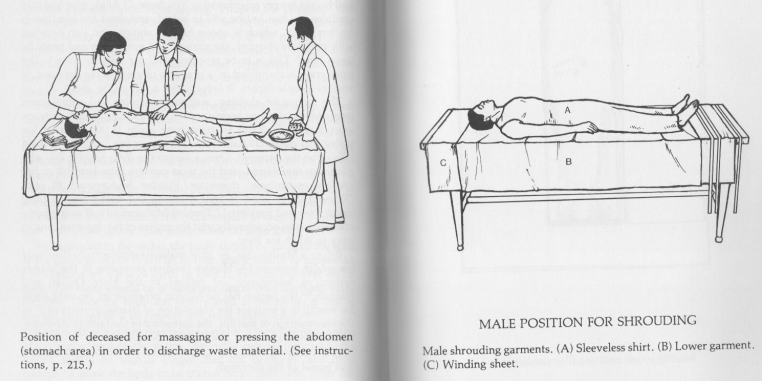
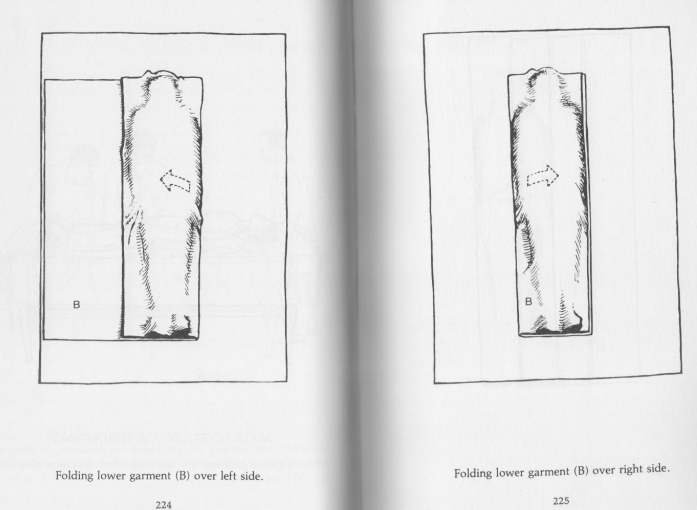
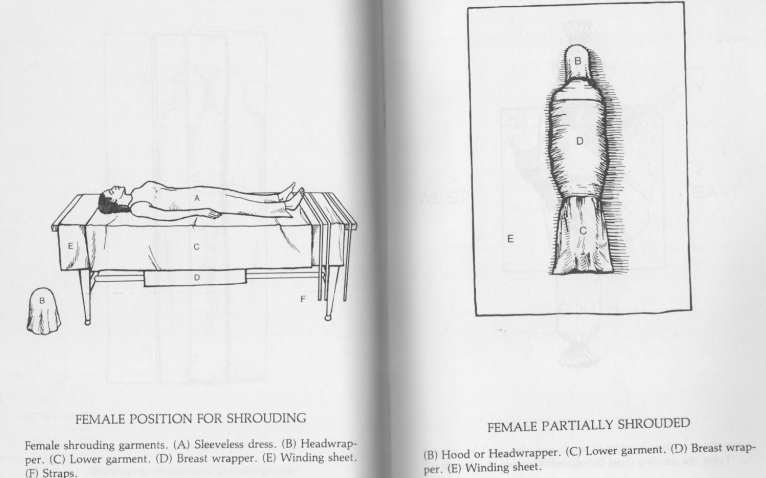
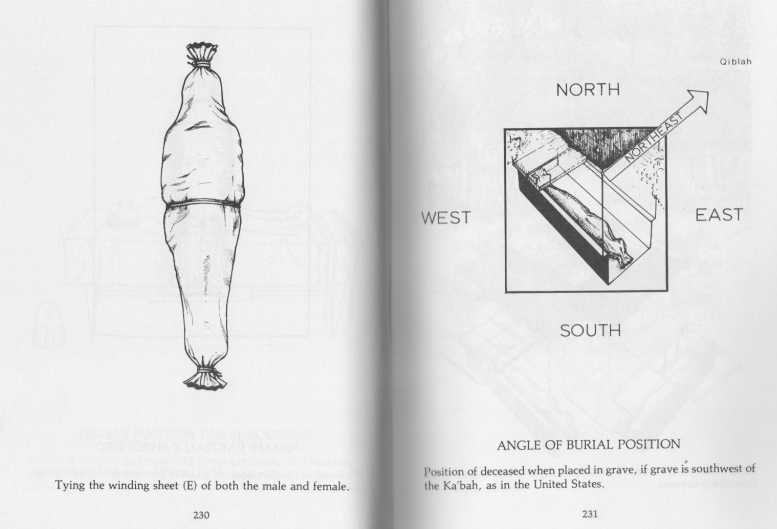
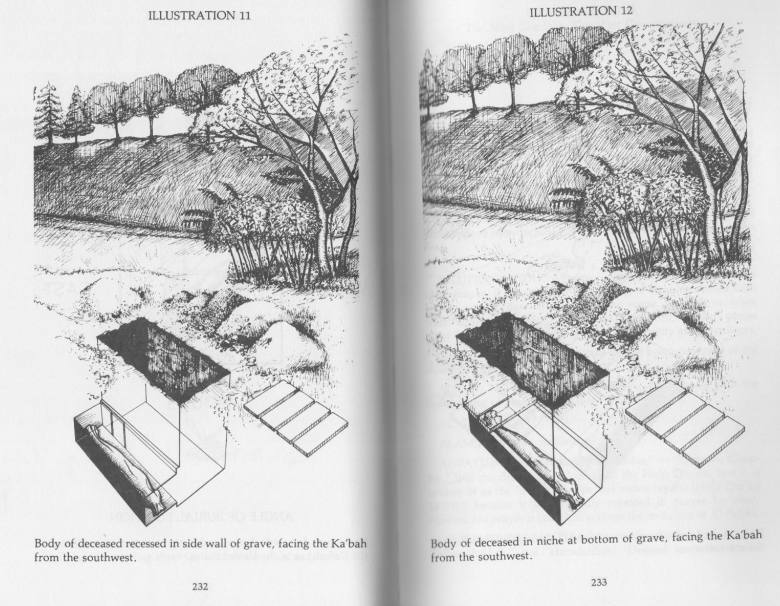
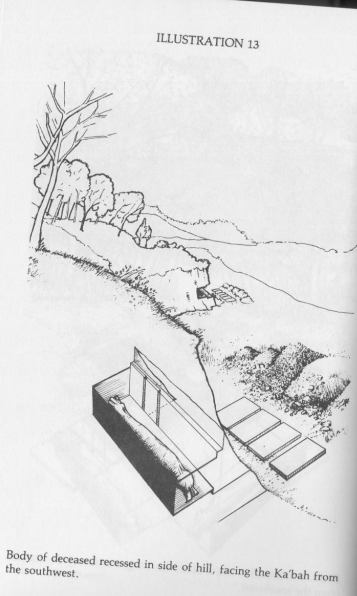 ILLUSTRATION 2
Position of deceased for massaging or pressing the abdomen
(stomach area) in order to discharge waste material. (See instruc-
tions, p. 215.)
MALE POSITION FOR SHROUDING
Male shrouding garments. (A) Sleeveless shirt. (B) Lower garment.
(C) Winding sheet.
223
ILLUSTRATION 3
ILLUSTRATION 4
Folding lower garment (B) over left side.
Folding lower garment (B) over right side.
224
225
ILLUSTRATION 5
ILLUSTRATION 6
C
Folding winding sheet (C) over left side.
Folding winding sheet (C) over right side.
226
ILLUSTRATION 7
ILLUSTRATION 8
FEMALE POSITION FOR SHROUDING
Female shrouding garments. (A) Sleeveless dress. (B) Headwrap-
per. (C) Lower garment. (D) Breast wrapper. (E) Winding sheet.
(F) Straps.
FEMALE PARTIALLY SHROUDED
(B) Hood or Headwrapper. (C) Lower garment. (D) Breast wrap-
per. (E) Winding sheet.
228
229
ILLUSTRATION 9
ILLUSTRATION 10
WEST
Qiblah
SOUTH
Tying the winding sheet (E) of both the male and female.
ANGLE OF BURIAL POSITION
*
I 'osition of deceased when placed in grave, if grave is southwest of
I lie Ka'bah, as in the United States.
230
231
ILLUSTRATION 11
ILLUSTRATION 12
Body of deceased in niche at bottom of grave, facing the Ka'bah
from the southwest.
Body of deceased recessed in side wall of grave, facing the Ka'bah
from the southwest.
233
232
ILLUSTRATION 13
In the Name Allah,
The Most Gracious, The Most Compassionate
Body of deceased recessed
the southwest.
in side of hill, facing the Ka'bah from
APPENDIX II
GLOSSARY
English translations and transliterations of Arabic words and
phrases have been included in alphabetical order for quick refer-
ence.
ABLUTION (WUDU): A form of worship which qualifies one to
enter prayer. It is performed by washing or cleaning oneself with
water, or with dust when there is no water available or when
water is not to be used due to illness. The word, "wudu," comes
Irom the root word, "wadu," which means purity and cleanliness.
ADHAN: Specific announcement for the commencement of the
lime of prayer.
AL-DIN: The Divine [religion] Making. Allah made it in the
best interest of humanity for this life and the next.
AL: The.
ALAMIN: Worlds, nations.
AL-FATIHA: Translated, "The Opening," or "Opening Chap-
ter." It is the first chapter (surah) of the Holy Qur'an, and it is
■■poken of as the "Seven oft-repeated verses (ayats) (Holy Qur'an
15:87)," because it is constantly repeated in prayer by every
Muslim. No prayer is complete without the recitation of Al-Fatiha.
Al.-HAMDULILLAH: "The Praise is for Allah." Pronounced,
"Alhamdulillah," not "Hamdulillah". Derived from the Arabic
234
GLOSSARY
GLOSSARY
words, "Al" (The, All), "hamida," (praise, appreciation and
thanksgiving), and "lillah" (for Allah).
AL-HAYY: Who has immortal life. (An attribute of Allah.)
AL-ISLAM: See Islam, A1-.
ALLAH: The Creator, Whose existence is absolutely necessary.
He is described with all descriptions of perfection. He is highly
glorified and exalted, and He is not to be described as having any
imperfections.
ALLAHU AKBAR: "Allah is The Greatest." This statement
shows a comparison between the Creator and His Creation
wherein The Creator is described as being greater, bigger and more
important than His Creation. This expression is known as "Takbir-
ah."
ALLAHU-S-SAMAD: The Eternal upon Whom all depend.
AL-RABB: Who sustains the creation and supplies it with His
Favor (One of the Names of Allah).
AN'AMTA: To give or to favor.
ANGEL: Their bodies are created by Allah from light. They are
not to be described as male or female. They are not produced by
birth, nor do they eat or drink. They are not disobedient to Allah,
and they do exactly as He orders. In the Holy Qur'an Allah says,
"O you who believe! Save yourselves and your families from a Fire
whose fuel is men and stones, over which are [appointed] angels
stern [and] severe, who flinch not [in executing] the Commands
they receive from Allah, but do [precisely] what they are com-
manded (Holy Qur'an 66:6)."
Each person has two angels who record his or her righteousness
or sin. The Holy Qur'an says, "It was We Who created man, We
know what dark suggestions his soul makes to him: for We are
nearer to him than [his] jugular vein. Behold, two [guardian
angels] appointed to learn [his doings] learn [and note it] (Holy
Qur'an 50:16-18)."
There are other angels who protect man from evil. The Holy
Qur'an says, "In the case of those who say, "Our Lord is Allah," j.
.Hid further, stand straight and steadfast, the angels descend on
them [from time to time]: 'Fear not! [they suggest], Nor grieve! But
icceive the glad tidings of the Garden [of Bliss], that which you
were promised! We are your protectors in this life and in the
I lereafter: Therein shall you have all that your souls shall desire;
l herein shall you have all that you ask for. A hospitable gift from
One Oft-Forgiving, Most Merciful! (Holy Qur'an 41:30-32).'"
AR-RAHMAN: The Beneficient (an Attribute of Allah).
AR-RAHIM: The Merciful (an Attribute of Allah).
ASHHADU: I bear witness.
ASHHADU ALLA ILAHA ILLA-LLAH: 1 bear witness that
there is no god (ilah) except Allah.
AS-SALAAM: The Peace. The name given to the pronounce-
ment of "As-salamu alaykum wa rahmatullah," while turning to
the right, and then repeating it while turning to the left at the end
of prayer.
AS-SALATU-KHAYRU-M-MINA-N-NAWM: Announcement
that prayer is better than sleep. Bilal first said it, and Prophet
Muhammad thereafter ordered him to include it in the Adhan
of Fajr.
A'UDHU BILLAHI MINASH SHAYTAN-NI-RAJIM: "I seek
refuge with Allah from Satan, the accursed." This statement is
< ailed ta'awwudh, and is to be said before each recital of the Holy
Qur'an (see Holy Qur'an 16:98), as well as before reciting Suratul-
l atiha in the first rak'ah of prayer. It is also said before one opens
I he Holy Qur'an.
AY AT: A sign or mark by which a thing is known. Verses or
words; one of the smaller portions of the Holy Qur’an's chapters
(nurahs). Ayat signifies a message or communication.
BISMILLAH: When translated into English it is relative to,
'In the Name Allah." The B in Bismillah signifies in, by, or
With. This expression is known as "Tasmiyah."
DHIKR: Remembrance of Allah. Repeating one or more of
236
glossary
GLOSSARY
words, "Al" •
thanksgiving),
AL-HAYY:
AL-ISLAM:
ALLAH: T1
He is describf
glorified and <
imperfections
ALLAHU
shows a cor
wherein The'
important th<
ah."
ALLAHU-
AL-RABB:
Favor (One <
AN'AMT,
ANGEL: ‘
not to be de
birth, nor d<
and they do
"O you who
whose fuel
stern [and]
they receivi
manded (H
Each per:
or sin. The
know wha<
nearer to
angels] apj
Qur'an 50:
There ai
Qur'an saj
Allah's Names silently or audibly as a form of worship.
DHUL-HIJJAH: The twelfth month of the lunar calenc
ing which the Pilgrimage to Makkah is made.
DIN AL-FITRAH: "The religion on that pattern establi
creation (Holy Qur'an 30:30)."
DU'A': Supplication; asking Allah, The Exalted O
anything relating to the affairs of this life or the Hereaftei
FAJR, SALATUL-: The Dawn prayer. The first prayei
day, which is said before sunrise. Salatul-Fajr has two obi
rak'ahs.
FALAH: Success.
FARD (WAJIB): Obligatory or compulsory. One gains m
doing such things. If one neglects them he is punished.
FATIHA: See AL-FATIHA.
FITRAH (FITR): To begin. Creation; the nature, constitut!
original condition in which all humanity is said to have
made. I
GHUSL: The washing of the whole body. In Is
jurisprudence (Fiqh) the term "ghusl" implies the purifyil
oneself in a prescribed manner, after the body has been rent
impure.
HADITH: A piece of news, tale, story or report relating
past or present event. In Al-Islam it is a record of the things
phet Muhammad jg said, practiced, approved and disappij
which reflect and demonstrate the teachings of the Holy Qu|
HAJJ: Literally, to repair to a place for the sake of a visl
Islamic terminology it implies performing pilgrimage to Mai
to visit the Ka'bah, which is often called "The House of Allah |
Allah)," and to observe necessary devotion. Hajj is obligator
least once in the life of a Muslim who is physically and finand
able. Performance of the Hajj includes taking part in the rituj
circling the Ka'bah, going between Safa and Marwa, standinl1
Arafat, throwing stones in Mina and participating in the sac®1
inimal. During Hajj it is also recommended to visit the tomb
phet Muhammad in Medinah.
[RAM: Forbidden or prevented. One who does such a thing
«• punished, one who avoids it will gain merit.
YYA: Come lively; come with life.
YYA 'ALAL-FALAH: Come to success.
YYA ALAS-SALAH: Come to prayer.
.IS, SHAITAN: He is the Chief Jinn. The Holy Qur'an says of
"Behold! We said to the angels, Bow down to Adam.' They
d down except Iblis. He was one of the Jinns, and he broke
ommand of his Lord. Will you then take him and his progeny
otectors rather than Me. And they are enemies to you! Evil
d be the exchange for the wrong-doers! I called them not to
css the creation of the heavens and the earth, nor [even their
creation]. Nor is it for Me to take as helpers such as lead
i] astray (Holy Qur'an 18:50)."
I is is also called Shaitan in the Holy Qur'an, wherein it says,
I behold, We said to the angels: 'Bow down to Adam.’ And
bowed down, not so Iblis. He refused and was haughty. He
of those who reject faith. We said: 'O Adam! dwell you and
wife in the Garden; and eat of the bountiful things therein as
rre and when] you will; but approach not this tree, or you run
harm and transgression.' Then did Shaitan (Satan) make them
Irom the [Garden], and get them out (Holy Qur'an 2:34-36)."
i the English language, Shaitan is also translated as "Devil."
I): A day which signifies happiness for Muslims. A day to wor-
i in congregation, to visit each other and to be kind to the poor
I destitute.
DUL ADHA: The Festival of Sacrifice which takes place at the
I of the Pilgrimage to Makkah. On this day, Muslims tradi-
i.illy sacrifice an animal for the pleasure of Allah, and to feed
poor and destitute members of the community.
DUL AL-FITR: Festival of Fastbreaking which comes after
nadan announcing that the fast is over, and that zakat has to be
238
239
GLOSSARY
GLOSSARY
paid before offering prayer.
If a crescent (moon in its first quarter) is sighted between the
time for the Maghrib and Isha prayer on the 29th day of fasting,
the following day is 'Id; if not, the Ramadan fast is observed for 30
full days, and the next (the thirty-first) day, will be 'Id. The cres-
cent has to be seen by two trustworthy adult male Muslims, who
may use a telescope. Once they have sighted it, the rest of the
Muslims in their country are obligated to finish the fasting. All the
Islamic countries which are geographically close enough to share
at least a few minutes of the night with the country which makes
the sighting are to follow it's lead in breaking the fast. The night is
significant because it is the time for making the intention to stop
fasting (and actions are judged by intentions). Thus, most coun-
tries of the Islamic world fast and break fast together. Muslims in
countries which don't share the night with the sighting country
will have daytime when the crescent is sighted. They are to con-
tinue fasting that day, and they are to break the fast together the
next day.
IKHLAS, AL-: Worshipping Allah alone.
ILAH: Worshipped One.
IMAM: A religious leader for the Muslim community. One who
leads or stands in front. He represents the best in obedience to the
law and teachings of Al-Islam, and he can best conduct the prayer
service of the Muslims.
IQAMAH: Announcement which marks the commencement of
congregational prayer.
ISHA, SALATUL-: Obligatory prayer offered between the
disappearance of the twilight and the first third of the night.
ISLAM, AL-: Peaceful resignation to the Will of the Creator.
The nature of everything in creation. Described in the Holy
Qur’an 30:30, as Din Al-Fitrah, the religion that is established on
the valuable pattern found in the very creation (nature) of the
heavens and the earth.
ISTIFTAH: Dhikr said between the first takbirah and The
Opening Chapter (Al-Fatiha). Several are reported to have been
'..lid by Prophet Muhammad %•,. The best known is: "Pure and
(.lorified are You, O Allah. Blessed is Your Name, and Exalted is
Your Majesty. There is nothing worthy of worship except You."
JA'IZ: Permitted (conceivable). One is free to do or not do such
things. If one's intention is to do them for the sake of Allah, he
gains merit.
JALSAH: The sitting position assumed between two prostra-
tions. It is essential in offering prayer. If one does not assume
j.ilsah his rak'ah is void, and he has to repeat it, otherwise his
whole prayer is void. Jalsah is assumed with the palms of the
hands on the thighs, with the fingers slightly parted and extending
to the knees.
JIHAD: The using or exerting of one's utmost power, efforts,
endeavors and ability in contending with an object of disapproba-
tion, whether by word or deed. There are three kinds of jihad:
1) against a visible enemy, 2) against the devil, 3) against oneself.
JINAZAH: A bier for a dead body, a funeral procession and the
corpse itself. From the word, "janaza," meaning, "he concealed or
hid [a thing]."
JINN: The Holy Qur'an says of the creation of Jinn, "We created
man from sounding clay, from mud moulded into shape; and the
linn race, We had created before [man], from the fire of a scor-
ching wind (Holy Qur'an 15:26-27)."
The Holy Qur'an also says that the Jinn are of two parties,
believers and unbelievers. It says of the believing Jinn, "Behold,
We turned towards you a company of Jinns [quietly] listening to
I he Qur'an; when they stood in the presence thereof, they said,
'Listen in silence!' When the [reading] was finished, they returned
to their people, to warn [them of their sins). They said, 'O our
people, (the Jinns)! We have heard a Book revealed after Moses,
confirming what came before it. It guides [men] to the Truth and
to a Straight Path. O our people, hearken to the one who invites
lyou] to Allah, and believe in Him: He will forgive you your
faults, and deliver you from a penalty grievous. If any does not
hearken to the one who invites [us] to Allah, he cannot frustrate
|Allah's Plan] on earth, and no protectors can he have besides
240
241
GLOSSARY
GLOSSARY
Allah. Such men [wander] in manifest error (Holy Qur'an
46:29-32)."'
Concerning the believing and the disbelieving Jinn, the Holy
Qur'an says, "Say: It has been revealed to me that a company of
Jinns listened [to the Qur'an]. They said, 'We have really heard a
wonderful recital! It gives guidance to the right, and we have
believed therein. We shall not join [in worship] any [gods] with
our Lord. And exalted is the Majesty of our Lord: He has taken
neither a wife nor a son. There were some foolish ones among us,
who used to utter extravagant lies against Allah; but we do think
that no man or spirit should say anything that is untrue against
Allah. True, there were persons among humanity who took shelter
with persons among the Jinns, but they increased them in folly.
And they [came to] think as you thought, that Allah would not
raise up any one [to Judgment], And we pried into the secrets of
heaven; but we found it filled with stern guards and flaming fires.
We used, indeed, to sit there in [hidden] stations, to [steal] a hear-
ing; but any who listens now will find a flaming fire watching him
in ambush. And we understand not whether ill is intended to those
on earth, or whether their Lord [really] intends to guide them to
right conduct. There are among us some that are righteous, and
some the contrary: we follow divergent paths. But we think that
we can by no means frustrate Allah throughout the earth, nor can
we frustrate Him by flight. And as for us, since we have listened to
the Guidance, we have accepted it: and any who believes in his
Lord has no fear, either of a short [account] or of any injustice.
Among us are some who submit their wills [to Allah], and some
who swerve from justice. Now those who submit their wills—they
have sought out [the path] of right conduct: but those who
swerve, they are [but] fuel for Hell-Fire (Holy Qur'an 72:1-15)."
JUMU'AH: Literally, Friday. An obligatory congregational
prayer which cannot be offered alone. An Imam is necessary to
lead this prayer service. In it he makes a speech or lecture (khut-
bah) in two parts and offers and audible prayer of two rak'ahs.
The prayer and khutbah are observed in place of the Zuhr prayer
on Friday.
JUNUB: A person (male or female) who is not in a state of
purification as a result of sexual intercourse (even if there has been
no ejaculation) or a wet dream.
KA'BAH-AL: The Sacred House of the Muslims, also known as
Bait Allah (the House of Allah). The oldest known house of wor-
ship on earth. It was rebuilt by Prophet Abraham and his son,
Ishmael, and it is situated in the Holy City of Makkah in Arabia. It
In the focal point for reckoning the proper direction to face when
pi.lying to Allah. The Ka'bah is twelve meters long, ten meters
wide and about sixteen meters high. The building is traditionally
i overed with a vesture (kiswah), made of cloth embroidered with
gold lettering, which is changed annually. The celebrated Black
Stone, which is enclosed in the structure, is not in the center of the
I a'bah, but in an outer wall close to its meridian angle.
K ALIM AH: "Ashhadu alia ilaha illa-llah. Muhammadur rasul-
ullah." "I bear witness that there is no god except Allah, and Mu-
ll.immad is the Messenger of Allah." A declaration of the unity of
Allah and the fact that Prophet Muhammad 5S is His Messenger.
Referred to as "The Word of Allah" in the Holy Qur'an. "And He
made the word of those who are unbelievers the lowest and the
Word of Allah the Highest (Holy Qur'an 9:40)."
KHUTBAH: A speech or lecture.
I.A-ILAHA ILLA-LLAH: Nothing is worthy of worship except
Allah. There is no god except Allah.
1.A1LATU AL-QADR: Night of Al Qadr (The Honor), during
which the Holy Qur'an came down from the protected tablets to
Bail Al Izzah (House of Respected Power) in the first heaven. Also
I lie night that the first five verses of the Holy Qur'an began to be
revealed to Prophet Muhammad S§. According to most Islamic
u< holars it occurred on the 27th night of Ramadan. (The 26th night
<d the lunar calendar, in which night precedes day.)
MAGHRIB, SALATUL: Obligatory prayer which is offered im-
mediately after sunset, announcing the commencement of the
< mning day.
MAHRAM: A woman whom a man is forbidden to marry and
have sex relations with i.e., his mother, daughters, sisters, aunts,
GLOSSARY
GLOSSARY
nieces, the ladies who breast fed him as a child, his mother-in-law,
step daughters, and the wives of his sons. It is also forbidden for a
man to be married to two sisters at the same time. All this is listed
in the Holy Qur'an (4:23).
MAKRUH: The hated, disliked or discouraged. One gains merit
by avoiding such a thing, but he is not punished for doing it.
MASJID: Mosque. Allah's House for the worship of Him. A
place of convenience for praying to Allah. Allah, The Most High
made the whole earth His Masjid for Prophet Muhammad ig and
his followers.
MIHRAB: A niche located in the center of a wall in a masjid. It
marks the direction of the Ka'bah and the place where the Imam
stands when leading the congregation in prayer.
MU'ADHDHIN: A man who gives the Call to Prayer (Adhan).
MUSLIM: One who submits himself to the Will of Allah. The
nature of all things. The major discipline for maintaining and ad-
vancing human life. The Holy Qur'an says, "It is He Who has
named you Muslims; both before and in this revelation that the
Messenger may be a witness to you, and you be a witness for
humanity (Holy Qur'an 22:78).''
MUSTAHABB: Recommended; advisable. One gains merit for
doing such a thing, but there is no punishment for not doing it.
MUTTAQI: One who fulfills his or her obligations, and who
avoids that which is forbidden; those who are right in their inten-
tions, and who have the fear of Allah in their hearts. Such persons
are dominated by the love of Allah, and they fear displeasing Him.
NAFL: A voluntary act; extra, above and beyond the obligatory
(fard). The Nafl prayer is recommended. Prophet Muhammad
offered two rak'ahs in prayer before Subh, two before and two
after Zuhr, two before 'Asr, two after Maghrib, two before Isha,
and three after Isha (Shaf and Witr). Each one of the above men-
tioned rak'ahs (offered by Prophet Muhammad are known as
Ratibah (parallel).
NIYYAH: The intention, aim or purpose of doing a thing.
QA'DAH (QU'UD): Literally, sitting. The sitting position in
which the Tashahhud is recited. The position of qa'dah is assumed
with the toes of the right foot touching the ground, and the left
hide of the left foot in contact with the ground. The hands rest
palms down on the thighs, with the fingers extending to the ends of
the knees. Qa'dah is not to be confused with jalsah, which is the
sitting position assumed between the two prostrations of each
rak'ah of prayer.
QAD-QAMAT1S-SALAH: "Prayer is commencing," Signal for
the congregation to form straight lines and assume the proper posi-
tion for prayer.
Q1BLAH, AL: The direction of the Ka'bah.
Q1YAM, AL: The standing position for prayer. It is assumed to
start the prayer (by saying "Allahu Akbar"), and when rising from
the bowing and prostrating positions.
QUNUT, AL: The humbling of oneself. The verse, "Stand up
lor Allah," means to humble oneself. "Al Qunut" is also the name
of the supplication to be said in the last rak'ah of Fajr prayer.
RABB: See Al-Rabb.
RAJIM: Exiled.
RAK'AH: Standing, bowing and making two prostrations,
assuming the sitting position between prostrations in prayer.
RAMADAN: The ninth month of the Muslim calendar year.
Ramadan is sacred for Muslims because it was during this month
I hat the Holy Qur'an was revealed to Prophet Muhammad Ufa. See
Holy Qur'an 2:185. Ramadan is also a month during which
Muslims fast through the day, and offer special prayer (Tarawih)
during the late night (Holy Qur'an 2:183).
RUKU': Bowing by bending the upper half of the body until the
back and the head are horizontally positioned, and even with the
floor.
SADAQAH: Additional charitable deed performed after the
obligation of zakat has been fulfilled.
244
GLOSSARY
GLOSSARY
SADAQATUL-FITR: Charity which is to be distributed to poor
and needy Muslims during the Festival of Fastbreaking ('Idul-Fitr).
This is a compulsory payment made at the end of the month of
Ramadan by every Muslim who is financially solvent enough to
pay it. Men are required to pay the Sadaqatul-Fitr charity on
behalf of themselves and their wives and children, including babies
who are born before sunset on the last day of Ramadan. It is
obligatory to pay this charity prior to the 'Idul-Fitr prayer. If one
pays afterwards instead, he is not considered to be paying Sadaqa-
tul-Fitr, but ordinary charity.
SAJDAH: The prostrating position for prayer. In this position
the nose, forehead, knees, toes, and palms of the hands are
touching the floor or ground. The head is placed between the
hands, which are beside the ears, with the fingers extended and
held together.
SALAH (SALAT): Prayer in Al-Islam; the burning out of im-
purities; purification and exaltation.
SALLA ALLAH ALAYHI WAS SALLAM: Allah praise and
venerate the Prophet, be kind to him and raise his position. "Wa
sallam" means, "give him continuous peace/safety."
SHAF: The even number. A term used for rak'ahs in prayer
when offered in pairs as a particular sunnah following Isha prayer.
SHAHADA: The bearing of witness, "Ashadu alia ilaha illa-
Ilah." (I bear witness that there is no god except Allah.)
SHAITAN: See Iblis.
SHART: Condition. Once it exists that which is built upon it
will exist, and vice versa.
SHAWWAL: The tenth month of the Muslim calendar year; the
month which follows Ramadan.
SUBH PRAYER: Obligatory prayer performed between the
beginning of the day (dawn) and sunrise. It is also called the Fajr
prayer because it is said during Fajr time (at the beginning of the
day).
SUBHANNALLAH: Pure and Glorified are You, O Allah. De-
•.< ribing Allah with no imperfections by saying "Subhan" ("I certify
I lie purity of Allah, Who is free from any description of imperfec-
tion").
SUNNAH: Literally means precedent and custom. Sunnah in
Al-lslam refers to the sayings, actions, and agreements made by
Prophet Muhammad and to the reports describing his life. It is
a tangible reference which embodies the way of life intended for
humanity.
SUTRAH: An object such as a stick, which is placed in front of a
praying person to act as a barrier between him and others who
pass in front of him in the area of his prostration. A sutrah must be
< lean, and its length must be equal to the distance from the elbow
Io the finger tips.
TA'AWWUDH: "A'udhu billahi minash shaytan-ni-rajim." (1
'.cek refuge with Allah from Satan, the accursed.)
TAHAJJUD: Literally, the giving up of sleep. It is derived from
bajada," which means, "he slept in the night," and, "he was wake-
lul in the night to pray." In Islamic religious terminology, tahajjud
denotes the prayer said in the latter part of the night, after rising
Irom sleep.
TAHANNUTH: Isolation far from sin.
TAKBIR, TAKBIRAH: Glorifying Allah by saying, "Allah is the
(neatest (Allahu Akbar)."
TAQABALLAH: Supplication asking Allah to accept a deed.
TAQWA: God-consciousness; the fear of God. It implies self-
lestraint in guarding oneself from all sin, wrong and injustice.
TARAWIH: The act of taking a rest. "Tarawih" is the plural of
l.irwihah, which is derived from "rahah," and which means to take
.1 rest. The name of the special night prayer offered during
Ramadan.
TASBIH: Declaring God to be free from every imperfection and
Impurity by saying, "Subhana-Allah." (Pure and Glorified are
246
247
GLOSSARY
GLOSSARY
You, O Allah.)
TASHAHHUD: Literally, testimony. A declaration of a Mus-
lim's faith recited during prayer: "All good whether rendered by
speech, by prayer, by worship or by deeds is for Allah. Peace be
on you, O Prophet and the Mercy and Blessings of Allah. Peace be
on us and the righteous servants of Allah. I bear witness that there
is no god except Allah. And I bear witness that Muhammad is His
Servant and Messenger." These words are recited while sitting |
after two rak'ahs (units), and at the final sitting before salutation
(salams) in prayer.
TASHRIQ, AYYAMUL: Derived from sharq, which means
east. The three days pilgrims spend at Mina during Hajj; three
days following the first day of the Festival of Sacrifice ('Id-
ul-Adha).
TASLIM: The saying of, "As-salamu 'alaykum wa rahma-
tullah." (Peace be on you and the Mercy of Allah.) It is the con-
cluding dhikr of the prayer service, and it is offered while in the j
sitting (qa'dah) position. {
TASMI' (Tabliqh): Saying, "Sami-allahu li-man-hamidah," (Al-
lah hears him who praises Him) in a loud voice while rising from
the bowing to the standing position to pass the Imam's word to
others who cannot hear (when one is at the limits of the Imam's
voice).
TASMIYAH: The saying of, " Bismillah Ar-Rahman, Ar-Rahim
(In the Name Allah, The Most Gracious, The Most Compas-
sionate)."
TAYAMMUM: Purification by dust. When there is no water
available, or when a worshipper is unable to use it, he may purify
himself for prayer by striking dust, stone, sand, etc., (once only)
before rubbing the face and the hands, and then intertwining the
fingers of both hands. See Holy Qur'an 5:7.
UMMAH (UMMAT): A nation or community.
WAJIB: See Fard.
WITR: The odd number. The name for the last rak'ah perform-
cd as a particular sunnah after Isha prayer.
WUDU: See ablution.
YAWM: Day; a period of time. Al Yawm extends from sunset of
one day to sunset of the next. (A full day of the lunar calendar, in
which night precedes day.)
YAWMU-AL-DIN: The Day of Account and Reward, accor-
ding to Islamic Jurisprudence.
ZAKAT: Obligatory charity observed by giving specific
amounts to the Muslim treasury. According to the Holy Qur'an
Zakat is only to be distributed to: 1) poor Muslims, 2) the desti-
lute, 3) those who work collecting the charity, 4) those whose
hearts are to be encouraged to accept Al-Islam, 5) to free the cap-
lives, 6) those who have debts, 7)those who are fighting unbe-
lievers, or preaching Islam according to the example of Prophet
Muhammad sg, without any luxury or expenditurewhich is not
approved by the Holy Qur'an, and 8) travelers who have lost their
money, even if they are wealthy in their own countries, and even
if they are traveling by an expensive mode of transportation, as
long as their travels are not for non-Islamic purposes. See Holy
Qur'an 9:60.
ZUHR, SALATUZ: Noon or midday obligatory prayer offered
after the sun moves from its zenith (center of heaven).
248
249
In the Name Allah,
The Most Gracious, The Most Compassionate
APPENDIX III
REFERENCE MATERIAL AND
EXPLANATORY NOTES
The material in this section is from various sources as indicated.
Material referred to can be found by locating the corresponding
lootnote number in the text.
1. For an explanation of the phrase, In the Name Allah (In
the Name of Allah), see Glossary, page 237.
2. Holy Qur'an 2:208, The Heifer, "O You who believe! come,
all of you, into peace [unto Him]; and follow not the foot-
steps of the devil. Lo! he is an open enemy to you."
3. Holy Qur'an 19:93, Mary.
4. Holy Qur'an 14:46, Abraham.
5. Holy Qur'an 29:13, The Spider.
6. Holy Qur'an 112:1-4, The Purity.
7. Holy Qur'an 6:103, Cattle.
8. Holy Qur'an 6:104, Cattle.
9. Holy Qur'an 2:285, The Heifer, "The Prophet believes in
what has been revealed to him from his Lord, as do the
believers. Each one [of them] believes in Allah, His Angels
and His Prophets. They say, 'We make no distinction be-
tween one and another of His Messengers.' And they say,
'We hear, and we obey.'"
251
APPENDIX III
REFERENCE MATERIAL AND EXPLANATORY NOTES
Holy Qur'an 4:136, The Women, "O you who believe!
Believe in Allah and His Messenger, and the scripture which
He has sent to those before [him]. Any who deny Allah, His
Angels, His Books, His Prophets, and the Day of Judgment,
has gone far astray."
10. Holy Qur'an 29:46, The Spider.
11. Holy Qur'an 41:43, Ha-Mim, "Nothing is said to you that
was not said to the messengers before you."
12. Holy Qur'an 16:44, The Bee.
13. The divisions of the Holy Qur'an pertain to the Makkah and
Madinah Revelations. The Holy Qur'an was revealed to Pro-
phet Muhammad Sg over a period of twenty-three years,
thirteen of which he spent in Makkah and ten in Madinah. Of
the 114 chapters, 93 were revealed in Madinah.
14. The Holy Qur'an is the Word of Allah. It was not created. It
was revealed to Prophet Muhammad $£. Prophet Muham-
mad personally dictated the Revelations to a Committee of
scribes who wrote the verses of the Holy Qur'an and placed
them in the text as he indicated in its present arrangement,
while in his presence. Abu Bakr, who became the first Khali-
fah immediately after the passing of Prophet Muhammad 5§,
commissioned the collection of Prophet Muhammad's jg
transcriptions in a single volume, with the verses conforming
to the arrangement dictated by Prophet Muhammad jg. Uth-
man, who succeeded Abu Bakr as Khalifah, ordered that all
copies of the Holy Qur’an be made from Abu Bakr's collec-
tion. Uthman then placed copies of the Holy Qur'an commis-
sioned by Abu Bakr in the various Islamic centers of learning
so that Muslims from outside of Arabia, and those who
would later reproduce the Holy Qur'an would have a stan-
dard copy to follow. Thus the Holy Qur'an was preserved.
To this day copies of the Holy Qur'an as written in the time
of the Khalifat of Uthman can be found in various centers of
learning.
15. Holy Qur'an 15:9, The Rocky Tract.
16. Holy Qur'an 35:31, The Originator.
17. Holy Qur'an 81:27-28, The Folding Up.
18. Holy Qur'an 49:13, The [Inner] Apartments.
19. From "The Benefactor," by Fakir Syed Waheed Uddin.
20. Holy Qur'an 26:192-195, The Poets (M.M. Pickthall).
21. Sahih Muslim, Vol. I, p. 96, no. 301. Aishah, the wife of Pro-
phet Muhammad jg, reported, 'The first form with which
began the Revelation to the Messenger of Allah sg was the
true vision in sleep. And he did not see any vision but it came
like the bright gleam of dawn. Thenceforth solitude became
dear to him and he used to seclude himself in the cave of
Hirah, where he would engage in tahannuth1 [and that is a
worship for a number of nights] before returning to his family
and getting provisions again for this purpose. He would then
return to Khadijah and take provisions for a like period, till
Truth came upon him while he was in the cave of Hirah.
There came to him the Angel Gabriel and said, 'Read,' to
which he replied, 'I cannot read.' He took hold of me [Pro-
phet Muhammad sg said] and pressed me till I was hard
pressed; thereafter he released me and said, 'Read.' I said, 'I
cannot read.' He then again took hold of me and pressed me
for a second time till I was hard pressed and then released me
and said, 'Read,' to which I replied, 'I cannot read.' He took
hold of me and pressed me for the third time till I was hard
pressed and then released me and said, 'Read in the name of
your Lord and Cherisher, Who created, created man out of a
clot of congealed blood. Read, and your Lord Most Bountiful
is He Who taught by [the use of] the pen, taught man that
which he knew not (Holy Qur'an 96:1-5).' Then Prophet
Muhammad sg returned therewith, his heart was trembling
and he went to Khadijah and said, 'Wrap me up, wrap me
up!' So she wrapped him till the fear had left him. He then
said to Khadijah, 'O Khadijah! What has happened to me?'
And he informed her of the happening, saying, 'I fear for
myself.' She replied, 'It can't be. Be happy, I swear by Allah
that He shall never humiliate you. By Allah, you join ties of
relationship, you speak the truth, you bear people's burdens,
1. Tahannuth means to avoid and abstain from sin. The worshipping of Allah for a
certain period in seclusion. The word is used in the latter sense for the seclusion of
Prophet Muhammad jig on Mt. Hirah. The original word is yatahannaf. which
means he follows the mode of worship of Hanifiyah, i.e., of Prophet Abraham.
253
252
APPENDIX III
REFERENCE MATERIAL AND EXPLANATORY NOTES
you help the destitute, you help against the vicissitudes which
affect people.' Khadijah then took him to Waraqah b. Nawfal
b. Asad b. Abd Al-Uzzah, who was the son of Khadijah’s
uncle (the brother of her father). And he was the man who
embraced Christianity in the Days of Ignorance [before Al-
Islam], and he used to write books in Arabic, and therefore
wrote Injil (Gospel) in Arabic as Allah Willed that he should
write. He was very old and had become blind. Khadijah said
to him, O Uncle! Listen to the son of your brother.' Waraqah
b. Nawfal said: 'O my nephew! What did you see?' The
Messenger of Allah sg then informed him [of] what he had
seen, and Waraqah said to him, 'It is Al-Namus2 that Allah
sent down to Musa (Moses). Would that I were then (during
your prophethood) a young man. Would that I might be alive
when your people would expel you!’ The Messenger of Allah
said, ‘Will they expel me?’ Waraqah said, 'Yes, never came
a man with a like of what you have brought but met hostili-
ties. If I see your day, I shall help you wholeheartedly.'"
22. Holy Qur'an 18:110, The Cave, "Say, ‘I am but a man like
yourselves, [but] the inspiration has come to me, that your
God is One God: whoever expects to meet his Lord, let him
work righteousness, and in the worship of his Lord, admit no
one as partner.'"
23. Imam Muhaddith Abdullah Ibn as-Siddiq reported, "Umar
Ibn Khatab came to Prophet Muhammad and found him
sleeping on the burlap cords of his bed frame without a mat-
tress. He saw that the cords had made an imprint on the Pro-
phet’s jg body. Umar looked around the room and saw, on a
window shelf, only a handful of barley for food. His eyes fill-
ed with tears and he cried. Prophet Muhammad asked
him, 'What is the matter with you, son of Khatab?' Umar
replied, 'Heraclius, the enemy of Allah, sleeps on silk, and
you, the Messenger of Allah jg are in this condition.’ The
Prophet asked him, 'Are you not pleased [to have] this life
for them and the next for usl' Umar answered, ‘I am pleased.'
The Prophet jig said, 'That's it.’"
2. ALNumus is the angel who is entrusted with Divine Revelations
Imam Muhaddith Abdullah Ibn as-Siddiq reported: when
Prophet Muhammad's friends saw him living in a condi-
tion of hardship and limited wealth, they said to him, "Why
don't you take something softer for your bedding than what
you have?" He replied, "My relationship with this life is like
that of a riding traveller who dismounts under the shade of a
tree for one hour of the day, then goes away, leaving it
[behind].”
24. Imam Muhaddith Abdullah Ibn as-Siddiq.
25. Holy Qur'an 4:7, Women, "Unto the men {of a family]
belongs a share of that which parents and near kindred leave,
and unto the women a share of that which parents and near
kindred leave, whether it be little or much, a legal share."
26. Holy Qur'an 39:6, The Crowds, "He created you [all] from a
single person: then created, of like nature his mate;. . ."
27. Holy Qur'an 68:4, The Pen.
28. Holy Qur'an 3:58, The Family of Imran.
29. Hadiths which stand up under the test of the Holy Qur'an are
obviously very valid and genuine. But if the hadith says
something that conflicts with the teachings of the Holy
Qur'an, it cannot be accepted as a genuine hadith. Sunnah
and hadith are the second sources from which the teachings
of Al-Islam are drawn. Literally, sunnah means a way, rule,
manner of acting or mode of life, and hadith means a state-
ment conveyed to man through hearing or revelation. In Al-
Islam, sunnah and hadith are the accurate accounts of the
practices and sayings of Prophet Muhammad sg. Although
both terms are generally considered to be synonymous,
hadith is actually a narration of the sunnah along with addi-
tional prophetical and historical elements. The Holy Qur’an
has also been referred to as Hadith because it is the First and
pure Hadith for Muslims (Holy Qur'an 18:6, 39:23).
The sunnah, or hadith of Prophet Muhammad 3g was not,
as is often supposed, a guide which gained practical necessity
only after his passing, [t was needed as much during his
lifetime as it is today. Any serious student of Al-lslam will
agree that the Holy Qur’an generally deals with the broad
254
255
APPENDIX III
REFERENCE MATERIAL AND EXPLANATORY NOTES
principles or essentials of our religion, rarely supplying
details. The details were supplied by Prophet Muhammad si.
It is reported that Prophet Muhammad said, "Honesty, de-
scended from the Heavens and settled in the roots of the hearts
of men [faithful believers], and then the Holy Qur'an was
revealed and the people read the Holy Qur'an [and learned it]
and also learned it from the sunnah." (Sahih Al-Bukhari, Vol.
IX, p. 283, no. 381.)
As Al-Islam covers the whole sphere of human life (activi-
ty), Prophet Muhammad had to explain hundreds of
points through his actions and words. The Holy Qur’an says,
"You have indeed in the Messenger of Allah a beautiful pat-
tern [of conduct] for anyone whose hope is in Allah and the
Final Day, and who engages much in the praises of Allah
(33:21)."
The Holy Qur'an enjoins us to believe in Allah and His
Messenger, yet it was Prophet Muhammad jf, who taught us
to express this belief through the statement, "I bear witness
there is no god but Allah, and Prophet Muhammad is His
Messenger." The Holy Qur'an enjoins us to pray, yet it con-
tains no details of how we are to pray. Prophet Muhammad
provided us with those details through the example
established in his actions. Similarly, the Holy Qur'an enjoins
Muslims to pay zakat (obligatory charity), yet it was Prophet
Muhammad who gave us the rules and regulations for its
payment and collection. These examples, and many others
show us that all who embrace Al-Islam stand in immediate
need of both the Holy Qur'an and the sunnah of Prophet
Muhammad Sg in order to fully implement the fundamentals
of Al-Islam.
Throughout both the Makkah and Madinah Revelations,
Allah emphasizes the importance of the example set by Pro-
phet Muhammad •?§. Allah says, "We have sent unto you a
messenger from among you, who recites unto you Our
Revelations and causes you to grow, and teaches you the
Scripture (Holy Qur'an) and wisdom (Hadith), and teaches
you of that which you did not know (the unseen)," and "We
sent not a Messenger, but to be obeyed, in accordance with
the Will of Allah." (2:151, and 4:64.)
In the Holy Qur'an Allah also says, "It is not fitting for a
believer, man or woman, when a matter has been decided by
Allah and His Messenger, to have any option about their
decision: If any one disobeys Allah and His Messenger, he is
indeed on a clearly wrong path (33:36)." And, "O you who
believe! Obey Allah, and obey the Messenger, and those
charged with authority among you. If you differ in anything
among yourselves, refer it to Allah and His Messenger, if you
do believe in Allah and the Last Day: that is best and most
suitable for final determination (4:59)."
Because some scholars have referred to certain hadiths as
sound, meaning that they are accurate, while labeling inac-
curate reports "unsound hadiths," we must be cautious in ac-
cepting accounts of Prophet Muhammad's sg words and
deeds when we are not knowledgeable regarding their source.
In the Holy Qur'an Allah says, "We have, without doubt,
sent down the Remembrance (dhikr), and We will assuredly
guard it [from corruption] (15:9)." In reality, inaccurate or
false reports are not to be considered hadiths at all, as the
words, "Hadith of Prophet Muhammad Sjs," refers only to ac-
curate reports of what he said and did. To exemplify the
perfection attained by Prophet Muhammad Sg, and the im-
portance of following his words, Allah says in the Holy
Qur'an, "Your companion is neither astray nor being mis-
lead, nor does he say [anything] of [his own] desire. It is no
less than inspiration (revelation) sent down to him: He was
taught by one Mighty in Power, endued with Wisdom: for he
appeared [in stately form] while he was in the highest part of
the horizon. Then he approached and came closer, and was
at a distance of but two bow lengths or [even] nearer; so did
[Allah] convey the inspiration to His Servant, [conveyed]
what He [meant] to convey. The [Prophet's mind and] heart
in no way falsified that which he saw. Will you then dispute
with him concerning what he saw?" (Holy Qur'an 53:2-12).
When there is a reference to Prophet Muhammad which
seems questionable, there is a test which scholars in the sci-
ence of Hadith must use. When we find a report attributed to
256
257
APPENDIX III
REFERENCE MATERIAL AND EXPLANATORY NOTES
Prophet Muhammad contrary to the spirit of the Holy
Qur'an, we cannot accept that account as true.
30. Holy Qur'an 33:21, The Confederates.
31. Holy Qur'an 4:59, The Women.
32. Holy Qur'an 59:7, The Gathering [or] Banishment (M.M.
Pickthall).
33. Holy Qur'an 17:95, The Children of Israel.
34. Holy Qur'an 3:64, The Family of Imran.
35. Leviticus 26:1.
36. Holy Qur'an 2:112, The Heifer.
37. St. John 16:12-13.
38. Holy Qur'an 5:4, The Table Spread.
39. When Prophet Muhammad began his mission he only re-
quired that his followers verbally pledge their hearts, accept-
ance of Al-Islam; later obligatory duties were imposed upon
them. These duties deal with prohibition. Wine was known
and forbidden during the lifetime of Prophet Muhammad
because it could make a person drunk and befog the mind.
Today there are many different kinds of wines and liquors
which can befog the mind. Some of these were not in exist-
ence during the lifetime of Prophet Muhammad j§, yet we
know they are also forbidden because they have the same ef-
fect on our minds and bodies.
Regarding putting faith into action: When the early after-
noon prayer time arrives, it becomes compulsory for a
Muslim to know how to pray. He is then to put that
knowledge into action. This is also the case with the other
obligatory prayers. When the month of Ramadan arrives it is
compulsory for the Muslim to know the rules of fasting in
order to fulfill his obligation to Allah. This also applies to
zakat, pilgrimage, and the other duties which are ordained by
Allah and His Messenger and which are binding on all
Muslims.
40. The early Christian Church regarded disease as a punishment
for sin and held the belief that illness could be cured only
through prayer and repentance. The human body was also
held to be sacred, and dissection was forbidden. (See En-
cyclopedia Britannica, 15th Edition, Medicine, History of, p.
828, for further information on this subject.)
41. Holy Qur'an 9:20, Repentance [or] Immunity (M.M. Pick-
thall).
42. Holy Qur'an 13:11, Thunder, "Surely Allah does not change
[the condition they are suffering from] that which is with a
nation until they change that which is within their souls [the
attitudes of their heart]."
43. Holy Qur'an 4:125, The Women, "Who can be better in
religion than one who submits his whole self to Allah, does
good, and follows the way of Abraham, the true in faith?
Allah chose Abraham for a close friend."
44. Holy Qur'an 3:67, The Family of Imran.
45. Holy Qur'an 41:30-32, Ha-Mim, "In the case of those who
say, 'Our Lord is Allah,' and further, stand straight and
steadfast, the angels descend on them [from time to time]:
'Fear not! [they suggest], Nor grieve! But receive the glad
tidings of the Garden [of Bliss] which you were promised! We
are your protectors in this life and in the Hereafter: Therein
shall you have all that your souls shall desire; therein shall
you have all that you ask for! A hospitable gift from The One
Oft-Forgiving, Most Merciful.'"
46. Holy Qur'an 22:78, The Pilgrimage.
47. Holy Qur'an 41:11, Ha-Mim.
48. Holy Qur'an 2:131-132, The Heifer.
49. St. Matthew 6:10.
50. Holy Qur'an 2:112, The Heifer.
51. Holy Qur'an 2:41-43, The Heifer.
52. Holy Qur'an 22:46, The Pilgrimage.
53. Holy Qur'an 34:6, The City of Saba.
54. Sahih Muslim, Vol. I, p. 3, 4, no. 4.
55. Holy Qur'an 7:201, The Heights.
56. A Muslim is one who submits himself or herself to Allah.
57. Holy Qur'an 25:63, The Criterion.
58. Holy Qur'an 57:28, Iron.
59. The Jinn is a kind of creation created from fire. They have an
influence on man's nature which has the tendency to keep
him from obeying Allah. They are of two kinds: believers
258
259
APPENDIX III
REFERENCE MATERIAL AND EXPLANATORY NOTES
and non-believers. Jinn will obey man, if man obeys Allah.
The Holy Qur'an 72:1-14, The Spirits, tells us that there were
Jinn who believed in the Message of the Holy Qur’an. Also
see Holy Qur'an 46:29, 51:56; and 55:33.
60. Holy Qur'an 51:56, The Winds That Scatter.
61. Holy Qur'an 3:84, The Family of Imran.
62. Holy Qur'an 42:13, Consultation.
63. I Corinthians 14:33.
64. Holy Qur'an 41:43, Ha-Mim.
65. St. John 9:5.
66. St. John 14:16.
67. Holy Qur'an 2:41, The Heifer.
68. Holy Qur'an 2:62, The Heifer.
69. Holy Qur'an 2:121, The Heifer.
70. Holy Qur'an 14:1, Abraham.
For information relating to the writers of the New Testa-
ment, see the following publications: 1) William Smith,
"Smith's Bible Dictionary." Westward, N.J., Fleming H.
Revell Company, Pyramid Publications, Inc., pp. 214, 445,
446. 2) Bamber Gascoigne, "The Christians." New York,
Granada Publishing, p. 9. 3) "Christianity." Encyclopedia
Britannica, 15th Edition, p. 489, 490. 4) H.G. Wells, "The
Outline of History." Third Edition, New York, The Mac-
Millan Company, pp. 49, 510, 511, 522 and 523. 5) "Paul the
Apostle, Saint." Encyclopedia Britannica, pp. 1090-, 15th
Edition.
71. Holy Qur'an 50:1-3, Qaf.
72. Holy Qur'an 99:1-8, The Convulsion.
73. Holy Qur'an 6:160, Cattle.
74. Holy Qur'an 2:30-31, The Heifer, "Behold, your Lord said to
the angels, 'I will create a viceregent on earth.' They said,
'Will You place therein one who will make mischief therein
and shed blood, while we do celebrate Your Praises and
glorify Your Holy [Name]?' He said, 'I know what you know
not.' And He taught Adam the nature of all things "
75. Holy Qur'an 4:135, The Women.
76. Holy Qur'an 29:56, The Spider.
77. Holy Qur'an 8:38, The Spoils of War.
78. Sahih Al-Bukhari, Vol. I, p. 36, Chapter 32, Abu Said Al-
Khudri reported that Allah's Messenger said, "If any per-
son embraces Al-Islam sincerely, then Allah shall forgive all
his past sins, and after that begins the settlement of accounts:
the reward of his good deeds will be ten times to seven hun-
dred times for each good deed, and a bad deed will be record-
ed as it is, unless Allah forgives it."
79. Sahih Muslim, Vol. I, p. 71, no. 222.
80. The spending of 2 Vi percent of one's annual net savings in
Al-Islam is not a voluntary charity. It is obligatory for every
Muslim who meets the requirements for paying it.
81. Holy Qur'an 70:24-25, The Ways of Ascent, "And those in
whose wealth is a recognized right for the [needy] who asks,
and for him who is prevented [for some reason from asking]."
82. Holy Qur'an 9:103, Repentance.
83. Holy Qur'an 107:4-7, The Neighborly Needs, "So woe to the
worshippers who are neglectful of their prayers, those who
[want but] to be seen [of men], but refuse [to supply even]
neighborly needs."
84. Holy Qur'an 2:264, The Heifer.
85. Sahih Muslim, Vol. II, p. 484, no. 2205.
86. Holy Qur'an 49:15, The Apartments.
87. Jihad is exerting one's utmost power, efforts, endeavors or
ability in contending with an object of disapprobation,
whether by word or deed [See Glossary],
88. Holy Qur’an 2:183, The Heifer.
89. Holy Qur'an 79:40-41, Those Who Tear Out.
90. Holy Qur'an 3:96, The Family of Imran, "Surely, the first
House [of worship] appointed for people was that at Mak-
kah, full of blessing and of guidance for all kinds of beings."
91. Holy Qur'an 4:125, The Women.
92. Holy Qur'an 2:256-257, The Heifer.
93. Holy Qur'an 22:40, The Pilgrimage.
94. Holy Qur'an 6:107, 108, Cattle.
95. Holy Qur'an 2:148, The Heifer.
96. Holy Qur'an 2:140, The Heifer, ". . .Ah! who is more unjust
than those who conceal the testimony they have from Allah?
97. Holy Qur'an 87:6, The Most High.
260
261
APPENDIX III
REFERENCE MATERIAL AND EXPLANATORY NOTES
98. Holy Qur'an 3:187, The Family of Imran.
99. Holy Qur'an 16:125, The Bee.
100. Holy Qur'an 41:33, Ha-Mim.
101. Holy Qur'an 2:140, The Heifer.
102. Holy Qur'an 2:283, The Heifer.
103. Sahih Al-Bukhari, Vol. VIII, p. 88, no. 137.
104. Holy Qur'an 3:102, 103, The Family of Imran.
105. Holy Qur'an 4:86, The Women.
106. Holy Qur'an 72:21-22, The Jinn.
107. Holy Qur'an 2:186, The Heifer.
108. Prayer in Al-Islam is not a common way of making supplica-
tion. It is a specific form of daily worship, and it distinguishes
the Muslim from the non-Muslim as Prophet Muhammad 5$
taught.
109. Psalms 55:17.
110. Sahih Muslim, Vol. I, p. 102, no. 309, Anas b. Malik
reported that Allah said to Prophet Muhammad jg, "There
are five prayers every day and night, O Muhammad, each be-
ing credited as ten; so that makes fifty prayers. He who in-
tends to do a good deed and does not do it will have a good
deed recorded for him; and if he does it, it will be recorded
for him as ten. Whereas he who intends to do an evil deed
and does not do it will not have an evil deed recorded for
him. And if he does it, only one evil deed will be recorded.”
Holy Qur'an 30:17-18. The Roman Empire, "So [give]
glory to Allah, when you reach eventide and when you rise in
the morning. Yea, to Him be praise in the heavens and on
earth; and in the late afternoon and when the day begins to
decline."
111. Sahih Muslim, Vol. I, p. 104, no. 313.
112. Isaiah 55:6.
113. St. Luke 21:36.
114. Holy Qur'an 29:45, The Spider.
115. Holy Qur'an 11:114, The Prophet Hud.
116. Sahih Muslim, Vol. I, p. 9, 10, no. 18. Abdullah, the son of
Umar, reported that Prophet Muhammad said, "The
superstructure of Al-Islam is raised on five [Pillars], i.e., the
Oneness of Allah, the establishment of prayer, payment of
zakat, the fast of Ramadan, pilgrimage [to Makkah]."
I 17. Holy Qur'an 30:31, The Roman Empire.
118. Holy Qur'an 74:42-46, One Wrapped Up.
119. Holy Qur'an 19:58-59, Mary.
I.’.O. Holy Qur'an 11:114, The Prophet Hud, "And establish
regular prayers at the two ends of the day and at the ap-
proaches of the night, for those things that are good remove
those that are evil. Be that the word of remembrance to those
who remember [their Lord]."
121. Holy Qur'an 2:45, The Heifer (M.M. Pickthall).
122. Ibid.
123. Holy Qur'an 2:2-3, The Heifer.
124. Holy Qur'an 5:1, The Table Spread.
125. Holy Qur'an 4:101-103, The Women.
12b. Holy Qur'an 23:1-2, The Believers (M.M. Pickthall).
127. Holy Qur'an 4:103, The Women.
128. Holy Qur'an 17:78, The Children of Israel, "Establish regular
prayers at the sun's decline, till the darkness of the night, and
the morning prayer and reading: for the prayer and reading
in the morning carry their [angel's] testimony."
129. See Essentials, page 189, for instructions on how to perform
delayed or postponed prayers.
130. Sahih Muslim, Vol. I, p. 307, no. 1324. Umara b. Ruwaiba is
reported to have said on the authority of his father, "I heard
the Messenger of Allah jg saying, 'He who observed prayer
before the rising of the sun and its setting, i.e., the Morning
prayer and the Afternoon prayer, would not enter the [Hell]
fire.'"
131. Gardens of the Righteous, Imam an-Nawawi, p. 220, no.
1124. "Ibn Umar relates that the Holy Prophet M supplicated,
'May Allah have mercy on one who offers four rak'ahs before
'Asr.'" Abu Dawud and Tirmidhi, p. 220, no. 1125. "AU Ibn
Abi Talib relates, 'The Holy Prophet -JS offered two rak'ahs
before 'Asr prayer.'" (Abu Dawud.)
132. Sunset is when the sun has descended below the horizon.
133. Holy Qur'an 5:7, The Table Spread.
134. Holy Qur’an 22:34, The Pilgrimage (M.M. Pickthall).
135. Revelation 16:10; Ephesians 6:12.
262
263
REFERENCE MATERIAL AND EXPLANATORY NOTES
APPENDIX III
136. Holy Qur'an 113:1-5, The Dawn.
137. Holy Qur'an 14:52, Abraham (M.M. Pickthall).
138. Revelation 1:3.
139. Amos 8:11-12.
140. Daniel 12:8.
141. Isaiah 29:11-15.
142. Holy Qur'an 5:7, The Table Spread.
143. Sahih Al-Bukhari, Vol. I, p. 301, no. 506.
144. Sahih Al-Bukhari, Vol. I, p. 101, Chapter 1. Abu 'Abdullah
said, "Prophet Muhammad had shown him that ablution
was to wash the parts once. Prophet Muhammad per-
formed ablution by washing the parts two or three times, but
never more than three times."
Washing the parts of the body in ablution at least once is
obligatory, but to wash them two or three times is the prac-
tice of Prophet Muhammad jg.
145. Sahih-Al-Bukhari, Vol. Ill, p. 373, no. 624.
146. Sahih Muslim, Vol. IV, p. 1375, no. 6307. Abdullah reported
the Messenger of Allah as saying, "Truth leads one to
Paradise, and virtue leads one to Paradise, and the person
tells the truth until he is recorded as truthful, and a lie leads to
obscenity, and obscenity leads to Hell, and the person tells a
lie until he is recorded as a liar."
147. Holy Qur'an 7:19-20, The Heights, "O Adam! dwell you and
your wife in the Garden and enjoy [its good things) as you
wish; but approach not this tree, or you run into harm and
transgression. Then Satan began to whisper suggestions to
them, bringing all their shame openly before their minds."
148. If a woman has had her hair covered, and she has not broken
her obligatory bath, it is not necessary for her to wipe it. She
can make a gesture over the headpiece with damp hands in-
stead. It is necessary that she touch a few strands of un-
covered hair when wiping over the headpiece.
Sahih Muslim, Vol. I, p. 165, no. 534. Urwa b. al-Maghira
b. Shu'ba reported on the authority of his father, "Verily, the
Messenger Sgj performed ablution and wiped over his fore-
head, and over his turban and over his socks."
149. If clean socks are put on after one has completed an ablution,
it is permissible to wipe over them.
150. Sahih Al-Bukhari, Vol. I, p. 335, no. 580.
151. Abu Dawud, Kitab al-Salat. See Sahih Muslim, Vol. I, p.
207, Footnote no. 595.
152. Holy Qur'an 2:144, The Heifer, "We see the turning of your
face [for guidance] to the heavens: now shall we turn you to a
Qiblah that shall please you. Turn then your face in the direc-
tion of the Sacred Masjid, wherever you are, turn your faces
in that direction."
153. Sahih Al-Bukhari, Vol. I, p. 338, no. 588.
154. Sahih Muslim, Vol. I, p. 211, no. 756. On the importance of
repeating the words of the Adhan after the Mu'adhdhin, Abu
Hurayrah reported the Messenger of Allah sg as saying,
"When the Call to Prayer (Adhan) is made, Satan runs back
through the wind so as not to hear it, and when the Call is
finished, he turns around. When the Iqamah is proclaimed he
turns his back, and when it is finished he turns around to
distract a man, saying, ‘Remember such and such,' referring
to something the man did not have in his mind, with the
result that he does not know how much he has prayed."
155. Sahih Muslim, Vol. I, p. 209, no. 747.
156. See Glossary for definition of Iqamah.
157. Sahih Al-Bukhari, Vol. I, p. 342, nos. 596 and 597. Abdullah
bin Mughaffal Al-Muzani reported that the Messenger of
Allah 5g5 said, "There is a prayer between the two Adhans
[Adhan and Iqamah], for whoever wants to pray."
158. Sahih Al-Bukhari, Vol. I, p. 336, no. 583. Abdul Rahman
reported that Sa'id Al-Khudri told his father, "I see you liking
sheep and the wilderness. So whenever you are with your
sheep or in the wilderness and you want to pronounce Adhan
for the prayer, raise your voice in doing so, for whoever
hears the Adhan, whether human being, a jinn or any other
creature, will be a witness for you on the Day of Resurrec-
tion." Abu Sa'id added, "You heard it from the Messenger of
Allah 56."
159. Sahih Al-Bukhari, Vol. I, p. 335, no. 580. Anas bin Malik
reported, "Bilal was ordered to pronounce the wording of
Adhan twice, and that of the Iqamah once only, except 'Qad
264
265
APPENDIX III
qamatis salat."
160. Sahih Al-Bukhari, Vol. I, p. 297, no. 500. Abu Mas'ud Al-
Ansari said, "Don't you know that once Gabriel came and of-
fered the prayer (Fajr prayer), and the Messenger of Allah
prayed too. Then he (Gabriel) prayed again (Zuhr prayer),
and the Messenger of Allah jg did the same. Again he (Gabri-
el) prayed ('Asr prayer), and the Messenger of Allah 5g did
the same. Again he (Gabriel) prayed (Maghrib prayer), and
so did the Messenger of Allah jg. Again he (Gabriel) prayed
(Isha prayer), and so did the Messenger of Allah SK. And
Gabriel said, 'I was ordered to do so to demonstrate the
prayer prescribed for you."'
161. Sahih Al-Bukhari, Vol. I, pp. 404-05, no. 724.
162. Sahih Al-Bukhari, Vol. I, p. 404, no. 723.
163. Holy Qur'an 16:98, The Bee.
Evil has no authority or influence on those who put their
trust in Allah. It is good to make a formal expression of that
trust in outward actions, as in the formula, "I seek refuge in
Allah from Satan the accursed."
164. Some scholars maintain that "Bismillah, Ar-Rahman Ar-
Rahim," is a verse of Al-Fatiha. Muslims who hold this belief
are not considered to be wrong. Various schools of thought
in Al-Islam also approach the practice of reciting the phrase
before Al-Fatiha differently. Members of the Shafi' school say
it audibly. Members of the Maliki and Hanbali school pro-
nounce it silently.
165. The Islamic Scholars are in complete agreement that Al-
Fatiha (The Opening Chapter) was revealed in Makkah when
its recitation became obligatory for Muslims. Some believe
that it was also revealed in Madinah when the direction faced
during prayer was changed from Jerusalem to Makkah. Al-
Fatiha is known by many names. In the Holy Qur'an it is call-
ed, "The Seven Oft-Repeated Verses," because it is repeated
in every Muslim's prayers. It is also known as the Seven
Twins (Holy Qur'an 15:87, 15:1, and 10:1), The Chapter of
Confidential Prayer, The Opening of the Book, The Mother
of the Qur'an (The Book), The Treasure, The Sufficient, The
Provider, The Chapter of Supplication, Divine Protection,
REFERENCE MATERIAL AND EXPLANATORY NOTES
The Praise, The Thanksgiving, The Foundation, The Whole,
The Healer, The Healing, The Light, The Recoverer, The Re-
covery, The Chapter of Submission, The Essence of the Qur'-
an, The Basis of the Qur'an, and the Chapter of Teaching
How to Ask.
166. The Arabic word for Lord (Rabb) has also been interpreted as
Owner, Master, Worshipped One, Constant and Amender.
167. Sahih Muslim, Vol. I, p. 215, no. 775.
168. Sahih Muslim, Vol. I, p. 215, no. 772.
169. Imam Shafi' and a number of other Jurists (Fuqaha) are of the
opinion that the recitation of Surah Al-Fatiha by each in-
dividual is essential in all rak'ahs of jahri (audible) and sirri
(silent) prayers. In the jahri prayers (Fajr, Maghrib and Isha)
the Imam recites audibly, and in the sirri prayers (Zuhr and
Asr) he recites inwardly. Imam Malik and Imam Ahmed b.
Hanbal are of the opinion that in jahri prayers one should
listen to the Imam attentively without reciting, as the recita-
tion of the Imam absolves the followers of the responsibility.
According to Imam Abu Hanifa, the followers need not recite
Surah Al-Fatiha, even in sirri prayers, as the recitation of the
Imam [even though it is done inwardly] is sufficient for the
followers. Imam Abu Hanifa draws his argument from a
Hadith recorded in Abu Dawud, Nasa'i, ibn Maja, in which
the Messenger of Allah jg said, "The Imam is conferred upon
[this privilege] that his followers should follow him. So when
the Imam recites the takbir, you must also recite, and when
he recites [the Qur'an], you should listen to him." This
Hadith is an elucidation of the Holy Qur'an 7:204, "And
when the Qur'an is recited, listen to it and remain silent [so]
that mercy may be shown to you."
One can easily find in these arguments the true nature of
the differences of opinion amongst the Jurists. They all draw
their arguments from the Holy Qur'an and the Sunnah, thus
their differences are of interpretation and understanding.
They are, in fact, differences of preference rather than of
disbelief. The above mentioned opinions are all considered
valid since their base is one and the same.
266
267
APPENDIX III
REFERENCE MATERIAL AND EXPLANATORY NOTES
170. "All Praise is due to Allah (Al-Hamdulillah)" means Allah
knows that His slaves are incapable of praising Him in the
way in which He should be praised, so He praises Himself. By
Praising Himself, He sets an example and makes it easy for
His slaves to praise Him. When we say, "All Praise is due to
Allah," we are praising His Greatness, Oneness, Power, Fa-
vors, Knowledge, Ability, Wisdom, and all other qualities
described by His first Ninety-Nine Attributes. We are also
thanking Him for each of His Favors and for each act of Mer-
cy He bestows upon His Creation, now and in the Hereafter.
Prophet Muhammad said, "He who says, 'There is no
god but Allah,' is rewarded twenty merits. He who says, 'All
Praise is due to Allah, The Lord of all the worlds,' is reward-
ed thirty merits." Because the affirmation of Oneness which
occurs in "There is no god but Allah" has already occurred in
"All Praise is due to Allah," and because the latter has more
meaning, believers say it to receive rewards. Those who enter
the faith are enjoined to declare it because it provides special
benefits which help to cleanse the slave of bad desires, and to
sever those things which he unknowingly associates with
Allah.
Praising can be giving thanks for a favor, but it can also be
paying homage regardless of favors received. While praising
is generally done with the tongue, thanking may be done
with the tongue, limbs and heart. To thank with the tongue is
to praise and venerate the Giver and to spread the news of
His Gifts. Prophet Muhammad sg said, "Spreading the news
of the gifts is thanking." Thanking with the limbs is practicing
obedience to Allah and avoiding what is prohibited. Thank-
ing with the heart is understanding the value of the gift,
realizing that it is from Allah alone, and that it is not a right
of the slave. The gifts which we are obligated to thank Allah
for are innumerable, but they may be generally included in
three categories: 1) worldly gifts, 2) religious gifts, and 3)
Hereafter gifts. World}/ gifts include inherited (spirit, brain,
thinking, speech, etc.), physical (the body and its powers,
health, sound organs, physical beauty, etc.), and earned gifts
(purification of the spirit, i.e., cleansing it of bad behavior
and giving it a good manner, etc.). Religious gifts include
knowledge and taqwa (obeying the commands and avoiding
what is forbidden; following the Revelation and being pre-
pared for death; being pleased with whatever Allah gives,
even if it is a little, etc.). Hereafter gifts include forgiveness of
sins, the great reward in reply to the insignificant deeds of the
slave's short lifetime, an eternal place in the close company of
angels, and the favors of Paradise.
171. This is understood to refer to the worlds of humanity, jinn,
angels, ants, fish, etc. Thus Allah is The Lord of all creation.
172. Holy Qur'an 16:18, The Bee.
173. Also interpreted as King.
174. Holy Qur'an 9:111, Repentance.
175. Holy Qur’an 6:162, Cattle.
176. Literally translated, "The Visual Way." Al-Islam is under-
stood to be the visual way because it is apparent to the
believers that it is the right way to approach Allah. It is called
the "visible way" because it is as apparent to the believer as a
physically visible path.
177. Holy Qur'an 23:1-2, The Believers.
178. If a person is sick or physically unable to assume the correct
position, he may say his prayers in whatever reverential posi-
tion he finds easy.
179. Holy Qur'an 20:132, Ta-Ha.
180. Holy Qur'an 2:142, The Heifer.
181. Masjid, which is called 'mosque' in the Western world, is a
house of worship. It is a place of convenience for praying to
Allah.
182. Holy Qur'an 2:144, The Heifer.
183. Holy Qur'an 2:43, The Heifer.
184. Sahih Muslim, Vol. I, p. 315, no. 1365.
185. Sahih Muslim, Vol. I, p. 327, no. 1422. Abu Mas'ud al-
Ansari reported that the Messenger of Allah SS said, "The
one who is most versed in the Book of Allah, and who is
distinguished among them in recitation should act as Imam
for the people. And if they are equally versed in reciting it,
then (the Imam should be) the one who has most knowledge
regarding Sunnah. If they are equal regarding the Sunnah,
268
269
APPENDIX III
REFERENCE MATERIAL AND EXPLANATORY NOTES
then the earliest one to emigrate. If they emigrated at the
same time, then the oldest one in age. No man must lead
another in prayer in another's house, or when another has
authority. Nor may any man sit in another's place of honor in
his house, except with his permission."
186. Sahih Muslim, Vol. I, p. 249, no. 942. Abu Hurayrah
reported that the Messenger of Allah said, "When any one
of you leads the people in prayers, he should be brief, for
among them are the young and the aged, the weak and the
sick. But when one of you prays by himself, he may [pro-
long] as he likes."
187. The mihrab is a niche in the middle of one of the walls in the
masjid which marks the direction of the Ka'bah.
188. The phrase, "Glory be to Allah {Subhan-Allah)," means that
Allah alone is free of all defects.
189. Sahih Muslim, Vol. I, pp. 238, 239, no. 875. Nu’man b.
Bashir reported, "The Messenger of Allah used to straight-
en our rows as if he were straightening an arrow with our
help, until he saw that we had learned it from him. One day
he came out, stood up for prayer and was about to say,
'Allah is the Greatest,' when he saw a man whose chest was
bulging out from the row. So he said, 'Servants of Allah, you
must straighten your rows or Allah will create dissension
among you.'"
190. Sahih Muslim, Vol. I, p. 226, no. 817. Anas b. Malik
reported, "The Messenger of Allah said, 'The Imam is ap-
pointed only to be followed.'"
191. Tashahhud literally means a testimony of faith made by
Muslims.
192. Sahih Muslim, Vol. 11, p. 416, no. 1921. Sa'ib, the son of
Namir's sister said, "I observed the Jumu'ah prayer along
with Mu'awiya in Maqsura, and after the Imam pronounced
salutation, I stood up at my place and observed [sunnah
prayer]. As he entered [the apartment], he sent for me and
said, 'Do not repeat what you have done. Whenever you
have observed the Jumu'ah, do not observe [sunnah prayer]
until you have talked or moved to another place. The
Messenger of Allah ig had ordered us to do this, and not to
combine two [types of] prayers without talking or moving to
another place.'"
193. There are some extenuating circumstances in Western and
non-Muslim countries which make it almost impossible for a
Muslim to offer each daily prayer in congregation. Under
such conditions the worshipper should offer prayer alone. If
one cannot perform the prayer at its stated time, he or she
should offer it later.
194. Sahih Al-Bukhari, Vol. I, p. 459, no. 832.
195. Sahih Muslim, Vol. I, p. 240, no. 886.
196. Sahih Al-Bukhari, Vol. I, p. 390, no. 694. Anas bin Malik
said, "One night an orphan and I offered the prayers behind
the Prophet sg in my house, and my mother (Um Salaim) was
standing behind us [by herself, forming a row]."
197. Sahih Al-Bukhari, Vol. I, p. 458, no. 829. Um Salama said,
"Whenever the Messenger of Allah sg completed the prayer
with taslim [salutation], the women used to get up im-
mediately, however, the Messenger of Allah Sig would remain
at his place for sometime before getting up." Az-Zuhri said,
"We think and Allah knows it is best that he did so, so that
the women might leave before men could come in contact
with them."
198. Holy Qur'an 62:9-10, The Assembly (Friday).
Sahih Muslim, Vol. II, p. 410, no. 1882. Abdullah b. Umar
and Abu Hurayrah said, "The Messenger of Allah is said on
the pulpit, 'People must cease to neglect the Friday prayer, or
Allah will seal their hearts and then they will be among the
negligent.'"
199. Jumu'ah literally means Friday. It is derived from jamaa,
which means to gather, and Yawm Al-Jumu'ah (the Day of
Congregation).
200. Sahih Al-Bukhari, Vol. II, p. 3, no. 5. Abu Sa'id reported
that the Messenger of Allah ig said, "The taking of a bath
on Friday is compulsory for every male Muslim who has at-
tained the age of puberty; and also the cleaning of his teeth
with siwak [toothbrush], and the using of perfume [for men]
if it is available."
201. Sahih Muslim, Vol. II, p. 406, no. 1864. Abu Hurayrah
270
271
APPENDIX III
REFERENCE MATERIAL AND EXPLANATORY NOTES
reported the Messenger of Allah sg as saying, "When it is Fri-
day, the angels stand at every door of the masjid and record ]
the people in the order of their arrival, and when the Imam i
sits [on the pulpit to deliver the sermon] they fold up their
sheets and listen to the mention [of Allah]. And he who
comes early is like one who offers a she-camel as a sacrifice,
the next like one who offers a cow, the next [like one who of- :
fers] a ram, the next [like one who offers] a hen, the next [like
one who offers] an egg." Il
202. Sahih Al-Bukhari, Vol. II, p. 27, no. 56.
203. Ibid.
204. The Holy Qur'an 21:92, The Prophets.
205. Sahih Muslim, Vol. II, p. 407, no. 1867. Abu Hurayrah
reported that the Messenger of Allah said, "He who took a
bath and then came for Jumu'ah prayer, and then prayed
what was fixed for him, then kept silent till the Imam finished |
the khutbah, and then prayed along with him, his sins be- 1
tween that time and the next Friday would be forgiven, and |
even of three days more."
206. Sahih Muslim, Vol. II, p. 413, no. 1901. Jabir B. Abdullah
reported that the Messenger of Allah jg delivered the khut-
bah and said, "When any of you comes for Friday [prayer],
and the Imam comes out from his apartment, even then
should he observe two rak'ahs in prayer." I]
Sahih Al-Bukhari, Vol. II, p. 26, no. 53. Whoever comes |
when the Imam is delivering the khutbah should offer a light 1
two rak'ah prayer. Jabir reported, "A man entered the masjid
while the Prophet ss was delivering the khutbah. The Pro-
phet said to him, 'Have you prayed?' The man replied in
the negative. The Prophet jg said, 'Pray two rak'ahs.”'
207. Sahih Al-Bukhari, Vol. II, p. 14, Chapter 16, Ibn Abass
reported, "Selling is forbidden at that time [Friday during
Jumu'ah]." |l
208. Sahih Al-Bukhari, Vol. II, p. 11, no. 24. Muhammad bin ■
Sirin reported that on a rainy day, Ibn Abass said to his ■
Mu'adhdhin, "After saying, Ashhadu anna Muhammad
Rasulullah (I bear witness that Muhammad is the Messenger
of Allah), do not say, Mayya alas-salat (Come to prayer), but
say, 'Pray in your houses.' [The man did so], but the people
disliked it. Ibn Abass said, 'It was done by one who was
much better than I [i.e., the Messenger of Allah $ ]. No
doubt, the Jumu'ah prayer is compulsory, but I dislike to put
you to task by bringing you out walking in mud and slush.'"
209. Sahih Al-Bukhari, Vol. I, p. 360, no. 636. Mahmud bin
Rabi'a al-Ansari reported, "Itban bin Malik, a blind man, us-
ed to lead his tribe in prayer. He said, 'O Messenger of Allah
jg! At times it is dark and flood water is flowing [in the
valley], and I am a blind man, so please pray at a place in my
house so that I can take it as a musalla (place of prayer).' So
the Messenger of Allah jg went to his house and said, 'Where
do you want me to pray?' Itban pointed to a place in his
house and the Messenger of Allah ig offered the prayer
there."
210. Holy Qur'an 33:59, The Confederates, "O Prophet! Tell your
wives and daughters, and the believing women that they
should cast their outer garments over their persons [when
abroad]: that is most convenient, that they should be known
[as such] and not molested. And Allah is Oft-Forgiving, Most
Merciful."
Holy Qur'an 24:31, Light, "And say to the believing
women that they should lower their gaze and guard their
modesty; that they should not display their beauty and or-
naments except what [must ordinarily] appear thereof; that
they should draw their veils over their bosoms and not
display beauty except to their husbands, their fathers, their
husbands' fathers, their sons, their husbands' sons, their
brothers (etc.) "
Sahih Al-Bukhari, Vol. VII, p. 513, no. 773. Ibn Abass
reported that the Messenger of Allah 5g said, "Cursed are
those men who are in the similitude of women, and those
women who are in the similitude of men."
211. Sahih Al-Bukhari, Vol. II, p. 15, no. 33. Salman al-Farisi
reported that the Messenger of Allah sg said, "Anyone who
takes a bath on Friday, and cleans himself as much as he can
and puts oil [on his hair] or scents himself; and then proceeds
for the prayer and does not force his way between two per-
272
273
APPENDIX III
REFERENCE MATERIAL AND EXPLANATORY NOTES
sons [assembled in the masjid for the Friday prayer], and
prays as much as is written for him, and remains quiet when
the Imam delivers the khutbah, all his sins in between the pre-
sent and the last Friday will be forgiven."
212. Pronounced, "Eed."
213. Holy Qur'an 3:92, The Family of Imran.
214. Imam Muhaddith Abdullah ibn As-Siddiq.
215. It is reported in Sahih Muslim, and Sahih Al-Bukhari, that
Prophet Muhammad said the following supplications for
the deceased:
O Allah, forgive our living and dead ones, and those
of us who are present, and those who are absent, and
our young ones, and old ones, and our males and
females.
O Allah, do not deprive us of his reward, [for pa-
tience on his loss]. And do not make us subject to trial
after him.
Imam Muhaddith Abdullah ibn as-Siddiq reports that Pro-
phet Muhammad $5 recited, "O Allah, forgive the deceased
Muslims, and be pleased with them in the east and the west of
the earth [and everyone ask for his relative]."
216. Ramadan, the ninth lunar month of the Muslim calendar
year, is a sacred month for Muslims. It was during this month
that the Holy Qur'an was revealed. The Festival of Fastbreak-
ing [Tdul-Fitr] falls on the first day of Shawwal, which is the
tenth month of the Muslim calendar year.
217. Holy Qur'an 2:185, The Heifer.
218. Sahih Muslim, Vol. II, p. 527, 528, no. 2384. Zuhri reported
that Urwa narrated to him from Aishah, "When twenty-nine
nights were over, which I had counted, the Messenger of
Allah came to me [he came to me first of all], I said,
'Messenger of Allah you had taken an oath that you
would not come to us for a month, whereas you have come
after twenty-nine days which I have counted.' Whereupon he
said, 'The month may also consist of twenty-nine days.'"
219. Sahih Muslim, Vol. II, p. 558, no. 2564.
220. Holy Qur'an 2:183, The Heifer.
221. The service consists of a speech by the Imam, and the Muslim
prayer service.
222. Sadaqatul-Fitr means, "Charity of breaking the fast."
Sahih Muslim, Vol. II, p. 470, no. 2159. Ibn Umar reported
that the Messenger of Allah ordered that the Sadaqatul-
Fitr should be paid before the people go out for prayer.
223. This tax [obligatory charity] is translated as "Zakat of Fitr." It
is the duty of each Muslim who can afford to do so to give
two and one-third kilograms of the best quality flour or its
equivalent for the poor.
224. Sahih Muslim, Vol. II, p. 468, no. 2149. Ibn Umar said, "The
Messenger of Allah jg prescribed the payment of Sadaqatul-
Fitr [on breaking the fast] of Ramadan upon every freeman,
and slave, male and female among the Muslims."
Sahih Al-Bukhari, Vol. II, p. 342, no. 587. Nafi reported,
"Once there was a scarcity of dates in Madinah and Ibn Umar
gave barley. And Ibn Umar used to give Sadaqatul-Fitr on
behalf of every young and old person. He even used to give
on behalf of my children. Ibn Umar used to give Sadaqatul-
Fitr to those who had been officially appointed for its collec-
tion. People used to give Sadaqatul-Fitr a day or two before
the 'Id."
225. Holy Qur'an 2:196, The Heifer, "And complete the Hajj or
Umrah in the service of Allah. But if you are prevented [from
completing it), send an offering for sacrifice, such as you may
find, and do not shave your heads until the offering reaches
the place of sacrifice. And if any of you is ill, or has an ail-
ment in his scalp, [necessitating shaving, he should] fast, feed
the poor or offer sacrifice in compensation; and when you are
in peaceful conditions [again], if any one wishes to continue
the Umrah on to the Hajj, he must make an offering such as
he can afford. If he cannot afford it, he should fast three days
during the Hajj and seven days on his return, for a total of ten
days in all. This is for those whose household is not within
[the precincts of] the Sacred Masjid. And fear Allah, and
know that Allah is strict in punishment."
226. Holy Qur'an 22:37, The Pilgrimage.
227. Holy Qur'an 22:36, The Pilgrimage, "The sacrificial camels
We have made for you are among the symbols from Allah: in
274
275
REFERENCE MATERIAL AND EXPLANATORY NOTES
APPENDIX III
them is [much] good for you: then pronounce the name of
Allah over them as they line up [for sacrifice]. When they are
down on their sides [after slaughter] eat thereof, and feed
such as [beg not but] live in contentment, and such as beg
with due humility: thus have We made animals subject to
you, that you may be grateful."
228. Holy Qur'an 37:102, Ha-Mim (M.M. Pickthall).
229. Holy Qur'an 37:104-106, Those Ranged in Ranks.
230. Sahih Muslim, Vol. I, p. 279, no. 1142.
231. Sahih Muslim, Vol. II, p. 419, no. 1933. Umm Atiyyah
reported, "On 'Id days we were commanded to bring out
ladies who were observing purdah (seclusion), and those un-
married, and menstruating women came out but remained
behind the people and pronounced takbir (Allahu Akbar)
along with them."
232. Sahih Muslim, Vol. II, p. 417 and 418, no. 1929. Jabir b.
Samura said, "I prayed on two 'Ids with the Messenger of
Allah sg more than once or twice without there being Adhan
or Iaqmah."
233. Sahih Al-Bukhari, Vol. II, p. 44, Chapter 10. To offer the 'Id
prayer early, Abdullah bin Busr said, "We used to finish the
'Id prayer [in the lifetime of the Prophet jg] at the time of
Tasbih [Duha or Ishraq prayer], i.e., after sunrise."
234. The Imam generally reads Surah 80, 50 or 54.
235. The khutbah for the Friday (Jumu'ah) prayer is obligatory,
whereas the khutbah for the 'Id is nonobligatory (sunnah).
Talking during the khutbah on Friday is prohibited, however
it is permitted during the 'Id khutbah.
236. The 'Id prayer cannot replace the Noon prayer because the
Noon prayer is obligatory, while the 'Id prayer is not.
Because the 'Id prayer is nonobligatory, it must be offered at
least thirty minutes after sunrise.
237. Sahih Al-Bukhari, Vol. II, p. 38, no. 73. Anas bin Malik
reported, "The Messenger of Allah jg never proceeded [for
the prayer] on the day of 'Idul-Fitr unless he had eaten some
dates." Anas also reported, "The Prophet jg used to eat an
odd number of dates."
238. See reference no. 233.
239. Sahih Muslim, Vol. II, p. 419, no. 1935. "Ibn Abass reported
that the Messenger of Allah sg went out on the day of Adha
or Fitr and observed two rak'ahs [of 'Id prayer], and that he
did not observe prayer [at the. same place] before or after
that."
240. Sahih Al-Bukhari, Vol. II, p. 55, Chapter 25. "Whoever mis-
sed the 'Id prayer should offer two rak'ahs [in prayer]. Wom-
en and those who are at home or in the villages should do the
same, and the statement from Prophet Muhammad Sig, 'O
Muslims, this is our 'Id.' Also At Az-Zawiya Anas bin Malik
ordered his slave, Ibn Abi Ghaniya, to collect his (Anas')
family and offspring. Anas led a prayer similar to that offered
by townspeople and recited Takbir similar to theirs. Ikrama
said, 'The villagers should gather on the day of 'Id and offer
two rak'ahs [in prayer] as the Imam does.' Ata said, 'Who-
ever misses the 'Id prayer, should pray two rak'ahs [in
prayer].'"
241. Sahih Muslim, Vol. II, p. 420, no. 1940. "Aishah reported
that Abu Bakr came to her on an Adha day. With her were
two girls who were singing and beating the tambourine, and
the Messenger of Allah jg, who had wrapped himself with his
mantle. Abu Bakr scolded them. The Messenger of Allah jg
uncovered [his face] and said, 'Abu Bakr, leave them alone
for these are the days of 'Id.' And Aishah said, 'I recapitulate
to my mind the fact that once the Messenger of Allah
screened me with his mantle and I saw the sports of the
Abyssinians and I was only a girl, so you can well imagine
how a girl of tender age is fond of watching the sport.'"
242. See reference no. 225.
243. Sahih Muslim, Vol. II, p. 662, no. 3024. Jabir b. Abdullah
reported, "In the year of Hudaibiyah (6 H) we, along with the
Messenger of Allah sg, sacrificed a camel on behalf of seven
persons and a cow on behalf of seven persons."
244. Sahih Al-Bukhari, Vol. II, p. 39, no. 75. Al-Bara bin Azib
reported, "The Prophet Sfe delivered the khutbah after offer-
ing the prayer on the day of Nahr [tenth day of 'Dhul-Hijjah,
on which pilgrims slaughter their sacrifice] and said,
Whoever offers the prayer like us and slaughters like us, then
276
APPENDIX III
REFERENCE MATERIAL AND EXPLANATORY NOTES
his sacrifice will be accepted by Allah. And whoever
slaughters his sacrifice before the 'Id prayer, then he has not
made the sacrifice.'"
245. See reference no. 244.
246. Sahih Muslim, Vol. II, p. 661, 662, no. 3022. "Ali b. Abu
Talib reported that the Messenger of Allah jg put him in
charge of his sacrificial animals and commanded him to
distribute the whole of their meat, hides, and saddle cloths to
the poor, and not to give the butcher anything from them."
Holy Qur'an 22:28, Hajj or the Pilgrimage M.M. Pick-
thall.)". . . and mention the name of Allah on appointed days
over the beast of cattle that He has bestowed upon them.
Then eat thereof and feed therewith the poor unfortunate."
247. Holy Qur'an 6:59, Cattle.
248. Holy Qur'an 7:180, The Heights.
249. Prophet Muhammad used his right hand for taking his
food. He used his left hand for cleaning after easing himself
and for removing noxious things (Kitab al-Sunan, Abu
Dawud). Prophet Muhammad said "When any of you
eats, he should eat with his right hand, and when he drinks,
he should drink with his right hand."
250. Sahih Al-Bukhari, Vol. I, p. 219, no. 357. Sa’id bin al-Harith
reported, "I asked Jabir bin Abdullah about praying in a
single garment. He said, 'I traveled with the Prophet on
one of his journeys. Once I went to him at night for some
purpose and found him praying. I was wearing a single gar-
ment with which I covered my shoulder, and I prayed by his
side. When he finished the prayer he asked, 'What has
brought you here?' I told him what I wanted. When I fin-
ished, he asked, 'Why have you covered your shoulders with
the garment?' I replied, 'It is a [tight] garment.' He said, 'If the
garment is large enough, wrap it round the body [covering
the shoulders] and if it is tight [too short], then use it as an
Izar (a sheet tied around the waist)."'
251. Sahih Al-Bukhari, Vol. I, p. 225, no. 368. Concerning the
sort of clothes in which a woman should pray, "Ikrima said,
'If she can cover her body with one garment, it is sufficient.'
Aishah reported, ‘The Messenger of Allah sg used to offer
Fajr prayer, and some faithful female believers, covered with
their clothes, used to attend the prayer with him. [After-
wards] they would go back to their homes unrecognized.'"
252. Sahih Al-Bukhari, Vol. I, p. 234, no. 386. Concerning the
superiority of praying facing the Qiblah with the toes also
pointing towards it. Abu Humaid said Anas bin Malik
reported that Prophet Muhammad jg said, "Whoever prays
like us and faces our Qiblah, and eats our slaughtered
animals is a Muslim, and is under the protection of Allah and
His Messenger jg."
253. Sahih Al-Bukhari, Vol. I, p. 395, no. 703. Raise both hands
while saying Takbir [on opening the prayers], before bowing
and after raising the head [after bowing],
Abdullah bin Umar reported, "I saw that whenever the
Messenger of Allah Ofc stood for the prayer, he used to raise
both his hands up to the shoulders "
254. Holy Qur'an 16:91, The Bee.
255. Sahih Muslim, Vol. I, p. 342, no. 1512. Anas b. Malik
reported, "Whenever the Messenger of Allah sg set out on a
journey before the sun declined [from the meridian], he
delayed the Noon prayer until the Afternoon prayer, and
then dismounted [his ride] and combined them [Noon and
Afternoon prayers], but if the sun had declined before he set
out on a journey, he observed the Noon prayer and then
mounted [the ride]."
Sahih Muslim, Vol. I, p. 343, no. 1517. Ibn Abass
reported, "The Messenger of Allah 5g combined the prayers
as he set out on a journey during the expedition to Tabuk. He
combined the Noon prayer with the Afternoon prayer, and
the Sunset prayer with the Night (Isha) prayer. Sa’id (one of
the narrators) said to Ibn Abass, 'What prompted him to do
this?' He replied, 'He did not want his Ummah to be put to
[unnecessary] hardship.'"
256. Sahih Al-Bukhari, Vol. II, p. Ill, no. 197. Abdullah bin
Umar reported, "I saw the Messenger of Allah sg delaying the
Maghrib prayer till he offered it along with the Isha prayer
whenever he was in a hurry during the journey . . . (On such
279
278
APPENDIX Ill
REFERENCE MATERIAL AND EXPLANATORY NOTES
occasions) he used to delay the Maghrib prayer and then of-
fer three rak'ahs in prayer [of the Maghrib] and perform
taslim. After a short while, Iqamah used to be pronounced
for the Isha prayer and he would perform two rak'ahs in
prayer [shortening Isha] and perform taslim."
Sahih Muslim, Vol. I, p. 344, no. 1521. Ibn Abass
reported, "1 observed, with the Messenger of Allah jg, eight
rak'ahs in prayer in combination, and seven rak'ahs in prayer
in combination I think that the Holy Prophet had
delayed the Noon prayer and hastened the Afternoon prayer,
and he delayed the Sunset prayer and hastened the Isha
prayer."
257. Prophet Muhammad did not offer any extra prayers when
combining the prayers until the middle of the night, when he
offered the Tahajjud prayer.
258. Sahih Muslim, Vol. I, p. 335, no. 1454.
259. Sahih Muslim, Vol. I, p. 298, no. 1263.
260. Holy Qur'an 4:101, The Women, "When you travel through
the earth, there is no blame on you if you shorten your
prayer for fear the unbelievers may attack you; for the unbe-
lievers are unto you open enemies."
261. Sahih Muslim, Vol. I, p. 336, no. 1463. Ibn Abass reported,
"Allah has prescribed the prayer through the word of our
Prophet xS as four rak'ahs [in prayer] when resident, two
when traveling, and one when danger [of war] is present."
262. Sahih Al-Bukhari, Vol. II, p. 115, no. 205. Chapter 11. Con-
cerning not praying the Nafl after and before the [obligatory]
prayer during a journey. Hafs bin Asim reported that Ibn
Umar said, "I accompanied the Prophet and he did not of-
fer voluntary (sunnah) prayers during the journey, and Allah
says: 'You have indeed in the Messenger of Allah jg a beauti-
ful pattern [of conduct.]"'
Sahih Al-Bukhari, Vol. II, p. 60, 61, no. 113. Sa'id bin
Yasar reported, "I was going to Makkah in the company of
Abdullah bin Umar, and when I apprehended the ap-
proaching dawn I dismounted and offered the Witr prayer
and then joined him. Abdullah bin Umar said, ‘Where have
you been?' I replied, 'I apprehended the approaching dawn so
I dismounted and prayed the Witr prayer.' Abdullah said,
'Isn't it sufficient for you to follow the good example of the
Messenger of Allah 5g,?' I replied, 'Yes, by Allah.' He said,
The Messenger of Allah xs used to pray Witr on the back of
the camel [while on a journey]."'
Sahih Al-Bukhari, Vol. II, p. 115. Chapter 12. Concerning
offering optional prayers before the compulsory prayer dur-
ing a journey. The Messenger of Allah xg. offered two rak'ahs
[in prayer] before the Fajr/Subh prayer on a journey.
263. Sahih Al-Bukhari, Vol. II, p. 120, no. 217. Abdullah bin
Buraida reported, "Imran bin Husain had piles. Once Abu
Mamar narrated for Imran bin Husain who said, 'I asked the
Prophet xg about the prayer of a person while sitting. He
said, 'It is better for one to pray standing. Whoever prays sit-
ting gets half the reward of he who prays while standing; and
whoever prays while lying gets half the reward of he who
prays while sitting."'
Sahih Al-Bukhari, Vol. II, p. 121. Chapter 19. Whoever
cannot pray while sitting can pray while lying on his side.
'Ata said, "If one is unable to turn towards the Qiblah, he can
offer the prayer in whatever direction his face may be."
264. Sahih Muslim, Vol. I, p. 341, no. 1499. "Ibn Umar reported
that the Messenger of Allah xg used to say [non-obligatory]
prayer on his camel facing in whatever direction his face had
turned while coming from Makkah to Madinah, and it was
[in this context] that this verse was revealed: ‘Withersoever
you turn, there is the presence of Allah (2:115).'"
265. Sahih Muslim, Vol. I, p. 283, 284, nos. 1166 and 1177.
266. Sahih Al-Bukhari, Vol. I, p. 349, no. 613. Abu Hurayrah
reported, "When Iqamah was pronounced and the people had
straightened the rows, the Messenger of Allah xg went for-
ward [to lead the prayer] but he was junub, so he said, 'Re-
main in your places.' And he went out, took a bath and
returned with water trickling from his head. Then he led the
prayer."
Imam Muhaddith Abdullah ibn As-Siddiq reported, "Abu
Hurayrah was sitting in the masjid after the Adhan [had been
pronounced]. One man left the masjid. Abu Hurayrah said
280
281
APPENDIX III
REFERENCE MATERIAL AND EXPLANATORY NOTES
that this man disobeyed Abu Al-Qasim (the Holy Prophet
sg)."
267. Sahih Al-Bukhari, Vol. I, p. 239, Chapter 32. Concerning
[facing] the Qiblah, "It has been said that there was no need
to repeat a prayer if one prayed facing something else by
mistake. When the Messenger of Allah jg did Taslim after of-
fering two rak'ahs of Zuhr prayer, he then faced the people
and completed the rest of the prayer."
268. Sahih Al-Bukhari, Vol. I, p. 401, no. 718. Aishah said, "I
asked the Messenger of Allah sg about looking here and there
during the prayer. He replied, 'It is a way of stealing by which
Satan takes away [a portion] from the prayer of a person.'''
269. Sahih Al-Bukhari, Vol. II, p. 3, no. 5. Abu Sa'id reported
that the Messenger of Allah jg said, "The taking of a bath
on Friday is compulsory for every male Muslim who has at-
tained the age of puberty and [also] the cleaning of his teeth
with siwak, and the using of perfume if it is available." Amr,
a sub-narrator said, "I confirm that the taking of a bath is
compulsory, but as for the siwak (used as a toothbrush), and
the using of perfume, Allah knows better whether it is oblig-
atory or not."
270. Sahih Muslim, Vol. IV, p. 1539, no. 7125. Anas b. Malik
reported that two persons sneezed in the presence of the
Messenger of Allah jg, who invoked mercy for one, and did
not invoke it for the other. The one for whom he had not
prayed said, "So and so sneezed and you said, 'May Allah
have mercy upon you.' I also sneezed, but you did not utter
these words for me.'" Prophet Muhammad sg said, "That
person praised Allah [saying AI-Hamdulillah], and you did
not praise Allah."
271. Sahih Al-Bukhari, Vol. I, p. 355, no. 628. Abu Hurayrah
reported that the Messenger of Allah iig said, "The angels
keep on praying for Allah's Blessing and Forgiveness for
anyone of you as long as he is at his musalla (praying place),
and does not do hadath (break the ablution) or talk to
anyone. The angels say, 'O Allah! forgive him and be mer-
ciful to him.' Each one of you is in the prayer as long as he is
waiting for the prayer and nothing but the prayer detains him
from going to his family."
272. Sahih Al-Bukhari, Vol. I, p. 352, no. 620. Abu Hurayrah
reports that the Messenger of Allah jg said, "The reward ol
the prayer offered by a person in congregation is twenty-five
times greater than that of the prayer offered in one's house or
in the market [alone]. When he performs ablution properly
and then proceeds to the masjid with the sole intention of
praying he is upgraded one degree, and one sin is taken off
for every step taken towards the masjid. When he offers his
prayer, the angels keep on asking Allah's Forgiveness for him
as long as he is [staying] at his musalla. They say, 'O Allah,
forgive him, and be Merciful to him.' And one is regarded in
prayer as long as one is waiting for the prayer."
273. Sahih Muslim, Vol. I, p. 366, no. 1663. Abu Hurayrah
reported, "The Messenger of Allah sg used to exhort [his
Companions] to pray [at night] during Ramadan without
commanding them to observe it as an obligatory act. [He
used to] say, 'He who observed the Night prayer in Ramadan
because of faith and seeking his reward [from Allah], all his
previous sins would be forgiven.' This was the practice when
the Messenger of Allah passed, and it continued during
Abu Bakr’s caliphate and through the early part of Umar's
caliphate."
Tarawih is the plural of "tarawwuh," which is derived from
"rahah," and means, "the act of taking a rest.'' The name
Tarawih seems to have been given to this prayer because the
worshipper takes a brief rest after every two rak'ahs.
274. After every two rak'ahs of prayer, a short rest is observed
while in the sitting position. Then the salutation, "As-salamu
'alaykum wa rahmatullah," is said before the next two
rak’ahs are performed.
275. Tahajjud literally means, "the giving up of sleep."
276. Holy Qur'an 17:79, The Children of Israel.
277. Sahih Al-Bukhari, Vol. II, p. 60, no. 112.
Sahih Muslim, Vol. I, p. 358, no. 1622. Aishah reported,
"The Messenger of Allah jg used to observe Witr every night,
and he would [at times] complete his Witr at the end of the
night."
282
283
APPENDIX III
REFERENCE MATERIAL AND EXPLANATORY NO! I '■
Maulana Shabbir Ahmad, explaining the three rak'ahs
which comprise the Witr prayer, states that Prophet Muham-
mad jig said, "Make the end of your prayer as Witr," meaning
that one rak'ah in prayer (witr) is observed with the last two
sunnah rak'ahs (shaf) in concluding the Night prayer.
278. Qunut, which comes from qanata, means, "He was humble in
obedience to God." Qunut is a prayer of humility; and it also
means standing long in prayer.
279. Sahih Muslim, Vol. I, p. 350, no. 1557.
280. Sahih Muslim, Vol. I, p. 348, no. 1549.
281. Sahih Muslim, Vol. I, p. 362, no. 1631.
282. Sahih Al-Bukhari, Vol. II, p. 149, no. 268.
283. Sahih Al-Bukhari, Vol. II, p. 152, no. 274.
284. Sahih Muslim, Vol. I, p. 300, no. 1276. Abdullah b. Amr b.
al-As reported, "The Messenger of Allah ig was asked about
the times of prayer. He said, 'The time for the Morning
prayer [lasts] as long as the first visible part of the rising sun
does not appear; the time of the Noon prayer is when the sun
declines from the zenith; the time for the Afternoon prayer is
before the sun becomes pale and its first visible part sets; and
the time for the Evening prayer is from when the sun disap-
pears until the twilight is no more; and the time for the Night
prayer is up to midnight."'
Sahih Muslim, Vol. II, p. 395, no. 1811. Uqba b. Amir
said, "There were three times at which the Messenger of Allah
forbade us to pray or bury our dead: When the sun begins
to rise, till it is fully up; when the sun is at its height at mid-
day, till it passes over the meridian; and when the sun draws
near setting, till it sets."
285. Ghusl literally means the washing of the whole body. In
Islamic jurisprudence (fiqh) ghusl implies the purifying of
oneself in a prescribed manner after the body has been
rendered impure.
286. Holy Qur'an 4:43, The Women.
287. The minimum period of post-natal bleeding is considered to
be twenty days. The maximum period is sixty days. If the
bleeding persists after sixty days the woman is to resume her
obligatory prayers. According to the Shafi school, obligatory
bathing becomes necessary in any case in which the ablution
is considered to have been neglected.
A woman is not to offer obligatory prayers during her
menstrual cycle, which is considered to start with the first
spurt of blood. The period of menstruation usually lasts from
four to ten days. If a woman is experiencing bleeding after fif-
teen days it is not considered menstrual, and she is to resume
offering the obligatory prayers.
288. Junub is a technical term for one who is under obligation to
perform an obligatory bath.
289. Sahih Muslim, Vol. I, p. 182, no. 616.
Imam Muhaddith Abdullah ibn as-Siddiq reported, "It is
reported that when Prophet Muhammad 5^ performed oblig-
atory bath, he started with the washing of his private parts,
then he washed his hands. He then made ablution like the
ablution for prayer. After performing ablution he took three
cupped handfuls of water and poured them over his head,
penetrating his hairs with the water [using his finger], then he
poured water over his entire body. After washing his body he
moved a short distance and washed his legs [and feet]."
290. Sahih Muslim, Vol. I, p. 187, no. 643.
291. Sutrah is an object such as a stick, etc., placed in front of a
praying person to act as a barrier between him and others. A
sutrah is not to be used when praying at the Grand Masjid in
Makkah, or at the Masjid of Prophet Muhammad jg in Madi-
nah. It is compulsory for a person to discontinue the prayer
in order to kill a snake or scorpion, or to aid a blind person or
child who is endangered. If one does not turn his or her chest
from the direction of the Ka'bah after interrupting the prayer
due to a danger, he may resume praying from where he left
off. If he had to turn from the direction of the Ka'bah, he
must start the prayer from its beginning. If a Muslim parent
calls his or her son or daughter during a nonobligatory
prayer, the worshipper may stop praying and respond to the
call. However, when returning to the prayer, the worshipper
must start again from the beginning. The above does not ap-
ply to the obligatory prayers.
284
285
REFERENCE MATERIAL AND EXPLANATORY NOTES
APPENDIX III
292. Sahih Muslim, Vol. I, p. 260, no. 1023.
293. Sahih Muslim, Vol. I, p. 258, no. 1006.
294. Holy Qur'an 9:18, 108, and 109 Repentance or Immunity.
295. Sahih Muslim, Vol. I, p. 346, no. 1538.
296. Sahih Muslim, Vol. I, p. 347, no. 1541.
297. Sahih Muslim, Vol. I, p. 322, no. 1397.
298. The masjid must be opened to make Adhan for the five daily
prayers. It must be opened in time for the Dawn (Fajr) and
Subh (Morning) prayers. Then it must be closed until time to
make Adhan for the Zuhr (Noon) prayer. It remains open un-
til the Isha (Night) prayer has been offered. Then it may be
closed until the time of Adhan for the Fajr prayer.
299. Janazah originally meant a bier for a dead body in accordance
with the manner described by Allah and His Prophet jg.
However, in the Western world it means a funeral proces-
sion.
300. Holy Qur'an 12:101, Joseph.
301. Holy Qur'an 2:28, The Heifer.
302. Holy Qur'an 29:57-58, The Spider.
303. Sahih Muslim, Vol. II, p. 435, no. 1996. Abu Sa'id al-Khudri
reported that the Messenger of Allah said, "Exhort those of
you who are dying to recite, 'There is no diety except Allah."'
304. If the relatives of the deceased are non-Muslims, it is the duty
of other Muslims to wash and shroud the body.
305. If the body has been delivered to a mortician it may be wash-
ed by a Muslim in the confines of the mortuary.
306. Sahih Al-Bukhari, Vol. II, p. 195. Umm Atiyyah reported in
regard to the washing of his daughter, "The Messenger of
Allah jg told them [the women] to start from the right side
with those parts of the body over which ablution is perform-
ed."
307. Sahih Muslim, Vol. II, pp. 460-61, no. 2124. Abbad b. Ab-
dullah b. Zubair reported on the authority of Aishah that
when Sa'd b. Abi Waqqas died, the wives of the Messenger of
Allah jg sent a message to bring his bier into the masjid so
that they should offer prayer for him. They [the participants
of the funeral] did accordingly, and it was placed in front of
their apartments and they offered prayer for him. It was
brought out of the door [known as] Bab al-Jana'iz, which was
towards the side of Maqa'id, and the news reached them [ the
wives of the Holy Prophet] that the peopl had criticized this
[i.e., offering of funeral prayer in the masjid], saying that it
was not desirable to take the bier inside the masjid. This was
conveyed to Aishah. She said, "How hastily the people
criticize that about which they know little. They criticize us
for carrying the bier in the masjid. The Messenger of Allah sg
offered the funeral prayer of Suhail b. Baida in the innermost
part of the masjid."
308. Sahih Al-Bukhari, Vol. II, p. 233, no. 416. Samura bin Jun-
dub reported: "I offered the funeral prayer behind the Pro-
phet -jg for a woman who had died during childbirth, and he
stood up facing the middle of the coffin."
309. See Illustration, page 102 for qiyam position.
310. Raising the hands for the second, third and fourth pro-
nouncements of "Allahu Akbar" is the option of the Imam.
311. The word "followers" has been translated from the Arabic
word, "al" which means, "family, relatives, kinsfolks, clan,
companions, partisans (followers), and people." See "The
Hans Wehr Arabic-English Dictionary of Modern Written
Arabic," edited by J.M. Cowan.
312. Sahih Muslim, Vol. II, pp. 458, 459, no. 2112. Amir b. Sad
b. Abu Waqqas reported that during his terminal illness Sa'd
b. Abu Waqqas said, "Make a niche for me in the side of the
grave and set up bricks over me as was done in the case of the
Messenger of Allah 5^,."
313. Sahih Muslim, Vol. II, p. 453, no. 2084. Sha'bi reported,
"The Messenger of Allah sg observed prayer over a grave
after the dead was buried, and he recited four takbirs over
him. Shaibani said, 'I said to Sha'bi, 'Who narrated it to you?'
He said, 'An authentic one, Abdullah b. Abass.'"
314. Sahih Muslim, Vol. III. p. 864, no. 3990. Salim reported on
the authority of his father (Abdullah b. Umar) that he (his
father) had heard the Messenger of Allah say, "It is not
proper for a Muslim who has something to bequeath to spend
even three nights without having his will written down with
him regarding it."
287
286
APPENDIX III
BIBLIOGRAPHY
Sahih Muslim, Vol. Ill, p. 864, no. 3991. Amir b. Sa'd
reported on the authority of his father (Sa'd b. Abi Waqqas),
"The Messenger of Allah sg visited me during my illness
which brought me near death in the year of Hajjat-uI-Wada
(Farewell Pilgrimage). I said: 'Messenger of Allah sg, you can
well see the pain with which I am afflicted. I am a man
possessing wealth, and there is none to inherit me except one
daughter. Should I give two-thirds of my property as Sada-
qah (charity)?' He said, 'Give one-third [in charity] and that
is quite enough. To leave your heirs rich is better than to
leave them poor, begging from people; that you would never
incur an expense seeking therewith the pleasure of Allah, but
you would be rewarded therefore even for a morsel of food
that you put in the mouth of your wife.' I said,: 'Messenger of
Allah would I survive my companions?' He said, 'If you
survive them, then do such a deed by means of which you
seek the pleasure of Allah, but you would increase in your
status [in religion] and prestige; you may survive so that peo-
ple would benefit from you, and others would be harmed by
you.'"
Abdalati, Hammudah. Islam in Focus, Indianapolis, Indiana:
American Trust Publications, 1975.
Al-Bukhari, Abu Abdullah Muhammad b. Isma'il. Sahih Al-
Bukhari. Translation of the Meanings by Dr. Muhammad
Muhsin Khan, Madinah, Saudi Arabia: Islamic University, Al-
Madinah.
Ali, Abdullah Yusuf. Holy Qur'an, Text, Translation and Com-
mentary, P.O. Box 6089, Beirut, Lebanon: Under supervision of
Dar al-Arabia.
Badawi, James A. At-Taharah, Purity and State of Undefilement,
Indianapolis, Indiana: Islamic Teaching Center.
Cowan, J.M. The Hans Wehr Dictionary of Modern Written
Arabic, Arabic-English, 3rd edition, P.O. Box 783, Ithaca, New
York: Spoken Language Services, Inc., 1976.
Encyclopedia Britannica. History of Medicine, p. 828, vol. 11,
Paul the Apostle, Saint, pp. 1090-94, Vol. 13, 15th edition,
Chicago, Illinois: Helen Hemingway Benton, Publisher,
1973-74.
Gascoigne, Bamber. The Christians, New York: Granada
Publishing.
Harakan, Muhammad Ali, al-. Funeral Regulations In Islam, Mak-
kah, Saudi Arabia: Islamic World League, Makkah Al-
Mukkarramah.
Maududi, Sayyid Abu A'la. Towards Understanding Islam,
translated and edited by Khurshid Ahmad, Indianapolis, In-
diana: Islamic Teaching Center, Reprinted May 1977.
Muhammad, Imam Warithuddin. Published and Unpublished Lec-
tures, Chicago, Illinois 1975-1982.
Muslim, Abu Husain. Sahih Muslim, compiled under the title, Al-
Jami'-Us-Sahih, Vol. I, II, III, and IV, translated by Abdul
Hamid Siddiqi, Lahore, Pakistan: Sh. Muhammad Ashraf.
Nawai, Imam an-. Forthy Hadith Qudsi, Selections and Transla-
tion by Ezzedin Ibrahim, B.A. (Cairo), Ph.D. (London), and
Denys Johnson-Davies (Abdul-Wadoud), M.A., P.O. Box 7492,
Beirut, Lebanon: Dar Al-Qur'an Al-Karim, 1980.
Nawawi, Imam an-. Gardens of the Righteous, Riyadh as-Salihin,
288
289
BIBLIOGRAPHY
translated from Arabic by Muhammad Zafrulla Khan, London,
England: Curzon Press, 1975, 1980.
Pickthall, Muhammad Marmaduke. Holy Qur'an, Text and
Translation, P.O. Box 4174, Grand Central Station, New York:
Muslim World League-Rabita, Office of the United Nations.
Scofield, Rev. C.I. Scofield Reference Bible, Authorized King
James Version, New York: Oxford University Press, 1945.
Smith, William. Smith's Bible Dictionary, pp. 214, 445, 446,
Westward, New Jersey: Pyramid Publications, Inc., Fleming H.
Revell Company, 1967.
Siddiqi, M. Abdul Hamid. Prayers of the Prophet (Masnun
Da'a'ain), as translated into English, 1st edition, 4160 Urdu
Bazar, Delhi, India: Arshad Saeed, May 1975.
Siddiqi, Maulana Muhammad Abdul-Aleem. Elementary
Teachings of Islam, Karachi, Pakistan: Taj Company Ltd.
Uthmani, 'Allamah Shabbir Ahmad. Al-Bari Fadi, Commentary
On The Sahih Al-Bulchari, Compiled by Qadi Abdur Rahman,
Vol. I, Karachi, Pakistan: Translation Bureau of Translation
and Compilation, Idarah 'Ulum-I-Shar'iyyah.
Wells, H.G. The Outline of History, pp. 49, 510, 511, 522, 523,
3rd edition, New York: Macmillan Company, 1923.
In the Name Allah,
The Most Gracious, The Most Compassionate
INDEX
Ablution (Wudu)
Adhan announced, at time of, 86
Breaking of, 72
Conscious act, 72
Dirt removed before performing, 71
Meaning of, 235
Mental, moral, spiritual, 77
Nullification of, 78
Obligatory, 72
Performing, 72-78
Cleansing bodily parts, 73-78
Symbology of
Intention before performing, 72, 77
Words stated
Steps in performing, 77, 78
Sequential order
Prayer, a higher form of, 71
Annuls evil deeds
Quranic references, 67, 263 (n. 133)
Ritual
Essential, 67
Symbolism of, 76
Shahadah recited after, 78
Supplications during, 80. 81
Talking, refrain from, 78
Tayammum
How to perform, 79
Meaning, 248
Water, 71, 77
Abraham, 147, 151-154
Actions
Conscious, unconscious, 76
Controlled by discipline, 73
Hands symbolize, 72, 74
Judgment of, 34
Liar defends, 73
Responsible for, 29, 34
Shameful, filthy acts, 73
(See Hands)
Adam, 11, 14, 75-76, 149
Adam (cont.)
Satan tempted, 75, 76
Son of, 149
Adhan, 83-89
Announced five times daily, 83
How to announce, 85, 86, 88
Commentary on, 87, 88
Declaration of principles, 88
Different forms of, 207
'Id services not preceded by, 157
Meaning, 83, 235
Morning prayer,
Has additional words, 86
(See Mu'adhdhin)
Origin of, 84
Purpose of, 83
Qur'an, Sunnah, summarized by, 83-
Selection of Mu'adhdhin, 87
Significance of origin, 83
Supplication following, 86
Afternoon CAsr) Prayer, 63
Aishah, 17
Ai-Fatiha, 235
Bismillah considered verse, 93
Divided, two halves, 92, 93, 94, 96
Du'a (Statement preceding), 92
Explanation of, 93-96
Obligatory in every rak'ah, 94
Prayer invalid without, 92, 103
Al-Hamdulillah, 235
Al-Islam
Acceptance (Declaration), 38, 39
Arabia, 16-18
Candidacy to serve Allah, 52, 53
Creation agreeable with, 41
Din AI-Fitrah, 15, 238
Disbeliever in, 30
Discipline, code of, 57
Faith, 15, 16, 28
Human dignity within, 42, 143
291
290
INDEX
INDEX
Al-Islam (cont.)
Intellect appealed to by. 16, 68
Justice in, 20
Knowledge of, 16, 28
Life, complete way of, 52
Logical, 16
Objective of, 21
Obligations within, 38, 49
Natural, 69
Not a new religion, 4, 31
Perfect religion, 16
Prayer in, 49, 50, 91
Principles of, 29-42, 58, 152
Conformity necessary, 29, 58
Fundamentals of Faith, 29-37
Fundamentals of Practice, 37-42, 152
Propagation of, 47
Prophets of, 16
Racism denounced. 20
Renaissance sparked by, 18. 19
Repentance in, 39
Ritual of prayer in, 68
Root word, "Aslama," 15
Salvation in, 52
Schools of thought within, 48, 49
Scientific method introduced, 18
Soldier of, 56, 57
Traditions, symbolism, ritualism of, 68
Universality, 16
Universities established, 18, 19
Women liberated in, 10
(See Muslim)
Ali, Muhammad, 56
Allah, 3, 25, 26, 27, 44, 162
Ninety-Nine Names, 164-175
Belief in, 29-38, 44
Believer bought by, 95
Changes not, 4
Confusion, not god of, 30
Creation
Dependent upon, 4
Allah greater than, 2
Devotion to, 49
Existence of, 27, 161
Faith in, 34
Faithful helped, protected by, 21, 44, 95
Fasting for, 149, 150
Fear of, 24-26
Forgiveness of, 28, 30
Judgment of, 25
Known through attributes, signs, 162
Mercy of, 28. 94, 95
Name, 162
Obedience to, 34, 41, 50, 58
Path to, 31, 32
Allah (cont.)
Power from, 29, 35
Praise, glory due only to, 49, 50
Prayer to, 54-57
Presence of, 27, 34
Qur'an exists with, 163
Remembrance of, 27, 54, 57, 148
Reverence for, 28
Rule, His, 2
Servants of, 3, 53
Signs, 24, 25, 26, 27, 32
Truth of, 3, 143
Unites the religions, 31, 44
Will of, 3, 63, 95, 151-154
Wrath of, 96
Allahu Akbar, 236
Amen, 96
America, 47, 48
(See United States)
American Muslim Mission, 85
Amin, 23, 28
Amina, 23
Aminah, mother of Prophet Muhammad, 6
Angel, 14, 40, 87, 236, 237
Belief in, 33, 36
Nature of, 32, 33
Anger, 48
Animal urges in humans, 50
Appetities controlled, 155
Arabia
Al-lslam in, 17
Qur'an revealed in, 6
Society in, 10, 16, 17
Arabic words, phrases
(See Glossary)
Arafat, Mt., 42
Arms, 74, 75. 77
Aslama, 15
'Asr, 111
(See Afternoon Prayer)
Astrology, 69
Astronomy, 19
Attitude, 16, 19. 34, 47, 49, 63, 92. 153
Authority
Creator highest, 1
Man needs, 1, 13, 95
'Awan, Zubayr ibn A1-, 18
Ayat, 237
Bakr, Abu, 17, 18
Bath, obligatory, 67, 199, 200
Behavior, 48, 49
Belief, 27, 29-37
(See Faith)
Believer's attitude, 4, 15, 23-28, 32, 34,
Believer's attitude (cont.'
37, 38, 40, 44, 48, 49, 58, 91, 96,
97
Belief, 27
(See Faith)
(See Mu'min)
Bible, 31, 33
Bilal ibn Rabah
Announced Adhan, 84
First Mu'adhdhin, 84
Persecuted by master, 18
Biological nature, 10
Bismillah, 92. 93
Blood, 155
Body, 63, 76
Book
Belief in Books of Allah, 29-32, 36
People of the, 4, 47
Camel, 156
Character, 74, 143
Charity, 24, 40, 41, 135, 148, 150
Children, 140
Christians, 4, 14, 15, 23, 24, 31, 38, 39,
44, 45, 54
Christianity, 68
Church, 19, 44
Cleanliness, 71, 72
Comforter, 30, 31
Communism, 2
Community, 47
Conceit, 56
Conduct, 47. 95
Congregational Prayer, 83, 84, 135-145
(See 'Id Prayer)
(See Prayer)
Conscious acts, 72
Constitution, U.S., 5
Conversation, 69
Cow, 156
Creation, 2, 3, 19, 23, 32, 34, 37, 41
Creator, 1, 2
(See Allah)
Crime, 69
Dark Ages, 6, 10
Darkness, 30, 31, 65, 68, 69
Death, 34
(See Funeral Regulations)
Declaration in Al-Islam, 37-39, 56, 57
Deeds, 42, 54, 94
Democracy, 2
Denominations, 31,44
Desires, 41, 47, 73-75, 150
Despair, 37
Development, 64
Devil, 46
Dhikr, 124, 125, 237, 238
Dhul-Hijjah, 151, 238
Dignity, prayer gives, 58, 87
Din
(See Al-Din)
Din Al-Fitrah, 15, 238
Disbeliever, 25, 27, 30, 33, 34, 58
Discipline, 1, 2, 12, 56, 57, 63, 73, 76, 155
Discrimination, 21
Divine, 74
Divine Ordinance, 35-37
Divinity, dialogue on, 144
Domination, 20
Du'a, 238
Duha prayer, 197, 198
Ears, 75, 76. 77, 81
Earth, 23, 35, 38, 211, 212
Emotions, 75
Equality, 143, 144
Essentials for Prayer, 187-209
(See Prayer)
Evil, 35, 53, 55, 56, 69, 71, 74, 75
Example, Prophet Muhammad as, 6, 7, 10
11, 13, 14
Excellence
Highest form, 26
Human potential, 44
Prayer develops, 40
Extremes, 69
Eyes, 26, 27, 77
Face, 74, 77, 80
Faith, 12, 16, 22, 24, 28, 29-37, 42, 43, 56
Acting upon, 39
Articles of, 29-37
Faithful, 21, 44
Muslim, 43ff
Fajr, Salatul, 238
(See Morning Prayer)
Falaq (The Dawn), 69
Fasting, 38, 41, 147-150
Fatiha
(See Al-Fatiha)
Faults, 48
Fear, 16, 24
Allah,of, 24-25
Feet, 76, 78, 81
Females, 54
Festival of Fastbreaking, 148, 150, 151, 155
(See ’Idul-Fitr)
Festival of Sacrifice, 141, 147, 151-157
Fitrah, 238
292
293
INDEX
INDEX
Five, symbology of, 71
Forgiveness, 28
Friday Uumu'ah) Prayer, 141-145
(See Jumu’ah Prayer)
Fundamentals of Al-Islam, 29-42
(See Al-lslam)
Funeral Regulations
Burial, 213, 214, 216, 217, 221, 222
Illustrations, 231-234
Funeral service, 218-221
Preparation for burial, 213-217
Shrouding, 216, 217
Illustrations, 223-230
Washing (Ghusl), 214, 215
Gabriel, 4, 7
Garlic, 157
Ghusl, 199, 238
(See Bath)
Glory, 49
Glossary, Arabic words, phrases, 235-249
Goat, 156
God
(See Allah, Creator)
Good, 29, 31, 35
Gospel
(See Bible, New Testament)
Habit, 76
Hadith, 13, 21, 37, 238
Hair, 75, 81
Hajj, 37, 41, 147, 148, 151-156
Hanafis, 48
Hanbalis, 48
Hands, 72, 74, 77, 81
Happiness, 32
Haram, 187, 239
Head, 77, 81
Heart, 24-27, 42, 43, 53, 148
Heaven, 22, 23
Hell, 73
Hereafter, 32, 97
Human being, 1, 7, 12, 23, 44, 48, 50, 61,
62. 74, 94, 95, 143
Character development, 163
Dignity, 143
Humanity, 5-6, 16, 42, 45, 143
Humility, 51, 91
Iblis (Shaitan), 239
’Id, 147-160, 239
(See 'Idul-Adha)
(See Tdul-Fitr)
(See ’Id Prayers)
'Id Prayers, 156-158, 208
’Id Prayers (cont.)
(See 'Idul-Adha)
(See Idul-Fitr)
'Idul-Adha, 141, 147, 151-157, 239
(See 'Id)
'Idul-Fitr, 148, 150, 151, 157
(See 'Id)
Ihsan, 27
Ikhlas, Al, 103, 239
Imam, 136, 240
Influences, corrupting, 22, 52, 73
Injustice. 36
Intellect, 16, 50, 156
Intention, 34, 72, 139-140
(See Niyyah)
Intuition, 73, 74
Iqamah, 84, 88, 89, 137, 157, 207
Isha Prayer
(See Night Prayer)
Ishmael, 147, 154
Islam
(See Al-Islam)
Israelites, 54
Ja'iz, 187, 241
Jalsah (Sitting Position), 108, 119, 126, 241
Jesus, 14, 16, 20, 31, 33, 39
Jews. 23, 24, 31, 38, 39, 44-46. 213
(See Israelites)
Jihad, 41, 152, 241
Jinn, 29, 163, 241, 242
Judaism, 68
(See Jews)
Judgment, 25, 33-37
(See Resurrection)
Jumu'ah (Friday) Prayer, 207, 208, 242
(See Friday Prayer)
Justice, 34, 36
Ka’bah, 41. 85, 97, 98, 152, 212, 245
Kalimah (Shahadah), 212, 237
Khutbah, 208, 243
(See Friday Prayer)
Knowledge, 16, 26-28, 32, 34, 39, 46, 47,
72, 75
Language, 68
Leaders, 9, 43
Leadership, 43
Liar, 73
Life, 21, 25, 34, 39, 211
(See Judgment, Resurrection)
Light, spiritual, 28, 30, 31
Logic, 16, 28
Love, 20
Lust, 36
Maghrib, Salatul, 243
(See Sunset Prayer)
Magic, 69
Makkah, 85
Makruh, 187, 244
Malikis, 48
Man, 1, 2, 10, 14, 16, 33, 35-37, 61, 62
Marx, Karl, 2
Masjid, 157, 204-206, 235. 244
Masses, 76
Materialism, 9, 21, 209
Mathematics, 19
Medicine, 19
Meditation, 55
Mental attitude, 56, 153
Mercy, 28
Messenger, 1, 14, 31, 32
(See Prophets)
Mihrab, 244, 270 (n. 187)
Mind, 34, 53, 62, 71
Minors, 58
Mistakes, 50
Modesty, 27
Monasteries, 45
Morals, 50, 56, 70
Morning (Fajr/Subh) Prayer, 62, 86
Mosque
(See Masjid)
Motherhood, 11
Motivation, 32, 34
Mt. Arafat
(See Arafat, Mt.)
Mouth, 73, 77, 80
Mu’adhdhin, 84, 85, 137
Muhammad ibn Abdullah (Prophet)
Biographical and Historical, 4-10, 13,
15-18, 30, 32, 49, 50, 132, 204
Example, as an, 6-15, 28, 30, 36, 37, 49,
62, 88, 132, 163
Supplications of, 177-185
Teachings, 3, 4. 8-14 17, 20, 28, 30, 36,
37, 44-47, 50, 53. 54, 87, 88,
93, 95, 118, 132, 133
Mu'min, 23, 27, 28
(See Believer)
Mu'mineen, 91
Mu'minun, 91
Muqtadin, 137
Musalla, 141
Muslim
Beliefs of, 2, 4, 13-15, 20-24, 27-29, 31,
33, 36-38, 40, 42-45, 47, 48,
50, 69, 95, 137, 143, 154. 212
Muslim (cont.)
Practices of (cont.)
Practices of, 11-15, 19-23, 28, 34, 36-38,
41-43, 45-50, 56, 72, 73, 83,
92, 93, 95, 97, 143, 151, 152
212
(See Faith)
(See Believer)
Mustahabb, 187, 244
Muttaqi, 244
Naml, Al (Surah 27), 93
Nas, Al (Surah 114). Ill
Nations, 55
Nature, 23, 26, 57
Negligence, 27
New Testament, 32, 33
Night, 65
Niyyah, 244
Noon (Zuhr) Prayer, 62, 63
Nostrils, 73, 74
Obedience, 22, 23, 34, 49, 50, 55-57, 61,
62, 154, 155
Occultist, 74
Opinions, 48
Oppression, 72, 73, 96
Pagan, 24
Paradise, 41, 43
Parents, 58
Passions, 48
Peace, 15, 16, 28, 143, 155
Pendulum, 19
Physics, 19
Pilgrimage, 151
(See Hajj)
Potential, 1
Power, 29, 35
Praise, 94
Prayer
Benefits of, 25, 26. 40, 53-57, 68, 71,
87-89, 92, 96, 135, 136
Performance of, 24-26, 37, 40, 53-59,
60-66. 71, 85. 87, 91-131. 187-
208, 235
Times of, 60-66
Illustrations and Instructions, 100-134
(See Congregational Prayer)
Prophets, 1-4, 13-16, 23, 29, 32, 34, 40,
44, 46, 47, 53, 87, 107, 163, 208
(See Fundamentals of Practice, Faith)
Qur'an, Holy
History, 4-7, 13, 15, 19, 31, 148-149
294
295
INDEX
INDEX
Qur'an, Holy (cont.)
Message of (cont.)
Message of, 13, 15, 19, 21, 24. 31-33,
37, 42. 44, 46, 48, 57, 68, 69
83, 149, 163
Quraish, 7
Qa'dah (Sitting position), 117, 245
Qadar, 35
Qiblah, 212, 245
Qiyam (Standing position), 100, 102, 131
Racism, 20, 42, 152, 155
Rak'ahs, 62-65, 100-121, 140
Ramadan, 4, 5, 147-149
Rational sense, 71
Reality, 74, 143
Reference Material, 251-288
Religion, 15, 16. 29, 30, 43, 44, 50, 53, 70,
144
Religious communities. 44
Religious freedom, 44
Repentance, 39
Responsibility, 29, 35
Revelation. 16, 24, 32
Reward, 34
Righteous, 97, 163
Ritual, 1, 66, 71
Ritualism, 61, 68
Ruku, 105, 245
Sacrifice, 153-157
Sadaqah, 245
Sadaqatul-Fitr, 150, 246
Sajdah (Prostration), 107, 128, 246
Salam, 120-121
Salla Allah Alayhi was sallam, 246
Salvation, 24, 32, 34, 41. 56. 73, 87, 148
Satan, 36, 68
Scriptures. 4, 30-32, 70
Self, 47, 49, 50. 87
Selfishness, 32, 47
Senses, 71
Servant, 53
(See Prophets)
Shaf, 196, 246
Shahadah, 48, 78. 237
Sheep, 156
Shi'ites, 48
Shyness. 91, 92
Sin, 25, 34, 38, 39, 46, 47, 53, 54, 96
Sincerity, 2, 96
Sinners, 55
Slave of Allah, 43. 53
Sneezing, 195
Society, 12, 49, 55, 64, 75, 76. 155
Soothsayer, 74
Speech, 73, 76
Spirit, 57, 58, 61. 62
Spiritual, 50, 55, 56, 59, 61, 153
Spirituality, 150
Subh Prayer, 246
(See Morning Prayer)
Subhannallah, 247
(See Tasbih)
Success, 48, 50
Sunnah. 13, 37. 62, 83, 139
Sunnis, 48
Sunset (Maghrib) Prayer, 64
Superiority, now to attain, 11
Superstition. 61, 69, 74
Supplications. 80, 81, 131, 213, 220, 221
Prophet Muhammad, of, 177-185
Sutrah, 203, 247
Symbolic language, 67, 68
Symbolism, 61, 68. 70
Synagogues, 44, 45
Taawwuz, 237, 247
Tahajjud Prayer, 197, 247
Takbir, 138, 157, 212, 236, 247
Takbiratul-Ihram, 127
Takbiri-Tehrimah, 101
Takbiru-l-'Id, 157
Taqwa, 24, 25, 247
Tarawih Prayer, 195, 196, 247
Tasbih, 247
Tashahhud, 117, 118, 139, 248
Taslim, 248
Tasmi, 248
Tasmiyah, 248
Tayammum, 67, 71, 72. 79. 80, 199, 200,
248
Times of Prayer, 57-63
(See Prayer)
Toilet. 202
Tolerance, 48
Tongue, 73
Tradition, 53, 61
Trigonometry, 19
Truth, 3, 24, 27, 29, 31, 46, 47, 61, 63. 73,
87, 88, 143
Umar b. Khattab, 84
Ummah (Ummat), 248
Understanding, 26, 27, 39, 70
United States, 19
Unity. 2
Universal Order, 63
Unseen, 33
Uthman, 18
Virtues, 9, 59
Wajib, 187
Wickedness. 39, 69
Will
Human, 33, 35
Legal, 22
Wisdom, heart learns, 25
Witchcraft, 69
Witr Prayer, 196, 197, 248
Women, 9, 10, 39, 140, 157
Words. 70, 73
World, 30, 31, 155
Worship, 1, 2, 27, 95
Wudu
(See Ablution)
Zakat, 26, 35, 37, 40, 249
Zayd. Abdullah ibn, 84
Zuhr (Noon) Prayer, 249
(See Noon Prayer)
ILLUSTRATION 2
Position of deceased for massaging or pressing the abdomen
(stomach area) in order to discharge waste material. (See instruc-
tions, p. 215.)
MALE POSITION FOR SHROUDING
Male shrouding garments. (A) Sleeveless shirt. (B) Lower garment.
(C) Winding sheet.
223
ILLUSTRATION 3
ILLUSTRATION 4
Folding lower garment (B) over left side.
Folding lower garment (B) over right side.
224
225
ILLUSTRATION 5
ILLUSTRATION 6
C
Folding winding sheet (C) over left side.
Folding winding sheet (C) over right side.
226
ILLUSTRATION 7
ILLUSTRATION 8
FEMALE POSITION FOR SHROUDING
Female shrouding garments. (A) Sleeveless dress. (B) Headwrap-
per. (C) Lower garment. (D) Breast wrapper. (E) Winding sheet.
(F) Straps.
FEMALE PARTIALLY SHROUDED
(B) Hood or Headwrapper. (C) Lower garment. (D) Breast wrap-
per. (E) Winding sheet.
228
229
ILLUSTRATION 9
ILLUSTRATION 10
WEST
Qiblah
SOUTH
Tying the winding sheet (E) of both the male and female.
ANGLE OF BURIAL POSITION
*
I 'osition of deceased when placed in grave, if grave is southwest of
I lie Ka'bah, as in the United States.
230
231
ILLUSTRATION 11
ILLUSTRATION 12
Body of deceased in niche at bottom of grave, facing the Ka'bah
from the southwest.
Body of deceased recessed in side wall of grave, facing the Ka'bah
from the southwest.
233
232
ILLUSTRATION 13
In the Name Allah,
The Most Gracious, The Most Compassionate
Body of deceased recessed
the southwest.
in side of hill, facing the Ka'bah from
APPENDIX II
GLOSSARY
English translations and transliterations of Arabic words and
phrases have been included in alphabetical order for quick refer-
ence.
ABLUTION (WUDU): A form of worship which qualifies one to
enter prayer. It is performed by washing or cleaning oneself with
water, or with dust when there is no water available or when
water is not to be used due to illness. The word, "wudu," comes
Irom the root word, "wadu," which means purity and cleanliness.
ADHAN: Specific announcement for the commencement of the
lime of prayer.
AL-DIN: The Divine [religion] Making. Allah made it in the
best interest of humanity for this life and the next.
AL: The.
ALAMIN: Worlds, nations.
AL-FATIHA: Translated, "The Opening," or "Opening Chap-
ter." It is the first chapter (surah) of the Holy Qur'an, and it is
■■poken of as the "Seven oft-repeated verses (ayats) (Holy Qur'an
15:87)," because it is constantly repeated in prayer by every
Muslim. No prayer is complete without the recitation of Al-Fatiha.
Al.-HAMDULILLAH: "The Praise is for Allah." Pronounced,
"Alhamdulillah," not "Hamdulillah". Derived from the Arabic
234
GLOSSARY
GLOSSARY
words, "Al" (The, All), "hamida," (praise, appreciation and
thanksgiving), and "lillah" (for Allah).
AL-HAYY: Who has immortal life. (An attribute of Allah.)
AL-ISLAM: See Islam, A1-.
ALLAH: The Creator, Whose existence is absolutely necessary.
He is described with all descriptions of perfection. He is highly
glorified and exalted, and He is not to be described as having any
imperfections.
ALLAHU AKBAR: "Allah is The Greatest." This statement
shows a comparison between the Creator and His Creation
wherein The Creator is described as being greater, bigger and more
important than His Creation. This expression is known as "Takbir-
ah."
ALLAHU-S-SAMAD: The Eternal upon Whom all depend.
AL-RABB: Who sustains the creation and supplies it with His
Favor (One of the Names of Allah).
AN'AMTA: To give or to favor.
ANGEL: Their bodies are created by Allah from light. They are
not to be described as male or female. They are not produced by
birth, nor do they eat or drink. They are not disobedient to Allah,
and they do exactly as He orders. In the Holy Qur'an Allah says,
"O you who believe! Save yourselves and your families from a Fire
whose fuel is men and stones, over which are [appointed] angels
stern [and] severe, who flinch not [in executing] the Commands
they receive from Allah, but do [precisely] what they are com-
manded (Holy Qur'an 66:6)."
Each person has two angels who record his or her righteousness
or sin. The Holy Qur'an says, "It was We Who created man, We
know what dark suggestions his soul makes to him: for We are
nearer to him than [his] jugular vein. Behold, two [guardian
angels] appointed to learn [his doings] learn [and note it] (Holy
Qur'an 50:16-18)."
There are other angels who protect man from evil. The Holy
Qur'an says, "In the case of those who say, "Our Lord is Allah," j.
.Hid further, stand straight and steadfast, the angels descend on
them [from time to time]: 'Fear not! [they suggest], Nor grieve! But
icceive the glad tidings of the Garden [of Bliss], that which you
were promised! We are your protectors in this life and in the
I lereafter: Therein shall you have all that your souls shall desire;
l herein shall you have all that you ask for. A hospitable gift from
One Oft-Forgiving, Most Merciful! (Holy Qur'an 41:30-32).'"
AR-RAHMAN: The Beneficient (an Attribute of Allah).
AR-RAHIM: The Merciful (an Attribute of Allah).
ASHHADU: I bear witness.
ASHHADU ALLA ILAHA ILLA-LLAH: 1 bear witness that
there is no god (ilah) except Allah.
AS-SALAAM: The Peace. The name given to the pronounce-
ment of "As-salamu alaykum wa rahmatullah," while turning to
the right, and then repeating it while turning to the left at the end
of prayer.
AS-SALATU-KHAYRU-M-MINA-N-NAWM: Announcement
that prayer is better than sleep. Bilal first said it, and Prophet
Muhammad thereafter ordered him to include it in the Adhan
of Fajr.
A'UDHU BILLAHI MINASH SHAYTAN-NI-RAJIM: "I seek
refuge with Allah from Satan, the accursed." This statement is
< ailed ta'awwudh, and is to be said before each recital of the Holy
Qur'an (see Holy Qur'an 16:98), as well as before reciting Suratul-
l atiha in the first rak'ah of prayer. It is also said before one opens
I he Holy Qur'an.
AY AT: A sign or mark by which a thing is known. Verses or
words; one of the smaller portions of the Holy Qur’an's chapters
(nurahs). Ayat signifies a message or communication.
BISMILLAH: When translated into English it is relative to,
'In the Name Allah." The B in Bismillah signifies in, by, or
With. This expression is known as "Tasmiyah."
DHIKR: Remembrance of Allah. Repeating one or more of
236
glossary
GLOSSARY
words, "Al" •
thanksgiving),
AL-HAYY:
AL-ISLAM:
ALLAH: T1
He is describf
glorified and <
imperfections
ALLAHU
shows a cor
wherein The'
important th<
ah."
ALLAHU-
AL-RABB:
Favor (One <
AN'AMT,
ANGEL: ‘
not to be de
birth, nor d<
and they do
"O you who
whose fuel
stern [and]
they receivi
manded (H
Each per:
or sin. The
know wha<
nearer to
angels] apj
Qur'an 50:
There ai
Qur'an saj
Allah's Names silently or audibly as a form of worship.
DHUL-HIJJAH: The twelfth month of the lunar calenc
ing which the Pilgrimage to Makkah is made.
DIN AL-FITRAH: "The religion on that pattern establi
creation (Holy Qur'an 30:30)."
DU'A': Supplication; asking Allah, The Exalted O
anything relating to the affairs of this life or the Hereaftei
FAJR, SALATUL-: The Dawn prayer. The first prayei
day, which is said before sunrise. Salatul-Fajr has two obi
rak'ahs.
FALAH: Success.
FARD (WAJIB): Obligatory or compulsory. One gains m
doing such things. If one neglects them he is punished.
FATIHA: See AL-FATIHA.
FITRAH (FITR): To begin. Creation; the nature, constitut!
original condition in which all humanity is said to have
made. I
GHUSL: The washing of the whole body. In Is
jurisprudence (Fiqh) the term "ghusl" implies the purifyil
oneself in a prescribed manner, after the body has been rent
impure.
HADITH: A piece of news, tale, story or report relating
past or present event. In Al-Islam it is a record of the things
phet Muhammad jg said, practiced, approved and disappij
which reflect and demonstrate the teachings of the Holy Qu|
HAJJ: Literally, to repair to a place for the sake of a visl
Islamic terminology it implies performing pilgrimage to Mai
to visit the Ka'bah, which is often called "The House of Allah |
Allah)," and to observe necessary devotion. Hajj is obligator
least once in the life of a Muslim who is physically and finand
able. Performance of the Hajj includes taking part in the rituj
circling the Ka'bah, going between Safa and Marwa, standinl1
Arafat, throwing stones in Mina and participating in the sac®1
inimal. During Hajj it is also recommended to visit the tomb
phet Muhammad in Medinah.
[RAM: Forbidden or prevented. One who does such a thing
«• punished, one who avoids it will gain merit.
YYA: Come lively; come with life.
YYA 'ALAL-FALAH: Come to success.
YYA ALAS-SALAH: Come to prayer.
.IS, SHAITAN: He is the Chief Jinn. The Holy Qur'an says of
"Behold! We said to the angels, Bow down to Adam.' They
d down except Iblis. He was one of the Jinns, and he broke
ommand of his Lord. Will you then take him and his progeny
otectors rather than Me. And they are enemies to you! Evil
d be the exchange for the wrong-doers! I called them not to
css the creation of the heavens and the earth, nor [even their
creation]. Nor is it for Me to take as helpers such as lead
i] astray (Holy Qur'an 18:50)."
I is is also called Shaitan in the Holy Qur'an, wherein it says,
I behold, We said to the angels: 'Bow down to Adam.’ And
bowed down, not so Iblis. He refused and was haughty. He
of those who reject faith. We said: 'O Adam! dwell you and
wife in the Garden; and eat of the bountiful things therein as
rre and when] you will; but approach not this tree, or you run
harm and transgression.' Then did Shaitan (Satan) make them
Irom the [Garden], and get them out (Holy Qur'an 2:34-36)."
i the English language, Shaitan is also translated as "Devil."
I): A day which signifies happiness for Muslims. A day to wor-
i in congregation, to visit each other and to be kind to the poor
I destitute.
DUL ADHA: The Festival of Sacrifice which takes place at the
I of the Pilgrimage to Makkah. On this day, Muslims tradi-
i.illy sacrifice an animal for the pleasure of Allah, and to feed
poor and destitute members of the community.
DUL AL-FITR: Festival of Fastbreaking which comes after
nadan announcing that the fast is over, and that zakat has to be
238
239
GLOSSARY
GLOSSARY
paid before offering prayer.
If a crescent (moon in its first quarter) is sighted between the
time for the Maghrib and Isha prayer on the 29th day of fasting,
the following day is 'Id; if not, the Ramadan fast is observed for 30
full days, and the next (the thirty-first) day, will be 'Id. The cres-
cent has to be seen by two trustworthy adult male Muslims, who
may use a telescope. Once they have sighted it, the rest of the
Muslims in their country are obligated to finish the fasting. All the
Islamic countries which are geographically close enough to share
at least a few minutes of the night with the country which makes
the sighting are to follow it's lead in breaking the fast. The night is
significant because it is the time for making the intention to stop
fasting (and actions are judged by intentions). Thus, most coun-
tries of the Islamic world fast and break fast together. Muslims in
countries which don't share the night with the sighting country
will have daytime when the crescent is sighted. They are to con-
tinue fasting that day, and they are to break the fast together the
next day.
IKHLAS, AL-: Worshipping Allah alone.
ILAH: Worshipped One.
IMAM: A religious leader for the Muslim community. One who
leads or stands in front. He represents the best in obedience to the
law and teachings of Al-Islam, and he can best conduct the prayer
service of the Muslims.
IQAMAH: Announcement which marks the commencement of
congregational prayer.
ISHA, SALATUL-: Obligatory prayer offered between the
disappearance of the twilight and the first third of the night.
ISLAM, AL-: Peaceful resignation to the Will of the Creator.
The nature of everything in creation. Described in the Holy
Qur’an 30:30, as Din Al-Fitrah, the religion that is established on
the valuable pattern found in the very creation (nature) of the
heavens and the earth.
ISTIFTAH: Dhikr said between the first takbirah and The
Opening Chapter (Al-Fatiha). Several are reported to have been
'..lid by Prophet Muhammad %•,. The best known is: "Pure and
(.lorified are You, O Allah. Blessed is Your Name, and Exalted is
Your Majesty. There is nothing worthy of worship except You."
JA'IZ: Permitted (conceivable). One is free to do or not do such
things. If one's intention is to do them for the sake of Allah, he
gains merit.
JALSAH: The sitting position assumed between two prostra-
tions. It is essential in offering prayer. If one does not assume
j.ilsah his rak'ah is void, and he has to repeat it, otherwise his
whole prayer is void. Jalsah is assumed with the palms of the
hands on the thighs, with the fingers slightly parted and extending
to the knees.
JIHAD: The using or exerting of one's utmost power, efforts,
endeavors and ability in contending with an object of disapproba-
tion, whether by word or deed. There are three kinds of jihad:
1) against a visible enemy, 2) against the devil, 3) against oneself.
JINAZAH: A bier for a dead body, a funeral procession and the
corpse itself. From the word, "janaza," meaning, "he concealed or
hid [a thing]."
JINN: The Holy Qur'an says of the creation of Jinn, "We created
man from sounding clay, from mud moulded into shape; and the
linn race, We had created before [man], from the fire of a scor-
ching wind (Holy Qur'an 15:26-27)."
The Holy Qur'an also says that the Jinn are of two parties,
believers and unbelievers. It says of the believing Jinn, "Behold,
We turned towards you a company of Jinns [quietly] listening to
I he Qur'an; when they stood in the presence thereof, they said,
'Listen in silence!' When the [reading] was finished, they returned
to their people, to warn [them of their sins). They said, 'O our
people, (the Jinns)! We have heard a Book revealed after Moses,
confirming what came before it. It guides [men] to the Truth and
to a Straight Path. O our people, hearken to the one who invites
lyou] to Allah, and believe in Him: He will forgive you your
faults, and deliver you from a penalty grievous. If any does not
hearken to the one who invites [us] to Allah, he cannot frustrate
|Allah's Plan] on earth, and no protectors can he have besides
240
241
GLOSSARY
GLOSSARY
Allah. Such men [wander] in manifest error (Holy Qur'an
46:29-32)."'
Concerning the believing and the disbelieving Jinn, the Holy
Qur'an says, "Say: It has been revealed to me that a company of
Jinns listened [to the Qur'an]. They said, 'We have really heard a
wonderful recital! It gives guidance to the right, and we have
believed therein. We shall not join [in worship] any [gods] with
our Lord. And exalted is the Majesty of our Lord: He has taken
neither a wife nor a son. There were some foolish ones among us,
who used to utter extravagant lies against Allah; but we do think
that no man or spirit should say anything that is untrue against
Allah. True, there were persons among humanity who took shelter
with persons among the Jinns, but they increased them in folly.
And they [came to] think as you thought, that Allah would not
raise up any one [to Judgment], And we pried into the secrets of
heaven; but we found it filled with stern guards and flaming fires.
We used, indeed, to sit there in [hidden] stations, to [steal] a hear-
ing; but any who listens now will find a flaming fire watching him
in ambush. And we understand not whether ill is intended to those
on earth, or whether their Lord [really] intends to guide them to
right conduct. There are among us some that are righteous, and
some the contrary: we follow divergent paths. But we think that
we can by no means frustrate Allah throughout the earth, nor can
we frustrate Him by flight. And as for us, since we have listened to
the Guidance, we have accepted it: and any who believes in his
Lord has no fear, either of a short [account] or of any injustice.
Among us are some who submit their wills [to Allah], and some
who swerve from justice. Now those who submit their wills—they
have sought out [the path] of right conduct: but those who
swerve, they are [but] fuel for Hell-Fire (Holy Qur'an 72:1-15)."
JUMU'AH: Literally, Friday. An obligatory congregational
prayer which cannot be offered alone. An Imam is necessary to
lead this prayer service. In it he makes a speech or lecture (khut-
bah) in two parts and offers and audible prayer of two rak'ahs.
The prayer and khutbah are observed in place of the Zuhr prayer
on Friday.
JUNUB: A person (male or female) who is not in a state of
purification as a result of sexual intercourse (even if there has been
no ejaculation) or a wet dream.
KA'BAH-AL: The Sacred House of the Muslims, also known as
Bait Allah (the House of Allah). The oldest known house of wor-
ship on earth. It was rebuilt by Prophet Abraham and his son,
Ishmael, and it is situated in the Holy City of Makkah in Arabia. It
In the focal point for reckoning the proper direction to face when
pi.lying to Allah. The Ka'bah is twelve meters long, ten meters
wide and about sixteen meters high. The building is traditionally
i overed with a vesture (kiswah), made of cloth embroidered with
gold lettering, which is changed annually. The celebrated Black
Stone, which is enclosed in the structure, is not in the center of the
I a'bah, but in an outer wall close to its meridian angle.
K ALIM AH: "Ashhadu alia ilaha illa-llah. Muhammadur rasul-
ullah." "I bear witness that there is no god except Allah, and Mu-
ll.immad is the Messenger of Allah." A declaration of the unity of
Allah and the fact that Prophet Muhammad 5S is His Messenger.
Referred to as "The Word of Allah" in the Holy Qur'an. "And He
made the word of those who are unbelievers the lowest and the
Word of Allah the Highest (Holy Qur'an 9:40)."
KHUTBAH: A speech or lecture.
I.A-ILAHA ILLA-LLAH: Nothing is worthy of worship except
Allah. There is no god except Allah.
1.A1LATU AL-QADR: Night of Al Qadr (The Honor), during
which the Holy Qur'an came down from the protected tablets to
Bail Al Izzah (House of Respected Power) in the first heaven. Also
I lie night that the first five verses of the Holy Qur'an began to be
revealed to Prophet Muhammad S§. According to most Islamic
u< holars it occurred on the 27th night of Ramadan. (The 26th night
<d the lunar calendar, in which night precedes day.)
MAGHRIB, SALATUL: Obligatory prayer which is offered im-
mediately after sunset, announcing the commencement of the
< mning day.
MAHRAM: A woman whom a man is forbidden to marry and
have sex relations with i.e., his mother, daughters, sisters, aunts,
GLOSSARY
GLOSSARY
nieces, the ladies who breast fed him as a child, his mother-in-law,
step daughters, and the wives of his sons. It is also forbidden for a
man to be married to two sisters at the same time. All this is listed
in the Holy Qur'an (4:23).
MAKRUH: The hated, disliked or discouraged. One gains merit
by avoiding such a thing, but he is not punished for doing it.
MASJID: Mosque. Allah's House for the worship of Him. A
place of convenience for praying to Allah. Allah, The Most High
made the whole earth His Masjid for Prophet Muhammad ig and
his followers.
MIHRAB: A niche located in the center of a wall in a masjid. It
marks the direction of the Ka'bah and the place where the Imam
stands when leading the congregation in prayer.
MU'ADHDHIN: A man who gives the Call to Prayer (Adhan).
MUSLIM: One who submits himself to the Will of Allah. The
nature of all things. The major discipline for maintaining and ad-
vancing human life. The Holy Qur'an says, "It is He Who has
named you Muslims; both before and in this revelation that the
Messenger may be a witness to you, and you be a witness for
humanity (Holy Qur'an 22:78).''
MUSTAHABB: Recommended; advisable. One gains merit for
doing such a thing, but there is no punishment for not doing it.
MUTTAQI: One who fulfills his or her obligations, and who
avoids that which is forbidden; those who are right in their inten-
tions, and who have the fear of Allah in their hearts. Such persons
are dominated by the love of Allah, and they fear displeasing Him.
NAFL: A voluntary act; extra, above and beyond the obligatory
(fard). The Nafl prayer is recommended. Prophet Muhammad
offered two rak'ahs in prayer before Subh, two before and two
after Zuhr, two before 'Asr, two after Maghrib, two before Isha,
and three after Isha (Shaf and Witr). Each one of the above men-
tioned rak'ahs (offered by Prophet Muhammad are known as
Ratibah (parallel).
NIYYAH: The intention, aim or purpose of doing a thing.
QA'DAH (QU'UD): Literally, sitting. The sitting position in
which the Tashahhud is recited. The position of qa'dah is assumed
with the toes of the right foot touching the ground, and the left
hide of the left foot in contact with the ground. The hands rest
palms down on the thighs, with the fingers extending to the ends of
the knees. Qa'dah is not to be confused with jalsah, which is the
sitting position assumed between the two prostrations of each
rak'ah of prayer.
QAD-QAMAT1S-SALAH: "Prayer is commencing," Signal for
the congregation to form straight lines and assume the proper posi-
tion for prayer.
Q1BLAH, AL: The direction of the Ka'bah.
Q1YAM, AL: The standing position for prayer. It is assumed to
start the prayer (by saying "Allahu Akbar"), and when rising from
the bowing and prostrating positions.
QUNUT, AL: The humbling of oneself. The verse, "Stand up
lor Allah," means to humble oneself. "Al Qunut" is also the name
of the supplication to be said in the last rak'ah of Fajr prayer.
RABB: See Al-Rabb.
RAJIM: Exiled.
RAK'AH: Standing, bowing and making two prostrations,
assuming the sitting position between prostrations in prayer.
RAMADAN: The ninth month of the Muslim calendar year.
Ramadan is sacred for Muslims because it was during this month
I hat the Holy Qur'an was revealed to Prophet Muhammad Ufa. See
Holy Qur'an 2:185. Ramadan is also a month during which
Muslims fast through the day, and offer special prayer (Tarawih)
during the late night (Holy Qur'an 2:183).
RUKU': Bowing by bending the upper half of the body until the
back and the head are horizontally positioned, and even with the
floor.
SADAQAH: Additional charitable deed performed after the
obligation of zakat has been fulfilled.
244
GLOSSARY
GLOSSARY
SADAQATUL-FITR: Charity which is to be distributed to poor
and needy Muslims during the Festival of Fastbreaking ('Idul-Fitr).
This is a compulsory payment made at the end of the month of
Ramadan by every Muslim who is financially solvent enough to
pay it. Men are required to pay the Sadaqatul-Fitr charity on
behalf of themselves and their wives and children, including babies
who are born before sunset on the last day of Ramadan. It is
obligatory to pay this charity prior to the 'Idul-Fitr prayer. If one
pays afterwards instead, he is not considered to be paying Sadaqa-
tul-Fitr, but ordinary charity.
SAJDAH: The prostrating position for prayer. In this position
the nose, forehead, knees, toes, and palms of the hands are
touching the floor or ground. The head is placed between the
hands, which are beside the ears, with the fingers extended and
held together.
SALAH (SALAT): Prayer in Al-Islam; the burning out of im-
purities; purification and exaltation.
SALLA ALLAH ALAYHI WAS SALLAM: Allah praise and
venerate the Prophet, be kind to him and raise his position. "Wa
sallam" means, "give him continuous peace/safety."
SHAF: The even number. A term used for rak'ahs in prayer
when offered in pairs as a particular sunnah following Isha prayer.
SHAHADA: The bearing of witness, "Ashadu alia ilaha illa-
Ilah." (I bear witness that there is no god except Allah.)
SHAITAN: See Iblis.
SHART: Condition. Once it exists that which is built upon it
will exist, and vice versa.
SHAWWAL: The tenth month of the Muslim calendar year; the
month which follows Ramadan.
SUBH PRAYER: Obligatory prayer performed between the
beginning of the day (dawn) and sunrise. It is also called the Fajr
prayer because it is said during Fajr time (at the beginning of the
day).
SUBHANNALLAH: Pure and Glorified are You, O Allah. De-
•.< ribing Allah with no imperfections by saying "Subhan" ("I certify
I lie purity of Allah, Who is free from any description of imperfec-
tion").
SUNNAH: Literally means precedent and custom. Sunnah in
Al-lslam refers to the sayings, actions, and agreements made by
Prophet Muhammad and to the reports describing his life. It is
a tangible reference which embodies the way of life intended for
humanity.
SUTRAH: An object such as a stick, which is placed in front of a
praying person to act as a barrier between him and others who
pass in front of him in the area of his prostration. A sutrah must be
< lean, and its length must be equal to the distance from the elbow
Io the finger tips.
TA'AWWUDH: "A'udhu billahi minash shaytan-ni-rajim." (1
'.cek refuge with Allah from Satan, the accursed.)
TAHAJJUD: Literally, the giving up of sleep. It is derived from
bajada," which means, "he slept in the night," and, "he was wake-
lul in the night to pray." In Islamic religious terminology, tahajjud
denotes the prayer said in the latter part of the night, after rising
Irom sleep.
TAHANNUTH: Isolation far from sin.
TAKBIR, TAKBIRAH: Glorifying Allah by saying, "Allah is the
(neatest (Allahu Akbar)."
TAQABALLAH: Supplication asking Allah to accept a deed.
TAQWA: God-consciousness; the fear of God. It implies self-
lestraint in guarding oneself from all sin, wrong and injustice.
TARAWIH: The act of taking a rest. "Tarawih" is the plural of
l.irwihah, which is derived from "rahah," and which means to take
.1 rest. The name of the special night prayer offered during
Ramadan.
TASBIH: Declaring God to be free from every imperfection and
Impurity by saying, "Subhana-Allah." (Pure and Glorified are
246
247
GLOSSARY
GLOSSARY
You, O Allah.)
TASHAHHUD: Literally, testimony. A declaration of a Mus-
lim's faith recited during prayer: "All good whether rendered by
speech, by prayer, by worship or by deeds is for Allah. Peace be
on you, O Prophet and the Mercy and Blessings of Allah. Peace be
on us and the righteous servants of Allah. I bear witness that there
is no god except Allah. And I bear witness that Muhammad is His
Servant and Messenger." These words are recited while sitting |
after two rak'ahs (units), and at the final sitting before salutation
(salams) in prayer.
TASHRIQ, AYYAMUL: Derived from sharq, which means
east. The three days pilgrims spend at Mina during Hajj; three
days following the first day of the Festival of Sacrifice ('Id-
ul-Adha).
TASLIM: The saying of, "As-salamu 'alaykum wa rahma-
tullah." (Peace be on you and the Mercy of Allah.) It is the con-
cluding dhikr of the prayer service, and it is offered while in the j
sitting (qa'dah) position. {
TASMI' (Tabliqh): Saying, "Sami-allahu li-man-hamidah," (Al-
lah hears him who praises Him) in a loud voice while rising from
the bowing to the standing position to pass the Imam's word to
others who cannot hear (when one is at the limits of the Imam's
voice).
TASMIYAH: The saying of, " Bismillah Ar-Rahman, Ar-Rahim
(In the Name Allah, The Most Gracious, The Most Compas-
sionate)."
TAYAMMUM: Purification by dust. When there is no water
available, or when a worshipper is unable to use it, he may purify
himself for prayer by striking dust, stone, sand, etc., (once only)
before rubbing the face and the hands, and then intertwining the
fingers of both hands. See Holy Qur'an 5:7.
UMMAH (UMMAT): A nation or community.
WAJIB: See Fard.
WITR: The odd number. The name for the last rak'ah perform-
cd as a particular sunnah after Isha prayer.
WUDU: See ablution.
YAWM: Day; a period of time. Al Yawm extends from sunset of
one day to sunset of the next. (A full day of the lunar calendar, in
which night precedes day.)
YAWMU-AL-DIN: The Day of Account and Reward, accor-
ding to Islamic Jurisprudence.
ZAKAT: Obligatory charity observed by giving specific
amounts to the Muslim treasury. According to the Holy Qur'an
Zakat is only to be distributed to: 1) poor Muslims, 2) the desti-
lute, 3) those who work collecting the charity, 4) those whose
hearts are to be encouraged to accept Al-Islam, 5) to free the cap-
lives, 6) those who have debts, 7)those who are fighting unbe-
lievers, or preaching Islam according to the example of Prophet
Muhammad sg, without any luxury or expenditurewhich is not
approved by the Holy Qur'an, and 8) travelers who have lost their
money, even if they are wealthy in their own countries, and even
if they are traveling by an expensive mode of transportation, as
long as their travels are not for non-Islamic purposes. See Holy
Qur'an 9:60.
ZUHR, SALATUZ: Noon or midday obligatory prayer offered
after the sun moves from its zenith (center of heaven).
248
249
In the Name Allah,
The Most Gracious, The Most Compassionate
APPENDIX III
REFERENCE MATERIAL AND
EXPLANATORY NOTES
The material in this section is from various sources as indicated.
Material referred to can be found by locating the corresponding
lootnote number in the text.
1. For an explanation of the phrase, In the Name Allah (In
the Name of Allah), see Glossary, page 237.
2. Holy Qur'an 2:208, The Heifer, "O You who believe! come,
all of you, into peace [unto Him]; and follow not the foot-
steps of the devil. Lo! he is an open enemy to you."
3. Holy Qur'an 19:93, Mary.
4. Holy Qur'an 14:46, Abraham.
5. Holy Qur'an 29:13, The Spider.
6. Holy Qur'an 112:1-4, The Purity.
7. Holy Qur'an 6:103, Cattle.
8. Holy Qur'an 6:104, Cattle.
9. Holy Qur'an 2:285, The Heifer, "The Prophet believes in
what has been revealed to him from his Lord, as do the
believers. Each one [of them] believes in Allah, His Angels
and His Prophets. They say, 'We make no distinction be-
tween one and another of His Messengers.' And they say,
'We hear, and we obey.'"
251
APPENDIX III
REFERENCE MATERIAL AND EXPLANATORY NOTES
Holy Qur'an 4:136, The Women, "O you who believe!
Believe in Allah and His Messenger, and the scripture which
He has sent to those before [him]. Any who deny Allah, His
Angels, His Books, His Prophets, and the Day of Judgment,
has gone far astray."
10. Holy Qur'an 29:46, The Spider.
11. Holy Qur'an 41:43, Ha-Mim, "Nothing is said to you that
was not said to the messengers before you."
12. Holy Qur'an 16:44, The Bee.
13. The divisions of the Holy Qur'an pertain to the Makkah and
Madinah Revelations. The Holy Qur'an was revealed to Pro-
phet Muhammad Sg over a period of twenty-three years,
thirteen of which he spent in Makkah and ten in Madinah. Of
the 114 chapters, 93 were revealed in Madinah.
14. The Holy Qur'an is the Word of Allah. It was not created. It
was revealed to Prophet Muhammad $£. Prophet Muham-
mad personally dictated the Revelations to a Committee of
scribes who wrote the verses of the Holy Qur'an and placed
them in the text as he indicated in its present arrangement,
while in his presence. Abu Bakr, who became the first Khali-
fah immediately after the passing of Prophet Muhammad 5§,
commissioned the collection of Prophet Muhammad's jg
transcriptions in a single volume, with the verses conforming
to the arrangement dictated by Prophet Muhammad jg. Uth-
man, who succeeded Abu Bakr as Khalifah, ordered that all
copies of the Holy Qur’an be made from Abu Bakr's collec-
tion. Uthman then placed copies of the Holy Qur'an commis-
sioned by Abu Bakr in the various Islamic centers of learning
so that Muslims from outside of Arabia, and those who
would later reproduce the Holy Qur'an would have a stan-
dard copy to follow. Thus the Holy Qur'an was preserved.
To this day copies of the Holy Qur'an as written in the time
of the Khalifat of Uthman can be found in various centers of
learning.
15. Holy Qur'an 15:9, The Rocky Tract.
16. Holy Qur'an 35:31, The Originator.
17. Holy Qur'an 81:27-28, The Folding Up.
18. Holy Qur'an 49:13, The [Inner] Apartments.
19. From "The Benefactor," by Fakir Syed Waheed Uddin.
20. Holy Qur'an 26:192-195, The Poets (M.M. Pickthall).
21. Sahih Muslim, Vol. I, p. 96, no. 301. Aishah, the wife of Pro-
phet Muhammad jg, reported, 'The first form with which
began the Revelation to the Messenger of Allah sg was the
true vision in sleep. And he did not see any vision but it came
like the bright gleam of dawn. Thenceforth solitude became
dear to him and he used to seclude himself in the cave of
Hirah, where he would engage in tahannuth1 [and that is a
worship for a number of nights] before returning to his family
and getting provisions again for this purpose. He would then
return to Khadijah and take provisions for a like period, till
Truth came upon him while he was in the cave of Hirah.
There came to him the Angel Gabriel and said, 'Read,' to
which he replied, 'I cannot read.' He took hold of me [Pro-
phet Muhammad sg said] and pressed me till I was hard
pressed; thereafter he released me and said, 'Read.' I said, 'I
cannot read.' He then again took hold of me and pressed me
for a second time till I was hard pressed and then released me
and said, 'Read,' to which I replied, 'I cannot read.' He took
hold of me and pressed me for the third time till I was hard
pressed and then released me and said, 'Read in the name of
your Lord and Cherisher, Who created, created man out of a
clot of congealed blood. Read, and your Lord Most Bountiful
is He Who taught by [the use of] the pen, taught man that
which he knew not (Holy Qur'an 96:1-5).' Then Prophet
Muhammad sg returned therewith, his heart was trembling
and he went to Khadijah and said, 'Wrap me up, wrap me
up!' So she wrapped him till the fear had left him. He then
said to Khadijah, 'O Khadijah! What has happened to me?'
And he informed her of the happening, saying, 'I fear for
myself.' She replied, 'It can't be. Be happy, I swear by Allah
that He shall never humiliate you. By Allah, you join ties of
relationship, you speak the truth, you bear people's burdens,
1. Tahannuth means to avoid and abstain from sin. The worshipping of Allah for a
certain period in seclusion. The word is used in the latter sense for the seclusion of
Prophet Muhammad jig on Mt. Hirah. The original word is yatahannaf. which
means he follows the mode of worship of Hanifiyah, i.e., of Prophet Abraham.
253
252
APPENDIX III
REFERENCE MATERIAL AND EXPLANATORY NOTES
you help the destitute, you help against the vicissitudes which
affect people.' Khadijah then took him to Waraqah b. Nawfal
b. Asad b. Abd Al-Uzzah, who was the son of Khadijah’s
uncle (the brother of her father). And he was the man who
embraced Christianity in the Days of Ignorance [before Al-
Islam], and he used to write books in Arabic, and therefore
wrote Injil (Gospel) in Arabic as Allah Willed that he should
write. He was very old and had become blind. Khadijah said
to him, O Uncle! Listen to the son of your brother.' Waraqah
b. Nawfal said: 'O my nephew! What did you see?' The
Messenger of Allah sg then informed him [of] what he had
seen, and Waraqah said to him, 'It is Al-Namus2 that Allah
sent down to Musa (Moses). Would that I were then (during
your prophethood) a young man. Would that I might be alive
when your people would expel you!’ The Messenger of Allah
said, ‘Will they expel me?’ Waraqah said, 'Yes, never came
a man with a like of what you have brought but met hostili-
ties. If I see your day, I shall help you wholeheartedly.'"
22. Holy Qur'an 18:110, The Cave, "Say, ‘I am but a man like
yourselves, [but] the inspiration has come to me, that your
God is One God: whoever expects to meet his Lord, let him
work righteousness, and in the worship of his Lord, admit no
one as partner.'"
23. Imam Muhaddith Abdullah Ibn as-Siddiq reported, "Umar
Ibn Khatab came to Prophet Muhammad and found him
sleeping on the burlap cords of his bed frame without a mat-
tress. He saw that the cords had made an imprint on the Pro-
phet’s jg body. Umar looked around the room and saw, on a
window shelf, only a handful of barley for food. His eyes fill-
ed with tears and he cried. Prophet Muhammad asked
him, 'What is the matter with you, son of Khatab?' Umar
replied, 'Heraclius, the enemy of Allah, sleeps on silk, and
you, the Messenger of Allah jg are in this condition.’ The
Prophet asked him, 'Are you not pleased [to have] this life
for them and the next for usl' Umar answered, ‘I am pleased.'
The Prophet jig said, 'That's it.’"
2. ALNumus is the angel who is entrusted with Divine Revelations
Imam Muhaddith Abdullah Ibn as-Siddiq reported: when
Prophet Muhammad's friends saw him living in a condi-
tion of hardship and limited wealth, they said to him, "Why
don't you take something softer for your bedding than what
you have?" He replied, "My relationship with this life is like
that of a riding traveller who dismounts under the shade of a
tree for one hour of the day, then goes away, leaving it
[behind].”
24. Imam Muhaddith Abdullah Ibn as-Siddiq.
25. Holy Qur'an 4:7, Women, "Unto the men {of a family]
belongs a share of that which parents and near kindred leave,
and unto the women a share of that which parents and near
kindred leave, whether it be little or much, a legal share."
26. Holy Qur'an 39:6, The Crowds, "He created you [all] from a
single person: then created, of like nature his mate;. . ."
27. Holy Qur'an 68:4, The Pen.
28. Holy Qur'an 3:58, The Family of Imran.
29. Hadiths which stand up under the test of the Holy Qur'an are
obviously very valid and genuine. But if the hadith says
something that conflicts with the teachings of the Holy
Qur'an, it cannot be accepted as a genuine hadith. Sunnah
and hadith are the second sources from which the teachings
of Al-Islam are drawn. Literally, sunnah means a way, rule,
manner of acting or mode of life, and hadith means a state-
ment conveyed to man through hearing or revelation. In Al-
Islam, sunnah and hadith are the accurate accounts of the
practices and sayings of Prophet Muhammad sg. Although
both terms are generally considered to be synonymous,
hadith is actually a narration of the sunnah along with addi-
tional prophetical and historical elements. The Holy Qur’an
has also been referred to as Hadith because it is the First and
pure Hadith for Muslims (Holy Qur'an 18:6, 39:23).
The sunnah, or hadith of Prophet Muhammad 3g was not,
as is often supposed, a guide which gained practical necessity
only after his passing, [t was needed as much during his
lifetime as it is today. Any serious student of Al-lslam will
agree that the Holy Qur’an generally deals with the broad
254
255
APPENDIX III
REFERENCE MATERIAL AND EXPLANATORY NOTES
principles or essentials of our religion, rarely supplying
details. The details were supplied by Prophet Muhammad si.
It is reported that Prophet Muhammad said, "Honesty, de-
scended from the Heavens and settled in the roots of the hearts
of men [faithful believers], and then the Holy Qur'an was
revealed and the people read the Holy Qur'an [and learned it]
and also learned it from the sunnah." (Sahih Al-Bukhari, Vol.
IX, p. 283, no. 381.)
As Al-Islam covers the whole sphere of human life (activi-
ty), Prophet Muhammad had to explain hundreds of
points through his actions and words. The Holy Qur’an says,
"You have indeed in the Messenger of Allah a beautiful pat-
tern [of conduct] for anyone whose hope is in Allah and the
Final Day, and who engages much in the praises of Allah
(33:21)."
The Holy Qur'an enjoins us to believe in Allah and His
Messenger, yet it was Prophet Muhammad jf, who taught us
to express this belief through the statement, "I bear witness
there is no god but Allah, and Prophet Muhammad is His
Messenger." The Holy Qur'an enjoins us to pray, yet it con-
tains no details of how we are to pray. Prophet Muhammad
provided us with those details through the example
established in his actions. Similarly, the Holy Qur'an enjoins
Muslims to pay zakat (obligatory charity), yet it was Prophet
Muhammad who gave us the rules and regulations for its
payment and collection. These examples, and many others
show us that all who embrace Al-Islam stand in immediate
need of both the Holy Qur'an and the sunnah of Prophet
Muhammad Sg in order to fully implement the fundamentals
of Al-Islam.
Throughout both the Makkah and Madinah Revelations,
Allah emphasizes the importance of the example set by Pro-
phet Muhammad •?§. Allah says, "We have sent unto you a
messenger from among you, who recites unto you Our
Revelations and causes you to grow, and teaches you the
Scripture (Holy Qur'an) and wisdom (Hadith), and teaches
you of that which you did not know (the unseen)," and "We
sent not a Messenger, but to be obeyed, in accordance with
the Will of Allah." (2:151, and 4:64.)
In the Holy Qur'an Allah also says, "It is not fitting for a
believer, man or woman, when a matter has been decided by
Allah and His Messenger, to have any option about their
decision: If any one disobeys Allah and His Messenger, he is
indeed on a clearly wrong path (33:36)." And, "O you who
believe! Obey Allah, and obey the Messenger, and those
charged with authority among you. If you differ in anything
among yourselves, refer it to Allah and His Messenger, if you
do believe in Allah and the Last Day: that is best and most
suitable for final determination (4:59)."
Because some scholars have referred to certain hadiths as
sound, meaning that they are accurate, while labeling inac-
curate reports "unsound hadiths," we must be cautious in ac-
cepting accounts of Prophet Muhammad's sg words and
deeds when we are not knowledgeable regarding their source.
In the Holy Qur'an Allah says, "We have, without doubt,
sent down the Remembrance (dhikr), and We will assuredly
guard it [from corruption] (15:9)." In reality, inaccurate or
false reports are not to be considered hadiths at all, as the
words, "Hadith of Prophet Muhammad Sjs," refers only to ac-
curate reports of what he said and did. To exemplify the
perfection attained by Prophet Muhammad Sg, and the im-
portance of following his words, Allah says in the Holy
Qur'an, "Your companion is neither astray nor being mis-
lead, nor does he say [anything] of [his own] desire. It is no
less than inspiration (revelation) sent down to him: He was
taught by one Mighty in Power, endued with Wisdom: for he
appeared [in stately form] while he was in the highest part of
the horizon. Then he approached and came closer, and was
at a distance of but two bow lengths or [even] nearer; so did
[Allah] convey the inspiration to His Servant, [conveyed]
what He [meant] to convey. The [Prophet's mind and] heart
in no way falsified that which he saw. Will you then dispute
with him concerning what he saw?" (Holy Qur'an 53:2-12).
When there is a reference to Prophet Muhammad which
seems questionable, there is a test which scholars in the sci-
ence of Hadith must use. When we find a report attributed to
256
257
APPENDIX III
REFERENCE MATERIAL AND EXPLANATORY NOTES
Prophet Muhammad contrary to the spirit of the Holy
Qur'an, we cannot accept that account as true.
30. Holy Qur'an 33:21, The Confederates.
31. Holy Qur'an 4:59, The Women.
32. Holy Qur'an 59:7, The Gathering [or] Banishment (M.M.
Pickthall).
33. Holy Qur'an 17:95, The Children of Israel.
34. Holy Qur'an 3:64, The Family of Imran.
35. Leviticus 26:1.
36. Holy Qur'an 2:112, The Heifer.
37. St. John 16:12-13.
38. Holy Qur'an 5:4, The Table Spread.
39. When Prophet Muhammad began his mission he only re-
quired that his followers verbally pledge their hearts, accept-
ance of Al-Islam; later obligatory duties were imposed upon
them. These duties deal with prohibition. Wine was known
and forbidden during the lifetime of Prophet Muhammad
because it could make a person drunk and befog the mind.
Today there are many different kinds of wines and liquors
which can befog the mind. Some of these were not in exist-
ence during the lifetime of Prophet Muhammad j§, yet we
know they are also forbidden because they have the same ef-
fect on our minds and bodies.
Regarding putting faith into action: When the early after-
noon prayer time arrives, it becomes compulsory for a
Muslim to know how to pray. He is then to put that
knowledge into action. This is also the case with the other
obligatory prayers. When the month of Ramadan arrives it is
compulsory for the Muslim to know the rules of fasting in
order to fulfill his obligation to Allah. This also applies to
zakat, pilgrimage, and the other duties which are ordained by
Allah and His Messenger and which are binding on all
Muslims.
40. The early Christian Church regarded disease as a punishment
for sin and held the belief that illness could be cured only
through prayer and repentance. The human body was also
held to be sacred, and dissection was forbidden. (See En-
cyclopedia Britannica, 15th Edition, Medicine, History of, p.
828, for further information on this subject.)
41. Holy Qur'an 9:20, Repentance [or] Immunity (M.M. Pick-
thall).
42. Holy Qur'an 13:11, Thunder, "Surely Allah does not change
[the condition they are suffering from] that which is with a
nation until they change that which is within their souls [the
attitudes of their heart]."
43. Holy Qur'an 4:125, The Women, "Who can be better in
religion than one who submits his whole self to Allah, does
good, and follows the way of Abraham, the true in faith?
Allah chose Abraham for a close friend."
44. Holy Qur'an 3:67, The Family of Imran.
45. Holy Qur'an 41:30-32, Ha-Mim, "In the case of those who
say, 'Our Lord is Allah,' and further, stand straight and
steadfast, the angels descend on them [from time to time]:
'Fear not! [they suggest], Nor grieve! But receive the glad
tidings of the Garden [of Bliss] which you were promised! We
are your protectors in this life and in the Hereafter: Therein
shall you have all that your souls shall desire; therein shall
you have all that you ask for! A hospitable gift from The One
Oft-Forgiving, Most Merciful.'"
46. Holy Qur'an 22:78, The Pilgrimage.
47. Holy Qur'an 41:11, Ha-Mim.
48. Holy Qur'an 2:131-132, The Heifer.
49. St. Matthew 6:10.
50. Holy Qur'an 2:112, The Heifer.
51. Holy Qur'an 2:41-43, The Heifer.
52. Holy Qur'an 22:46, The Pilgrimage.
53. Holy Qur'an 34:6, The City of Saba.
54. Sahih Muslim, Vol. I, p. 3, 4, no. 4.
55. Holy Qur'an 7:201, The Heights.
56. A Muslim is one who submits himself or herself to Allah.
57. Holy Qur'an 25:63, The Criterion.
58. Holy Qur'an 57:28, Iron.
59. The Jinn is a kind of creation created from fire. They have an
influence on man's nature which has the tendency to keep
him from obeying Allah. They are of two kinds: believers
258
259
APPENDIX III
REFERENCE MATERIAL AND EXPLANATORY NOTES
and non-believers. Jinn will obey man, if man obeys Allah.
The Holy Qur'an 72:1-14, The Spirits, tells us that there were
Jinn who believed in the Message of the Holy Qur’an. Also
see Holy Qur'an 46:29, 51:56; and 55:33.
60. Holy Qur'an 51:56, The Winds That Scatter.
61. Holy Qur'an 3:84, The Family of Imran.
62. Holy Qur'an 42:13, Consultation.
63. I Corinthians 14:33.
64. Holy Qur'an 41:43, Ha-Mim.
65. St. John 9:5.
66. St. John 14:16.
67. Holy Qur'an 2:41, The Heifer.
68. Holy Qur'an 2:62, The Heifer.
69. Holy Qur'an 2:121, The Heifer.
70. Holy Qur'an 14:1, Abraham.
For information relating to the writers of the New Testa-
ment, see the following publications: 1) William Smith,
"Smith's Bible Dictionary." Westward, N.J., Fleming H.
Revell Company, Pyramid Publications, Inc., pp. 214, 445,
446. 2) Bamber Gascoigne, "The Christians." New York,
Granada Publishing, p. 9. 3) "Christianity." Encyclopedia
Britannica, 15th Edition, p. 489, 490. 4) H.G. Wells, "The
Outline of History." Third Edition, New York, The Mac-
Millan Company, pp. 49, 510, 511, 522 and 523. 5) "Paul the
Apostle, Saint." Encyclopedia Britannica, pp. 1090-, 15th
Edition.
71. Holy Qur'an 50:1-3, Qaf.
72. Holy Qur'an 99:1-8, The Convulsion.
73. Holy Qur'an 6:160, Cattle.
74. Holy Qur'an 2:30-31, The Heifer, "Behold, your Lord said to
the angels, 'I will create a viceregent on earth.' They said,
'Will You place therein one who will make mischief therein
and shed blood, while we do celebrate Your Praises and
glorify Your Holy [Name]?' He said, 'I know what you know
not.' And He taught Adam the nature of all things "
75. Holy Qur'an 4:135, The Women.
76. Holy Qur'an 29:56, The Spider.
77. Holy Qur'an 8:38, The Spoils of War.
78. Sahih Al-Bukhari, Vol. I, p. 36, Chapter 32, Abu Said Al-
Khudri reported that Allah's Messenger said, "If any per-
son embraces Al-Islam sincerely, then Allah shall forgive all
his past sins, and after that begins the settlement of accounts:
the reward of his good deeds will be ten times to seven hun-
dred times for each good deed, and a bad deed will be record-
ed as it is, unless Allah forgives it."
79. Sahih Muslim, Vol. I, p. 71, no. 222.
80. The spending of 2 Vi percent of one's annual net savings in
Al-Islam is not a voluntary charity. It is obligatory for every
Muslim who meets the requirements for paying it.
81. Holy Qur'an 70:24-25, The Ways of Ascent, "And those in
whose wealth is a recognized right for the [needy] who asks,
and for him who is prevented [for some reason from asking]."
82. Holy Qur'an 9:103, Repentance.
83. Holy Qur'an 107:4-7, The Neighborly Needs, "So woe to the
worshippers who are neglectful of their prayers, those who
[want but] to be seen [of men], but refuse [to supply even]
neighborly needs."
84. Holy Qur'an 2:264, The Heifer.
85. Sahih Muslim, Vol. II, p. 484, no. 2205.
86. Holy Qur'an 49:15, The Apartments.
87. Jihad is exerting one's utmost power, efforts, endeavors or
ability in contending with an object of disapprobation,
whether by word or deed [See Glossary],
88. Holy Qur’an 2:183, The Heifer.
89. Holy Qur'an 79:40-41, Those Who Tear Out.
90. Holy Qur'an 3:96, The Family of Imran, "Surely, the first
House [of worship] appointed for people was that at Mak-
kah, full of blessing and of guidance for all kinds of beings."
91. Holy Qur'an 4:125, The Women.
92. Holy Qur'an 2:256-257, The Heifer.
93. Holy Qur'an 22:40, The Pilgrimage.
94. Holy Qur'an 6:107, 108, Cattle.
95. Holy Qur'an 2:148, The Heifer.
96. Holy Qur'an 2:140, The Heifer, ". . .Ah! who is more unjust
than those who conceal the testimony they have from Allah?
97. Holy Qur'an 87:6, The Most High.
260
261
APPENDIX III
REFERENCE MATERIAL AND EXPLANATORY NOTES
98. Holy Qur'an 3:187, The Family of Imran.
99. Holy Qur'an 16:125, The Bee.
100. Holy Qur'an 41:33, Ha-Mim.
101. Holy Qur'an 2:140, The Heifer.
102. Holy Qur'an 2:283, The Heifer.
103. Sahih Al-Bukhari, Vol. VIII, p. 88, no. 137.
104. Holy Qur'an 3:102, 103, The Family of Imran.
105. Holy Qur'an 4:86, The Women.
106. Holy Qur'an 72:21-22, The Jinn.
107. Holy Qur'an 2:186, The Heifer.
108. Prayer in Al-Islam is not a common way of making supplica-
tion. It is a specific form of daily worship, and it distinguishes
the Muslim from the non-Muslim as Prophet Muhammad 5$
taught.
109. Psalms 55:17.
110. Sahih Muslim, Vol. I, p. 102, no. 309, Anas b. Malik
reported that Allah said to Prophet Muhammad jg, "There
are five prayers every day and night, O Muhammad, each be-
ing credited as ten; so that makes fifty prayers. He who in-
tends to do a good deed and does not do it will have a good
deed recorded for him; and if he does it, it will be recorded
for him as ten. Whereas he who intends to do an evil deed
and does not do it will not have an evil deed recorded for
him. And if he does it, only one evil deed will be recorded.”
Holy Qur'an 30:17-18. The Roman Empire, "So [give]
glory to Allah, when you reach eventide and when you rise in
the morning. Yea, to Him be praise in the heavens and on
earth; and in the late afternoon and when the day begins to
decline."
111. Sahih Muslim, Vol. I, p. 104, no. 313.
112. Isaiah 55:6.
113. St. Luke 21:36.
114. Holy Qur'an 29:45, The Spider.
115. Holy Qur'an 11:114, The Prophet Hud.
116. Sahih Muslim, Vol. I, p. 9, 10, no. 18. Abdullah, the son of
Umar, reported that Prophet Muhammad said, "The
superstructure of Al-Islam is raised on five [Pillars], i.e., the
Oneness of Allah, the establishment of prayer, payment of
zakat, the fast of Ramadan, pilgrimage [to Makkah]."
I 17. Holy Qur'an 30:31, The Roman Empire.
118. Holy Qur'an 74:42-46, One Wrapped Up.
119. Holy Qur'an 19:58-59, Mary.
I.’.O. Holy Qur'an 11:114, The Prophet Hud, "And establish
regular prayers at the two ends of the day and at the ap-
proaches of the night, for those things that are good remove
those that are evil. Be that the word of remembrance to those
who remember [their Lord]."
121. Holy Qur'an 2:45, The Heifer (M.M. Pickthall).
122. Ibid.
123. Holy Qur'an 2:2-3, The Heifer.
124. Holy Qur'an 5:1, The Table Spread.
125. Holy Qur'an 4:101-103, The Women.
12b. Holy Qur'an 23:1-2, The Believers (M.M. Pickthall).
127. Holy Qur'an 4:103, The Women.
128. Holy Qur'an 17:78, The Children of Israel, "Establish regular
prayers at the sun's decline, till the darkness of the night, and
the morning prayer and reading: for the prayer and reading
in the morning carry their [angel's] testimony."
129. See Essentials, page 189, for instructions on how to perform
delayed or postponed prayers.
130. Sahih Muslim, Vol. I, p. 307, no. 1324. Umara b. Ruwaiba is
reported to have said on the authority of his father, "I heard
the Messenger of Allah jg saying, 'He who observed prayer
before the rising of the sun and its setting, i.e., the Morning
prayer and the Afternoon prayer, would not enter the [Hell]
fire.'"
131. Gardens of the Righteous, Imam an-Nawawi, p. 220, no.
1124. "Ibn Umar relates that the Holy Prophet M supplicated,
'May Allah have mercy on one who offers four rak'ahs before
'Asr.'" Abu Dawud and Tirmidhi, p. 220, no. 1125. "AU Ibn
Abi Talib relates, 'The Holy Prophet -JS offered two rak'ahs
before 'Asr prayer.'" (Abu Dawud.)
132. Sunset is when the sun has descended below the horizon.
133. Holy Qur'an 5:7, The Table Spread.
134. Holy Qur’an 22:34, The Pilgrimage (M.M. Pickthall).
135. Revelation 16:10; Ephesians 6:12.
262
263
REFERENCE MATERIAL AND EXPLANATORY NOTES
APPENDIX III
136. Holy Qur'an 113:1-5, The Dawn.
137. Holy Qur'an 14:52, Abraham (M.M. Pickthall).
138. Revelation 1:3.
139. Amos 8:11-12.
140. Daniel 12:8.
141. Isaiah 29:11-15.
142. Holy Qur'an 5:7, The Table Spread.
143. Sahih Al-Bukhari, Vol. I, p. 301, no. 506.
144. Sahih Al-Bukhari, Vol. I, p. 101, Chapter 1. Abu 'Abdullah
said, "Prophet Muhammad had shown him that ablution
was to wash the parts once. Prophet Muhammad per-
formed ablution by washing the parts two or three times, but
never more than three times."
Washing the parts of the body in ablution at least once is
obligatory, but to wash them two or three times is the prac-
tice of Prophet Muhammad jg.
145. Sahih-Al-Bukhari, Vol. Ill, p. 373, no. 624.
146. Sahih Muslim, Vol. IV, p. 1375, no. 6307. Abdullah reported
the Messenger of Allah as saying, "Truth leads one to
Paradise, and virtue leads one to Paradise, and the person
tells the truth until he is recorded as truthful, and a lie leads to
obscenity, and obscenity leads to Hell, and the person tells a
lie until he is recorded as a liar."
147. Holy Qur'an 7:19-20, The Heights, "O Adam! dwell you and
your wife in the Garden and enjoy [its good things) as you
wish; but approach not this tree, or you run into harm and
transgression. Then Satan began to whisper suggestions to
them, bringing all their shame openly before their minds."
148. If a woman has had her hair covered, and she has not broken
her obligatory bath, it is not necessary for her to wipe it. She
can make a gesture over the headpiece with damp hands in-
stead. It is necessary that she touch a few strands of un-
covered hair when wiping over the headpiece.
Sahih Muslim, Vol. I, p. 165, no. 534. Urwa b. al-Maghira
b. Shu'ba reported on the authority of his father, "Verily, the
Messenger Sgj performed ablution and wiped over his fore-
head, and over his turban and over his socks."
149. If clean socks are put on after one has completed an ablution,
it is permissible to wipe over them.
150. Sahih Al-Bukhari, Vol. I, p. 335, no. 580.
151. Abu Dawud, Kitab al-Salat. See Sahih Muslim, Vol. I, p.
207, Footnote no. 595.
152. Holy Qur'an 2:144, The Heifer, "We see the turning of your
face [for guidance] to the heavens: now shall we turn you to a
Qiblah that shall please you. Turn then your face in the direc-
tion of the Sacred Masjid, wherever you are, turn your faces
in that direction."
153. Sahih Al-Bukhari, Vol. I, p. 338, no. 588.
154. Sahih Muslim, Vol. I, p. 211, no. 756. On the importance of
repeating the words of the Adhan after the Mu'adhdhin, Abu
Hurayrah reported the Messenger of Allah sg as saying,
"When the Call to Prayer (Adhan) is made, Satan runs back
through the wind so as not to hear it, and when the Call is
finished, he turns around. When the Iqamah is proclaimed he
turns his back, and when it is finished he turns around to
distract a man, saying, ‘Remember such and such,' referring
to something the man did not have in his mind, with the
result that he does not know how much he has prayed."
155. Sahih Muslim, Vol. I, p. 209, no. 747.
156. See Glossary for definition of Iqamah.
157. Sahih Al-Bukhari, Vol. I, p. 342, nos. 596 and 597. Abdullah
bin Mughaffal Al-Muzani reported that the Messenger of
Allah 5g5 said, "There is a prayer between the two Adhans
[Adhan and Iqamah], for whoever wants to pray."
158. Sahih Al-Bukhari, Vol. I, p. 336, no. 583. Abdul Rahman
reported that Sa'id Al-Khudri told his father, "I see you liking
sheep and the wilderness. So whenever you are with your
sheep or in the wilderness and you want to pronounce Adhan
for the prayer, raise your voice in doing so, for whoever
hears the Adhan, whether human being, a jinn or any other
creature, will be a witness for you on the Day of Resurrec-
tion." Abu Sa'id added, "You heard it from the Messenger of
Allah 56."
159. Sahih Al-Bukhari, Vol. I, p. 335, no. 580. Anas bin Malik
reported, "Bilal was ordered to pronounce the wording of
Adhan twice, and that of the Iqamah once only, except 'Qad
264
265
APPENDIX III
qamatis salat."
160. Sahih Al-Bukhari, Vol. I, p. 297, no. 500. Abu Mas'ud Al-
Ansari said, "Don't you know that once Gabriel came and of-
fered the prayer (Fajr prayer), and the Messenger of Allah
prayed too. Then he (Gabriel) prayed again (Zuhr prayer),
and the Messenger of Allah jg did the same. Again he (Gabri-
el) prayed ('Asr prayer), and the Messenger of Allah 5g did
the same. Again he (Gabriel) prayed (Maghrib prayer), and
so did the Messenger of Allah jg. Again he (Gabriel) prayed
(Isha prayer), and so did the Messenger of Allah SK. And
Gabriel said, 'I was ordered to do so to demonstrate the
prayer prescribed for you."'
161. Sahih Al-Bukhari, Vol. I, pp. 404-05, no. 724.
162. Sahih Al-Bukhari, Vol. I, p. 404, no. 723.
163. Holy Qur'an 16:98, The Bee.
Evil has no authority or influence on those who put their
trust in Allah. It is good to make a formal expression of that
trust in outward actions, as in the formula, "I seek refuge in
Allah from Satan the accursed."
164. Some scholars maintain that "Bismillah, Ar-Rahman Ar-
Rahim," is a verse of Al-Fatiha. Muslims who hold this belief
are not considered to be wrong. Various schools of thought
in Al-Islam also approach the practice of reciting the phrase
before Al-Fatiha differently. Members of the Shafi' school say
it audibly. Members of the Maliki and Hanbali school pro-
nounce it silently.
165. The Islamic Scholars are in complete agreement that Al-
Fatiha (The Opening Chapter) was revealed in Makkah when
its recitation became obligatory for Muslims. Some believe
that it was also revealed in Madinah when the direction faced
during prayer was changed from Jerusalem to Makkah. Al-
Fatiha is known by many names. In the Holy Qur'an it is call-
ed, "The Seven Oft-Repeated Verses," because it is repeated
in every Muslim's prayers. It is also known as the Seven
Twins (Holy Qur'an 15:87, 15:1, and 10:1), The Chapter of
Confidential Prayer, The Opening of the Book, The Mother
of the Qur'an (The Book), The Treasure, The Sufficient, The
Provider, The Chapter of Supplication, Divine Protection,
REFERENCE MATERIAL AND EXPLANATORY NOTES
The Praise, The Thanksgiving, The Foundation, The Whole,
The Healer, The Healing, The Light, The Recoverer, The Re-
covery, The Chapter of Submission, The Essence of the Qur'-
an, The Basis of the Qur'an, and the Chapter of Teaching
How to Ask.
166. The Arabic word for Lord (Rabb) has also been interpreted as
Owner, Master, Worshipped One, Constant and Amender.
167. Sahih Muslim, Vol. I, p. 215, no. 775.
168. Sahih Muslim, Vol. I, p. 215, no. 772.
169. Imam Shafi' and a number of other Jurists (Fuqaha) are of the
opinion that the recitation of Surah Al-Fatiha by each in-
dividual is essential in all rak'ahs of jahri (audible) and sirri
(silent) prayers. In the jahri prayers (Fajr, Maghrib and Isha)
the Imam recites audibly, and in the sirri prayers (Zuhr and
Asr) he recites inwardly. Imam Malik and Imam Ahmed b.
Hanbal are of the opinion that in jahri prayers one should
listen to the Imam attentively without reciting, as the recita-
tion of the Imam absolves the followers of the responsibility.
According to Imam Abu Hanifa, the followers need not recite
Surah Al-Fatiha, even in sirri prayers, as the recitation of the
Imam [even though it is done inwardly] is sufficient for the
followers. Imam Abu Hanifa draws his argument from a
Hadith recorded in Abu Dawud, Nasa'i, ibn Maja, in which
the Messenger of Allah jg said, "The Imam is conferred upon
[this privilege] that his followers should follow him. So when
the Imam recites the takbir, you must also recite, and when
he recites [the Qur'an], you should listen to him." This
Hadith is an elucidation of the Holy Qur'an 7:204, "And
when the Qur'an is recited, listen to it and remain silent [so]
that mercy may be shown to you."
One can easily find in these arguments the true nature of
the differences of opinion amongst the Jurists. They all draw
their arguments from the Holy Qur'an and the Sunnah, thus
their differences are of interpretation and understanding.
They are, in fact, differences of preference rather than of
disbelief. The above mentioned opinions are all considered
valid since their base is one and the same.
266
267
APPENDIX III
REFERENCE MATERIAL AND EXPLANATORY NOTES
170. "All Praise is due to Allah (Al-Hamdulillah)" means Allah
knows that His slaves are incapable of praising Him in the
way in which He should be praised, so He praises Himself. By
Praising Himself, He sets an example and makes it easy for
His slaves to praise Him. When we say, "All Praise is due to
Allah," we are praising His Greatness, Oneness, Power, Fa-
vors, Knowledge, Ability, Wisdom, and all other qualities
described by His first Ninety-Nine Attributes. We are also
thanking Him for each of His Favors and for each act of Mer-
cy He bestows upon His Creation, now and in the Hereafter.
Prophet Muhammad said, "He who says, 'There is no
god but Allah,' is rewarded twenty merits. He who says, 'All
Praise is due to Allah, The Lord of all the worlds,' is reward-
ed thirty merits." Because the affirmation of Oneness which
occurs in "There is no god but Allah" has already occurred in
"All Praise is due to Allah," and because the latter has more
meaning, believers say it to receive rewards. Those who enter
the faith are enjoined to declare it because it provides special
benefits which help to cleanse the slave of bad desires, and to
sever those things which he unknowingly associates with
Allah.
Praising can be giving thanks for a favor, but it can also be
paying homage regardless of favors received. While praising
is generally done with the tongue, thanking may be done
with the tongue, limbs and heart. To thank with the tongue is
to praise and venerate the Giver and to spread the news of
His Gifts. Prophet Muhammad sg said, "Spreading the news
of the gifts is thanking." Thanking with the limbs is practicing
obedience to Allah and avoiding what is prohibited. Thank-
ing with the heart is understanding the value of the gift,
realizing that it is from Allah alone, and that it is not a right
of the slave. The gifts which we are obligated to thank Allah
for are innumerable, but they may be generally included in
three categories: 1) worldly gifts, 2) religious gifts, and 3)
Hereafter gifts. World}/ gifts include inherited (spirit, brain,
thinking, speech, etc.), physical (the body and its powers,
health, sound organs, physical beauty, etc.), and earned gifts
(purification of the spirit, i.e., cleansing it of bad behavior
and giving it a good manner, etc.). Religious gifts include
knowledge and taqwa (obeying the commands and avoiding
what is forbidden; following the Revelation and being pre-
pared for death; being pleased with whatever Allah gives,
even if it is a little, etc.). Hereafter gifts include forgiveness of
sins, the great reward in reply to the insignificant deeds of the
slave's short lifetime, an eternal place in the close company of
angels, and the favors of Paradise.
171. This is understood to refer to the worlds of humanity, jinn,
angels, ants, fish, etc. Thus Allah is The Lord of all creation.
172. Holy Qur'an 16:18, The Bee.
173. Also interpreted as King.
174. Holy Qur'an 9:111, Repentance.
175. Holy Qur’an 6:162, Cattle.
176. Literally translated, "The Visual Way." Al-Islam is under-
stood to be the visual way because it is apparent to the
believers that it is the right way to approach Allah. It is called
the "visible way" because it is as apparent to the believer as a
physically visible path.
177. Holy Qur'an 23:1-2, The Believers.
178. If a person is sick or physically unable to assume the correct
position, he may say his prayers in whatever reverential posi-
tion he finds easy.
179. Holy Qur'an 20:132, Ta-Ha.
180. Holy Qur'an 2:142, The Heifer.
181. Masjid, which is called 'mosque' in the Western world, is a
house of worship. It is a place of convenience for praying to
Allah.
182. Holy Qur'an 2:144, The Heifer.
183. Holy Qur'an 2:43, The Heifer.
184. Sahih Muslim, Vol. I, p. 315, no. 1365.
185. Sahih Muslim, Vol. I, p. 327, no. 1422. Abu Mas'ud al-
Ansari reported that the Messenger of Allah SS said, "The
one who is most versed in the Book of Allah, and who is
distinguished among them in recitation should act as Imam
for the people. And if they are equally versed in reciting it,
then (the Imam should be) the one who has most knowledge
regarding Sunnah. If they are equal regarding the Sunnah,
268
269
APPENDIX III
REFERENCE MATERIAL AND EXPLANATORY NOTES
then the earliest one to emigrate. If they emigrated at the
same time, then the oldest one in age. No man must lead
another in prayer in another's house, or when another has
authority. Nor may any man sit in another's place of honor in
his house, except with his permission."
186. Sahih Muslim, Vol. I, p. 249, no. 942. Abu Hurayrah
reported that the Messenger of Allah said, "When any one
of you leads the people in prayers, he should be brief, for
among them are the young and the aged, the weak and the
sick. But when one of you prays by himself, he may [pro-
long] as he likes."
187. The mihrab is a niche in the middle of one of the walls in the
masjid which marks the direction of the Ka'bah.
188. The phrase, "Glory be to Allah {Subhan-Allah)," means that
Allah alone is free of all defects.
189. Sahih Muslim, Vol. I, pp. 238, 239, no. 875. Nu’man b.
Bashir reported, "The Messenger of Allah used to straight-
en our rows as if he were straightening an arrow with our
help, until he saw that we had learned it from him. One day
he came out, stood up for prayer and was about to say,
'Allah is the Greatest,' when he saw a man whose chest was
bulging out from the row. So he said, 'Servants of Allah, you
must straighten your rows or Allah will create dissension
among you.'"
190. Sahih Muslim, Vol. I, p. 226, no. 817. Anas b. Malik
reported, "The Messenger of Allah said, 'The Imam is ap-
pointed only to be followed.'"
191. Tashahhud literally means a testimony of faith made by
Muslims.
192. Sahih Muslim, Vol. 11, p. 416, no. 1921. Sa'ib, the son of
Namir's sister said, "I observed the Jumu'ah prayer along
with Mu'awiya in Maqsura, and after the Imam pronounced
salutation, I stood up at my place and observed [sunnah
prayer]. As he entered [the apartment], he sent for me and
said, 'Do not repeat what you have done. Whenever you
have observed the Jumu'ah, do not observe [sunnah prayer]
until you have talked or moved to another place. The
Messenger of Allah ig had ordered us to do this, and not to
combine two [types of] prayers without talking or moving to
another place.'"
193. There are some extenuating circumstances in Western and
non-Muslim countries which make it almost impossible for a
Muslim to offer each daily prayer in congregation. Under
such conditions the worshipper should offer prayer alone. If
one cannot perform the prayer at its stated time, he or she
should offer it later.
194. Sahih Al-Bukhari, Vol. I, p. 459, no. 832.
195. Sahih Muslim, Vol. I, p. 240, no. 886.
196. Sahih Al-Bukhari, Vol. I, p. 390, no. 694. Anas bin Malik
said, "One night an orphan and I offered the prayers behind
the Prophet sg in my house, and my mother (Um Salaim) was
standing behind us [by herself, forming a row]."
197. Sahih Al-Bukhari, Vol. I, p. 458, no. 829. Um Salama said,
"Whenever the Messenger of Allah sg completed the prayer
with taslim [salutation], the women used to get up im-
mediately, however, the Messenger of Allah Sig would remain
at his place for sometime before getting up." Az-Zuhri said,
"We think and Allah knows it is best that he did so, so that
the women might leave before men could come in contact
with them."
198. Holy Qur'an 62:9-10, The Assembly (Friday).
Sahih Muslim, Vol. II, p. 410, no. 1882. Abdullah b. Umar
and Abu Hurayrah said, "The Messenger of Allah is said on
the pulpit, 'People must cease to neglect the Friday prayer, or
Allah will seal their hearts and then they will be among the
negligent.'"
199. Jumu'ah literally means Friday. It is derived from jamaa,
which means to gather, and Yawm Al-Jumu'ah (the Day of
Congregation).
200. Sahih Al-Bukhari, Vol. II, p. 3, no. 5. Abu Sa'id reported
that the Messenger of Allah ig said, "The taking of a bath
on Friday is compulsory for every male Muslim who has at-
tained the age of puberty; and also the cleaning of his teeth
with siwak [toothbrush], and the using of perfume [for men]
if it is available."
201. Sahih Muslim, Vol. II, p. 406, no. 1864. Abu Hurayrah
270
271
APPENDIX III
REFERENCE MATERIAL AND EXPLANATORY NOTES
reported the Messenger of Allah sg as saying, "When it is Fri-
day, the angels stand at every door of the masjid and record ]
the people in the order of their arrival, and when the Imam i
sits [on the pulpit to deliver the sermon] they fold up their
sheets and listen to the mention [of Allah]. And he who
comes early is like one who offers a she-camel as a sacrifice,
the next like one who offers a cow, the next [like one who of- :
fers] a ram, the next [like one who offers] a hen, the next [like
one who offers] an egg." Il
202. Sahih Al-Bukhari, Vol. II, p. 27, no. 56.
203. Ibid.
204. The Holy Qur'an 21:92, The Prophets.
205. Sahih Muslim, Vol. II, p. 407, no. 1867. Abu Hurayrah
reported that the Messenger of Allah said, "He who took a
bath and then came for Jumu'ah prayer, and then prayed
what was fixed for him, then kept silent till the Imam finished |
the khutbah, and then prayed along with him, his sins be- 1
tween that time and the next Friday would be forgiven, and |
even of three days more."
206. Sahih Muslim, Vol. II, p. 413, no. 1901. Jabir B. Abdullah
reported that the Messenger of Allah jg delivered the khut-
bah and said, "When any of you comes for Friday [prayer],
and the Imam comes out from his apartment, even then
should he observe two rak'ahs in prayer." I]
Sahih Al-Bukhari, Vol. II, p. 26, no. 53. Whoever comes |
when the Imam is delivering the khutbah should offer a light 1
two rak'ah prayer. Jabir reported, "A man entered the masjid
while the Prophet ss was delivering the khutbah. The Pro-
phet said to him, 'Have you prayed?' The man replied in
the negative. The Prophet jg said, 'Pray two rak'ahs.”'
207. Sahih Al-Bukhari, Vol. II, p. 14, Chapter 16, Ibn Abass
reported, "Selling is forbidden at that time [Friday during
Jumu'ah]." |l
208. Sahih Al-Bukhari, Vol. II, p. 11, no. 24. Muhammad bin ■
Sirin reported that on a rainy day, Ibn Abass said to his ■
Mu'adhdhin, "After saying, Ashhadu anna Muhammad
Rasulullah (I bear witness that Muhammad is the Messenger
of Allah), do not say, Mayya alas-salat (Come to prayer), but
say, 'Pray in your houses.' [The man did so], but the people
disliked it. Ibn Abass said, 'It was done by one who was
much better than I [i.e., the Messenger of Allah $ ]. No
doubt, the Jumu'ah prayer is compulsory, but I dislike to put
you to task by bringing you out walking in mud and slush.'"
209. Sahih Al-Bukhari, Vol. I, p. 360, no. 636. Mahmud bin
Rabi'a al-Ansari reported, "Itban bin Malik, a blind man, us-
ed to lead his tribe in prayer. He said, 'O Messenger of Allah
jg! At times it is dark and flood water is flowing [in the
valley], and I am a blind man, so please pray at a place in my
house so that I can take it as a musalla (place of prayer).' So
the Messenger of Allah jg went to his house and said, 'Where
do you want me to pray?' Itban pointed to a place in his
house and the Messenger of Allah ig offered the prayer
there."
210. Holy Qur'an 33:59, The Confederates, "O Prophet! Tell your
wives and daughters, and the believing women that they
should cast their outer garments over their persons [when
abroad]: that is most convenient, that they should be known
[as such] and not molested. And Allah is Oft-Forgiving, Most
Merciful."
Holy Qur'an 24:31, Light, "And say to the believing
women that they should lower their gaze and guard their
modesty; that they should not display their beauty and or-
naments except what [must ordinarily] appear thereof; that
they should draw their veils over their bosoms and not
display beauty except to their husbands, their fathers, their
husbands' fathers, their sons, their husbands' sons, their
brothers (etc.) "
Sahih Al-Bukhari, Vol. VII, p. 513, no. 773. Ibn Abass
reported that the Messenger of Allah 5g said, "Cursed are
those men who are in the similitude of women, and those
women who are in the similitude of men."
211. Sahih Al-Bukhari, Vol. II, p. 15, no. 33. Salman al-Farisi
reported that the Messenger of Allah sg said, "Anyone who
takes a bath on Friday, and cleans himself as much as he can
and puts oil [on his hair] or scents himself; and then proceeds
for the prayer and does not force his way between two per-
272
273
APPENDIX III
REFERENCE MATERIAL AND EXPLANATORY NOTES
sons [assembled in the masjid for the Friday prayer], and
prays as much as is written for him, and remains quiet when
the Imam delivers the khutbah, all his sins in between the pre-
sent and the last Friday will be forgiven."
212. Pronounced, "Eed."
213. Holy Qur'an 3:92, The Family of Imran.
214. Imam Muhaddith Abdullah ibn As-Siddiq.
215. It is reported in Sahih Muslim, and Sahih Al-Bukhari, that
Prophet Muhammad said the following supplications for
the deceased:
O Allah, forgive our living and dead ones, and those
of us who are present, and those who are absent, and
our young ones, and old ones, and our males and
females.
O Allah, do not deprive us of his reward, [for pa-
tience on his loss]. And do not make us subject to trial
after him.
Imam Muhaddith Abdullah ibn as-Siddiq reports that Pro-
phet Muhammad $5 recited, "O Allah, forgive the deceased
Muslims, and be pleased with them in the east and the west of
the earth [and everyone ask for his relative]."
216. Ramadan, the ninth lunar month of the Muslim calendar
year, is a sacred month for Muslims. It was during this month
that the Holy Qur'an was revealed. The Festival of Fastbreak-
ing [Tdul-Fitr] falls on the first day of Shawwal, which is the
tenth month of the Muslim calendar year.
217. Holy Qur'an 2:185, The Heifer.
218. Sahih Muslim, Vol. II, p. 527, 528, no. 2384. Zuhri reported
that Urwa narrated to him from Aishah, "When twenty-nine
nights were over, which I had counted, the Messenger of
Allah came to me [he came to me first of all], I said,
'Messenger of Allah you had taken an oath that you
would not come to us for a month, whereas you have come
after twenty-nine days which I have counted.' Whereupon he
said, 'The month may also consist of twenty-nine days.'"
219. Sahih Muslim, Vol. II, p. 558, no. 2564.
220. Holy Qur'an 2:183, The Heifer.
221. The service consists of a speech by the Imam, and the Muslim
prayer service.
222. Sadaqatul-Fitr means, "Charity of breaking the fast."
Sahih Muslim, Vol. II, p. 470, no. 2159. Ibn Umar reported
that the Messenger of Allah ordered that the Sadaqatul-
Fitr should be paid before the people go out for prayer.
223. This tax [obligatory charity] is translated as "Zakat of Fitr." It
is the duty of each Muslim who can afford to do so to give
two and one-third kilograms of the best quality flour or its
equivalent for the poor.
224. Sahih Muslim, Vol. II, p. 468, no. 2149. Ibn Umar said, "The
Messenger of Allah jg prescribed the payment of Sadaqatul-
Fitr [on breaking the fast] of Ramadan upon every freeman,
and slave, male and female among the Muslims."
Sahih Al-Bukhari, Vol. II, p. 342, no. 587. Nafi reported,
"Once there was a scarcity of dates in Madinah and Ibn Umar
gave barley. And Ibn Umar used to give Sadaqatul-Fitr on
behalf of every young and old person. He even used to give
on behalf of my children. Ibn Umar used to give Sadaqatul-
Fitr to those who had been officially appointed for its collec-
tion. People used to give Sadaqatul-Fitr a day or two before
the 'Id."
225. Holy Qur'an 2:196, The Heifer, "And complete the Hajj or
Umrah in the service of Allah. But if you are prevented [from
completing it), send an offering for sacrifice, such as you may
find, and do not shave your heads until the offering reaches
the place of sacrifice. And if any of you is ill, or has an ail-
ment in his scalp, [necessitating shaving, he should] fast, feed
the poor or offer sacrifice in compensation; and when you are
in peaceful conditions [again], if any one wishes to continue
the Umrah on to the Hajj, he must make an offering such as
he can afford. If he cannot afford it, he should fast three days
during the Hajj and seven days on his return, for a total of ten
days in all. This is for those whose household is not within
[the precincts of] the Sacred Masjid. And fear Allah, and
know that Allah is strict in punishment."
226. Holy Qur'an 22:37, The Pilgrimage.
227. Holy Qur'an 22:36, The Pilgrimage, "The sacrificial camels
We have made for you are among the symbols from Allah: in
274
275
REFERENCE MATERIAL AND EXPLANATORY NOTES
APPENDIX III
them is [much] good for you: then pronounce the name of
Allah over them as they line up [for sacrifice]. When they are
down on their sides [after slaughter] eat thereof, and feed
such as [beg not but] live in contentment, and such as beg
with due humility: thus have We made animals subject to
you, that you may be grateful."
228. Holy Qur'an 37:102, Ha-Mim (M.M. Pickthall).
229. Holy Qur'an 37:104-106, Those Ranged in Ranks.
230. Sahih Muslim, Vol. I, p. 279, no. 1142.
231. Sahih Muslim, Vol. II, p. 419, no. 1933. Umm Atiyyah
reported, "On 'Id days we were commanded to bring out
ladies who were observing purdah (seclusion), and those un-
married, and menstruating women came out but remained
behind the people and pronounced takbir (Allahu Akbar)
along with them."
232. Sahih Muslim, Vol. II, p. 417 and 418, no. 1929. Jabir b.
Samura said, "I prayed on two 'Ids with the Messenger of
Allah sg more than once or twice without there being Adhan
or Iaqmah."
233. Sahih Al-Bukhari, Vol. II, p. 44, Chapter 10. To offer the 'Id
prayer early, Abdullah bin Busr said, "We used to finish the
'Id prayer [in the lifetime of the Prophet jg] at the time of
Tasbih [Duha or Ishraq prayer], i.e., after sunrise."
234. The Imam generally reads Surah 80, 50 or 54.
235. The khutbah for the Friday (Jumu'ah) prayer is obligatory,
whereas the khutbah for the 'Id is nonobligatory (sunnah).
Talking during the khutbah on Friday is prohibited, however
it is permitted during the 'Id khutbah.
236. The 'Id prayer cannot replace the Noon prayer because the
Noon prayer is obligatory, while the 'Id prayer is not.
Because the 'Id prayer is nonobligatory, it must be offered at
least thirty minutes after sunrise.
237. Sahih Al-Bukhari, Vol. II, p. 38, no. 73. Anas bin Malik
reported, "The Messenger of Allah jg never proceeded [for
the prayer] on the day of 'Idul-Fitr unless he had eaten some
dates." Anas also reported, "The Prophet jg used to eat an
odd number of dates."
238. See reference no. 233.
239. Sahih Muslim, Vol. II, p. 419, no. 1935. "Ibn Abass reported
that the Messenger of Allah sg went out on the day of Adha
or Fitr and observed two rak'ahs [of 'Id prayer], and that he
did not observe prayer [at the. same place] before or after
that."
240. Sahih Al-Bukhari, Vol. II, p. 55, Chapter 25. "Whoever mis-
sed the 'Id prayer should offer two rak'ahs [in prayer]. Wom-
en and those who are at home or in the villages should do the
same, and the statement from Prophet Muhammad Sig, 'O
Muslims, this is our 'Id.' Also At Az-Zawiya Anas bin Malik
ordered his slave, Ibn Abi Ghaniya, to collect his (Anas')
family and offspring. Anas led a prayer similar to that offered
by townspeople and recited Takbir similar to theirs. Ikrama
said, 'The villagers should gather on the day of 'Id and offer
two rak'ahs [in prayer] as the Imam does.' Ata said, 'Who-
ever misses the 'Id prayer, should pray two rak'ahs [in
prayer].'"
241. Sahih Muslim, Vol. II, p. 420, no. 1940. "Aishah reported
that Abu Bakr came to her on an Adha day. With her were
two girls who were singing and beating the tambourine, and
the Messenger of Allah jg, who had wrapped himself with his
mantle. Abu Bakr scolded them. The Messenger of Allah jg
uncovered [his face] and said, 'Abu Bakr, leave them alone
for these are the days of 'Id.' And Aishah said, 'I recapitulate
to my mind the fact that once the Messenger of Allah
screened me with his mantle and I saw the sports of the
Abyssinians and I was only a girl, so you can well imagine
how a girl of tender age is fond of watching the sport.'"
242. See reference no. 225.
243. Sahih Muslim, Vol. II, p. 662, no. 3024. Jabir b. Abdullah
reported, "In the year of Hudaibiyah (6 H) we, along with the
Messenger of Allah sg, sacrificed a camel on behalf of seven
persons and a cow on behalf of seven persons."
244. Sahih Al-Bukhari, Vol. II, p. 39, no. 75. Al-Bara bin Azib
reported, "The Prophet Sfe delivered the khutbah after offer-
ing the prayer on the day of Nahr [tenth day of 'Dhul-Hijjah,
on which pilgrims slaughter their sacrifice] and said,
Whoever offers the prayer like us and slaughters like us, then
276
APPENDIX III
REFERENCE MATERIAL AND EXPLANATORY NOTES
his sacrifice will be accepted by Allah. And whoever
slaughters his sacrifice before the 'Id prayer, then he has not
made the sacrifice.'"
245. See reference no. 244.
246. Sahih Muslim, Vol. II, p. 661, 662, no. 3022. "Ali b. Abu
Talib reported that the Messenger of Allah jg put him in
charge of his sacrificial animals and commanded him to
distribute the whole of their meat, hides, and saddle cloths to
the poor, and not to give the butcher anything from them."
Holy Qur'an 22:28, Hajj or the Pilgrimage M.M. Pick-
thall.)". . . and mention the name of Allah on appointed days
over the beast of cattle that He has bestowed upon them.
Then eat thereof and feed therewith the poor unfortunate."
247. Holy Qur'an 6:59, Cattle.
248. Holy Qur'an 7:180, The Heights.
249. Prophet Muhammad used his right hand for taking his
food. He used his left hand for cleaning after easing himself
and for removing noxious things (Kitab al-Sunan, Abu
Dawud). Prophet Muhammad said "When any of you
eats, he should eat with his right hand, and when he drinks,
he should drink with his right hand."
250. Sahih Al-Bukhari, Vol. I, p. 219, no. 357. Sa’id bin al-Harith
reported, "I asked Jabir bin Abdullah about praying in a
single garment. He said, 'I traveled with the Prophet on
one of his journeys. Once I went to him at night for some
purpose and found him praying. I was wearing a single gar-
ment with which I covered my shoulder, and I prayed by his
side. When he finished the prayer he asked, 'What has
brought you here?' I told him what I wanted. When I fin-
ished, he asked, 'Why have you covered your shoulders with
the garment?' I replied, 'It is a [tight] garment.' He said, 'If the
garment is large enough, wrap it round the body [covering
the shoulders] and if it is tight [too short], then use it as an
Izar (a sheet tied around the waist)."'
251. Sahih Al-Bukhari, Vol. I, p. 225, no. 368. Concerning the
sort of clothes in which a woman should pray, "Ikrima said,
'If she can cover her body with one garment, it is sufficient.'
Aishah reported, ‘The Messenger of Allah sg used to offer
Fajr prayer, and some faithful female believers, covered with
their clothes, used to attend the prayer with him. [After-
wards] they would go back to their homes unrecognized.'"
252. Sahih Al-Bukhari, Vol. I, p. 234, no. 386. Concerning the
superiority of praying facing the Qiblah with the toes also
pointing towards it. Abu Humaid said Anas bin Malik
reported that Prophet Muhammad jg said, "Whoever prays
like us and faces our Qiblah, and eats our slaughtered
animals is a Muslim, and is under the protection of Allah and
His Messenger jg."
253. Sahih Al-Bukhari, Vol. I, p. 395, no. 703. Raise both hands
while saying Takbir [on opening the prayers], before bowing
and after raising the head [after bowing],
Abdullah bin Umar reported, "I saw that whenever the
Messenger of Allah Ofc stood for the prayer, he used to raise
both his hands up to the shoulders "
254. Holy Qur'an 16:91, The Bee.
255. Sahih Muslim, Vol. I, p. 342, no. 1512. Anas b. Malik
reported, "Whenever the Messenger of Allah sg set out on a
journey before the sun declined [from the meridian], he
delayed the Noon prayer until the Afternoon prayer, and
then dismounted [his ride] and combined them [Noon and
Afternoon prayers], but if the sun had declined before he set
out on a journey, he observed the Noon prayer and then
mounted [the ride]."
Sahih Muslim, Vol. I, p. 343, no. 1517. Ibn Abass
reported, "The Messenger of Allah 5g combined the prayers
as he set out on a journey during the expedition to Tabuk. He
combined the Noon prayer with the Afternoon prayer, and
the Sunset prayer with the Night (Isha) prayer. Sa’id (one of
the narrators) said to Ibn Abass, 'What prompted him to do
this?' He replied, 'He did not want his Ummah to be put to
[unnecessary] hardship.'"
256. Sahih Al-Bukhari, Vol. II, p. Ill, no. 197. Abdullah bin
Umar reported, "I saw the Messenger of Allah sg delaying the
Maghrib prayer till he offered it along with the Isha prayer
whenever he was in a hurry during the journey . . . (On such
279
278
APPENDIX Ill
REFERENCE MATERIAL AND EXPLANATORY NOTES
occasions) he used to delay the Maghrib prayer and then of-
fer three rak'ahs in prayer [of the Maghrib] and perform
taslim. After a short while, Iqamah used to be pronounced
for the Isha prayer and he would perform two rak'ahs in
prayer [shortening Isha] and perform taslim."
Sahih Muslim, Vol. I, p. 344, no. 1521. Ibn Abass
reported, "1 observed, with the Messenger of Allah jg, eight
rak'ahs in prayer in combination, and seven rak'ahs in prayer
in combination I think that the Holy Prophet had
delayed the Noon prayer and hastened the Afternoon prayer,
and he delayed the Sunset prayer and hastened the Isha
prayer."
257. Prophet Muhammad did not offer any extra prayers when
combining the prayers until the middle of the night, when he
offered the Tahajjud prayer.
258. Sahih Muslim, Vol. I, p. 335, no. 1454.
259. Sahih Muslim, Vol. I, p. 298, no. 1263.
260. Holy Qur'an 4:101, The Women, "When you travel through
the earth, there is no blame on you if you shorten your
prayer for fear the unbelievers may attack you; for the unbe-
lievers are unto you open enemies."
261. Sahih Muslim, Vol. I, p. 336, no. 1463. Ibn Abass reported,
"Allah has prescribed the prayer through the word of our
Prophet xS as four rak'ahs [in prayer] when resident, two
when traveling, and one when danger [of war] is present."
262. Sahih Al-Bukhari, Vol. II, p. 115, no. 205. Chapter 11. Con-
cerning not praying the Nafl after and before the [obligatory]
prayer during a journey. Hafs bin Asim reported that Ibn
Umar said, "I accompanied the Prophet and he did not of-
fer voluntary (sunnah) prayers during the journey, and Allah
says: 'You have indeed in the Messenger of Allah jg a beauti-
ful pattern [of conduct.]"'
Sahih Al-Bukhari, Vol. II, p. 60, 61, no. 113. Sa'id bin
Yasar reported, "I was going to Makkah in the company of
Abdullah bin Umar, and when I apprehended the ap-
proaching dawn I dismounted and offered the Witr prayer
and then joined him. Abdullah bin Umar said, ‘Where have
you been?' I replied, 'I apprehended the approaching dawn so
I dismounted and prayed the Witr prayer.' Abdullah said,
'Isn't it sufficient for you to follow the good example of the
Messenger of Allah 5g,?' I replied, 'Yes, by Allah.' He said,
The Messenger of Allah xs used to pray Witr on the back of
the camel [while on a journey]."'
Sahih Al-Bukhari, Vol. II, p. 115. Chapter 12. Concerning
offering optional prayers before the compulsory prayer dur-
ing a journey. The Messenger of Allah xg. offered two rak'ahs
[in prayer] before the Fajr/Subh prayer on a journey.
263. Sahih Al-Bukhari, Vol. II, p. 120, no. 217. Abdullah bin
Buraida reported, "Imran bin Husain had piles. Once Abu
Mamar narrated for Imran bin Husain who said, 'I asked the
Prophet xg about the prayer of a person while sitting. He
said, 'It is better for one to pray standing. Whoever prays sit-
ting gets half the reward of he who prays while standing; and
whoever prays while lying gets half the reward of he who
prays while sitting."'
Sahih Al-Bukhari, Vol. II, p. 121. Chapter 19. Whoever
cannot pray while sitting can pray while lying on his side.
'Ata said, "If one is unable to turn towards the Qiblah, he can
offer the prayer in whatever direction his face may be."
264. Sahih Muslim, Vol. I, p. 341, no. 1499. "Ibn Umar reported
that the Messenger of Allah xg used to say [non-obligatory]
prayer on his camel facing in whatever direction his face had
turned while coming from Makkah to Madinah, and it was
[in this context] that this verse was revealed: ‘Withersoever
you turn, there is the presence of Allah (2:115).'"
265. Sahih Muslim, Vol. I, p. 283, 284, nos. 1166 and 1177.
266. Sahih Al-Bukhari, Vol. I, p. 349, no. 613. Abu Hurayrah
reported, "When Iqamah was pronounced and the people had
straightened the rows, the Messenger of Allah xg went for-
ward [to lead the prayer] but he was junub, so he said, 'Re-
main in your places.' And he went out, took a bath and
returned with water trickling from his head. Then he led the
prayer."
Imam Muhaddith Abdullah ibn As-Siddiq reported, "Abu
Hurayrah was sitting in the masjid after the Adhan [had been
pronounced]. One man left the masjid. Abu Hurayrah said
280
281
APPENDIX III
REFERENCE MATERIAL AND EXPLANATORY NOTES
that this man disobeyed Abu Al-Qasim (the Holy Prophet
sg)."
267. Sahih Al-Bukhari, Vol. I, p. 239, Chapter 32. Concerning
[facing] the Qiblah, "It has been said that there was no need
to repeat a prayer if one prayed facing something else by
mistake. When the Messenger of Allah jg did Taslim after of-
fering two rak'ahs of Zuhr prayer, he then faced the people
and completed the rest of the prayer."
268. Sahih Al-Bukhari, Vol. I, p. 401, no. 718. Aishah said, "I
asked the Messenger of Allah sg about looking here and there
during the prayer. He replied, 'It is a way of stealing by which
Satan takes away [a portion] from the prayer of a person.'''
269. Sahih Al-Bukhari, Vol. II, p. 3, no. 5. Abu Sa'id reported
that the Messenger of Allah jg said, "The taking of a bath
on Friday is compulsory for every male Muslim who has at-
tained the age of puberty and [also] the cleaning of his teeth
with siwak, and the using of perfume if it is available." Amr,
a sub-narrator said, "I confirm that the taking of a bath is
compulsory, but as for the siwak (used as a toothbrush), and
the using of perfume, Allah knows better whether it is oblig-
atory or not."
270. Sahih Muslim, Vol. IV, p. 1539, no. 7125. Anas b. Malik
reported that two persons sneezed in the presence of the
Messenger of Allah jg, who invoked mercy for one, and did
not invoke it for the other. The one for whom he had not
prayed said, "So and so sneezed and you said, 'May Allah
have mercy upon you.' I also sneezed, but you did not utter
these words for me.'" Prophet Muhammad sg said, "That
person praised Allah [saying AI-Hamdulillah], and you did
not praise Allah."
271. Sahih Al-Bukhari, Vol. I, p. 355, no. 628. Abu Hurayrah
reported that the Messenger of Allah iig said, "The angels
keep on praying for Allah's Blessing and Forgiveness for
anyone of you as long as he is at his musalla (praying place),
and does not do hadath (break the ablution) or talk to
anyone. The angels say, 'O Allah! forgive him and be mer-
ciful to him.' Each one of you is in the prayer as long as he is
waiting for the prayer and nothing but the prayer detains him
from going to his family."
272. Sahih Al-Bukhari, Vol. I, p. 352, no. 620. Abu Hurayrah
reports that the Messenger of Allah jg said, "The reward ol
the prayer offered by a person in congregation is twenty-five
times greater than that of the prayer offered in one's house or
in the market [alone]. When he performs ablution properly
and then proceeds to the masjid with the sole intention of
praying he is upgraded one degree, and one sin is taken off
for every step taken towards the masjid. When he offers his
prayer, the angels keep on asking Allah's Forgiveness for him
as long as he is [staying] at his musalla. They say, 'O Allah,
forgive him, and be Merciful to him.' And one is regarded in
prayer as long as one is waiting for the prayer."
273. Sahih Muslim, Vol. I, p. 366, no. 1663. Abu Hurayrah
reported, "The Messenger of Allah sg used to exhort [his
Companions] to pray [at night] during Ramadan without
commanding them to observe it as an obligatory act. [He
used to] say, 'He who observed the Night prayer in Ramadan
because of faith and seeking his reward [from Allah], all his
previous sins would be forgiven.' This was the practice when
the Messenger of Allah passed, and it continued during
Abu Bakr’s caliphate and through the early part of Umar's
caliphate."
Tarawih is the plural of "tarawwuh," which is derived from
"rahah," and means, "the act of taking a rest.'' The name
Tarawih seems to have been given to this prayer because the
worshipper takes a brief rest after every two rak'ahs.
274. After every two rak'ahs of prayer, a short rest is observed
while in the sitting position. Then the salutation, "As-salamu
'alaykum wa rahmatullah," is said before the next two
rak’ahs are performed.
275. Tahajjud literally means, "the giving up of sleep."
276. Holy Qur'an 17:79, The Children of Israel.
277. Sahih Al-Bukhari, Vol. II, p. 60, no. 112.
Sahih Muslim, Vol. I, p. 358, no. 1622. Aishah reported,
"The Messenger of Allah jg used to observe Witr every night,
and he would [at times] complete his Witr at the end of the
night."
282
283
APPENDIX III
REFERENCE MATERIAL AND EXPLANATORY NO! I '■
Maulana Shabbir Ahmad, explaining the three rak'ahs
which comprise the Witr prayer, states that Prophet Muham-
mad jig said, "Make the end of your prayer as Witr," meaning
that one rak'ah in prayer (witr) is observed with the last two
sunnah rak'ahs (shaf) in concluding the Night prayer.
278. Qunut, which comes from qanata, means, "He was humble in
obedience to God." Qunut is a prayer of humility; and it also
means standing long in prayer.
279. Sahih Muslim, Vol. I, p. 350, no. 1557.
280. Sahih Muslim, Vol. I, p. 348, no. 1549.
281. Sahih Muslim, Vol. I, p. 362, no. 1631.
282. Sahih Al-Bukhari, Vol. II, p. 149, no. 268.
283. Sahih Al-Bukhari, Vol. II, p. 152, no. 274.
284. Sahih Muslim, Vol. I, p. 300, no. 1276. Abdullah b. Amr b.
al-As reported, "The Messenger of Allah ig was asked about
the times of prayer. He said, 'The time for the Morning
prayer [lasts] as long as the first visible part of the rising sun
does not appear; the time of the Noon prayer is when the sun
declines from the zenith; the time for the Afternoon prayer is
before the sun becomes pale and its first visible part sets; and
the time for the Evening prayer is from when the sun disap-
pears until the twilight is no more; and the time for the Night
prayer is up to midnight."'
Sahih Muslim, Vol. II, p. 395, no. 1811. Uqba b. Amir
said, "There were three times at which the Messenger of Allah
forbade us to pray or bury our dead: When the sun begins
to rise, till it is fully up; when the sun is at its height at mid-
day, till it passes over the meridian; and when the sun draws
near setting, till it sets."
285. Ghusl literally means the washing of the whole body. In
Islamic jurisprudence (fiqh) ghusl implies the purifying of
oneself in a prescribed manner after the body has been
rendered impure.
286. Holy Qur'an 4:43, The Women.
287. The minimum period of post-natal bleeding is considered to
be twenty days. The maximum period is sixty days. If the
bleeding persists after sixty days the woman is to resume her
obligatory prayers. According to the Shafi school, obligatory
bathing becomes necessary in any case in which the ablution
is considered to have been neglected.
A woman is not to offer obligatory prayers during her
menstrual cycle, which is considered to start with the first
spurt of blood. The period of menstruation usually lasts from
four to ten days. If a woman is experiencing bleeding after fif-
teen days it is not considered menstrual, and she is to resume
offering the obligatory prayers.
288. Junub is a technical term for one who is under obligation to
perform an obligatory bath.
289. Sahih Muslim, Vol. I, p. 182, no. 616.
Imam Muhaddith Abdullah ibn as-Siddiq reported, "It is
reported that when Prophet Muhammad 5^ performed oblig-
atory bath, he started with the washing of his private parts,
then he washed his hands. He then made ablution like the
ablution for prayer. After performing ablution he took three
cupped handfuls of water and poured them over his head,
penetrating his hairs with the water [using his finger], then he
poured water over his entire body. After washing his body he
moved a short distance and washed his legs [and feet]."
290. Sahih Muslim, Vol. I, p. 187, no. 643.
291. Sutrah is an object such as a stick, etc., placed in front of a
praying person to act as a barrier between him and others. A
sutrah is not to be used when praying at the Grand Masjid in
Makkah, or at the Masjid of Prophet Muhammad jg in Madi-
nah. It is compulsory for a person to discontinue the prayer
in order to kill a snake or scorpion, or to aid a blind person or
child who is endangered. If one does not turn his or her chest
from the direction of the Ka'bah after interrupting the prayer
due to a danger, he may resume praying from where he left
off. If he had to turn from the direction of the Ka'bah, he
must start the prayer from its beginning. If a Muslim parent
calls his or her son or daughter during a nonobligatory
prayer, the worshipper may stop praying and respond to the
call. However, when returning to the prayer, the worshipper
must start again from the beginning. The above does not ap-
ply to the obligatory prayers.
284
285
REFERENCE MATERIAL AND EXPLANATORY NOTES
APPENDIX III
292. Sahih Muslim, Vol. I, p. 260, no. 1023.
293. Sahih Muslim, Vol. I, p. 258, no. 1006.
294. Holy Qur'an 9:18, 108, and 109 Repentance or Immunity.
295. Sahih Muslim, Vol. I, p. 346, no. 1538.
296. Sahih Muslim, Vol. I, p. 347, no. 1541.
297. Sahih Muslim, Vol. I, p. 322, no. 1397.
298. The masjid must be opened to make Adhan for the five daily
prayers. It must be opened in time for the Dawn (Fajr) and
Subh (Morning) prayers. Then it must be closed until time to
make Adhan for the Zuhr (Noon) prayer. It remains open un-
til the Isha (Night) prayer has been offered. Then it may be
closed until the time of Adhan for the Fajr prayer.
299. Janazah originally meant a bier for a dead body in accordance
with the manner described by Allah and His Prophet jg.
However, in the Western world it means a funeral proces-
sion.
300. Holy Qur'an 12:101, Joseph.
301. Holy Qur'an 2:28, The Heifer.
302. Holy Qur'an 29:57-58, The Spider.
303. Sahih Muslim, Vol. II, p. 435, no. 1996. Abu Sa'id al-Khudri
reported that the Messenger of Allah said, "Exhort those of
you who are dying to recite, 'There is no diety except Allah."'
304. If the relatives of the deceased are non-Muslims, it is the duty
of other Muslims to wash and shroud the body.
305. If the body has been delivered to a mortician it may be wash-
ed by a Muslim in the confines of the mortuary.
306. Sahih Al-Bukhari, Vol. II, p. 195. Umm Atiyyah reported in
regard to the washing of his daughter, "The Messenger of
Allah jg told them [the women] to start from the right side
with those parts of the body over which ablution is perform-
ed."
307. Sahih Muslim, Vol. II, pp. 460-61, no. 2124. Abbad b. Ab-
dullah b. Zubair reported on the authority of Aishah that
when Sa'd b. Abi Waqqas died, the wives of the Messenger of
Allah jg sent a message to bring his bier into the masjid so
that they should offer prayer for him. They [the participants
of the funeral] did accordingly, and it was placed in front of
their apartments and they offered prayer for him. It was
brought out of the door [known as] Bab al-Jana'iz, which was
towards the side of Maqa'id, and the news reached them [ the
wives of the Holy Prophet] that the peopl had criticized this
[i.e., offering of funeral prayer in the masjid], saying that it
was not desirable to take the bier inside the masjid. This was
conveyed to Aishah. She said, "How hastily the people
criticize that about which they know little. They criticize us
for carrying the bier in the masjid. The Messenger of Allah sg
offered the funeral prayer of Suhail b. Baida in the innermost
part of the masjid."
308. Sahih Al-Bukhari, Vol. II, p. 233, no. 416. Samura bin Jun-
dub reported: "I offered the funeral prayer behind the Pro-
phet -jg for a woman who had died during childbirth, and he
stood up facing the middle of the coffin."
309. See Illustration, page 102 for qiyam position.
310. Raising the hands for the second, third and fourth pro-
nouncements of "Allahu Akbar" is the option of the Imam.
311. The word "followers" has been translated from the Arabic
word, "al" which means, "family, relatives, kinsfolks, clan,
companions, partisans (followers), and people." See "The
Hans Wehr Arabic-English Dictionary of Modern Written
Arabic," edited by J.M. Cowan.
312. Sahih Muslim, Vol. II, pp. 458, 459, no. 2112. Amir b. Sad
b. Abu Waqqas reported that during his terminal illness Sa'd
b. Abu Waqqas said, "Make a niche for me in the side of the
grave and set up bricks over me as was done in the case of the
Messenger of Allah 5^,."
313. Sahih Muslim, Vol. II, p. 453, no. 2084. Sha'bi reported,
"The Messenger of Allah sg observed prayer over a grave
after the dead was buried, and he recited four takbirs over
him. Shaibani said, 'I said to Sha'bi, 'Who narrated it to you?'
He said, 'An authentic one, Abdullah b. Abass.'"
314. Sahih Muslim, Vol. III. p. 864, no. 3990. Salim reported on
the authority of his father (Abdullah b. Umar) that he (his
father) had heard the Messenger of Allah say, "It is not
proper for a Muslim who has something to bequeath to spend
even three nights without having his will written down with
him regarding it."
287
286
APPENDIX III
BIBLIOGRAPHY
Sahih Muslim, Vol. Ill, p. 864, no. 3991. Amir b. Sa'd
reported on the authority of his father (Sa'd b. Abi Waqqas),
"The Messenger of Allah sg visited me during my illness
which brought me near death in the year of Hajjat-uI-Wada
(Farewell Pilgrimage). I said: 'Messenger of Allah sg, you can
well see the pain with which I am afflicted. I am a man
possessing wealth, and there is none to inherit me except one
daughter. Should I give two-thirds of my property as Sada-
qah (charity)?' He said, 'Give one-third [in charity] and that
is quite enough. To leave your heirs rich is better than to
leave them poor, begging from people; that you would never
incur an expense seeking therewith the pleasure of Allah, but
you would be rewarded therefore even for a morsel of food
that you put in the mouth of your wife.' I said,: 'Messenger of
Allah would I survive my companions?' He said, 'If you
survive them, then do such a deed by means of which you
seek the pleasure of Allah, but you would increase in your
status [in religion] and prestige; you may survive so that peo-
ple would benefit from you, and others would be harmed by
you.'"
Abdalati, Hammudah. Islam in Focus, Indianapolis, Indiana:
American Trust Publications, 1975.
Al-Bukhari, Abu Abdullah Muhammad b. Isma'il. Sahih Al-
Bukhari. Translation of the Meanings by Dr. Muhammad
Muhsin Khan, Madinah, Saudi Arabia: Islamic University, Al-
Madinah.
Ali, Abdullah Yusuf. Holy Qur'an, Text, Translation and Com-
mentary, P.O. Box 6089, Beirut, Lebanon: Under supervision of
Dar al-Arabia.
Badawi, James A. At-Taharah, Purity and State of Undefilement,
Indianapolis, Indiana: Islamic Teaching Center.
Cowan, J.M. The Hans Wehr Dictionary of Modern Written
Arabic, Arabic-English, 3rd edition, P.O. Box 783, Ithaca, New
York: Spoken Language Services, Inc., 1976.
Encyclopedia Britannica. History of Medicine, p. 828, vol. 11,
Paul the Apostle, Saint, pp. 1090-94, Vol. 13, 15th edition,
Chicago, Illinois: Helen Hemingway Benton, Publisher,
1973-74.
Gascoigne, Bamber. The Christians, New York: Granada
Publishing.
Harakan, Muhammad Ali, al-. Funeral Regulations In Islam, Mak-
kah, Saudi Arabia: Islamic World League, Makkah Al-
Mukkarramah.
Maududi, Sayyid Abu A'la. Towards Understanding Islam,
translated and edited by Khurshid Ahmad, Indianapolis, In-
diana: Islamic Teaching Center, Reprinted May 1977.
Muhammad, Imam Warithuddin. Published and Unpublished Lec-
tures, Chicago, Illinois 1975-1982.
Muslim, Abu Husain. Sahih Muslim, compiled under the title, Al-
Jami'-Us-Sahih, Vol. I, II, III, and IV, translated by Abdul
Hamid Siddiqi, Lahore, Pakistan: Sh. Muhammad Ashraf.
Nawai, Imam an-. Forthy Hadith Qudsi, Selections and Transla-
tion by Ezzedin Ibrahim, B.A. (Cairo), Ph.D. (London), and
Denys Johnson-Davies (Abdul-Wadoud), M.A., P.O. Box 7492,
Beirut, Lebanon: Dar Al-Qur'an Al-Karim, 1980.
Nawawi, Imam an-. Gardens of the Righteous, Riyadh as-Salihin,
288
289
BIBLIOGRAPHY
translated from Arabic by Muhammad Zafrulla Khan, London,
England: Curzon Press, 1975, 1980.
Pickthall, Muhammad Marmaduke. Holy Qur'an, Text and
Translation, P.O. Box 4174, Grand Central Station, New York:
Muslim World League-Rabita, Office of the United Nations.
Scofield, Rev. C.I. Scofield Reference Bible, Authorized King
James Version, New York: Oxford University Press, 1945.
Smith, William. Smith's Bible Dictionary, pp. 214, 445, 446,
Westward, New Jersey: Pyramid Publications, Inc., Fleming H.
Revell Company, 1967.
Siddiqi, M. Abdul Hamid. Prayers of the Prophet (Masnun
Da'a'ain), as translated into English, 1st edition, 4160 Urdu
Bazar, Delhi, India: Arshad Saeed, May 1975.
Siddiqi, Maulana Muhammad Abdul-Aleem. Elementary
Teachings of Islam, Karachi, Pakistan: Taj Company Ltd.
Uthmani, 'Allamah Shabbir Ahmad. Al-Bari Fadi, Commentary
On The Sahih Al-Bulchari, Compiled by Qadi Abdur Rahman,
Vol. I, Karachi, Pakistan: Translation Bureau of Translation
and Compilation, Idarah 'Ulum-I-Shar'iyyah.
Wells, H.G. The Outline of History, pp. 49, 510, 511, 522, 523,
3rd edition, New York: Macmillan Company, 1923.
In the Name Allah,
The Most Gracious, The Most Compassionate
INDEX
Ablution (Wudu)
Adhan announced, at time of, 86
Breaking of, 72
Conscious act, 72
Dirt removed before performing, 71
Meaning of, 235
Mental, moral, spiritual, 77
Nullification of, 78
Obligatory, 72
Performing, 72-78
Cleansing bodily parts, 73-78
Symbology of
Intention before performing, 72, 77
Words stated
Steps in performing, 77, 78
Sequential order
Prayer, a higher form of, 71
Annuls evil deeds
Quranic references, 67, 263 (n. 133)
Ritual
Essential, 67
Symbolism of, 76
Shahadah recited after, 78
Supplications during, 80. 81
Talking, refrain from, 78
Tayammum
How to perform, 79
Meaning, 248
Water, 71, 77
Abraham, 147, 151-154
Actions
Conscious, unconscious, 76
Controlled by discipline, 73
Hands symbolize, 72, 74
Judgment of, 34
Liar defends, 73
Responsible for, 29, 34
Shameful, filthy acts, 73
(See Hands)
Adam, 11, 14, 75-76, 149
Adam (cont.)
Satan tempted, 75, 76
Son of, 149
Adhan, 83-89
Announced five times daily, 83
How to announce, 85, 86, 88
Commentary on, 87, 88
Declaration of principles, 88
Different forms of, 207
'Id services not preceded by, 157
Meaning, 83, 235
Morning prayer,
Has additional words, 86
(See Mu'adhdhin)
Origin of, 84
Purpose of, 83
Qur'an, Sunnah, summarized by, 83-
Selection of Mu'adhdhin, 87
Significance of origin, 83
Supplication following, 86
Afternoon CAsr) Prayer, 63
Aishah, 17
Ai-Fatiha, 235
Bismillah considered verse, 93
Divided, two halves, 92, 93, 94, 96
Du'a (Statement preceding), 92
Explanation of, 93-96
Obligatory in every rak'ah, 94
Prayer invalid without, 92, 103
Al-Hamdulillah, 235
Al-Islam
Acceptance (Declaration), 38, 39
Arabia, 16-18
Candidacy to serve Allah, 52, 53
Creation agreeable with, 41
Din AI-Fitrah, 15, 238
Disbeliever in, 30
Discipline, code of, 57
Faith, 15, 16, 28
Human dignity within, 42, 143
291
290
INDEX
INDEX
Al-Islam (cont.)
Intellect appealed to by. 16, 68
Justice in, 20
Knowledge of, 16, 28
Life, complete way of, 52
Logical, 16
Objective of, 21
Obligations within, 38, 49
Natural, 69
Not a new religion, 4, 31
Perfect religion, 16
Prayer in, 49, 50, 91
Principles of, 29-42, 58, 152
Conformity necessary, 29, 58
Fundamentals of Faith, 29-37
Fundamentals of Practice, 37-42, 152
Propagation of, 47
Prophets of, 16
Racism denounced. 20
Renaissance sparked by, 18. 19
Repentance in, 39
Ritual of prayer in, 68
Root word, "Aslama," 15
Salvation in, 52
Schools of thought within, 48, 49
Scientific method introduced, 18
Soldier of, 56, 57
Traditions, symbolism, ritualism of, 68
Universality, 16
Universities established, 18, 19
Women liberated in, 10
(See Muslim)
Ali, Muhammad, 56
Allah, 3, 25, 26, 27, 44, 162
Ninety-Nine Names, 164-175
Belief in, 29-38, 44
Believer bought by, 95
Changes not, 4
Confusion, not god of, 30
Creation
Dependent upon, 4
Allah greater than, 2
Devotion to, 49
Existence of, 27, 161
Faith in, 34
Faithful helped, protected by, 21, 44, 95
Fasting for, 149, 150
Fear of, 24-26
Forgiveness of, 28, 30
Judgment of, 25
Known through attributes, signs, 162
Mercy of, 28. 94, 95
Name, 162
Obedience to, 34, 41, 50, 58
Path to, 31, 32
Allah (cont.)
Power from, 29, 35
Praise, glory due only to, 49, 50
Prayer to, 54-57
Presence of, 27, 34
Qur'an exists with, 163
Remembrance of, 27, 54, 57, 148
Reverence for, 28
Rule, His, 2
Servants of, 3, 53
Signs, 24, 25, 26, 27, 32
Truth of, 3, 143
Unites the religions, 31, 44
Will of, 3, 63, 95, 151-154
Wrath of, 96
Allahu Akbar, 236
Amen, 96
America, 47, 48
(See United States)
American Muslim Mission, 85
Amin, 23, 28
Amina, 23
Aminah, mother of Prophet Muhammad, 6
Angel, 14, 40, 87, 236, 237
Belief in, 33, 36
Nature of, 32, 33
Anger, 48
Animal urges in humans, 50
Appetities controlled, 155
Arabia
Al-lslam in, 17
Qur'an revealed in, 6
Society in, 10, 16, 17
Arabic words, phrases
(See Glossary)
Arafat, Mt., 42
Arms, 74, 75. 77
Aslama, 15
'Asr, 111
(See Afternoon Prayer)
Astrology, 69
Astronomy, 19
Attitude, 16, 19. 34, 47, 49, 63, 92. 153
Authority
Creator highest, 1
Man needs, 1, 13, 95
'Awan, Zubayr ibn A1-, 18
Ayat, 237
Bakr, Abu, 17, 18
Bath, obligatory, 67, 199, 200
Behavior, 48, 49
Belief, 27, 29-37
(See Faith)
Believer's attitude, 4, 15, 23-28, 32, 34,
Believer's attitude (cont.'
37, 38, 40, 44, 48, 49, 58, 91, 96,
97
Belief, 27
(See Faith)
(See Mu'min)
Bible, 31, 33
Bilal ibn Rabah
Announced Adhan, 84
First Mu'adhdhin, 84
Persecuted by master, 18
Biological nature, 10
Bismillah, 92. 93
Blood, 155
Body, 63, 76
Book
Belief in Books of Allah, 29-32, 36
People of the, 4, 47
Camel, 156
Character, 74, 143
Charity, 24, 40, 41, 135, 148, 150
Children, 140
Christians, 4, 14, 15, 23, 24, 31, 38, 39,
44, 45, 54
Christianity, 68
Church, 19, 44
Cleanliness, 71, 72
Comforter, 30, 31
Communism, 2
Community, 47
Conceit, 56
Conduct, 47. 95
Congregational Prayer, 83, 84, 135-145
(See 'Id Prayer)
(See Prayer)
Conscious acts, 72
Constitution, U.S., 5
Conversation, 69
Cow, 156
Creation, 2, 3, 19, 23, 32, 34, 37, 41
Creator, 1, 2
(See Allah)
Crime, 69
Dark Ages, 6, 10
Darkness, 30, 31, 65, 68, 69
Death, 34
(See Funeral Regulations)
Declaration in Al-Islam, 37-39, 56, 57
Deeds, 42, 54, 94
Democracy, 2
Denominations, 31,44
Desires, 41, 47, 73-75, 150
Despair, 37
Development, 64
Devil, 46
Dhikr, 124, 125, 237, 238
Dhul-Hijjah, 151, 238
Dignity, prayer gives, 58, 87
Din
(See Al-Din)
Din Al-Fitrah, 15, 238
Disbeliever, 25, 27, 30, 33, 34, 58
Discipline, 1, 2, 12, 56, 57, 63, 73, 76, 155
Discrimination, 21
Divine, 74
Divine Ordinance, 35-37
Divinity, dialogue on, 144
Domination, 20
Du'a, 238
Duha prayer, 197, 198
Ears, 75, 76. 77, 81
Earth, 23, 35, 38, 211, 212
Emotions, 75
Equality, 143, 144
Essentials for Prayer, 187-209
(See Prayer)
Evil, 35, 53, 55, 56, 69, 71, 74, 75
Example, Prophet Muhammad as, 6, 7, 10
11, 13, 14
Excellence
Highest form, 26
Human potential, 44
Prayer develops, 40
Extremes, 69
Eyes, 26, 27, 77
Face, 74, 77, 80
Faith, 12, 16, 22, 24, 28, 29-37, 42, 43, 56
Acting upon, 39
Articles of, 29-37
Faithful, 21, 44
Muslim, 43ff
Fajr, Salatul, 238
(See Morning Prayer)
Falaq (The Dawn), 69
Fasting, 38, 41, 147-150
Fatiha
(See Al-Fatiha)
Faults, 48
Fear, 16, 24
Allah,of, 24-25
Feet, 76, 78, 81
Females, 54
Festival of Fastbreaking, 148, 150, 151, 155
(See ’Idul-Fitr)
Festival of Sacrifice, 141, 147, 151-157
Fitrah, 238
292
293
INDEX
INDEX
Five, symbology of, 71
Forgiveness, 28
Friday Uumu'ah) Prayer, 141-145
(See Jumu’ah Prayer)
Fundamentals of Al-Islam, 29-42
(See Al-lslam)
Funeral Regulations
Burial, 213, 214, 216, 217, 221, 222
Illustrations, 231-234
Funeral service, 218-221
Preparation for burial, 213-217
Shrouding, 216, 217
Illustrations, 223-230
Washing (Ghusl), 214, 215
Gabriel, 4, 7
Garlic, 157
Ghusl, 199, 238
(See Bath)
Glory, 49
Glossary, Arabic words, phrases, 235-249
Goat, 156
God
(See Allah, Creator)
Good, 29, 31, 35
Gospel
(See Bible, New Testament)
Habit, 76
Hadith, 13, 21, 37, 238
Hair, 75, 81
Hajj, 37, 41, 147, 148, 151-156
Hanafis, 48
Hanbalis, 48
Hands, 72, 74, 77, 81
Happiness, 32
Haram, 187, 239
Head, 77, 81
Heart, 24-27, 42, 43, 53, 148
Heaven, 22, 23
Hell, 73
Hereafter, 32, 97
Human being, 1, 7, 12, 23, 44, 48, 50, 61,
62. 74, 94, 95, 143
Character development, 163
Dignity, 143
Humanity, 5-6, 16, 42, 45, 143
Humility, 51, 91
Iblis (Shaitan), 239
’Id, 147-160, 239
(See 'Idul-Adha)
(See Tdul-Fitr)
(See ’Id Prayers)
'Id Prayers, 156-158, 208
’Id Prayers (cont.)
(See 'Idul-Adha)
(See Idul-Fitr)
'Idul-Adha, 141, 147, 151-157, 239
(See 'Id)
'Idul-Fitr, 148, 150, 151, 157
(See 'Id)
Ihsan, 27
Ikhlas, Al, 103, 239
Imam, 136, 240
Influences, corrupting, 22, 52, 73
Injustice. 36
Intellect, 16, 50, 156
Intention, 34, 72, 139-140
(See Niyyah)
Intuition, 73, 74
Iqamah, 84, 88, 89, 137, 157, 207
Isha Prayer
(See Night Prayer)
Ishmael, 147, 154
Islam
(See Al-Islam)
Israelites, 54
Ja'iz, 187, 241
Jalsah (Sitting Position), 108, 119, 126, 241
Jesus, 14, 16, 20, 31, 33, 39
Jews. 23, 24, 31, 38, 39, 44-46. 213
(See Israelites)
Jihad, 41, 152, 241
Jinn, 29, 163, 241, 242
Judaism, 68
(See Jews)
Judgment, 25, 33-37
(See Resurrection)
Jumu'ah (Friday) Prayer, 207, 208, 242
(See Friday Prayer)
Justice, 34, 36
Ka’bah, 41. 85, 97, 98, 152, 212, 245
Kalimah (Shahadah), 212, 237
Khutbah, 208, 243
(See Friday Prayer)
Knowledge, 16, 26-28, 32, 34, 39, 46, 47,
72, 75
Language, 68
Leaders, 9, 43
Leadership, 43
Liar, 73
Life, 21, 25, 34, 39, 211
(See Judgment, Resurrection)
Light, spiritual, 28, 30, 31
Logic, 16, 28
Love, 20
Lust, 36
Maghrib, Salatul, 243
(See Sunset Prayer)
Magic, 69
Makkah, 85
Makruh, 187, 244
Malikis, 48
Man, 1, 2, 10, 14, 16, 33, 35-37, 61, 62
Marx, Karl, 2
Masjid, 157, 204-206, 235. 244
Masses, 76
Materialism, 9, 21, 209
Mathematics, 19
Medicine, 19
Meditation, 55
Mental attitude, 56, 153
Mercy, 28
Messenger, 1, 14, 31, 32
(See Prophets)
Mihrab, 244, 270 (n. 187)
Mind, 34, 53, 62, 71
Minors, 58
Mistakes, 50
Modesty, 27
Monasteries, 45
Morals, 50, 56, 70
Morning (Fajr/Subh) Prayer, 62, 86
Mosque
(See Masjid)
Motherhood, 11
Motivation, 32, 34
Mt. Arafat
(See Arafat, Mt.)
Mouth, 73, 77, 80
Mu’adhdhin, 84, 85, 137
Muhammad ibn Abdullah (Prophet)
Biographical and Historical, 4-10, 13,
15-18, 30, 32, 49, 50, 132, 204
Example, as an, 6-15, 28, 30, 36, 37, 49,
62, 88, 132, 163
Supplications of, 177-185
Teachings, 3, 4. 8-14 17, 20, 28, 30, 36,
37, 44-47, 50, 53. 54, 87, 88,
93, 95, 118, 132, 133
Mu'min, 23, 27, 28
(See Believer)
Mu'mineen, 91
Mu'minun, 91
Muqtadin, 137
Musalla, 141
Muslim
Beliefs of, 2, 4, 13-15, 20-24, 27-29, 31,
33, 36-38, 40, 42-45, 47, 48,
50, 69, 95, 137, 143, 154. 212
Muslim (cont.)
Practices of (cont.)
Practices of, 11-15, 19-23, 28, 34, 36-38,
41-43, 45-50, 56, 72, 73, 83,
92, 93, 95, 97, 143, 151, 152
212
(See Faith)
(See Believer)
Mustahabb, 187, 244
Muttaqi, 244
Naml, Al (Surah 27), 93
Nas, Al (Surah 114). Ill
Nations, 55
Nature, 23, 26, 57
Negligence, 27
New Testament, 32, 33
Night, 65
Niyyah, 244
Noon (Zuhr) Prayer, 62, 63
Nostrils, 73, 74
Obedience, 22, 23, 34, 49, 50, 55-57, 61,
62, 154, 155
Occultist, 74
Opinions, 48
Oppression, 72, 73, 96
Pagan, 24
Paradise, 41, 43
Parents, 58
Passions, 48
Peace, 15, 16, 28, 143, 155
Pendulum, 19
Physics, 19
Pilgrimage, 151
(See Hajj)
Potential, 1
Power, 29, 35
Praise, 94
Prayer
Benefits of, 25, 26. 40, 53-57, 68, 71,
87-89, 92, 96, 135, 136
Performance of, 24-26, 37, 40, 53-59,
60-66. 71, 85. 87, 91-131. 187-
208, 235
Times of, 60-66
Illustrations and Instructions, 100-134
(See Congregational Prayer)
Prophets, 1-4, 13-16, 23, 29, 32, 34, 40,
44, 46, 47, 53, 87, 107, 163, 208
(See Fundamentals of Practice, Faith)
Qur'an, Holy
History, 4-7, 13, 15, 19, 31, 148-149
294
295
INDEX
INDEX
Qur'an, Holy (cont.)
Message of (cont.)
Message of, 13, 15, 19, 21, 24. 31-33,
37, 42. 44, 46, 48, 57, 68, 69
83, 149, 163
Quraish, 7
Qa'dah (Sitting position), 117, 245
Qadar, 35
Qiblah, 212, 245
Qiyam (Standing position), 100, 102, 131
Racism, 20, 42, 152, 155
Rak'ahs, 62-65, 100-121, 140
Ramadan, 4, 5, 147-149
Rational sense, 71
Reality, 74, 143
Reference Material, 251-288
Religion, 15, 16. 29, 30, 43, 44, 50, 53, 70,
144
Religious communities. 44
Religious freedom, 44
Repentance, 39
Responsibility, 29, 35
Revelation. 16, 24, 32
Reward, 34
Righteous, 97, 163
Ritual, 1, 66, 71
Ritualism, 61, 68
Ruku, 105, 245
Sacrifice, 153-157
Sadaqah, 245
Sadaqatul-Fitr, 150, 246
Sajdah (Prostration), 107, 128, 246
Salam, 120-121
Salla Allah Alayhi was sallam, 246
Salvation, 24, 32, 34, 41. 56. 73, 87, 148
Satan, 36, 68
Scriptures. 4, 30-32, 70
Self, 47, 49, 50. 87
Selfishness, 32, 47
Senses, 71
Servant, 53
(See Prophets)
Shaf, 196, 246
Shahadah, 48, 78. 237
Sheep, 156
Shi'ites, 48
Shyness. 91, 92
Sin, 25, 34, 38, 39, 46, 47, 53, 54, 96
Sincerity, 2, 96
Sinners, 55
Slave of Allah, 43. 53
Sneezing, 195
Society, 12, 49, 55, 64, 75, 76. 155
Soothsayer, 74
Speech, 73, 76
Spirit, 57, 58, 61. 62
Spiritual, 50, 55, 56, 59, 61, 153
Spirituality, 150
Subh Prayer, 246
(See Morning Prayer)
Subhannallah, 247
(See Tasbih)
Success, 48, 50
Sunnah. 13, 37. 62, 83, 139
Sunnis, 48
Sunset (Maghrib) Prayer, 64
Superiority, now to attain, 11
Superstition. 61, 69, 74
Supplications. 80, 81, 131, 213, 220, 221
Prophet Muhammad, of, 177-185
Sutrah, 203, 247
Symbolic language, 67, 68
Symbolism, 61, 68. 70
Synagogues, 44, 45
Taawwuz, 237, 247
Tahajjud Prayer, 197, 247
Takbir, 138, 157, 212, 236, 247
Takbiratul-Ihram, 127
Takbiri-Tehrimah, 101
Takbiru-l-'Id, 157
Taqwa, 24, 25, 247
Tarawih Prayer, 195, 196, 247
Tasbih, 247
Tashahhud, 117, 118, 139, 248
Taslim, 248
Tasmi, 248
Tasmiyah, 248
Tayammum, 67, 71, 72. 79. 80, 199, 200,
248
Times of Prayer, 57-63
(See Prayer)
Toilet. 202
Tolerance, 48
Tongue, 73
Tradition, 53, 61
Trigonometry, 19
Truth, 3, 24, 27, 29, 31, 46, 47, 61, 63. 73,
87, 88, 143
Umar b. Khattab, 84
Ummah (Ummat), 248
Understanding, 26, 27, 39, 70
United States, 19
Unity. 2
Universal Order, 63
Unseen, 33
Uthman, 18
Virtues, 9, 59
Wajib, 187
Wickedness. 39, 69
Will
Human, 33, 35
Legal, 22
Wisdom, heart learns, 25
Witchcraft, 69
Witr Prayer, 196, 197, 248
Women, 9, 10, 39, 140, 157
Words. 70, 73
World, 30, 31, 155
Worship, 1, 2, 27, 95
Wudu
(See Ablution)
Zakat, 26, 35, 37, 40, 249
Zayd. Abdullah ibn, 84
Zuhr (Noon) Prayer, 249
(See Noon Prayer)